Latest episode
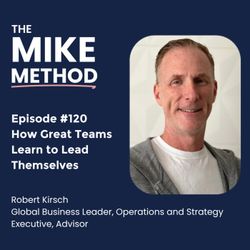
EP120 How Great Teams Learn to Lead Themselves with Robert Kirsch
44:12|What changes when a leader stops trying to have all the answers and creates more room for the team to contribute?In this episode of The Mike Method, Mike Desjardins is joined by Robert Kirsch, a people-first leader with more than 25 years of experience across executive leadership, operations, coaching and sport. Rob's career has included helping scale lululemon before and after its IPO, serving as President and COO of Houston Landscapes, leading supply chain and operations at Native Shoes, and now working with leaders and organizations at ViRTUS.Mike and Rob explore what separates a group of talented individuals from a team that can truly work together. Rob shares why some of the strongest teams operate more like a jazz band than an orchestra, with people able to adapt, contribute in different ways and step forward when circumstances change.They also discuss why showing up matters even when you're not at your best, how leaders can create greater ownership by talking less, and why silence can be one of the most useful tools available to a leader.The conversation explores the role of emotional intelligence and adaptability in leadership, including the importance of combining data with lived experience rather than relying entirely on either one. Mike and Rob also discuss how our job titles can limit the way we think about our contribution and why asking others what they rely on us for can reveal strengths we may not recognize in ourselves.They finish with a powerful analogy about the counterbalance inside a skyscraper and what it can teach us about staying grounded and adaptable when circumstances around us change.In this episode:What separates a group from a teamWhy showing up can matter more than performing at your bestHow leaders can create greater ownership within a teamWhy adaptability matters when things don't go according to planThe value of silence and listening in leadershipHow to make more room for quieter voicesWhy your contribution extends beyond your job titleHow data and lived experience can inform better decisionsThe role of emotional intelligence in leadershipHow to build an internal counterbalance when circumstances changeResources mentioned:Connect with RobertBurke’s Law by Brian Burke and Stephen BruntMultipliers by Liz WisemanEssentialism by Greg McKeownQuiet by Susan CainCliftonStrengths / StrengthsFinder 2.0EQ-i 2.0 Emotional Intelligence AssessmentWorking with Emotional Intelligence by Daniel GolemanSearch Inside Yourself by Chade-Meng TanGood to Great by Jim Collins
More episodes
View all episodes
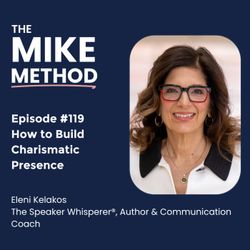
EP119 How to Build Charismatic Presence with Eleni Kelakos
48:53|What if charisma isn’t something you’re born with, but something you already have?In this episode of The Mike Method, Mike Desjardins is joined by Eleni Kelakos, also known as the Speaker Whisperer. A professional actress, award-winning singer-songwriter, author, and communication coach, Eleni has spent more than two decades helping leaders become more powerful, authentic communicators.Eleni believes we’re all born with what she calls a “charisma pilot light.” But as we become more concerned with fitting in, impressing others, or getting things right, we can begin to monitor ourselves so closely that our natural presence starts to dim.Mike and Eleni explore what happens when leaders feel pressure to perform a version of themselves, why authenticity plays such an important role in building trust, and how to adapt to the people around you without hiding behind a mask.They also unpack the role of vulnerability in leadership, including how personal stories can create connection without becoming oversharing, and why some of the most effective leadership stories are the ones where things didn’t go according to plan.Eleni then shares the five principles behind her approach to charismatic presence: Know Thyself, Be Thyself, Prepare Thyself, Commit Thyself, and Turn Thyself On So You Can Turn Others On.You’ll also learn why preparation can create more freedom in high-stakes moments, how to stay present when you don’t have a script, and Eleni’s simple FBI practice using your feet, breath, and intention to help you ground yourself before an important meeting, presentation, or conversation.Eleni Kelakos is the author of three award-winning books, including Charismatic Presence: Five Principles for Magnetic Presentations.In this episode:• Why charisma may be something we uncover rather than acquire• How self-consciousness can interfere with authentic presence• The difference between adapting to others and performing for them• Why authenticity and trust are closely connected• How leaders can share personal stories without oversharing• Eleni’s five principles of charismatic presence• Why preparation creates greater freedom in the moment• How to respond when you don’t have a prepared answer• The connection between energy, presence, and communication• A simple feet, breath, and intention practice for high-stakes momentsResources mentioned:Eleni Kelakos: Website / LinkedInCharismatic Presence: Five Principles for Magnetic Presentations by Eleni KelakosYour Body Language May Shape Who You Are | Amy Cuddy | TED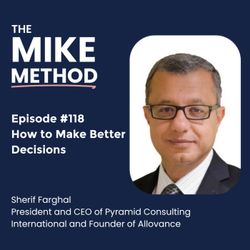
EP118 How to Make Better Decisions with Sherif Farghal
50:52|How do you know when to trust your gut and when a decision deserves a more structured approach?In this episode of The Mike Method, Mike Desjardins talks with Sherif Farghal, President and CEO of Pyramid Consulting International and founder of Alllovance, about what actually goes into making better decisions.Sherif’s fascination with decision making began after an earthquake in Cairo damaged priceless historic buildings and left decision makers facing an almost impossible question: with limited resources, what should be saved first?That question eventually shaped his doctoral research and a methodology designed to bring greater structure, shared understanding, and evidence into complex decisions.Mike and Sherif explore why even seemingly objective measures are influenced by context, how biases like anchoring, confirmation bias, optimism bias, and sunk cost can shape our choices, and why relying on gut instinct can become risky when the stakes are high.Sherif also breaks down a practical five-step decision-making process:Define what creates value.Determine what deserves attention right now.Establish meaningful metrics and KPIs.Evaluate your options against those measures.Select the combination that creates the greatest strategic value within your constraints.They also dig into one of the biggest challenges facing leadership teams: alignment. When priorities compete and resources are limited, a structured process can help teams move beyond individual opinions and understand not only what matters, but how much it matters relative to everything else.Sherif brings more than 20 years of management consulting experience across utilities, construction, manufacturing, communications, and healthcare. His doctoral research at the University of Michigan became the foundation for Elovance and his work helping organizations strengthen strategic planning, capital allocation, and decision making.If you lead a team or organization where priorities compete for limited time, attention, and resources, this conversation offers a practical framework for making those choices with greater clarity.In this episode:Why objectivity can be understood as “shared subjectivity”The difference between fast, intuitive and slow, structured decision makingHow bias influences organizational decisionsWhy the loudest voice in the room can distort prioritiesHow to define and quantify strategic valueSherif’s five-step framework for better decisionsWhy relative priorities matter more than simply rating everythingHow pairwise comparison can reveal alignment and disagreement within a teamWhy organizations benefit from a consistent decision-making processEpisode Resources:Sherif Farghal: LinkedIn Allovance
117. EP117 The Mentorship Advantage: How Great Leaders Open Doors with Cybele Negris
49:21||Ep. 117The best mentoring relationships are not one-way. They create value, learning, and opportunity for both people.In this episode of The Mike Method, Mike Desjardins is joined by Cybele Negris, CEO and co-founder of Webnames.ca, Canada’s original .CA registrar. An accomplished technology entrepreneur and corporate director, Cybele has spent decades experiencing mentorship from both sides, learning from leaders who helped shape her career while mentoring and sponsoring others along the way.Mike and Cybele explore what makes a mentoring relationship work, including why the mentee should take ownership of the relationship, come prepared, and be clear about what they hope to gain. They also discuss why being asked to mentor someone can be an honour rather than a burden, and how much mentors can learn from the people they support.The conversation expands beyond traditional one-to-one mentorship into peer mentorship and sponsorship. Mike and Cybele share how trusted peer groups can create space for conversations that may be difficult to have elsewhere, and why you do not need to join a formal organization to start building your own advisory group.They also explore the important difference between mentoring and sponsoring. A mentor can offer guidance, perspective, and support. A sponsor goes further by making introductions, creating access, and talking about someone when they are not in the room.Finally, Cybele shares how this mindset shapes her leadership at Webnames.ca, where supporting someone’s career does not necessarily mean expecting their entire career to happen within the company. That approach has helped create remarkable loyalty, with 20% of Webnames.ca employees who have left eventually choosing to return.This conversation is a reminder that leadership is not only about helping people succeed in the role they have today. It is also about investing in who they are becoming and, when you can, opening a door that helps them get there.Episode Resources:Connect with Cybele on LinkedInWebnames.ca
EP116 How to Use Humour and Storytelling to Become a More Memorable Leader with Judy Carter
52:21|What if some of the moments you'd rather forget are actually the stories that could help you connect most powerfully with others?In this episode of The Mike Method, Mike Desjardins is joined by Judy Carter, pioneering comedian, bestselling author, keynote speaker, and internationally recognized expert in using humour and personal stories to connect with an audience. From performing stand-up and appearing on more than 100 television shows to writing The New Comedy Bible and The Message of You, Judy has spent decades studying what makes people laugh, listen, and remember.Judy shares why the "messes" in our lives often contain our most meaningful messages and how leaders can turn difficult, imperfect, and unexpected experiences into stories that create connection.She breaks down the three stories every leader should have ready: a personal heart story, the origin story of their organization or career, and a client success story. She also explains why the strongest stories don't position the leader as the hero, but instead help the audience recognize something of themselves in the experience.Mike and Judy also explore the mechanics of humour. Judy introduces simple comedy formulas, including "small, small, big," and explains why surprise and contrast are at the heart of making people laugh. She shares practical ways leaders can use humour without becoming comedians, from opening a presentation with a shared experience to paying attention to what's happening in the room before stepping on stage.They also discuss vulnerability, why sharing failure can change how others perceive a leader, how to remove unnecessary details from a story, and why a speaker's biggest competition for attention may be the phone in someone's hand.In this episode:• How to turn a personal "mess" into a meaningful message• The three stories every leader should know how to tell• Why vulnerability can strengthen connection and trust• How to tell a client success story without making yourself the hero• Judy's "small, small, big" comedy formula• Why surprise and contrast make humour work• How to create connection early in a presentation• Why good storytelling requires knowing which details to leave out• How humour can make leadership communication more engaging and memorable• Why reading the room matters before you begin speakingEpisode Resources:• The New Comedy Bible• The Message of You• Judy Carter's website• Judy's Instagram
115. EP115 Why Play Belongs at Work with Kristi Herold
43:28||Ep. 115What if play wasn't the opposite of work, but one of the most underused tools leaders have for building connection, trust, creativity, and engagement?In this episode of The Mike Method, Mike Desjardins is joined by Kristi Herold, founder and CEO of JAM and author of It Pays to Play: How Play Improves Business Culture.Kristi has built her career around a simple idea: we don't have to leave play behind when we grow up. When leaders create opportunities for people to laugh, connect, celebrate, and have fun together, they can strengthen the relationships that help teams work better together.Mike and Kristi explore why friendships at work matter, how play can support retention and collaboration, and why the relationships people build beyond their job descriptions can make it easier to work across functions and solve problems together.Kristi also shares practical ways JAM brings play into everyday work, from shout-out channels and playful onboarding traditions to meeting rituals, team sports, core value awards, and their daily huddle.They also discuss:• Why play and meaningful work aren't mutually exclusive• The connection between friendship, belonging, and engagement at work• How leaders can make recognition more memorable• Why social wellness deserves a place alongside other workplace wellbeing initiatives• How play can strengthen relationships across teams and functions• Why trust can create more space for creativity and new ideas• Simple ways to make meetings more engaging• How playful traditions can become part of organizational culture• Why taking your business seriously doesn't require taking yourself seriouslyKristi's challenge to leaders is simple: make room for play. Not as a distraction from the work, but as another way to strengthen the relationships that help people do great work together.Episode Resources:Connect with Kristi LinkedIn / Website / InstagramIt Pays to Play by Kristi Herold JAM Group: https://jamgroup.com/
EP114 Remote Work Isn’t the Problem: Building Trust and Connection with Katherine Robinette
47:32|What if the real challenge with remote work isn't where people work, but how teams connect, communicate, and build trust when they aren't sharing the same physical space?In this episode of The Mike Method, Mike sits down with Katherine Robinette, founder and president of Keystone and Raven. With more than 30 years of experience as a speaker, consultant, and facilitator, Katherine helps leaders understand what is happening beneath the surface of their organizations and address the friction that can get in the way of progress.Mike and Katherine explore why remote and hybrid work can work well when leaders are intentional about the norms that support it. They discuss the social interactions teams can miss in virtual environments, why difficult conversations often need more than an email or Slack message, and how curiosity can help leaders understand before responding.They also explore the role of one-on-ones as a space for attunement rather than accountability, why employees should have ownership over those conversations, and how leaders can support people without needing to know every detail of their work.Katherine closes the conversation with four dimensions she believes can help leaders navigate today's changing work environment: mindset, method, metrics, and mood.In this episode:Why remote work requires intentional social normsHow leaders can build stronger human connection virtuallyWhy the meeting can start before the agenda doesChoosing the right communication channel when emotion or conflict is involvedHow better questions can prevent misunderstandings from escalatingWhy curiosity matters when leaders disagreeThe difference between alignment and attunementHow to make one-on-ones more useful for employeesWhy leaders don't need to know every detail of their team's workKatherine's four dimensions of leadership: mindset, method, metrics, and moodEpisode Resources:Katherine: Website / LinkedIn Katherine's Blog Shed the Armor: https://keystoneandraven.com/blog