Share
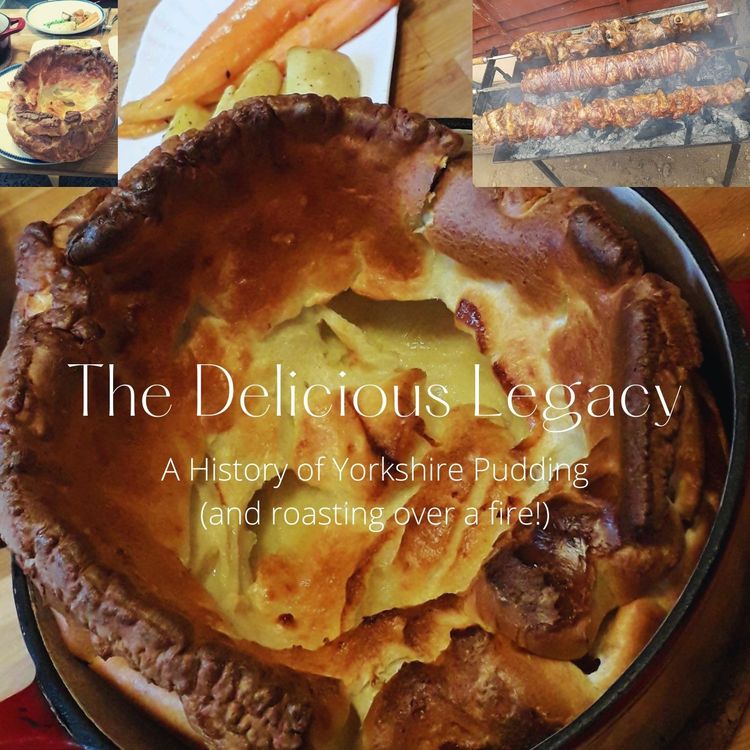
The Delicious Legacy
Yearning for Yorkshire Pudding (A History of)
The pudding is a dish very difficult to be described, because of the several sorts there are of it: flour, milk, eggs, butter, sugar, suet, marrow, raising, etc are the most common ingredients...They make them fifty several ways: BLESSED BE HE THAT INVENTED PUDDING for it is a manna that hits the palates of all sorts of people... Ah what an excellent thing is an English pudding!' - Henry Misson "Misson's Memoirs and Observations in His Travels Over England"
All puddings started their lives as meat puddings. Mostly sausage-like concoctions similar black pudding. Even when we started wrapping food stuffs in cloth, and boiling them, they were heavy on meat, and some fruit and spices and even some sugar. How, from this we went to the Yorkshire pudding? A good question!
A kind of early boiled pudding called thryon is described by the ancient Greek grammarian and gastronome Pollux: lard, brains, eggs and cream cheese were beaten together, the mixture was wrapped in fig leaves (in the same way as puddings were tied in a cloth later) and boiled in chicken or kid broth, then untied and given a final cooking in boiling honey. (Julius Pollux was a Greek scholar and rhetorician from Naucratis*, Ancient Egypt. Emperor Commodus appointed him a professor-chair of rhetoric in Athens at the Academy — on account of his melodious voice, or at least that's what we know according to Philostratus' Lives of the Sophists. Pollux Died in 238 AD in Athens.)
Praise of course for cooking over fire! Any cooking; meat, vegetables, stews soups for that matter! Amazing skills from people who (still) do it!
Plus my recipe for Yorkshire puddings! Tasty fluffy morsels of deliciousness! Heh...! Hope you're going to make them!
It's been a while as I was very busy ...I had it all written down, but never had the chance to go to the studio and record it. So I decided to record this in my bedroom and in a hurry so apologies for the drop in audio quality of my recorded voice!
Thanks to Sebastien Froment for lending me his French voice and accent to record as the French 17th century traveller Henri Misson. (From "Misson's Memoirs and Observations in His Travels Over England")
Charles Lamb essay is from this little gem of a book :
https://www.amazon.co.uk/Dissertation-Upon-Roast-Other-Essays-ebook/dp/B004V2WR22
(Finally a credible explanation on how humankind started cooking over fire! Only kidding, I love the Chinese myth though!)
I've tried my best to read the Yorkshire saying “Them ‘at eats t’most pudding gets t’most meat” without trying to pretend I'm from Yorkshire!
I appreciate it might sound wrong when i say "batter" it might sound like "butter" but for the purpose of this episode, mostly when I say "batter" I mean "batter" ie flour and liquid mix that needs cooking and not the dairy product! Ha!
Another point I thought might bring confusion is "Medieval Tansie" so what's that? Tansy is an edible flower/herb/plant whom the name can be traced back to the Latin athanasia, or immortality, from the Greek athanatos, meaning deathless, perhaps because the herb has been used to preserve bodies.
Tansy was used to flavour puddings, cakes, and eggs, and gave its name to a pancake flavoured with bitter herbs known as a “tansie,” which was traditionally eaten in spring and associated with Easter. (One sixteenth-century authority noted that tansy was beneficial in purging the body of the excessive phlegm engendered by a Lenten diet of fish.)
Tansy was more often added to sweet than savoury dishes, although it is the flavouring agent in a traditional Irish blood pudding known as drisheen. Alan Davidson, in The Oxford Companion to Food, speculates that the amount of tansy used was relatively small, given its strong taste.
Some hopefully illuminating photos can be found here:
http://wildflowerfinder.org.uk/Flowers/T/Tansy/Tansy.htm
As always music is kindly composed & provided by Pavlos Kapralos:
https://www.youtube.com/channel/UCzgAonk4-uVhXXjKSF-Nz1A
Expect the opening and closing theme tune, which is "Waltz Detunee" performed, recorded and mixed by Cloudcub: https://cloudcub.bandcamp.com/album/down-memory-lane-ep
Maltby & Greek link, for your 15% off of your next purchase please go here: maltbyandgreek.com/delicious
Many thanks and Happy listening!
Thom & The Delicious Legacy
Support the podcast on Ko-Fi and Patreon for ad-free episodes!
More episodes
View all episodes
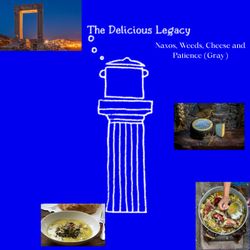
20. Naxos, Weeds, Cheese and Patience Gray
32:19||Season 8, Ep. 20Hello!Welcome back to another adventure my curious archaeogastronomers!Honey from a Weed, Fasting and Feasting in Tuscany, Catalonia the Cyclades and Apulia by Patience Gray is an iconic book about Mediterranean food, traditions centred around the simplest and most common dishes of everyday people.Patience Gray was an English cookery and travel writer of the mid-20th century. Her two most popular books were Plats Du Jour (1957) – written with Primrose Boyd, about French cooking – and Honey From A Weed (1986), an account of the Mediterranean way of life.In my opinion this book has to be more universally known and celebrated so here's a start. I will be coming back to explore the author's life and recipes in another episode!For this episode I explore quickly a few recipes from the book that are Greek and a couple of them more from the island of Naxos.I hope you'll enjoy!You can buy Honey from a Weed:Fasting and feasting in Tuscany, Catalonia, the Cyclades and Apuliaby Patience Gray (1917-2005), Food and Travel WriterContributor: Illustrated by Corinna Sargood, Artisat Equinox Publishing website, digital, print or ebook here: https://www.equinoxpub.com/projects/honey-from-weedMy recommendations for the week include:Endangered Eating: America’s Vanishing Foodshttps://sarahlohman.com/endangered-eating-book/The Ancient Magic of Malt: Making Malt Sugars and Ale from Grain Using Traditional Techniques:https://exarc.net/issue-2021-2/at/ancient-magic-malt-makingLove & Fish SoupThom & The Delicious Legacy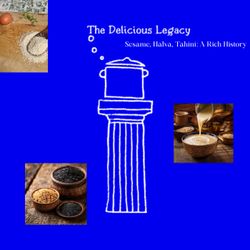
19. Sesame, Halva and Tahini: A Rich Complicated History
41:29||Season 8, Ep. 19Hello!New episode is out and it's all about, the history of sesame seeds, their use in ancient cuisines, especially Greek, their symbolism and spread across the ancient world...And what is halva anyway?! Hint: Tahini & honey...So today we are travelling to the source of sesame seeds in India, then to Ancient Mesopotamia, and Egypt, and we are examining ancient Greek desserts, and from there we are going all the way to China too!We are also looking at the role that trade between Arabia-India-China played to the spread of goods in the ancient world.Enjoy!The Delicious Legacy
Recipe of the week on a Sunday: Two Traditional Onion Recipes
13:32|Hello! Welcome to the recipe of the week on a Sunday by The Delicious Legacy!Two Greek recipes with onion as the star ingredient one way or another!Enjoy!Thom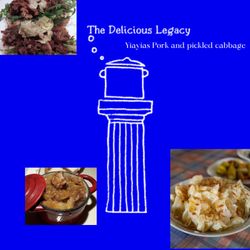
My Grandmother's slow cooked pork & pickled cabbage
16:34|This is a recipe and a short story that I wrote about six years ago, which you'll find out listening as to what it is and why, I hope you will enjoy it!Love,The Delicious Legacy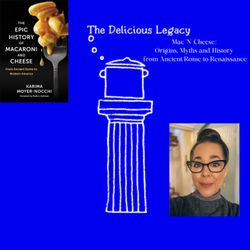
18. Macaroni and Cheese: Origins, Myths and History, from Ancient Rome to Renaissance
58:25||Season 8, Ep. 18Hello!Brand new episode is out!I’m talking with food historian Karima Moyer Nocchi. Earlier this year she published a brand new fascinating book titled THE EPIC HISTORY OF MACARONI AND CHEESE: FROM ANCIENT ROME TO MODERN AMERICA by Columbia University Press, which I devoured from start to finish. I was made aware late last year and I could not wait for its publication. So the honour talking with her and the excitement is even bigger than normally guys and girls!Before we go to the interview with my excellent and erudite guest, let me make an exciting announcement …!The online Serve it Forth Food History Festival will be returning on Saturday 17th of October 2026. Curated by the guild of food writers members and podcasters, historians, writers and all around hyper talented humans, Sam Bilton, Neil Buttery, Alessandra Pino alongside with me, Thom Ntinas. The festival will explore many different aspects of historical food featuring fascinating discussions and historical cookery demos. Details on the full line up will be coming soon but you can view the summary of the day’s “menu” on our website. https://serveitforthfest.wixsite.com/info/bill-of-fareLet me just tell you that for our amuse bouche introduction course we have none other than the amazing food historian Eleanor Barnett! I’ll be exploring the diet and lifestyle of ancient olympians and gladiators in the Greek and Roman world with historian Alexandra Sills.Tickets are available on eventbrite and I’ll put a link below:https://www.eventbrite.com/e/serve-it-forth-food-history-festival-2026-tickets-1992224789976?aff=ebdsoporgprofile My recommendations for the week:Glorious Exploits by Ferdia Lennon – classical tragedy as a Celtic caperhttps://www.theguardian.com/books/2024/jan/06/glorious-exploits-by-ferdia-lennon-review-classical-tragedy-as-a-celtic-caperAmerican farmers slid solar panels over 62,000 acres of farmland, and the biggest payoff had almost nothing to do with electricity.https://energiesmedia.com/solar-panels-farmland-crops-agrivoltaics/The English Olive Co, the original english olive oil:https://www.englisholive.co.uk/. You can get Karima's book here:https://cup.columbia.edu/book/the-epic-history-of-macaroni-and-cheese/9780231215312/More about Karima:https://www.theeternaltable.com/. Love,Thom & The Delicious Legacy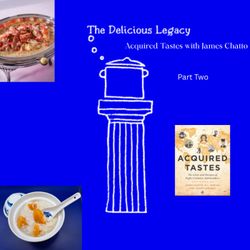
17. Acquired Tastes: An Interview With James Chatto Part Two
39:13||Season 8, Ep. 17Hello!Here's part two of my delightful conversation with James Chatto where we delve into the main characters of his fabulous book!Enjoy!Thom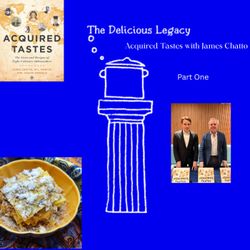
16. Acquired Tastes an Interview with James Chatto Part One
39:57||Season 8, Ep. 16James Chatto. Actor, puppet maker, author, food writer and journalist. A truly multi-talented, one would say even a renaissance man! He is my honoured guest on The Delicious Legacy today, to tell us all about his latest book “Acquired Tastes” a food history book, which explores the extraordinary journeys of specific recipes as they moved from one culture to another—carried and transmitted by eight remarkable individuals...Hello! Welcome back to another episode of the Delicious Legacy!You can get James' book here:https://utppublishing.com/doi/book/10.3138/9781487566609Enjoy!LoveThom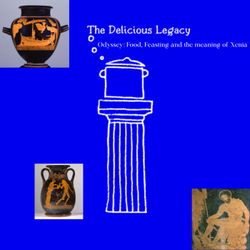
15. Odyssey: Food, Feasting and the meaning of 'Xenia'
46:18||Season 8, Ep. 15Hello!Welcome back to another archaeogastronomical adventure!I couldn't help myself but having Odyssey as my inspiration for this week's episode!As you probably have heard Christopher Nolan has his epic film Odyssey in official release this Friday 17th of July 2026 so I thought what better way to dive into the ancient Homeric epic poem than exploring their foods, cooking, dishes and the meaning of xenia, hospitality, kindness to strangers and welcoming others into ones house?We will also dive into the real Bronze Age Greece and the archaeological discoveries there. What do these tell about feasting, communal eating and the food of the people in the Helladic world, three thousand years ago?Enjoy!The recommendations for this week are:Did Roman Britain Ever End?Nicholas J. Higham writes about the long death of Roman Britainhttps://www.unseenhistories.com/did-roman-britain-ever-end-nicholas-j-higham/Alexandra Sills:https://www.waterstones.com/book/gladiators-in-the-greek-world/alexandra-sills//9781036130480Welsh Smokery and shop:https://welshsmokery.co.uk/about-us/our-story/Love and wineThom & The Delicious Legacy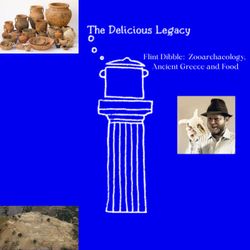
14. Flint Dibble: Zooarchaeology, Ancient Greece and Food
01:19:59||Season 8, Ep. 14Hello!Ugly stuff? Broken Bones? The earliest archaeologists a century ago ignored these. But not my guest today! Flint Dibble is an ancient historian and archaeological scientist who studies people, animals, and the environment in the ancient Greek world. According to his words, his goal is to make real archaeological research accessible to everyone.With the publication of "The agropastoral debate in context: the relationship between the consumption and management of animals at Azoria on Crete" I wanted to share this conversation I had with Flint about the food in Ancient Greece. What do we know? What does the archaeological evidence tells us that is the same, similar or diverges, from the literary sources that survived the passage of time?What animals were eaten in ancient Greece? How did the ancient Greeks prepared them? And what was the difference between home cooking and sacrificial, professional butchering and cooking for public feasts? How were the poor and the elite different in their eating habits, and how was the food cooked at home and in mobile situations? What does the isotope analysis of teeth and bones tells us about the climate through a millennia of ancient greek history, and how that affected the agropastoralism and transhumanism? When were the first chickens eaten in the Greek context? All the above and a lot more are discussed in our conversation with the fantastic Flint Dibble!The write up about Flint's article can be found here:A goat’s tooth may have solved a 100‑year debate about ancient Greek farminghttps://theconversation.com/a-goats-tooth-may-have-solved-a-100-year-debate-about-ancient-greek-farming-285839The article:https://link.springer.com/article/10.1007/s12520-026-02512-7Flint's YouTube channel:www.youtube.com/@flintdibbleMusic by Pavlos KapralosEnjoy!Thom & The Delicious Legacy Podcast