Share
The Creative Asylum
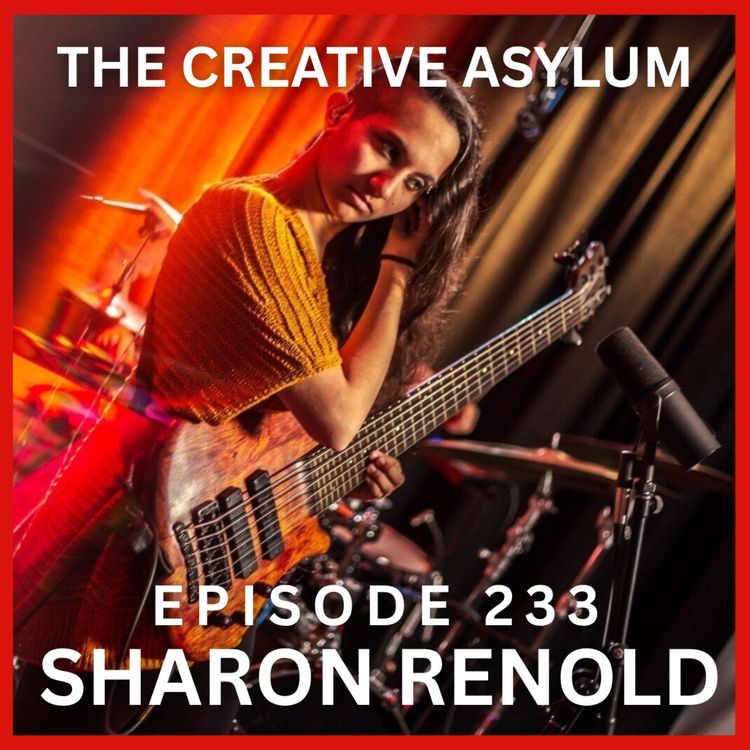
Sharon Renold - EP233 - The Creative Asylum
Swiss-born and Berklee-trained, Sharon Renold was Grammy-nominated before she'd even graduated Berklee. In this episode, Sharon and I talk about growing up in a Berklee household with international musicians as parents, an environment where she was surrounded by jazz legends throughout her musical journey which started with her learning to play bass at the age of four. She is one of the founding members of the Grammy-nominated Berklee Indian Ensemble, in which she's composed and performed on the group's acclaimed album Shuruaat, including her own original piece "Aakash." That group cracked open a world of Indian classical and fusion influence for her, pulling in artists like Tigran Hamasyan and A.R. Rahman, an experience that's informed the genre-blurring approach she's done since.
In this conversation, we talk about her parallel life as a fixture of Scott's Bass Lessons, the massively popular YouTube channel where she's become a go-to voice for breaking down iconic basslines and albums for bass players worldwide — from Esperanza Spalding deep-dives to technique tutorials watched by hundreds of thousands.
Renold gets candid about balancing session work, content creation, and her own songwriting, including her original track "Open Letter" and her long-awaited debut solo album. This is a conversation about groove as a language, the low end as a form of storytelling, and what it takes to build a career as both a world-class player and a creative explorer at the very beginning of what is bound to be a very long musical journey.
* * * *
PLEASE FOLLOW US ON SOCIAL MEDIA:
Website:
https://www.TheCApod.com
Facebook:
https://www.facebook.com/TheCApod/
Instagram:
https://www.instagram.com/CreativeAsylumCA/
More episodes
View all episodes
239. Paul Leary (Butthole Surfers) - EP239 - The Creative Asylum
52:10||Season 2, Ep. 239Paul Leary co-founded one of the most gleefully deranged bands in American rock history — and came out the other end living a decades-long career producing other bands. As guitarist and de facto sonic architect of the Butthole Surfers, Leary helped build a catalog of cult-classic noise-punk landmarks throughout the '80. From Psychic Powerless...Another Man's Sac to Hairway to Steven and the band's brief brush with mainstream success via their song "Pepper," the Butthole Surfers left behind a stream of chaos that can only be celebrated for it's sheer audacity and mayhem.In this conversation, Paul dips his toe into how two Trinity University accounting students turned into art-punk provocateurs. The band's outrageous, legendary live shows are documented in the new documentary Butthole Surfers: The Hole Truth and Nothing Butt, directed by Tom Stern, which traces the band's history and cultural impact through interviews, archival footage, and multimedia elements. We also discuss Leary's parallel life and subsequent career as an alt-rock producer, with an impressive resume including bands like Sublime, Meat Puppets, Daniel Johnston, Reverend Horton Heat, the Toadies, U2, Weezer, and Jane's Addiction. In his current place in life as a "boring adult," we talk about what it takes to bring order in the studio after building a career on total chaos in his own band. This is a conversation about weirdness as a discipline, the accidental producer, and staying gleefully uncategorizable for over four decades.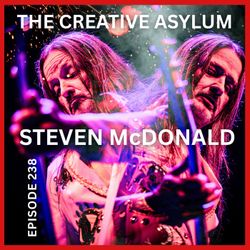
238. Steven McDonald (Redd Kross, Melvins) - EP238 - The Creative Asylum
01:06:30||Season 2, Ep. 238Steven McDonald picked up a bass at age 11, and along with his older brother Jeff, co-founded Redd Kross. Redd Kross made their live debut opening for Black Flag while basically still being in Jr. High. In this conversation, Steven and I discuss the creative process, the dynamics of juggling two bands at once, the brilliance of the Beatles and Redd Kross' 2024 self-titled double album, which is—in my opinion—one of the best records of the band's entire career.Steven and I talk about his parallel life as the touring and recording bassist for the Melvins since 2015, with King Buzzo and Dale Crover while Redd Kross is never that far in the shadows. For a period of time, Steven played in and was a founding member of Keith Morris's hardcore outfit OFF! from 2009 to 2021. We also dip into Born Innocent: The Redd Kross Story, director Andrew Reich's documentary tracing the band's four-decade history, and what it's been like having a camera crew — and now an audience — finally reckon with a career this tumultuous and this undeniably good. This is a candid conversation about being a lifer, a brother, a parent and a bass player who's somehow made it look easy since before he could drive. Photo of Steve McDonald by the inimitable Master Jaron: https://www.instagram.com/masterjaron/
237. Robyn Hitchcock - EP237 - The Creative Asylum
49:55||Season 2, Ep. 237Robyn Hitchcock has spent five decades making music with the kind of color and whimsy that sounds like musical paintings as much as being any kind of standard for quirky British art-rock. He's always been surreal, wry, and stubbornly uninterested in trends. As co-founder and songwriter for the critically influential Soft Boys (1976–81), Hitchcock helped forge an influential art-rock touchstone that outlasted the lifespan of the band itself. Decades later, the jangly, off-kilter psychedelia of the Soft Boys have influenced R.E.M., the Replacements, Uncle Tupelo, and a generation of songwriters who came after.In addition to being a musical painter, Hitchcock has also been an avid explorer of the written word, having penned TWO two acclaimed memoirs, both of which are available from Akashic Books: 1967: How I Got There and Why I Never Left, a hallucinatory account of the year he turned 14 and discovered Pink Floyd and Sgt. Pepper's while stuck at boarding school, and the recent follow-up, Stranded in the Future, which picks up the story from 1968 and continues through to 1978. the book chronicles his self-taught songwriting, doomed romances, and the formation of the Soft Boys against the backdrop of London as punk was taking hold and changing the very foundation upon which popular culture was being built. We talk about writing, music and the surreal experience of life itself. Robyn's remained one of the most singular, unclassifiable voices in British music, and with that' the Creative Asylum is lucky to have him on!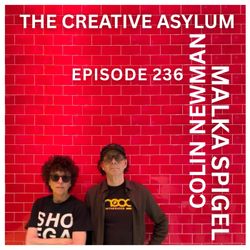
236. Colin Newman & Malka Spigel - EP236 - The Creative Asylum
51:47||Season 2, Ep. 236Few couples have lived in the world of independent music from as many angles as Colin Newman and Malka Spigel have. Colin is the co-founder, voice and guitarist behind Wire, the art-punk originators whose austere, angular sound still sound pioneering today , even decades after their formation in the 1970s. Malka was the bassist for Minimal Compact, the Tel Aviv-born post-punk outfit that became a cornerstone of the '80s European underground. In this episode, I get to have a conversation with these two artists who have been together for decades now and have built a remarkable shared body of work including their long-running duo, Immersion, their collaborative project Nanocluster and their band - about to be revived - Githead. They are more independent that they've ever been, running their own record label, swim~. We spend most of the conversation talking about where they are now: Immersion, the electronic duo Newman and Spigel formed in 1994, built on a genuinely collaborative process where the music comes first and the ideas evolve organically between them. We also talk about their ongoing Nanocluster series — a rotating-cast collaboration project pulling in artists like Laetitia Sadier of Stereolab, Ulrich Schnauss, Scanner, and ambient trio SUSSThis is a conversation about staying restless after 40-plus years in music, and what it actually looks like to build a life and a body of work with your partner, and why neither of them has any interest in coasting on legacy. VISIT https://immersionhq.uk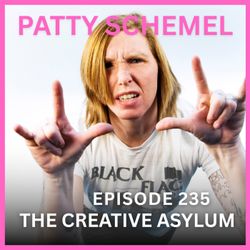
235. Patty Schemel (Hit So Hard) - EP235 - The Creative Asylum
49:31||Season 2, Ep. 235Prior to Grohl, Patty Schemel was Kurt Cobain's choice as Nirvana's (new) drummer. She ended up playing in Hole and changed the band's trajectory with a power and determination that anchored the band's music on stage. Outside of life in the studio and on the road, Patty was also fighting a war that most fans never saw. She was a powerhouse drummer (just listen to 'Live Through This' if you have any doubt), but as with so many others from the Seattle music scene, also found the allure of hard drugs, which sadly led to her departure from music and a brutal stretch of homelessness, living on the streets of L.A. for over a year.It's all laid out with unflinching honesty in the documentary 'Hit So Hard' from 2011 and the acclaimed memoir (from Da Capo Press) of the same name that followed. Now over a decade living clean and sober, Patty is living a stable and happy life, is working on new craetive projects and is working in addiction recovery with homeless women from those same streets of Los Angeles.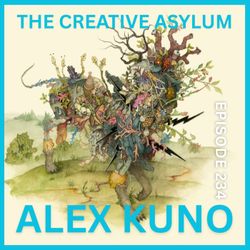
234. Alex Kuno - EP234 - The Creative Asylum
48:24||Season 2, Ep. 234Working out of his studio in the Arts District of Saint Paul, Minnesota, Alex Kuno has spent over two decades building a visual language all his own. Alex's figures look like they wandered out of a medieval medical textbook and into a fairy tale gone strange. His characters sprout, mutate, and dissolve into hybrid states — part specimen, part storybook creature, wild and often as organic as the flora in the frame. Kuno works primarily in oils these days, but we discuss a time in his development when he was experimenting with watercolor and colored-pencils as well as with acrylic. Adam Jones from TOOL noticed Kuno's remarkable work and has used his images on over a dozen concert posters.Alex Kuno has one of the most distinct visual styles in contemporary lowbrow and pop-surrealist art. It's dark, but maintains an element of humor, and it never quite explains itself. This is a conversation about making weird, personal work and building a career out of a life that is dedicated to making art.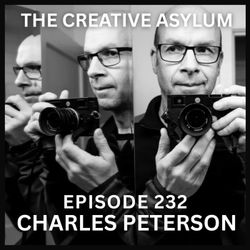
232. Charles Peterson - EP232 - The Creative Asylum
56:35||Season 2, Ep. 232I moved to Seattle in 1981 and met Charles Peterson the following year, pretty sure it was through U-Men, but you know - memory... He was already shooting pics and had a camera everywhere he went — front row, flash popping, catching the sweat and blur of bands nobody outside Seattle had heard of yet. Years later, as Sub Pop's de facto house photographer (at the same time that I was working there - EARLY on), he didn't just document the birth of a genre, his black-and-white images became synonymous with grunge itself, gracing early album covers by Soundgarden, Mudhoney and Nirvana. He largely defined how the rest of the world would come to picture the scene, and to that end is just as important to that history as any of the bands who have received the majority of the accolades. In this episode, Charles Peterson takes us inside the cramped, sweaty clubs of late-'80s and early-'90s Seattle, breaking down how his signature motion-blurred, high-contrast style — shot from inside the pit, up against the stage — became the visual language of an entire movement. If you're not already aware, Charles has published many books, starting with Screaming Life: A Chronicle of the Seattle Music Scene (Harper Collins, 1995) and Pearl Jam: Place/Date (Rizzoli, 1997), through Touch Me I'm Sick (with an introduction from Eddie Vedder) and Cypher (powerHouse), up to his most recent work: 2024's Charles Peterson's Nirvana, released on what would've been Kurt Cobain's 57th birthday, with a foreword by Krist Novoselic, plus its companion volume We're All Pros Here: Under the Covers with Charles Peterson's Nirvana. This is a conversation about being in the right pit at the right time — and how a self-described "music fanatic" with a camera ended up as the definitive visual chronicler of grunge. Here's to old friends who continue to keep the creative spirit alive.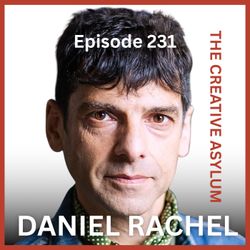
231. Daniel Rachel (This Ain't Rock 'n' Roll) - EP231 - The Creative Asylum
46:07||Season 2, Ep. 231From Keith Moon parading in an SS uniform to Siouxsie Sioux flashing a swastika armband, rock 'n' roll has been flirting with fascist iconography for decades — and nobody's called it out with this much rigor until now. Award-winning music historian Daniel Rachel — former musician turned best-selling author whose previous books include Too Much Too Young: The 2 Tone Records Story, Isle of Noises: Conversations with Great British Songwriters, and The Lost Album of the Beatles: What If the Beatles Hadn't Split Up? — joins the show to unpack his explosive new book, This Ain't Rock 'n' Roll: Pop Music, the Swastika and the Third Reich, with an introduction by Billy Bragg. We dig into why generations of performers — from punk provocateurs to arena-filling icons — have wrapped themselves in the aesthetics and mass hysteria of Nazism, and Third Reich iconography, whether for shock value, ignorance, or something far more disturbing, and what that says about an industry that's largely given them a pass.This Ain't Rock 'n' Roll isn't a nostalgia trip — it's a reckoning. Rachel walks us through the uncomfortable throughline connecting Keith Richards posing in an SS uniform through to Kanye West's own descent into open Nazi sympathizing, asking the question the music press has avoided for decades: how accountable should artists, fans, and labels be for glamorizing and trivializing the imagery of genocide? Critics have called the book "the most necessary music book of the year" and "as essential now as at any point in our history," and this conversation goes straight at the heart of it. If you care about music history, cultural accountability, or how far "shock value" can really go before it curdles into something darker, this episode is one you'll want to dig in to.