Latest episode

32. My top 10 archaeological sites (that I've actually been to)
24:49||Season 1, Ep. 32In today's video, archaeologist Giselle reveals her top 10 favourite archaeological sites across the globe. We look at the Roman streets of Ephesus to the 29,000-year-old ice-age cave paintings in France and Scotland’s Neolithic treasures! You can become a certified Dirt Nerd and watch exclusive content by becoming a channel member here: https://www.youtube.com/channel/UCCJyzOQzeHJfZJMZ9-r_h3A/joinWelcome to The Archaeologist's Notebook! Your hub for uncovering and understanding thousands of years of human history, with working archaeologist Giselle Király.--Source Materials:GettyAlamyhttps://commons.wikimedia.org/wiki/File:Pech_Merle_(35169882674).jpg. Ben Sale from UK, CC BY 2.0 https://creativecommons.org/licenses/by/2.0Grotte Peche Merle, France. Wolly mammoth. 25,000 BC. By Jon Gudorf Photography (1998).https://www.flickr.com/photos/jongudorf/34484820491/in/photostream/. — https://creativecommons.org/licenses/by-sa/2.0/deed.enhttps://commons.wikimedia.org/wiki/File:Chevaux_ponctu%C3%A9s_de_la_grotte_du_Pech_Merle.jpg Céréales Killer, CC BY-SA 4.0 — https://creativecommons.org/licenses/by-sa/4.0
More episodes
View all episodes

31. Archaeologist reveals the dark truth about the Crusader Knights
27:54||Season 1, Ep. 31History paints the Knights Hospitaller as heroic warriors, but the archaeology tells a much darker story. In today’s video, Giselle looks at physical evidence revealing how the Order of Saint John rand one of history’s most lucrative human trafficking rings, and how these enslaved people built early modern Malta. You can become a certified Dirt Nerd and watch exclusive content by becoming a channel member here: https://www.youtube.com/channel/UCCJyzOQzeHJfZJMZ9-r_h3A/joinWelcome to The Archaeologist's Notebook! Your hub for uncovering and understanding thousands of years of human history, with working archaeologist Giselle Király.--Source Materials:Alamy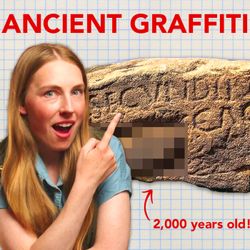
30. Ancient graffiti is much more vulgar than you think
25:35||Season 1, Ep. 30We've been doodling and writing on surfaces for millennia! We've loved swearing and drawing lewd images on things for just as long as well... In today's video, Giselle goes through the years of ancient graffiti, from confessions of love to business complaints! You can become a certified Dirt Nerd and watch exclusive content by becoming a channel member here: https://www.youtube.com/channel/UCCJyzOQzeHJfZJMZ9-r_h3A/join--Source Materials:AlamyDigital Storm/stock.adobe.comrpbmedia/stock.adobe.comMichael/stock.adobe.comThe Vindolanda Trust
29. What was fast food like in Ancient Rome?
37:20||Season 1, Ep. 29What did Ancient Romans eat when they wanted a quick meal? Today, Giselle is joined by Alex Compiani from The Time Travellers Kitchen to talk all about Roman fast food and street vendors, with home-cooked, authentic Roman food for them both to taste test!--Source Materials:Alamy
28. The Bizarre Rabbithole Of Nazi Pseudoarchaeology
24:30||Season 1, Ep. 28In today’s video, Giselle looks into the dark and bizarre history of the Ahnenerbe— Heinrich Himmler’s SS division dedicated to rewriting global prehistory to justify the Nazi regime.Giselle looks into how the Third Reich hijacked real sites and fabricated data, from the Nazis searching for the Lost City of Atlantis and cosmic "World Ice" theories, to hunting for the Holy Grail in France, and trying to cover up the death camps at Treblinka.--Source Materials:AlamyAdobe Stock / JarekAdobe Stock / gerasimov174zef art - http://stock.adobe.com/GettyProfessor Caroline Sturdy-Colls / The Centre Of Archaeology / Treblinka Memorial Museum #Archaeology #History #Pseudoarchaeology #Ahnenerbe #Documentary #AncientHistory #Treblinka #WorldIceTheory #TibetExpedition #Tiwanaku #ForensicArchaeology
27. The greatest Viking gold ever discovered
35:31||Season 1, Ep. 27In today’s episode, Giselle talks all about Viking gold! For the Vikings, gold was rare. So what happens when archaeologists uncover massive gold neck-rings, ornate bird pins, or thousands of grams of pure gold buried in Danish forests and bogs?Giselle is also joined by Viking expert Dr. Tom Horne to dive into 6 of the most incredible Viking Age gold discoveries of all time!Thank you to History Hit for sponsoring this video! Sign up to History Hit and start watching today: https://eu1.hubs.ly/H0gFQZ50Thank you to Dr. Tom Horne for joining! You can see what Tom is up to here:Website: https://drtomhorne.com/Substack: https://drtomhornearchaeology.substack.com/Instagram: https://www.instagram.com/tomhorne870?stkn=azJsczduMzk4b2RxTwitter: https://x.com/HorneSupremacy?t=fII54K_MMYiNwoYmKwsmLw&s=09Bluesky: https://bsky.app/profile/hornesupremacy.bsky.social--Source Materials:AlamyNordjyske MuseerLennart Larsen, National Museum of DenmarkHerefordshire Hoard phorographs provided by Herefordshire CouncilHoenskatten 1834 Bilde 1 by Ove Holst, Kulturhistorisk Museum (2025), https://commons.wikimedia.org/wiki/File:Hoenskatten_1834_Bilde_1.jpg via https://creativecommons.org/licenses/by-sa/4.0 Parts of the Hon hoard found in 1834 in Øvre Eiker, Buskerud in the south-east of Norway, by Wolfmann / Kulturhistorisk Museum (2020), https://commons.wikimedia.org/wiki/File:Cultural_History_(historisk)_Museum_Oslo_VIKINGR_Norwegian_Viking-Age_Exhib_02_Hon_Hoard_(Hoenskatten)_Gold_treasure_875-900_(1)_Neck_arm_rings_Frankish_jewelry_Arabian_coins_w_loops_Necklace_glass_beads_Roman_gemstone_English_ring_619.jpg via https://creativecommons.org/licenses/by-sa/4.0 Trefliket frankisk beslag av gull fra Hoenskatten. Trefoil Frankish mount of gold from the Hoenskatten treasure. By Mona Knudsen, Kulturhistorisk Museum (2025). https://commons.wikimedia.org/wiki/File:Hoenskatten_1834_Gullbeslag_Bilde_4.jpg via https://creativecommons.org/licenses/by-sa/4.0 Photo: Senior Curator at National Museums Scotland, Martin Goldberg, looking at objects from the Viking age Galloway Hoard. By National Museum Scotland (2021). https://upload.wikimedia.org/wikipedia/commons/6/65/NMSGallowayHoard1_PF1040456_900x673_96dpi.jpg?utm_source=commons.wikimedia.org&utm_campaign=index&utm_content=original via https://creativecommons.org/licenses/by-sa/4.0 Photo: Galloway Hoard. By National Museums Scotland / Johnbod (2021). https://commons.wikimedia.org/wiki/File:NMSGallowayHoard4_PF1034117_674x900_96dpi_(cropped).jpg via https://creativecommons.org/licenses/by-sa/4.0 Photo: The rock crystal jar. Photo © Neil HannaPhoto: Galloway Hoard. By National Museums Scotland https://commons.wikimedia.org/wiki/File:NMSGallowayHoard5_pectoral_cross_900x682_96dpi_(cropped).jpg
26. Henry VIII in VIII archaeological discoveries
26:25||Season 1, Ep. 26Henry VIII is one of the most famous monarchs in English history, but what can we actually learn about him and his life from archaeological discoveries? It's hard to believe that this man could be a romantic, considering his track record, but will a certain heart-shaped locket and engraved coins have you thinking otherwise? We walk you through some fascinating and bizarre discoveries pertaining to this controversial king in today's video!Watch How the Tudors Lost Their Heads, Sundays at 8pm, on National Geographic. Also streaming on Disney+ https://www.natgeotv.com/uk/special/how-the-tudors-lost-their-heads--Source Materials:AlamyOld Royal Naval CollegeClassical Numismatic Group, Inc. http://www.cngcoins.com