Share
R2Kast - People in Food and Farming/All In
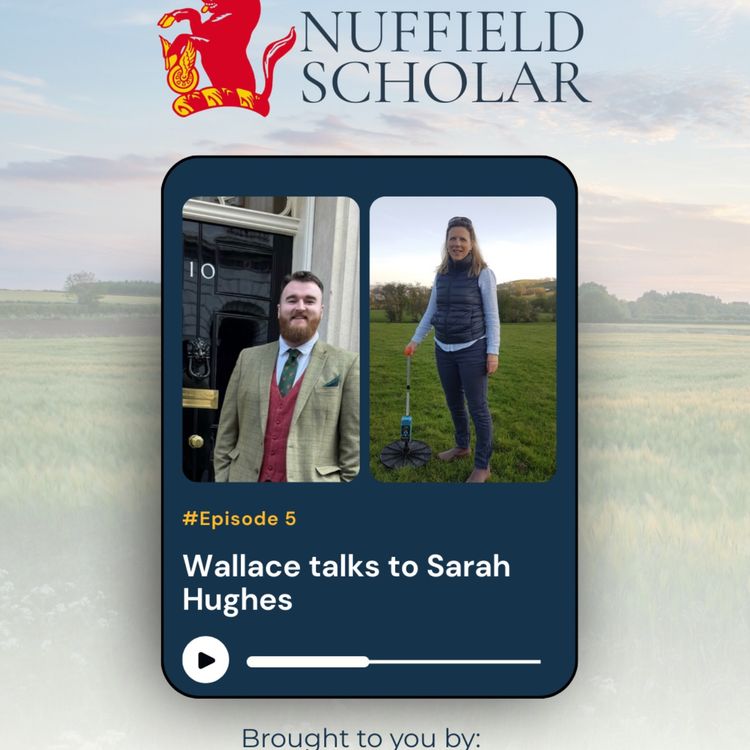
Tales of a Nuffield Scholar with Sarah Hughes
Today on the Tales of a Nuffield Scholar series I had the pleasure of chatting with Sarah Hughes 🎙️ Sarah works with Syngenta leading their amenity business across the UK and Ireland, covering sectors such as turf, forestry, pest management and ornamentals. She is also a 2017 Nuffield Scholar whose study explored the economics of vertical farming and whether controlled environment agriculture could offer viable opportunities for food production 🌾
We spoke about Sarah’s unusual career path through agriculture, from training as an agronomist and working in arable crops to later running her own edible flower business supplying high end restaurants and hotels. That experience of producing high value crops sparked her interest in vertical farming and ultimately shaped the focus of her Nuffield study 🚜
Sarah’s travels took her across the Netherlands, Germany, Japan, Dubai and the United States, alongside the global Nuffield group on the CSC in Brazil. She reflected on how much excitement surrounded vertical farming at the time and how her research quickly showed the real challenge was the economics behind it. The technology could work, but the costs of energy, labour and infrastructure often made the model incredibly difficult to sustain 🌍
We also spoke about balancing Nuffield with family life, running a business and raising two children at the same time. Sarah made a really important point that there is no single way to complete a Nuffield Scholarship. Everyone’s circumstances are different and sometimes the best approach is simply finding a way to make it work around the life you already have 🌱
Thank you to NFU Mutual for their support of this project.
Enjoy! 🙂
More episodes
View all episodes
38. R2Kast 441 – Nick Shorter on Velcourt, farm management and developing the next generation
01:07:03||Season 6, Ep. 38Today I had Nick on the R2Kast 🎙️ Nick is CEO of Velcourt Group, overseeing a business working across farming, forestry, conservation and rural asset management throughout the UK. 🌾We spoke about growing up in Dorset with no farming background, becoming fascinated by agriculture and eventually heading to Harper Adams before joining Velcourt. That relationship has lasted his entire career, taking him from milking cows and the graduate training programme through farm management, a stint managing a huge farming operation in Hungary and eventually into the CEO role. 🍎A big part of the conversation focused on what Velcourt actually does. The farming business manages over 100 farming businesses covering around 52,000 hectares, from dairy and livestock through to arable, potatoes, fruit and fresh produce. We spoke about managing farms for everyone from farming families to large estates and institutional landowners, and how every relationship requires something slightly different. 🌍We also chatted about Velcourt’s management training programme, developing people internally, financial responsibility at farm level and how forestry and conservation are becoming increasingly important parts of the wider business. It was a really interesting look at the scale of the organisation and how it continues to evolve while keeping people and farm management at its core.Enjoy! 🙂
Field to Front Door – Episode 16 on heritage grains, no input farming and selling direct
54:12|Field to Front Door – Episode 16 on heritage grains, no input farming and selling directToday we’re back with Field to Front Door 🎙️David, Martin and Wallace catching up as plans for next season start taking shape, with plenty on heritage grains, direct selling and experimenting with different ways of growing crops.David has made another impulse purchase, this time a roller mill, which led us into naked oats, porridge and swapping grain with Martin. We also got into heritage varieties, why bakers and millers are increasingly interested in them and whether older, taller varieties could offer another route towards growing crops with fewer inputs.That brought us back to the ongoing no input experiments. We chatted about mixed varieties, soil disturbance, weed control, cover crops and the economics of reducing inputs when conventional crops can cost so much to establish before you even know what they’ll yield.The direct selling experiment has moved pretty quickly too. Just over a month in, David is now bringing together produce from loads of different farms, with vegetables, fruit, milk and meat all heading directly to customers. There have been a few casualties along the way, particularly the eggs 😂, but some weeks are already seeing thousands of pounds worth of produce going out.We also got into the bigger question of what food is actually worth, how much of that value reaches the farmer and whether becoming more efficient has really benefited producers when machinery and input costs have risen so dramatically.We’re keeping this going fortnightly, so feel free to send us any ideas or topics you’d like us to get into.Enjoy! 🙂
37. R2Kast 440 – Jill Hewitt on agricultural contractors, farm safety and representing a vital part of farming
01:00:17||Season 6, Ep. 37Today I had Jill on the R2Kast 🎙️ Jill runs the National Association of Agricultural Contractors and has spent much of her career representing the people and businesses providing essential services across UK agriculture. 🌾We spoke about growing up around farming, wanting to become a shepherdess and studying animal science before starting her career with the Humane Slaughter Association. That took Jill into abattoirs, animal welfare and slaughter training, alongside a Churchill Fellowship looking at the welfare of male chicks across China, Israel and the USA. 🍎A big part of the conversation focused on agricultural contractors and just how important they are to farming. Over 90% of farmers use contractors in some form, covering everything from shearing and fencing to drainage, machinery and whole farm operations. We spoke about investment, labour, red diesel and making sure contractors are properly represented when agricultural policy is being developed. 🌍We also got into farm safety, the unacceptable number of deaths and serious injuries still happening across the sector and why safety needs to become part of everyday decision making rather than simply paperwork.Enjoy! 🙂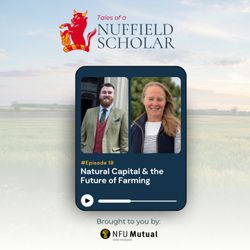
Tales of a Nuffield Scholar - Liz Warner on Natural Capital
41:37|Series three of Tales of a Nuffield Scholar continues 🎙️ This series is looking at some of the biggest challenges, innovations and conversations shaping agriculture today, and this time we’re getting into a topic that is becoming increasingly important across UK farming, natural capital 🌱I was joined by 2026 Nuffield Scholar Liz Warner, a first generation tenant farmer from Devon who farms around 200 acres of beef, arable and grassland alongside working as a farm and natural capital consultant. Liz and her husband started with rented land and a few sheep before taking on a Devon County Council farm, so there is a really interesting story behind how they found their way into farming in the first place 🌾We spoke about what natural capital actually means for farmers, from biodiversity net gain and carbon through to water management and wider environmental outcomes. One of the really interesting points was around additionality and how these markets often reward the improvement you make rather than simply what is already there, raising some big questions around how we recognise farmers who have been looking after nature for years.Liz’s Nuffield topic is “Cultivating Capital: A Farmer’s Role in a Growing Natural Capital Economy” and comes from wanting to make sure farmers have a genuine voice as these markets develop. We spoke about balancing food production with nature recovery, making natural capital commercially viable for farms of different sizes and ensuring farmers properly understand the long term commitments that can come with entering these markets 🌍Her Nuffield journey is still very much underway. After focusing heavily on the UK so far, Liz is looking towards Brazil, the US and the Netherlands, with Australia and Kazakhstan potentially on the list too. What I particularly liked was her ambition to look not only at natural capital projects that have worked, but also those that have gone wrong and understand what can be learned from both.We also chatted about her CSC in Japan, the realities of farming through another incredibly dry summer in Devon and how natural capital might eventually sit alongside food production as another part of building more resilient farm businesses.There is clearly a lot still to develop in this space, which makes following Liz’s Nuffield journey over the next year particularly interesting.Thank you to NFU Mutual for their support of this project.Enjoy! 🙂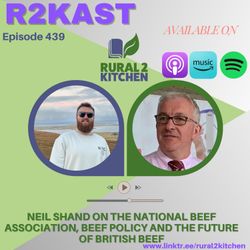
R2Kast 439 – Neil Shand on the National Beef Association, beef policy and the future of British beef
01:08:28|Today I had Neil on the R2Kast 🎙️ Neil is Chief Executive of the National Beef Association and Scottish Beef Association, representing beef producers and working with government and industry across the UK. 🌾We spoke about growing up around farming in Aberdeenshire, an unexpected career in paper production that took him around the world and eventually finding his way back into agriculture through the British Simmental Cattle Society. That led into his current work representing the beef sector. 🍎A big part of the conversation focused on the National Beef Association, lobbying government and the very different policy landscapes facing farmers across Scotland, England, Wales and Northern Ireland. We got into agricultural support, TB, Bluetongue, beef prices and the challenge of keeping UK beef production viable while still recognising the importance of trade. 🌍We also chatted about consumer trust in British farming, promoting beef, food security and why good policy needs people who actually understand what is happening on farms.Enjoy! 🙂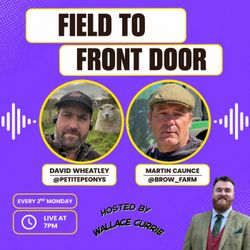
Field to Front Door – Episode 15 on selling direct, SFI and low input farming
39:27|Today we’re back with Field to Front Door 🎙️David, Martin and Wallace catching up after a couple of weeks away, with harvest largely behind us and attention starting to turn towards what comes next.A big part of this one was David’s growing direct selling venture. We chatted about everything from vegetables, milk and meat through to eggs, delivery companies and whether bringing produce from multiple farmers together could create something genuinely competitive while still giving the farmer a fairer share.We also got into SFI and what it actually means for farmers. David talked through some of the options he’s considering, while Martin questioned whether schemes like this really reward the farmers who have already spent years changing how they farm.There was plenty on low input farming too. Martin shared the results from around 100 acres grown with virtually no inputs, the money saved on fertiliser and sprays, mixed cropping with peas and cereals, and why yield alone doesn’t necessarily tell you whether a crop has made money.And the Johnson Sue experiments continue, with David now treating oilseed rape seed and leaving untreated areas to see whether they can actually spot a difference as the crop develops.We’re keeping this going fortnightly, so feel free to send us any ideas or topics you’d like us to get into.Enjoy! 🙂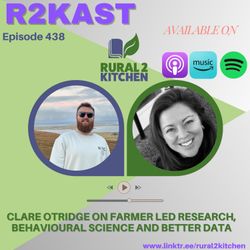
R2Kast 438 – Clare Otridge on farmer led research, behavioural science and better data
51:29|Today I had Clare on the R2Kast 🎙️ Clare is a farmer’s daughter, behavioural scientist and the driving force behind Grounded Research, using research and data to make sure farmers and others across the food supply chain have a genuine voice in decision making. 🌾We spoke about growing up on an arable farm in Cambridgeshire, moving into marketing and consultancy, life as a military wife and eventually finding her way back into agriculture during the pandemic. That journey also led Clare into behavioural science and understanding why people actually make the decisions they do. 🍎A big part of the conversation focused on Five Bar Gate and the communities Clare has created to make agricultural research easier, quicker and more representative. We spoke about paying farmers for their time, building robust data sets and making sure the people actually producing food are involved in the research and decisions that affect them. 🌍We also chatted about ADOPT, farmer led innovation, getting farmers engaged in research and Clare’s nomination for Woman of the Year at the British Farming Awards.Enjoy! 🙂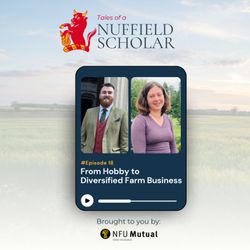
Tales of a Nuffield Scholar - Natalie Hepburn on the Relationship with a Nuffield Sponsor
37:25|Series three of Tales of a Nuffield Scholar is here 🎙️ Thank you for watching series two, where we looked ahead to the scholars and Next Gen Scholars presenting at the 2026 Nuffield Farming Scholarships Conference in Leeds. This time we’re changing things up and looking at some of the biggest challenges, innovations and conversations shaping agriculture today 🌾To start the series I was joined by Natalie Hepburn, a fellow scholar from my own Nuffield cohort and someone I travelled to Brazil with on our CSC. Natalie farms around Cardiff, keeping sheep and goats while producing goats milk skincare and sheep milk cheese.Natalie’s scholarship explored farm diversification and how farmers actually manage everything that comes with turning what they produce into a product. Her travels took her to Brazil, Rwanda, the Netherlands, Ireland, Northern Ireland and around the UK, with one of her biggest takeaways being the importance of networks and businesses supporting each other 🌍The main focus of this episode though was the relationship between a Nuffield Scholar and their sponsor. Natalie’s scholarship was sponsored by the NFU Mutual Charitable Trust and we spoke about how that relationship went far beyond simply providing the funding. From visiting NFU Mutual headquarters and being connected with people who could help her research, to keeping in touch throughout her travels and sharing her findings afterwards, it showed the role sponsors can play throughout the whole Nuffield journey.We also chatted about turning months of travel into a 5,000 word report and 12 minute presentation, the Nuffield moments that can completely change your thinking and why sometimes the best thing you can do while travelling is leave gaps in the diary for the opportunities you never planned for 🌱A great way to kick off series three and a chance to highlight a part of Nuffield that we probably do not speak about enough.Thank you to the NFU Mutual Charitable Trust for their support of this project.Enjoy! 🙂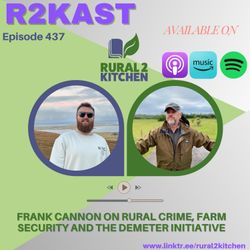
34. R2Kast 437 – Frank Cannon on rural crime, farm security and the Demeter Initiative
01:05:22||Season 6, Ep. 34Today I had Frank on the R2Kast 🎙️ Frank is a Chartered Security Professional whose career has taken him from farming in Lincolnshire into the military and then security roles across the world, including a decade working in Kazakhstan. 🌾We spoke about how that career eventually brought him back towards agriculture and the creation of Rural Safeguard, using decades of experience in security to help farmers better understand and reduce their risk of rural crime. From machinery and livestock theft to hare coursing and farmyard security, we got into just how broad rural crime actually is. 🍎A big part of the conversation focused on protecting farms without turning them into fortresses. Frank explained the importance of understanding where you’re vulnerable, building sensible layers of security and having a plan for what happens if someone does enter the farm. His message of better tin than skin was a simple one, protecting yourself and your family has to come before protecting machinery. 🌍We also spoke about how rural crime is changing through technology, cyber attacks and increasingly sophisticated organised crime, alongside the Demeter Initiative and Frank’s work to bring farming, policing, government and the security sector together to tackle the problem.Enjoy! 🙂