Share
Leaving Academia: Becoming a Freelance Editor
Why DIY-ing Your Academic Business is Killing Your Profits (and What to Invest in First)
Why does investing in your academic business feel terrifying?
You've spent tens of thousands of dollars on your education—but when it comes to starting your academic editing or coaching business, you're trying to do it with zero investment, zero tools, and zero support. Why?
Because academia trained you to survive on scraps.
This week, I’m breaking down:
💡 Why investing feels so risky for academics
💡 How to shift into a true ROI (return on investment) mindset
💡 What I did wrong at first (and how I changed my strategy)
💡 Small, high-impact investments that can save you time and land you clients faster
If you're tired of spinning in circles and trying to figure it all out yourself—this episode will help you take that first powerful step toward a business that actually pays you (well!) and gives you your life back.
👇 Resources mentioned in this episode:
PerfectIt editing software: intelligentediting.com
BeefText: beeftext.org
TextExpander: textexpander.com
Want to end burnout and become an academic editor or coach? Go to AcadiaEditing.com/BecomeAnEditor
00:00 - Introduction of the topic about money in business.
00:52 - Importance of investment in your business, not treating it like a hobby.
03:28 - Academia teaches resourcefulness, not investment.
04:07 - Spending on your business is a responsible choice.
04:49 - You need tools and support to build a successful business.
06:10 - Reclaiming agency as a business owner is essential.
07:07 - Invest in learning how to run a successful business.
11:55 - DIY mindset keeps you stuck; investing buys back your time.
12:29 - Shift to an ROI mindset to think like a CEO.
14:32 - Statistical predictions guide your investment decisions.
20:04 - Coaching programs provide structure and accountability for growth.
22:22 - Tools and systems simplify workflows and improve efficiency.
24:26 - Use flexible payment options to attract more clients.
28:52 - Community support enhances your business journey.
31:00 - Over-analysis can hinder decision-making and progress.
35:00 - Start small but start investing now to see growth.
36:28 - Acting like a CEO boosts confidence in business.
38:00 - Investing improves your chances of attracting higher-paying clients.
39:58 - Your past investments in education justify new business investments.
41:45 - Importance of joining a program to support your growth.
42:28 - Conclusion and invitation to consider the program offered.
More episodes
View all episodes
67. Should You Leave Academia for Industry or Business? A Path to Coaching via Data Science
52:20||Season 2, Ep. 67🎓 Should You Leave Academia for Industry or Business?If you're standing at that crossroads—wondering whether to jump into industry or build something of your own—this episode is required listening.💡 In this conversation, Tory Wobber shares how she went from a Harvard PhD in biology to a leadership role in data science at Facebook and Google… and eventually became a sought-after coach helping other academics make the leap.Here's Your Problem:You’ve done everything right—grants, publications, multiple job market seasons—and it still feels like you’re losing.When Tory faced this, she set a boundary, walked away from academia, and found a path that gave her both impact and freedom.Her coaching program, Academic Exit, has helped over 100 PhDs (especially in the social sciences) transition successfully into industry jobs they actually enjoy.In this episode, you’ll learn how to:🔑 Decide if industry or entrepreneurship is right for you🔑 Translate your PhD into real-world skills🔑 Avoid the biggest mistakes academics make when leaving🔑 Build a career rooted in your actual goals—not just survivalWhether you’re curious about data science, career coaching, or just desperate for a way out—this one’s for you.Resources:Join Tory's program, Academic Exit: VictoriaWobber.comAcademicExit.comConnect with Tory on LinkedIn: https://www.linkedin.com/in/victoria-tory-wobber-phd-cpcc-0364682b/Recovering Academics group:Message Gabrielle Filip-Crawford on LinkedIn: https://www.linkedin.com/in/gabriellefc/Ready to explore academic editing or coaching? → AcadiaEditing.com/map4:27 - Tori's Journey From Harvard PhD to Industry Leader7:07 - Academia's Unreasonable Expectations10:18 - The Data Science Leap to Facebook14:25 - Navigating Corporate Culture Shock18:00 - Finding Your Fit Beyond Academia22:30 - The Power of Career Coaching26:00 - Avoid the Spray-and-Pray Job Search30:00 - Your Next Career Chapter
66. Why Good Academics Struggle to Make Good Money (and How to Fix It)
26:51||Season 2, Ep. 66💰 How to Make Money as an Academic Outside Higher Ed (Even If You Feel Guilty Charging)Burnt-out from academia but still struggling with guilt about charging for your skills?In this episode, I challenge the beliefs that keep academics underpaid and overworked—and show you what’s possible when you embrace your worth.I share how I went from tenure-track burnout to running a six-figure editing and coaching business. You'll also learn how not being perfect in your marketing can actually help you grow, and why higher pricing doesn’t scare good clients away—it attracts them.If you’ve ever felt uneasy about charging for your work or feared being “one of the bad guys” for making money, this episode will change your mind.🎧 Listen on your favorite podcast app or watch on YouTube.Want to end burnout and become an academic editor or coach? Go to AcadiaEditing.com/map04:04 - Academia's pressure to work without financial reward. 06:15 - The belief that good people don't care about money. 10:56 - Sharing knowledge builds respect and encourages payment. 11:32 - Common misconception that lower prices attract more clients. 13:18 - Price perception affects perceived value. 15:14 - Good people can also accumulate wealth. 16:16 - Wealth brings the ability to help others. 17:17 - Abundance allows for increased generosity and freedom. 18:12 - Fair exchange for knowledge without guilt. 18:51 - Authenticity earns trust more than polish. 21:57 - Reflection on personal limitations and guilt about pricing. 23:24 - Confidence is developed through overcoming past fears. 25:02 - You deserve to be paid well for your knowledge. 25:46 - Encouragement to make 2026 a year of change. 26:05 - Invitation to connect for support in building a business.
65. Marketing as an Academic Editor: What No One Teaches You
45:55||Season 2, Ep. 65🔥 Burned out in academia? Wondering how to turn your PhD into a flexible, fulfilling business?Cara Jordan did just that—and in this episode, she reveals how she went from freelancing for artists in NYC to founding Flatpage, a thriving academic editing agency and publishing house.So many academics feel stuck, exhausted, and unsure how to market themselves beyond word of mouth.Cara shares exactly how she marketed her editing services, grew a team, and expanded into publishing—all while navigating relocation, burnout, and the challenges of marketing to academic clients.Today, Flatpage serves a wide range of humanities and social science scholars. Cara teaches in the UCSD editing certificate program and co-edited the fabulous book, The Art of Academic Editing.In this episode, you’ll learn how to attract clients, overcome fear of visibility, and build a sustainable editing business—even if you're starting from scratch.Resources Mentioned:Flatpage: https://www.flatpage.com/UCSD Copyediting Certificate: https://extendedstudies.ucsd.edu/certificates/copyeditingBook: The Art of Academic Editing (affiliate link): https://amzn.to/48uH30uWant to end burnout and become an academic editor or coach? Go to AcadiaEditing.com/BecomeAnEditor00:01:00 - Cara's Academic Background 00:02:30 - Early Freelance Experience 00:04:00 - Transitioning from Academia to Freelancing 00:05:30 - Initial Client Acquisition 00:07:00 - The Importance of Word of Mouth 00:08:30 - Marketing Strategies for Editors 00:10:00 - Overcoming Marketing Hesitations 00:11:30 - Networking and Community Engagement 00:13:00 - Challenges of Marketing to Academics 00:14:30 - Creative Approaches to Finding Clients 00:16:00 - The Importance of Niching Down 00:17:30 - Growth of Cara's Editing Business 00:19:00 - Starting Flatpage and Team Expansion 00:20:30 - Differences Between Copy Editing and Developmental Editing 00:22:00 - The Value of Formal Editing Training 00:23:30 - The Role of Academic Background in Editing 00:25:00 - The Need for Professional Development 00:26:30 - Advice on Working for Free 00:28:00 - The Decision to Add Publishing Services 00:29:30 - Advocacy Through Publishing 00:31:00 - Final Advice for Aspiring Editors
64. How to Create Regular Marketing Content without Losing Your Mind
39:57||Season 2, Ep. 64Burnt out by content creation? Glued to your phone, cranking out posts that barely get engagement? You're not alone—and there’s a better way.Academics starting their businesses often fall into the trap of chasing social media trends—thinking they have to do Reels, show up daily, and perform for the algorithm.In this episode, I walk you through a step-by-step system that simplifies content creation by drawing on your academic strengths—writing, planning, and strategic thinking.This is the exact system I've used to create a month of content in a few hours—and stay off the content hamster wheel that leads to burnout.You’ll learn how to brainstorm blog topics, batch-write posts, repurpose them for social media, and even delegate to AI (ethically and efficiently). If content has ever felt overwhelming, this is how you can simplify.🎧 What You’ll Learn:Why Instagram-style content isn’t effective for academic businessesHow to repurpose blog content into multiple social postsA 3-step batching system that saves hours of timeTips for using AI tools (like Claude and ChatGPT) without losing your voiceHow to avoid burnout and still show up online📚 Resources Mentioned:Ep 39 of my podcast with SEO expert Laura Jawad📣 Want to end burnout and become an academic editor or coach? Go to AcadiaEditing.com/BecomeAnEditor00:00 - Target mindset shift away from fleeting social media engagements. 03:40 - Choose where to spend time online based on ideal client presence. 04:02 - Brainstorm topics based on client questions to improve SEO. 05:14 - Create a list of five to ten questions, select the top four. 06:27 - Draft short blog articles, aiming for 1000-1500 words each. 11:48 - Avoid task switching; focus periods for each content creation step. 13:24 - Repurpose blog posts into social media content for consistent messaging. 15:07 - Use excerpts from blog articles for engaging LinkedIn posts. 19:05 - Use AI tools for drafting social media posts based on articles. 21:14 - Expect low visibility; only a small percentage of followers will see posts. 25:38 - Schedule blog articles in advance for consistent content delivery. 30:05 - Implement a systematic approach for efficient content creation over time. 31:26 - Protect your energy; pace content creation to avoid burnout. 32:57 - Focus on platforms that resonate with your target audience. 35:02 - Success isn’t based on follower count but on client conversion. 36:17 - Prioritize driving engagement toward your email list for control. 37:17 - Understand that building a brand takes time and effort. 37:55 - Practice will help refine your brand voice and messaging. 39:02 - Utilize support resources like coaching when growing your business. 39:44 - Explore educational opportunities for aspiring academic editors. 39:52 - Each step in content creation contributes to your professional growth.
63. How to Regret-Proof Your Life: Leaving Academia Mid-Career
42:50||Season 2, Ep. 63Are you afraid to leave academia because you've “invested too much” or feel like it’s “too late” to start over? In this episode, master life coach and midlife mentor Suzy Rosenstein shares how to regret-proof your life, especially if you’re over 50 and stuck in a career that no longer fits.Suzy left a 27-year career and built a thriving coaching business—proof that it’s never too late to pivot.If you're in midlife and wondering “is this all there is?”, this episode is your wake-up call.We cover:☑️ Why being stuck isn't just painful—it's costly☑️ How identity and fear keep us trapped in academia☑️ Simple mindset shifts to help you imagine a new future☑️ How Suzy used coaching to get unstuck and build a business☑️ Why it’s okay (and essential) to want more🎧 Whether you're thinking about leaving your faculty role, building a side hustle, or just feeling “off,” this is a must-listen for anyone craving more clarity and freedom in midlife.RESOURCES MENTIONED:Suzy Rosenstein's podcast: Women in the MiddleTake Suzy's Midlife Quiz: https://midlifequiz.comSuzy's coaching site: https://suzyrosenstein.comConnect with Suzy on Instagram: https://www.instagram.com/themidlifecoach_suzy🎯 Want to end burnout and become an academic editor or coach?Go to AcadiaEditing.com/BecomeAnEditor02:23 - Personal transformations during midlife are common and necessary10:00 - Detaching from academic identity is a significant challenge11:12 - Rethinking identity can offer opportunities rather than a crisis17:09 - Understanding the cost of staying stuck is crucial19:00 - Prestige in academia does not equate to personal fulfillment20:06 - Journaling helps examine limiting beliefs . 24:21 - Imagining success can counter fears of failure 25:24 - Exploring alternatives can unveil unexpected career options . 29:28 - Engaging in curiosity without immediate action is valuable . 31:27 - Identifying perspectives about potential career changes is critical . 33:01 - Solidifying your what is essential before determining how . 34:42 - "I'm open to the idea that" promotes exploration of possibilities . 36:32 - Transitioning from academia to business fosters community connections . 39:04 - The online entrepreneurial world offers diverse opportunities . 40:57 - Group coaching can enhance the transition experience . 41:36 - Taking advantage of midlife opportunities can be life-changing . 42:11 - Personal stories of resilience in entrepreneurship are inspiring . 42:44 - Midlife quizzes and exploration can clarify future desires . 46:29 - Embracing a beginner's mindset is essential for growth
61. "You Can't Eat Prestige": Why Academic Identity Is a Trap, and How to Get Over It
23:34||Season 2, Ep. 61“You Can’t Eat Prestige.”It’s a brutal truth that haunts many academics—but what does it actually mean?In this raw and radically honest episode, I sit down with coaches Tory Wobber and Jen Polk to unpack one of the hardest parts of leaving academia: letting go of your academic identity.For so many of us, being a professor isn’t just a job—it’s a calling. We internalize the idea that we’re special, self-sacrificing, and above the grubby world of capitalism. But all that prestige? It doesn’t pay the bills. And it definitely doesn’t buy you freedom.Tory and Jen offer a compassionate, no-BS conversation about how to grieve your academic identity, try on new ones, and build a life that actually makes you happy—even if it’s outside the ivory tower.Drawing from their own exits from academia and years of coaching other scholars through the same process, they reveal just how common—and navigable—this identity shift can be.By the end of this episode, you’ll feel seen and supported. You’ll have practical tools to begin detaching your self-worth from your job title. And you'll have permission to build an identity that’s truly yours.▶ Sign up for Tory's newsletterJoin 2000 PhDs on the Academic Exit Newsletter to receive free tools and techniques for how to move from academia into industry quickly and easily:https://www.academicexit.com/opt-in-36add534-500b-4e74-a319-408d4810480e▶ Subscribe to Jen’s From PhD to Life newsletter to get advice and resources for professors, postdocs, and other PhDs who are ready to change careers, even if that means moving away from academia or their discipline: https://subscribe.fromphdtolife.com/▶ Get Paulina’s free workbookLove what you do but hate where you do it? Get my free workbook Map Your Academic Business and start building your “Plan B.” Use your academic training inside a profitable business that you control–no more free labor, no more toxic workplace, no more burnout. https://acadiaediting.com/map1. **00:00** - Transitioning from academic to alternative careers discussed.2. **01:11** - Cultural norms in academia strongly influence identity.3. **02:52** - Academics often feel a calling, tying work to identity.4. **05:00** - Discussing barriers to seeing oneself in new roles.5. **06:15** - Grieving the loss of previous academic identity is crucial.6. **09:02** - Finding personal identity beyond job titles emphasized.7. **14:56** - Practicing new identities through self-reflection suggested.8. **17:00** - Importance of letting go of old descriptors for self-identity.9. **18:56** - Emphasizing gradual exploration of new professional identities.10. **20:00** - Taking small steps towards new roles instead of abrupt changes encouraged.
60. Are Career Coaches for PhDs Worth the Money?
15:30||Season 2, Ep. 60Are PhD career coaches worth the money??In this week's podcast episode, I'm joined by fabulous PhD career coaches Victoria (Tory) Wobber, PhD, CPCC and Jennifer Polk, PhD to answer this very question.Rather than just saying "yes" and patting ourselves on the back, we share insights into our own experiences working with coaches and clients and give some tips on when and how you might go about choosing a coach to work with.🎃 Jen shares her own journey from academia into coaching🎃 I talk about how my childhood affected my own money mindset🎃 Tory explains how a talented coach can help you feel good about yourself and your job search so you don't end up mired in self-doubtTune in for this info and other spicy snippets, and keep your eyes peeled for more videos from these lovely post-ac coaches! 🤩Happy Halloween! 👻Learn from PhD Career Coaches Tory Wobber (Academic Exit) and Jen Polk (From PhD to Life) in conversation with PhD Business Coach Paulina Cossette (Acadia Editing) about whether and when coaches are worth the money. Looking for more resources to chart your path outside of academia? ▶ Sign up for Tory's newsletterJoin 2000 PhDs on the Academic Exit Newsletter to receive free tools and techniques for how to move from academia into industry quickly and easily:https://www.academicexit.com/opt-in-3...▶ Subscribe to Jen’s From PhD to Life newsletter to get advice and resources for professors, postdocs, and other PhDs who are ready to change careers, even if that means moving away from academia or their discipline: https://subscribe.fromphdtolife.com/▶ Get Paulina’s free workbookLove what you do but hate where you do it? Get my free workbook Map Your Academic Business and start building your “Plan B.” Use your academic training inside a profitable business that you control–no more free labor, no more toxic workplace, no more burnout.https://acadiaediting.com/map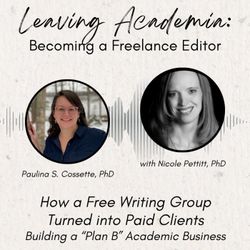
59. How a Free Writing Group Turned into Paid Clients: Building a "Plan B" Academic Business
49:43||Season 2, Ep. 59What if your own accountability tool became a profitable business--and academic escape plan?Dr. Nicole Pettitt didn’t set out to build a business. She just wanted accountability for her own writing. So she launched a free co-writing group for women in grad school—and it quietly became a coaching business, with paid clients and real impact.Many academics want a “Plan B” but don’t know where to start. They feel stuck between their current role and the unknowns of entrepreneurship—especially when they still enjoy aspects of their job.Nicole started with what she already had: experience advising grad students, a deep understanding of writing struggles, and a Zoom link. From there, she organically built a coaching business—without quitting her tenure-line role.In this episode, she shares how she turned her Saturday morning co-writing group into a business that supports women finishing their dissertations—while staying in alignment with her values and energy.Whether you’re toying with a side hustle or looking for a sustainable exit strategy from academia, Nicole’s story will give you the clarity and confidence to begin.🔗 Learn more about the BAE program: AcadiaEditing.com/BecomeAnEditorConnect with Nicole:https://www.linkedin.com/in/nicole-pettitt/Email: drnicolep31@gmail.com01:24 – Nicole's shift toward supporting women in academia05:14 – Balancing academic roles with entrepreneurial aspirations08:11 – Free writing group beneficial for community building09:13 – Majority of clients found through the writing group10:57 – Importance of providing community for online doctoral students12:11 – Similarities between coaching others and personal challenges14:30 – Bridging the gap between knowledge and action14:30 – The necessity of community and feedback for doctoral students16:07 – Community aspects tied to external feedback in coursework18:48 – Recognizing that information alone isn’t enough for student success22:39 – Advice to focus on one-on-one coaching first24:56 – Writing group as a funnel for attracting one-on-one clients26:03 – Clarity is key to helping clients execute their projects30:20 – Establishing boundaries between coaching and editing services36:39 – Pricing coaching services fairly based on value offered42:03 – Strategies for promoting coaching services to writing group members48:40 – Testing marketing strategies as a scientific experiment49:43 – Understanding client pain points as core to effective marketing50:53 – Providing contact information for potential clients51:21 – Encouragement for women to pursue their academic goals