Share
Leaving Academia: Becoming a Freelance Editor
Why Good Academics Struggle to Make Good Money (and How to Fix It)
💰 How to Make Money as an Academic Outside Higher Ed (Even If You Feel Guilty Charging)
Burnt-out from academia but still struggling with guilt about charging for your skills?
In this episode, I challenge the beliefs that keep academics underpaid and overworked—and show you what’s possible when you embrace your worth.
I share how I went from tenure-track burnout to running a six-figure editing and coaching business. You'll also learn how not being perfect in your marketing can actually help you grow, and why higher pricing doesn’t scare good clients away—it attracts them.
If you’ve ever felt uneasy about charging for your work or feared being “one of the bad guys” for making money, this episode will change your mind.
🎧 Listen on your favorite podcast app or watch on YouTube.
Want to end burnout and become an academic editor or coach? Go to AcadiaEditing.com/map
04:04 - Academia's pressure to work without financial reward.
06:15 - The belief that good people don't care about money.
10:56 - Sharing knowledge builds respect and encourages payment.
11:32 - Common misconception that lower prices attract more clients.
13:18 - Price perception affects perceived value.
15:14 - Good people can also accumulate wealth.
16:16 - Wealth brings the ability to help others.
17:17 - Abundance allows for increased generosity and freedom.
18:12 - Fair exchange for knowledge without guilt.
18:51 - Authenticity earns trust more than polish.
21:57 - Reflection on personal limitations and guilt about pricing.
23:24 - Confidence is developed through overcoming past fears.
25:02 - You deserve to be paid well for your knowledge.
25:46 - Encouragement to make 2026 a year of change.
26:05 - Invitation to connect for support in building a business.
More episodes
View all episodes
79. How to Market Your Academic Business... Without Feeling Gross
36:20||Season 2, Ep. 79You think marketing will be gross. But what if it doesn't have to look the way you imagine?If the word "marketing" makes you cringe—if it conjures images of pushy salespeople, empty promises, and Instagram influencers claiming you can make $250K from a $47 mini course—I get it. Completely.But here's what I want you to consider: the resistance most academics feel toward marketing isn't really about values. It's about fear. And once you see marketing for what it actually is (hint: it's just letting people know you exist), it might stop feeling so gross—and start feeling like something you actually enjoy doing (and you're really good at).In this episode, I'm breaking down:💡 Why academics are conditioned to distrust marketing—and why that's not entirely wrong💡 The sneaky second layer of resistance that's really just self-doubt in disguise💡 What marketing is when you strip away all the noise💡 How you've already been doing it your whole academic career💡 How to make marketing feel like connection instead of a transaction💡 Your first concrete homework assignment to land your first private clientsWhether you're terrified to put yourself out there or just convinced that marketing requires you to become someone you're not, this episode is for you.📌 Resources Mentioned:Episode 72: Niching Down https://youtu.be/EWbD4y9j378 Episode 77: How to Land Your First Coaching Client https://youtu.be/yK_mRRAFmTo🔔 Subscribe so you never miss a new episode, and if this resonated with you, share it with a colleague who's thinking about leaving academia.🖥️ Save Your Seat for my 3-Day Live Training, April 8-10, 2026. Go to AcadiaEditing.com/live1:35 - Facing Your Marketing Fears3:10 - Values vs. Self-Doubt Resistance5:05 - The Truth About Marketing7:40 - How Academics Already Market10:15 - Your Marketing Control Center12:00 - Overcoming Rejection Fears14:30 - Warm Outreach: Your First Step
78. The Money Stuff Nobody Tells You: What a Financial Planner Wants Academics in Business to Know
43:07||Season 2, Ep. 78Think you want to leave academia and go freelance? You should watch this.Most academics who dream of leaving their job focus on the exciting stuff—landing clients, working from home, finally having freedom. But there's a whole other conversation that almost nobody is having: the financial one. What happens to your retirement accounts? Can you actually afford health insurance? When do you really need an LLC?In this episode, I sit down with Inga Timmerman, a finance professor and Certified Financial Planner (CFP) who works exclusively with academics. She's seen it all—the people who quit too soon, the people who drain their savings in six months, and the people who get the transition right because they planned ahead.Here's what we cover:🪙 The savings benchmark you should hit before you quit🪙 Why mixing personal and business finances is a bigger mistake than you think🪙 What to do with your TIAA account (and whether to roll it into an IRA)🪙 Honest talk about health insurance in 2026—including options most people overlook🪙 Why you probably don't need an LLC yet (and when you do)🪙 What to do—and not do—with your investments when the market is in chaosWhether you're building a side hustle in academic editing or coaching, or you're deep in your exit planning, this episode will help you think through the money side of your transition clearly and without the panic.🔔 Subscribe so you don't miss new episodes every week.🐦🔥 When you want to take the leap, find out more about launching an academic editing or coaching business: https://AcadiaEditing.com/BecomeAnEditorResources Mentioned:Inga's podcast: Academics and Their Money, https://attainablewealthfp.com/welcome-to-academics-and-their-money/Work with Inga: https://attainablewealthfp.com2:05 - Academia to Entrepreneurship, Inga's Journey4:31 - Why Top-Tier Research Felt Hollow6:58 - Impact Over Ivory Tower9:12 - Launching a Business as a Hobby11:35 - Mastering Academic Niches For Clients13:58 - Academic Financial Fears Addressed16:21 - Planning Your Exit18:44 - Budgeting For Business Independence21:07 - Smart Spending, Avoid Shiny Objects23:30 - Navigating Taxes As A Business Owner25:53 - When To Leave Academia Full-Time28:16 - Health Insurance Hurdles & Solutions30:40 - Retirement Accounts After Academia33:03 - Protecting Yourself, Insurance Needs35:26 - Business Structure, When To Start37:49 - Market Volatility39:55 - Get Expert Help, Find Your Advisor
77. How to Land Your First Coaching Client (When You Have No Idea What You're Doing)
36:07||Season 2, Ep. 77He had no coaching packages. No clients. No idea how to run a sales call. And then, in week 5 of his BAE cohort, he signed his first client to a 6-month coaching contract. 🥳In this episode, I'm walking you through one BAE student's journey—from "I have no idea what I'm doing" to landing a real, paying coaching client faster than he ever thought possible.I'm calling him Michael to protect his privacy, but his story is real, and it's one that I know you'll find instructive.Here's what you'll hear in this episode:🎧 How Michael went from joining BAE to having a website, a LinkedIn profile, and a niche—all within the first month of his cohort🎧 Why a referral from a former colleague turned into his first real client inquiry (and how he almost let fear talk him out of it)🎧 What a discovery call looks like, and how it's different from a sales call🎧 Why I pushed Michael to raise his prices—and why he was glad I did🎧 How to handle the nerve-wracking gap between your client saying "I need to think about it" and "I'm in"🎧 The mindset shift that separates academics who stay stuck from those who actually launchI also share what's been happening in the current cohort with other BAE students—including someone who landed TWO dissertation editing clients in a single day, and two MORE just a few weeks later. 🤯The big lesson running through all of this: you are never going to feel ready. The fear doesn't go away. But you CAN (and should!) do it scared—and that's exactly what growth looks like.🎙️ Subscribe to the podcast so you don't miss future episodes on life beyond academia, freelance editing and academic coaching, and building a business that brings you joy.Want to end burnout and become an academic editor or coach? Go to AcadiaEditing.com/BecomeAnEditor2:30 - Define Your Niche & Build Your Website5:15 - How To Land Your First Coaching Client8:00 - Master Discovery Calls For Clients11:45 - Price Your Packages With Confidence15:00 - How To Nail Your Sales Call19:30 - Key Takeaways For Business Growth23:00 - Join BAE Core Or Accelerator30:00 - Why You Have To Do It Scared
76. Rethinking Education: How to Teach Outside the Traditional Classroom
01:03:06||Season 2, Ep. 76You love teaching. You love the research. So why does it feel like academia is suffocating you?In this episode, I sit down with Kelly Merritt—education PhD, former K–12 teacher in Switzerland, and founder of Define Your Lines—to talk about what it really looks like to build a freelance business from the ground up—while navigating toxic workplaces, health crises, expat life, and the slow, complicated grief of letting go of an academic identity.Kelly's story doesn't follow the typical "I burned out and quit" script. She's been layering her exit for years—thoughtfully, strategically, and honestly. And what she shares in this conversation is some of the most nuanced, honest advice you'll hear about what it takes to make this work.In this episode, we cover:✏️ Why leaving academia isn't always enough—and what you actually need to heal and build something sustainable✏️ The difference between strategy and experimentation in business—and why you need both✏️ How to balance client-facing work with the behind-the-scenes infrastructure work✏️ How Kelly navigated a full brand refinement six months after launching her first website (and why it was worth it)✏️ How Kelly serves three different audiences (teachers, students, and writers) with one business—and the thread that connects themWhether you're deep in the details of business-building, still deciding if you can make the leap, or just needing to hear that someone else has been in the messy middle—this episode is for you.Resources Mentioned:Define Your Lines: https://defineyourlines.comKelly Merritt on Instagram, Facebook, and LinkedIn: @defineyourlines / https://www.linkedin.com/in/kellymmerritt/Kelly's free self-assessment for writers: Five Pillars of Sustainability and Joy in a Writing Practice: https://defineyourlines.com/writers/five-pillars/The Academic Entrepreneurs Studio (Paulina's mastermind for academic business owners): https://acadiaediting.com/studio🎙️ Subscribe so you never miss an episode, and if this one resonated, share it with a colleague who's been quietly dreaming about a different kind of life.Want to end burnout and become an academic editor or coach? Go to AcadiaEditing.com/BecomeAnEditor2:14 - Kelly's Academic Background5:09 - Journey from Academia to Business10:01 - Navigating Academia's Oddities15:30 - The Decision to Move Abroad20:15 - Toxic Academic Environments25:18 - Building a Sustainable Business30:16 - The Brand Refinement Process35:11 - Balancing Strategy & Experimentation40:24 - Defining Your Lines Explained45:25 - Serving Diverse Audiences50:07 - The Value of Community55:00 - The Long Road to Success
75. Academia Uncensored: The Top 5 Reasons Why People Are Leaving
43:28||Season 2, Ep. 75You did everything right. So why does academia feel so wrong?In this episode, I'm sharing data I've been collecting for over a year: raw, unfiltered responses from academics all over the world who answered one simple question—What's going on in your life that brought you here?What I found wasn't two-word answers. It was grief. It was burnout so deep it had started destroying people's bodies. It was the specific, quiet devastation of realizing that tenure—the thing you sacrificed everything for—isn't the finish line you were promised.The data are clear: this isn't an individual failure. It's a systemic one.In this episode, I walk you through the 5 most common themes in the responses I've collected from academics who are leaving or thinking about leaving higher ed.I also share what I believe is possible on the other side: a career that uses every skill you've developed in academia, in a context where you're respected, fairly paid, and in control.If you've been wondering whether you're alone in feeling this way—you're not. I've got the receipts.🎙️ Resources Mentioned:Episode 61 on academic identity, with Tory Wobber and Jen Polk: https://youtu.be/JqdqPkEFdfs📌 Subscribe to the channel so you never miss an episodeIf this topic resonated with you, share it with an academic friend who needs to hear it.🐦🔥 Want to end burnout and become an academic editor or coach? Go to AcadiaEditing.com/BecomeAnEditor4:10 - Devastating Realities Unfiltered Stories7:45 - Burnout Is Not a Phase10:55 - Feeling Undervalued and Underpaid16:40 - The Pain of Institutional Betrayal21:20 - Reclaiming Your Life and Time24:15 - Finding Hope Beyond Academia
74. Hosting Your First Writing Retreat? Here's Everything You Need to Know to Make It a Success
36:48||Season 2, Ep. 74Hosting Your First Writing Retreat? Here's What You Need to Know to Make It a Smashing SuccessYou've built an editing or coaching business. You love working with academics. And somewhere in the back of your mind, you've been wondering: Could I host a writing retreat?Short answer: probably yes. But the logistics are important.In this episode, I'm talking with Kimberly Hale, PhD—interpreter educator and ICF-certified faculty success coach—about exactly how she plans and runs her academic writing retreats.Not the inspirational version. The real version: how to find the right space, feed people well, handle airport logistics, price it so you actually earn money for your time, and navigate the very particular headache of getting paid by universities.Here's what you'll learn:🏠 The first question to ask yourself before you book anything (hint: it's about vibe)🏠 How Kimberly structures her retreat across Thursday evening through Sunday lunch🏠 Her approach to food, dietary preferences, and why feeding people is harder to plan than you'd think🏠 Where she finds participants and how she markets without advertising to her own university🏠 How she handles institutional payments, purchase orders, and slow-paying universities🏠 What participants actually accomplish—and how that becomes your best marketingIf you're an academic editor or coach thinking about adding retreats to your business, this episode will save you a lot of trial and error.🎙️ Subscribe to the channel so you don't miss a new episode.📌 Resources Mentioned:Kimberly Hale's website: https://facultysuccesscoach.com🏠 Kimberly's upcoming writing retreat (March 19–22): facultysuccesscoach.com/retreat💰 Discount code for $300 off the March retreat: INL20261:40 - Overwhelmed? Find Your Academic Path4:05 - How To Balance Faculty and Business7:10 - Unlock Your Productivity Secrets11:50 - What is Coaching vs. Mentoring?18:30 - Master Your Writing Retreats25:00 - Join Our March Writing Retreat!33:50 - Main Takeaways for Your Career🐦🔥 Want to end burnout and become an academic editor or coach? Go to AcadiaEditing.com/BecomeAnEditor
73. Why Your Academic Job Search Isn't Working (Hint: It's Not Your Resume)
45:19||Season 2, Ep. 73Burned out, overworked, and secretly Googling "alternative careers for PhDs"—but not sure what you actually want to do next? This episode is for you.In this conversation, I sit down with Jen Polk, one of the most well-known and trusted post-academic career coaches, to talk about what it really takes to figure out your next move after academia.Jen has been doing this work since 2013, and she has helped dozens of PhDs—from postdocs to full professors to tenured department chairs—find career clarity and build lives they enjoy.Here's what we get into:🖋️ Why so many tenured professors (not just grad students) are leaving academia right now🖋️ The #1 mistake academics make when starting a job search—and why "converting your CV to a resume" is a symptom, not a solution🖋️ The self-reflection question that Jen uses with every single client (it's deceptively simple yet powerful)🖋️ Whether you need coach training to become a coach—and Jen's honest, no-BS answer🖋️ What Jen's PhD Career Clarity Program looks like and who it's for🖋️ Why small-group coaching can be more powerful than one-on-one support (backed by what actually happened in her program last week)If you've been feeling lost, stuck, or like academia has wrung every last bit of joy out of you, this conversation will remind you that you're not alone—and that there's a way through.👉 Subscribe so you never miss an episode.Resources Mentioned:Jen Polk's PhD Career Clarity Program: https://fromphdtolife.com/Jen Polk on LinkedIn: https://www.linkedin.com/in/jennifer-polk-phd/Want to end burnout and become an academic editor or coach? Go to AcadiaEditing.com/BecomeAnEditor2:40 - Academic Background to Coaching7:00 - How Coaching Changed Her Life10:00 - The Rise of Post-Academia14:00 - Why Tenured Faculty Leave18:00 - Global Higher Ed Challenges22:00 - Finding Your Next Career Path27:00 - What is "Flow" State?31:00 - Resume vs. Clarity36:00 - The Power of Community42:00 - Coaching vs. Mentoring47:00 - PhD Career Clarity Program53:00 - Finding Your True Calling
72. Don't List Your Credentials, Tell Your Story: The Real Secret to Attracting Clients
50:57||Season 2, Ep. 72💡 When you're starting your freelance editing or coaching business, the instinct is to offer everything to everyone. But what if niching down is what gets you more clients?In this episode, I walk you through the counterintuitive truth about developing a profitable niche—and why your credentials aren't what's going to sell your services.What You'll Learn:💡 Why "being for everyone" is actually limiting your income💡 The common mistake I made when I started my business💡 How emotions—not analytics—drive hiring decisions💡 Why your first niche WILL change (and why that's okay)💡 How to journal your way to discovering the people you're obsessed with helping💡 The 6-month feedback loop: when to expect clarity on your nicheKey takeaway: Your niche isn't about your credentials. It's about the collection of people who hear what you say and feel hope. It's the people drawn to you because of how passionate you are and the real solutions you've discovered. This is what you should lead with in your marketing to land consistent clients.Resources Mentioned:Map Your Academic Business Workbook – Download at AcadiaEditing.com/map BAE Program – 12-week live cohort for academics becoming freelance editors or coachesWant to end burnout and become an academic editor or coach? Go to AcadiaEditing.com/BecomeAnEditor2:14 - Stop Being for Everyone4:32 - Why Broad Messaging Fails7:02 - Credentials Don't Sell Services9:26 - Emotional Connection Drives Hires11:30 - How to Start Niching Down14:05 - Map Your Academic Business16:27 - Journal Your Ideal Client19:19 - The Non-Traditional Scholar22:17 - Burnout Mom's Struggle24:20 - Find Relief Through Your Services27:40 - The Messaging Feedback Loop31:07 - Listen to Your Customers33:51 - Refine Your Messaging36:30 - What People Truly Want40:24 - Offering Hope and Relief42:33 - Your Unique Solution44:20 - Be Real Be Passionate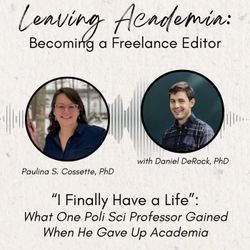
71. "I Finally Have a Life": What One Poli Sci Professor Gained When He Gave Up Academia
48:19||Season 2, Ep. 71What happens when everything looks perfect on paper but your life feels like it's falling apart?Today's guest, Daniel DeRock, was a successful assistant professor of international political economy at a "dream" university—yet he walked away. Why?In this episode, Daniel shares the truth about burnout, the hidden costs of chasing credentials, and how he's now building a thriving freelance business that finally honors all of who he is.In this conversation, you'll hear:☑️ Why Daniel left academia despite appearing to "have it all" on paper☑️ The moment he decided to quit (spoiler: it was sudden and definitive)☑️ How health problems and work-life balance pushed him to the breaking point☑️ Why he's now doing a fiction book coaching certification alongside academic editing☑️ How to build a business around what you actually want, not what you "should" want☑️ The power of claiming your full identity when you leave academiaDaniel's journey is a reminder that success in academia doesn't equal happiness. He was doing everything "right"—defended his dissertation, got the postdoc, landed the faculty job at the university where he'd studied abroad. Yet the constant task-switching, budget cuts, isolation, and unsustainable workload made him reach his limit.What's beautiful about Daniel's story is that he didn't just escape academia—he's actively building a business that brings together both his academic expertise AND his passion for fiction writing and the literary world. He's not abandoning his credentials; he's leveraging them in a completely new way.This episode is for anyone who's been told they should be grateful for their academic position, or who's struggling to admit that their "dream job" isn't actually working for them.If you're considering leaving academia or starting an editing/coaching business, watch this episode. And if you're ready to take the leap, check out my program, Becoming an Academic Editor or Coach—a 12-week group coaching program paired with lifetime access to the course materials.Resources Mentioned:Daniel's website: flowstateediting.comConnect with Daniel on LinkedIn: https://www.linkedin.com/in/daniel-derock-988883302/Want to end burnout and become an academic editor or coach? Go to AcadiaEditing.com/BecomeAnEditor[2:30] Daniel's Academic BackgroundDouble major in political science and English, studying in the Netherlands[5:45] Graduate School JourneyMaster's degree and PhD in Amsterdam, field work and teaching experience[9:20] Burnout During PhDTeaching full-time while finishing dissertation and applying for jobs[12:15] Landing the Dream JobAssistant professor position at his study abroad university[15:40] Health DeteriorationStress-related health problems and work-life balance issues[18:30] Budget Cuts and Increased WorkloadDoing the work of multiple people without support[21:00] The Decision to LeaveAbrupt departure from academia after reaching breaking point[24:45] Early Interest in EditingProofreading for colleagues, freelance editing during PhD[28:20] Discovering the Path ForwardFinding Paulina's course and realizing editing could be viable[32:10] Starting the BusinessRegistering Flow State Editing, first clients from colleagues[35:50] LinkedIn as Marketing PlatformReturning to LinkedIn and building presence[38:40] Types of Editing WorkCopy editing, developmental editing, coaching for academics[42:15] Expanding into Fiction EditingInterest in creative writing and book coaching[45:30] The Challenge of Niching DownBalancing academic editing with fiction editing interests