Leaving Academia: You Are Meant for More
All Episodes
105. No Advisor, No Plan B: How a Full Professor Built a Top 5% Podcast and Editing Business
41:17||Season 2, Ep. 105You hit full professor. You edited the top journal in your field. And somehow you still felt adrift.In this episode, Kyle Rudick (professor, graduate program coordinator, and host of the Publishing Academic Research podcast) shares how he went from losing his advisor in his first year of hid PhD to building a podcast, a coaching practice, and a career that truly brings him joy.We discuss:🎙️ Why Kyle tells his students to build an identity anchor outside higher ed🎙️ What it was like to navigate a PhD with no real mentorship and no plan B🎙️ How journal editing gave him a front-row seat to what makes research publishable🎙️ Why a podcast came first and clients came about eight months later🎙️ Why he thinks professors should have at least a toe out the door🎙️ What he'd say to colleagues who call side businesses "selling out"If this hits home, subscribe to my channel so you don't miss the next conversation. And if you've ever wondered whether your skills could earn money outside your institution (spoiler: they can), you're in the right place.Resources mentioned:Publishing Academic Research podcast and coaching: publishingacademicresearch.comPlan, Goal, Plan podcast, hosted by Kyle's colleague Danielle McGeough: https://www.plangoalplan.com/Want to turn your skills into rewarding paid services? Go to AcadiaEditing.com/mapTimestamps00:00 - Meet Kyle Ruddick, professor and podcaster01:00 - From small-town Oklahoma to grad school03:00 - Losing his advisor, finding no mentorship06:00 - Why you need an identity outside academia09:00 - No safety net: the pressure of no plan B11:30 - Landing the job at Northern Iowa14:00 - How he published 50+ articles17:00 - Why PhD programs skip practical skills20:00 - Becoming a journal editor22:00 - Feeling adrift after making full professor25:00 - Paulina's messy start in copy editing27:00 - Keeping a toe out the door30:00 - "Selling out" and the capitalist machine33:00 - Building a top 5% podcast35:30 - Audience tiers and a podcast course idea37:30 - How to work with Kyle104. Sell a Group Program in a Hurry: How to Test Your Idea Before the Season Starts (and Before Perfectionism Talks You Out of It)
29:28||Season 2, Ep. 104You have a great idea for a paid program, but it only works at a certain time of year, and that time of year is almost here. Do you scramble, or do you wait another 12 months and hope the idea is still good? In this episode, I walk you through a "minimum viable playbook" for testing a program idea when you're short on time, have no audience yet, and are tempted to let perfectionism make the decision for you.I cover: ⏱️ Why waiting a year costs you more than launching imperfectly (no data, no market language, no idea what your buyers care about) ⏱️ How to build a simple interest-list landing page, and why to leave the price off it ⏱️ Where to share it (hint: academic Facebook groups are a goldmine) and how to write posts that lead with your ideal client's struggles ⏱️ Which numbers to watch, including the conversion rate I use as a starting benchmark with academics ⏱️ How to tell whether your problem is the idea, the posts, or the landing page copy ⏱️ How to sell once people raise their hands, and what call to action to use at under $500, $500+, and $1,000+ Also, you may have noticed the new podcast name and cover art. We're now Leaving Academia: You Are Meant For More, because this community is bigger than editors. Welcome, I'm so glad to have you here! Like this episode? Subscribe so you don't miss the next one, and visit AcadiaEditing.com/map to find out more. Resources Mentioned: Kit (email platform used in this episode for landing pages and email automations): https://partners.kit.com/koj113xbly45 Academic Entrepreneurs Studio (six-month group program for women+ academics growing and scaling an existing business): https://acadiaediting.com/studio Becoming an Academic Editor or Coach (BAE): https://AcadiaEditing.com/map Timestamps 00:00 - Podcast rebrand: you are meant for more 02:15 - Great idea, but the timing's tight 04:30 - Job market season example scenario 06:00 - What waiting a full year costs 08:00 - Choosing imperfect action over perfect timing 10:00 - Step one: build an interest landing page 13:00 - Setting up Kit with one email 15:30 - Step two: share it everywhere 19:00 - Step three: watch your conversion data 22:30 - Is it the idea or copy? 24:30 - Step four: sell the transformation, not logistics 27:00 - Calls to action by price point 29:00 - Recap and finding your weak points103. Tenured and a Little "Woo": How One Professor Is Working to End Scarcity Thinking Among Faculty
40:11||Season 2, Ep. 103You've probably been told you have two choices: stay in academia and hope for flexibility, or leave for a 9-to-5 job in industry. There's a third one nobody talks about, and it's a lot more fun.In this episode, I talk with Marie Gasper-Hulvat, a tenured art history professor at Kent State and the founder of Soulstar Attunement. She also created the Ivory Tower Inner Fire Summit, a free online event for academics who are disenchanted and want a livelihood that sustains them.When Marie asked online whether anyone else felt caught between academia and the woo, hundreds of people answered. Then, 740 signed up for her first summit.Now Marie is hosting a second round of the Summit, and this one is focused on the "vow of poverty" that faculty take, even if they don't realize it. You'll hear us gab about:🐦🔥 Why so many academics keep parts of themselves closeted and masked at work🐦🔥 How Marie teaches a full course load and runs a business, and why finding a supportive co-working community changed everything🐦🔥 Why "abundance" is almost heretical in faculty meetings, and how the scarcity stories in academia keep us small🐦🔥 What's happening at the summit (Oct 9–11): 24 pre-recorded presentations, live Q&A panels, hot-seat coaching, and a fabulous community of people like you🐦🔥 Why "nobody's going to pay me for that" is usually a story, not a factRegister for and access the Ivory Tower Inner Fire Summit here: https://ivorytowerinnerfire.com/2-summit-registration?am_id=paulina2538Resources Mentioned: Ivory Tower Inner Fire Summit, Oct 9–11 (free to attend, or get your VIP pass for extra goodies): https://ivorytowerinnerfire.com/2-summit-registration?am_id=paulina2538Soulstar Attunement (Marie's business): https://soulstarattunement.com/Flow Club (the online co-working space Marie mentions): https://in.flow.club/?inviteCode=marie698Want to turn your academic skills into paying clients in 90 days? Go to AcadiaEditing.com/map01:45 - Teaching art history 100% online03:30 - Founding Soulstar Attunement and human design06:45 - Are academics open to woo?08:00 - The Venn diagram post that started it09:45 - Academics with PhDs who read tarot12:00 - Wanting a livelihood that sustains you14:30 - Marie's group programs and offers18:00 - Doing both: Flow Club co-working20:15 - How the summit came together23:00 - Who the summit is for27:00 - Summit schedule, VIP pass, and gifts29:30 - Changing the story you tell yourself31:30 - The third option beyond academia or corporate33:30 - Scarcity versus abundance in academia35:15 - How to register (it's free)102. How He Got 13k LinkedIn Followers After His PhD (the Exact Formula)
56:05||Season 2, Ep. 102You've been trying to grow your reach on LinkedIn—posting consistently, following the experts' advice, tweaking your hooks—and nothing's working. Each post gets 8 likes and disappears into the void.Christos Efthymiou, PhD, knows that feeling. After a random rant went viral on LinkedIn, he thought that maybe there was something to the platform that could help him grow his consulting business. But then he spent two months struggling to strike gold with another LinkedIn post before he finally figured out a formula that works. Now he has over 13,000 followers and gets hundreds of likes per post. And he's sharing his step-by-step framework with us here!In this episode, Christos breaks down exactly how he plans and writes his posts, as well as:-how long it really takes to find your LinkedIn voice,-the post structure that works for an academic audience, -why the "one line per paragraph" advice might be wrong for PhDs, -how to handle links without killing your reach, and -why authentic comments beat formulaic engagement every time.Have you been struggling to expand your reach on LinkedIn? What tactics have you tried? Share them in the comments!Subscribe and hit the bell so you don't miss new weekly episodes.Resources Mentioned:Follow Christos on LinkedIn: https://www.linkedin.com/in/christos-efthymiou/BioVectoral (Christos's Substack): https://biovectoral.substack.com/Connect on Threads: https://www.threads.com/@christos_efthymiou_phdWant to end burnout and become an academic editor or coach? Go to AcadiaEditing.com/mapTIMESTAMPS0:00 - Meet Christos Efthymiou, PhD1:30 - Leaving computational biology for entrepreneurship3:45 - How one frustrated post went viral6:15 - Why personal brand matters for academics9:00 - The no-cost barrier to entry on LinkedIn11:30 - Two months of struggle before finding his formula14:00 - Where post ideas actually come from16:45 - Why specific moments beat general topics19:30 - The hook is 70% of your post's success22:00 - Finding your genuine writing style (stop copying)25:15 - Post structure: get to the point by the middle28:30 - Should you put links in LinkedIn posts?31:00 - Why CTAs in every post can backfire34:00 - Dealing with negative comments and haters37:00 - Workflow: writing and posting same day39:30 - Does posting time actually matter?42:00 - Authentic commenting vs. formulaic engagement101. My Husband's Honest Take on My Academic Exit and Building My Business
51:29||Season 2, Ep. 101If you're an academic, have you ever wondered what your spouse really thinks about the countless moves, job insecurity, stress, and burnout that are likely shaping your life together?In this episode, my husband, Travis, sits down with me on our back porch in Maine to talk about what he saw—from the outside looking in—during my entire journey through academia and into business.We moved six times in seven years chasing tenure-track jobs and a prestigious fellowship. Travis left a 12-year research career in Florida to follow me to Washington, D.C. He watched me grade papers seven days a week, pump breast milk between lectures, and slowly lose myself to a system that demanded everything and gave back very little.And then he watched me leave. Build a six-figure business from our kitchen table. Take summers off with our kids.This is a conversation about what the people closest to us notice before we do—and what it looks like when you finally choose your life over your academic career.In this episode, you'll hear:💕 What it was like for Travis to be the "trailing spouse" through 6 academic moves💕 How academia's career-first culture affected our marriage and family💕 The moment we finally said "let's just go" and moved to Maine💕 Travis's perspective on watching me build a business vs. watching me survive academia💕 His honest advice for the spouse of someone considering leavingWant to identify your transferable academic skills? Go to AcadiaEditing.com/map0:00 Intro3:14 Meet Travis4:14 Dating during the dissertation6:38 The first academic move: St. Augustine8:22 Jacksonville and the trailing spouse question10:00 Leaving Florida for Washington, D.C.15:54 Travis's career pivot to vet medicine19:04 Back to Jacksonville—and hitting bottom23:37 The decision to try Maryland25:40 "Let's just go"—moving to Maine27:39 New baby, teaching overload, breaking point32:04 Starting over: job hunting and freelancing35:31 The book proposal course flop37:38 Launching BAE and diving into business39:15 Academia's overwhelm vs. business's overwhelm40:07 Choosing summers off with the kids43:03 Dinner table business talk and hiring a coach47:48 What this business gave our family49:15 Travis's advice for the trailing spouse
100. From Burnout to 10k Followers: How Erin Schleiden Built The Academic Writing Coach
30:10||Season 2, Ep. 100You've always assumed that niching down will scare clients away, but you're getting it wrong.I know it's counterintuitive, but Erin Schleiden, PhD, is the perfect example of why narrowing your niche is the way to grow your audience and expand your client list.After grad school, Erin picked one tiny slice of the dissertation--the literature review--and became the go-to editor for it. That's what got her from a business idea to more clients than she could take on.In this episode, Erin, founder of The Academic Writing Coach, walks us through her journey, from burning out while teaching six classes in grad school, to freelancing on Upwork, to building a successful business--including 11,500 followers on Instagram.She also explains why having an ultra-specific niche worked in her favor when she was scared it would backfire, and how a year of posting on Pinterest every single day contributed to her success.Whether you've spent decades in academia or you're just finishing your PhD, it IS possible to use the skills you've developed to build the life you've always wanted.In addition to editing, Erin offers a Lit Review Writing Bootcamp and a 14-Day Methodology Momentum Challenge. Get more info and join her email list at the links below.Resources Mentioned:The Academic Writing Coach: https://theacademicwritingcoach.comErin on Instagram: @theacademicwritingcoachWant to end burnout and become an academic editor or coach? Go to AcadiaEditing.com/mapTimestamps00:00 - Meet Erin Schleiden, the Academic Writing Coach02:58 - Burnout from teaching six courses at once04:48 - Freelancing on Upwork back in 201207:33 - Building a basic website beyond Upwork09:50 - Niching into literature review editing11:40 - Why niching down brings in more clients13:57 - Pinterest SEO and posting daily for a year16:14 - Officially launching The Academic Writing Coach18:05 - Growing Instagram from 300 to 10,000 followers21:17 - Using a VA for voice-of-customer research24:02 - Inside her 1:1 coaching and editing packages26:46 - Running the 30-day dissertation writing challenge31:48 - Her teaching background as a business asset34:06 - Where to find and work with Erin
99. 4 Signs Your Academic Business Has Outgrown You (and What to Do Next)
56:29||Season 2, Ep. 99You're fully booked with editing or coaching clients. Revenue is good. And somehow you still feel like something's about to fall apart.If that sounds familiar, you haven't done anything wrong—you've hit a point that almost every academic entrepreneur hits after the early growth stage.In this episode, I walk through the four signs that your editing or coaching business has outgrown the "figure it out alone" phase: 1. doing everything yourself2. being too busy to market3. trading time for money, and4. decision fatigue and shiny object syndromeI share what each one looks like day to day, why the skills that got you here stop working past this point, and what changed for me once I stopped trying to solve all of it solo (hint: my business grew well past $100k).If you're past the launch phase and starting to feel the ceiling pressing down on you, this episode will show you that it's time to make a change so you can keep growing.Want to end burnout and become an academic editor or coach? Go to AcadiaEditing.com/map00:00 - Why scaling has no one-size-fits-all formula03:00 - The BAE roadmap and why early growth is simple07:15 - Sign 1: doing everything yourself09:30 - Why delegating feels harder than it should13:25 - Sign 2: fully booked but no time to market16:30 - Building a marketing system that runs in the background19:00 - Sign 3: trading time for money21:30 - Pricing on value instead of hours23:20 - Sign 4: decision fatigue and shiny object syndrome26:30 - The shiny object syndrome story with my coach29:30 - Refining what already works instead of chasing new offers33:00 - Recapping all four signs36:00 - What changed after getting the right support
98. The "House Cleaner Theory" of Pricing Your Academic Editing Services
52:16||Season 2, Ep. 98If you're still charging 2 cents a word for academic editing, this episode is going to make you uncomfortable—in a good way.In this episode, I break down the two beliefs that keep editors underpriced ("I'll lose clients" and "who am I to charge more?"), why the EFA rate chart is training the whole industry to undercharge, and exactly what I charge now for copy editing, developmental editing, and coaching.I also share real rates that editors inside BAE are landing right now, from US$350 journal article edits to US$2,300-a-month coaching clients.I explain why a client who leaves when you raise your rates was never the right client to begin with (and how you can attract the right clients who value your expertise).And I offer the "house cleaner" analogy to help you stop feeling guilty for raising your rates.Watch the full episode or listen wherever you get your podcasts. And be sure to register for my free training on Sept 2: "Where Are All the Private Clients? How to Stop Relying on Agencies and Start Attracting Clients Who Value Your Work"Get the Zoom link at: https://acadiaediting.com/editorsliveResources Mentioned:Editorial Freelancers Association (EFA) rate chart: https://www.the-efa.org/rates/#ratechart**A note on the EFA rate chart: Since recording, I've been thinking about my comments on pricing and the EFA rate chart, and I want to clarify some things.First, I've heard from dozens of editors who charge very low rates (around 2 cents a word) because they think that charging less will get them more clients. These are experienced editors who should be learning how to market themselves, instead of keeping their prices low. This is the audience I was thinking about when I recorded this episode.Second, I think the 4-6 cents per word that the rate chart quotes for line editing in the humanities is in line with the pricing that I see among BAE members (brand-new editors), but I do think that editors with a year or more of experience and positive client feedback should be charging closer to 7-8 cents per word (yes, even in the humanities and social sciences). Furthermore, the EFA chart's rates for STEM, legal, and medical are far too low. Editors with 6-12 mos of experience (and positive client feedback) in these fields should be charging 7-12 cents per word, especially for shorter articles.Finally, I'd like to repeat my call to the EFA to release more data from the survey: what is the sample size (total and per category), what does the distribution of rates look like (total and per category), etc. The medians are helpful but they are not the whole story.Timestamps0:00 - Why raising your rates feels so scary2:00 - The two beliefs driving underpricing fear5:00 - Beliefs vs. facts: unmaking the fear8:30 - How Paulina went from 2 to 8 cents a word11:30 - What editors in BAE are actually charging15:00 - Clients who leave are a fit problem, not a price problem18:30 - The house cleaner pricing analogy21:30 - What premium clients are really paying for24:30 - Why pricing for everyone prices you for no one27:30 - Why the EFA rate chart is too low31:00 - Real BAE member rates and project examples34:00 - How to actually price editing and coaching work37:00 - Community, confidence, and the free Sept 2 workshop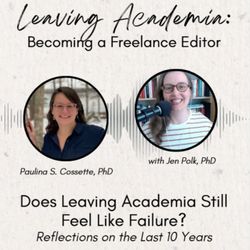
97. Does Leaving Academia Still Feel Like Failure? Reflections on the Last 10 Years
36:58||Season 2, Ep. 97Leaving academia can feel like admitting the whole thing was a mistake. It isn't—and the fear that says otherwise isn't an accident.In this episode, Paulina sits down with career coach Jen Polk (From PhD to Life) for an honest conversation about the stigma around leaving academia: where it comes from, whether it's actually loosening, and how to push through it if it's holding you back.You'll hear the "you can never come back" fear-mongering both of us heard firsthand, why the tenure-track benchmark is more arbitrary than it feels, and practical ways to rebuild your sense of identity and community outside a university.Watch the full conversation, subscribe for more real-talk about life after academia, and check out Jen and Paulina's Monday YouTube Live series for weekly conversations on leaving academia.Resources Mentioned:Jen Polk — From PhD to Life.comWant to end burnout and become an academic editor or coach? Go to AcadiaEditing.com/map1:21 – Today's question: does the stigma persist3:45 – Catching up before diving in6:43 – Paulina's story: fear-mongering to stay put9:10 – "You can never come back" myth11:33 – Stigma exists to keep academics trapped14:21 – The "such a shame" irony story17:37 – Coaching clients who wait for tenure18:51 – Ticking the box before feeling free22:38 – Hiding your job search from colleagues24:14 – Publishing outside academia gets you shunned31:38 – Nobody outside academia cares about tenure32:22 – Who are you without the title35:36 – Reframe: pick your top three hats
loading...