Share

Your Mind On Podcast
Therapy Speak vs Real Communication
Have you ever scrolled through social media and felt like everyone suddenly became a licensed therapist? From "setting boundaries" and "healing trauma" to calling an ex a "narcissist," clinical terms are everywhere. But is this surge in psychological jargon actually helping us connect, or is it making things "pretty messy"?
In this episode, host John Shaw takes a deep dive into the world of "therapy speak." We explore the fine line between using language for self-awareness and using it as a tool for power negotiation and psychological control. We’ll break down why misusing these terms doesn't just spread misinformation—it actually minimizes the lived experiences of those dealing with severe clinical conditions.
In this episode, we discuss:
- Boundaries vs. Ultimatums: Why a boundary is about protecting yourself, while an ultimatum is about controlling someone else (featuring the infamous Jonah Hill text controversy).
- The Myth of "Everyday OCD": Why liking a clean desk isn't a disorder, and how casual use of the term trivializes a debilitating condition.
- Gaslighting & Narcissism: How to tell the difference between a jerk who lies and a true clinical diagnosis.
- The "Triggered" Debate: A personal perspective from a combat veteran on why being "offended" isn't the same as being "triggered."
- Concept Creep: Understanding how the definitions of trauma and abuse have expanded and why that can sometimes rob us of our own personal agency.
Join us for a straight-talk session on how to move past the buzzwords and get back to real, authentic communication.
Connect with the Show:
- Website: www.yourmindonpodcast.com
- Instagram: @yourmindonpodcast
- Email: hello@yourmindonpodcast.com
Music Credit: Intro/Outro Music: More Now Than Ever by North Sphere.
If you found this episode helpful, please leave a rating in your preferred listening app to help us grow the community!
More episodes
View all episodes
19. Neuroplasticity
39:36||Ep. 19For a long time, we were told the brain was like a concrete sculpture—once it dried in your twenties, that was it. Any cracks or chips were permanent. But what if that “old dogma” was completely wrong?In this episode, we’re diving into the incredible world of Neuroplasticity. From the "Father of Neuroscience" to the singing brains of canaries, we explore how our minds are actually dynamic, living landscapes capable of growth at any age. We’ll break down the "Miracle-Gro" of the brain (BDNF), how stress acts as a molecular muzzle, and why learning a new skill is like installing high-speed fiber optics in your head.Whether you’re looking to heal, grow, or just stay sharp, remember: your past is not your sentence. Your brain is a masterpiece that’s never actually finished. In this episode, we discuss:The transition from "fixed" brain theory to a growth-based model. How cortisol and stress physically impact your neural connections. The "Miracle-Gro" protein (BDNF) and how to trigger it. The role of learning and exercise in building a resilient mind. 🎵 Music Credits:Song: More Now Than EverArtist: North Sphere📬 Connect with the Show:Email: hello@yourmindonpodcast.com Instagram: @yourmindonpodcast Website: yourmindonpodcast.com I’m always open to corrections if I get a detail wrong or miss a specific vibe you’re going for! The best way to do this is to just tell me what I got wrong, or what I need to know.
Mindfulness Monday 1
05:11|Welcome to the first mini-episode of Mindfulness Monday! I will be releasing these short 5-10 minute episodes each Monday to help power you through your week. Some weeks it will be a motivational story, some will be mindfulness and relaxation exercises.Please feel free to reach out with questions, comments, or episode suggestions!Website: www.yourmindonpodcast.comEmail: hello@yourmindonpodcast.comInstagram: @yourmindonpodcastMusic for this episode is Fields by Shuta YasukochiDon't for get to like, comment, download, and share with friends and family!
18. Modern Masculinity
52:23||Ep. 18What does it actually mean to "be a man" in today's world? In this episode, we step outside the traditional "Man Box" to explore how societal expectations impact men’s mental health, relationships, and self-worth.We dive deep into the history of hegemonic masculinity, the psychological "pillars" that often keep men isolated, and why the bravest thing a man can do is dismantle the idea that vulnerability is a weakness. Whether you are a man navigating these pressures or someone supporting a man in your life, this conversation offers a roadmap toward a more authentic, emotionally healthy way of living.In this episode, we discuss:The transition from the "Protector/Provider" role to the "Emotional Guardian."The origins and consequences of the "Man Box."Why the "Man Up" culture is failing our boys.Actionable steps for reclaiming emotional freedom.Connect With UsI’d love to hear your thoughts on this episode. Reach out and join the conversation!Website: www.yourmindonpodcast.comInstagram: @yourmindonpodcastEmail: hello@yourmindonpodcast.comMusic CreditsIntro and outro music graciously provided by North Sphere.Song: More Now Than EverArtist: North Sphere
17. The Bystander Effect
43:58||Ep. 17Episode Summary: Have you ever witnessed an emergency and wondered why nobody was moving to help? Or perhaps you've found yourself frozen in a crowd, waiting for someone else to take the lead? Today, we dive into the "Paradox of the Crowd." We explore the tragic history of the Kitty Genovese case, the psychological mechanics of "diffusion of responsibility," and why our brains are hardwired to look for an out when we are in a group. More importantly, we discuss the "Active Bystander" strategies you can use to break the silence and be the one who makes a difference.In this episode, we cover:The real story behind the Kitty Genovese murder and the "38 witnesses" myth.The 5-stage model of intervention: Why we fail to notice or act.Psychological barriers: Pluralistic ignorance and evaluation apprehension.Neurological triggers: Mirror neurons and the "freeze" response.Practical tools: The four intervention strategies from OHSU and the BIFF method of communication.Connect with the Show:Website: yourmindonpodcast.com Instagram: @yourmindonpodcast Email: hello@yourmindonpodcast.com Join our new "Collective Exhale" segment: Life is heavy, and we all need a place to set that weight down. If you need a safe, anonymous space to vent about life's stressors, record a voice memo or write an email and send it to hello@yourmindonpodcast.com.Note: This segment is for general venting and "life stuff." If you are experiencing a mental health crisis or considering self-harm, please reach out to a professional or a crisis hotline immediately.Music Credits:"More Now Than Ever" by North SphereSpecial Thanks:A huge thank you to Emma and the Real Life Ghost Stories podcast for their incredible support of this show.
15. Mindfulness
35:44||Ep. 15Do you ever feel like a can of soda that’s been shaken to its max, right on the verge of exploding? Or as Bilbo Baggins once famously said, "like butter scraped over too much bread"? In this week's episode, host John Shaw dives into the world of mindfulness—a topic that has become a major "buzzword" in the last decade but actually finds its roots in ancient practices. We’re moving past the "hippy-dippy" stereotypes of incense and kittens to explore mindfulness as a practical cognitive skill that can help you reclaim control from your "autopilot" brain.In this episode, we explore:The Science of Stress: How mindfulness impacts cortisol levels and why it is particularly vital for physical health.The 8 Core Attitudes: From "Beginner’s Mind" to "Self-Compassion," we break down the mental framework needed to start your practice.Mindfulness in the "Real World": Why activities like fishing, cooking, or even sitting in traffic can be powerful forms of mindfulness.Weekly Homework: A simple, 5-minute daily exercise to help you start strengthening your "mental muscles" right now.Whether you’re a skeptic or a seasoned practitioner, join us as we learn to let go of stress and embrace a calmer state. Remember: understanding your mind is the first step to changing your life.Connect with the Show:Website: www.yourmindonpodcast.com Instagram: @yourmindonpodcast Email: hello@yourmindonpodcast.com Music Credit: Intro/Outro Music: More Now Than Ever by North Sphere.If you enjoyed this episode, please leave a rating in your preferred listening app to help others find the show!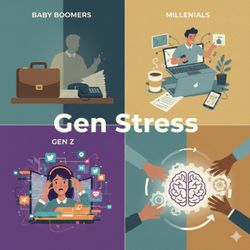
14. Gen Stress
37:55||Ep. 14Have you ever sat in a meeting and felt like you and your coworkers were speaking entirely different languages? Whether it’s the "no-nonsense" boss, the fiercely independent Gen Xer, the purpose-driven Millennial, or the boundary-pushing Gen Z intern, our generational backgrounds shape how we show up at work more than we realize.In this episode of Your Mind On, we’re diving deep into the "Great Generational Stress Gap." We explore how upbringing, global events, and technology have created distinct emotional frameworks for the four generations currently in the workforce.In this episode, we discuss:The "Why" Behind the Tropes: From "latchkey" Gen Xers to "digital native" Gen Z, we break down the history that shaped each generation's work ethic and emotional regulation.The Five Dimensions of Emotional Intelligence: How self-awareness, empathy, and motivation differ across age groups.The Stress Statistics: Why a staggering 91% of Gen Z employees report feeling stressed and what that means for the future of work. with the ShowWebsite: yourmindonpodcast.comInstagram: @yourmindonpodcastEmail: hello@yourmindonpodcast.comRemember, understanding your mind is the first step to changing your life. Be kind to yourself!
13. Codependency
29:35||Ep. 13Have you ever felt like you’re the only one in your life who knows how to get things done? Or maybe you’ve noticed that your mood is entirely dependent on how the people around you are feeling?In this episode, we’re peeling back the layers on codependency. It’s a word that gets thrown around a lot, but what does it actually look like in our daily lives—especially at work or in our closest relationships? We dive into the difference between healthy interdependency and the "helper" roles we often fall into, like the Caretaker, the Rescuer, and the Enabler.Whether you’re a self-proclaimed "fixer" or just someone who cares deeply, this episode offers a gentle look at how to start reclaimed your identity while still being a supportive friend, partner, and colleague.Connect With Us:Website: www.yourmindonpodcast.comInstagram: @yourmindonpodcastEmail: hello@yourmindonpodcast.comResources Mentioned:Codependents Anonymous (CoDA): Find meetings and resources at coda.orgThe CoDA Workbook: Available through the CoDA website or major book retailers.Music Credits:Band: North SphereSong: More Now Than EverMusic provided by Epidemic Sound
12. Narcissism
51:26||Ep. 12In this episode, we pull back the curtain on one of the most talked-about yet misunderstood topics in modern psychology: Narcissism. Moving beyond the cold, clinical definitions, we explore how narcissistic personality disorder actually shows up in our daily lives—from our kitchens and office cubicles to our closest relationships.We dive deep into the psychology and neuroscience behind the disorder, discussing:The Greek myth of Narcissus and its modern-day metaphors.The difference between "grandiose" and "vulnerable" narcissism.How narcissism impacts relationships through the phases of idealization, devaluation, and discard.The "perfect, psychologically unhealthy match" between narcissism and codependency.Practical coping strategies, including the "Gray Rock" method and "BIFF" communication.Why it is vital to distinguish true narcissism from neurodivergence, C-PTSD, or simple burnout before using the term as a weapon.Join us for a conversation that aims to turn down the "professor" and turn up the "friend" to help you better understand the human mind and navigate your Thursday morning.Music Credit:Band: North SphereSong: More Now Than EverConnect with the Show:Email: hello@yourmindonpodcast.com Instagram: @yourmindonpodcast Website: www.yourmindonpodcast.com Sources mentioned in this episode:Can neuroscience help to understand narcissism? A systematic review of an emerging field – Emanuel Jauk and Philipp Kanske: https://pubmed.ncbi.nlm.nih.gov/34124536/ Distinguishing Between Overt Vs Covert Narcissism – Bay Area CBT Center: https://bayareacbtcenter.com/overt-vs-covert-narcissism/ Narcissistic Abuse Cycle: Stages, Impact, and Coping – Sanjana Gupta: https://www.verywellmind.com/narcissistic-abuse-cycle-stages-impact-and-coping-6363187 Narcissistic Gaslighting: How to Identify and Cope – Dr. Raffaello Antonino: https://therapy-central.com/2025/03/27/surviving-narcissistic-gaslighting-signs-and-coping-strategies/ PSYCHOLOGY WORKS Fact Sheet: Narcissism – Canadian Psychological Association: cpa.ca/psychologyfactsheets Strategies for dealing with narcissistic behaviors in co-parenting: https://www.ourfamilywizard.com/blog/how-co-parent-narcissist-strategies-cheat-sheet The Damage Done: Dealing with Narcissists in the Workplace – Brian O'Connell: https://www.shrm.org/topics-tools/news/managing-smart/damage-done-dealing-narcissists-workplace The Grey Rock Method: Techniques & How to Use It – Kaytee Gillis, LCSW-BACS: Choosing Therapy