Latest episode

2. London vs New York, Dubai & Singapore: Who Wins the Future?
23:33||Season 2, Ep. 2London remains one of the world’s great centres of finance, technology and ideas. But how long can it afford to take that position for granted?Christian May, editor of City AM, joins Georgina Godwin on Visionary to examine the forces shaping the future of London and the British economy. After years of sluggish growth and stagnant living standards, May argues that the UK still possesses formidable advantages — from its universities and financial expertise to thriving clusters of technology and innovation — but faces increasingly fierce competition from cities around the world.So what would it take to make Britain dynamic again? The conversation ranges from tax, regulation and housing to AI, entrepreneurship and the future of the high street, while asking whether London can continue to attract the people, capital and companies that have made it a global powerhouse. May also considers what Britain’s next phase of economic growth might look like — and why complacency could be one of its greatest obstacles.
More episodes
View all episodes

1. Sir Alistair Spalding on the future of Sadler's Wells
20:56||Season 2, Ep. 1What happens when a cultural institution refuses to stand still? For more than two decades, Sir Alistair Spalding has made the case that the arts thrive on risk: new artists, new audiences and ideas that might not work until, suddenly, they do.The artistic director of Sadler’s Wells joins Georgina Godwin to discuss the creative gamble behind one of London’s great cultural institutions. Since taking the helm in 2005, Spalding has helped move contemporary dance from the margins towards the mainstream, more than doubling audiences while giving choreographers the freedom to experiment, surprise and occasionally confound.Now the story has a new stage. With Sadler’s Wells East open in Stratford, Spalding is turning his attention to the next generation: the dancers and choreographers who will shape the art form, and the audiences who might be encountering it for the first time. It is also an experiment in what culture can do for a place – not as decoration added after the buildings go up, but as part of what makes a city interesting, imaginative and alive.Spalding and Godwin discuss the pleasures of the unexpected, why artistic institutions must take risks and what live performance can offer in an age increasingly experienced through screens.Visionary returns with a new season of conversations, brought to you by Here East, London’s home of creativity and innovation.
Future Vision: Flow's vision of a world without people
06:07|What would the world look like without us?In the Oscar-winning animated film Flow, humanity has disappeared. Cities and homes remain, but nature has begun to reclaim them. A cat, a dog, a capybara and a handful of other animals navigate a flooded landscape in which survival has replaced civilisation — and the absence of human beings hangs over everything.Author and film writer Caspar Salmon examines the unsettling ideas beneath one of the most remarkable animated films of recent years. Is Flow simply a story about animals surviving a climate catastrophe, or a vision of a planet finally released from human control?What happens when humanity is no longer the centre of the story? And as the climate changes, should imagining our own absence force us to think differently about the world we leave behind?Future Vision tells the stories behind great leaps forward in creativity. Brought to you by the team behind Visionary and presented by Here East, London’s home of creativity and innovation.
Future Vision: Dolly Parton and the untold story of Steel Magnolias
09:36|In 1989, Dolly Parton joined Sally Field, Shirley MacLaine, Daryl Hannah, Olympia Dukakis and a young Julia Roberts in Steel Magnolias — a film about friendship, grief and the women who face life’s worst moments with a well-timed wisecrack.Nearly four decades later, it is a Hollywood classic. But when Steel Magnolias arrived in cinemas, plenty of critics were less impressed. Its overwhelmingly female world was dismissed as sentimental, frivolous and lacking a “strong male figure” — criticisms that now say almost as much about Hollywood as they do about the film.In this edition of Future Vision, we look at why Dolly Parton was perfectly cast as Truvy, how Steel Magnolias turned a deeply personal tragedy into one of the era’s most enduring films, and what happened to the Hollywood movies made unapologetically for grown women.Writer and critic Hadley Freeman, author of Life Moves Pretty Fast, explains how the economics of Hollywood changed — and why studios increasingly turned their attention towards the teenage boys they believed could deliver a blockbuster opening weekend.From Steel Magnolias and Terms of Endearment to Moonstruck and Baby Boom, this is the story of a kind of mainstream cinema that once flourished — and then almost disappeared.
Future Vision: Michael Caine's lost cult classic
10:17|There are cult films, and then there are films that seem almost to disappear. For this special edition of Visionary, part of our Future Vision summer series, we unearth a conversation with the late Mike Hodges, the director who gave British cinema Get Carter, to revisit its stranger, more playful follow-up: Pulp.Hodges tells Benjamin Wilson how the 1972 film grew out of his fascination with B-movies, postwar Italy, political extremism and the strange scandals of the paparazzi age, before taking shape with an extraordinary cast led by Michael Caine and Mickey Rooney.But at the heart of the conversation is Lizabeth Scott. One of film noir’s most distinctive stars, Scott had largely retreated from the screen when Hodges persuaded her to return for what would become her final film appearance. He recalls their delicate first meetings, her anxieties about returning to the camera and the moment she decided to take the role – before dismissing some of the rumours that have followed her performance ever since.A rare encounter with a great British filmmaker, looking back at a forgotten Hollywood star and one of the most curious films of his career.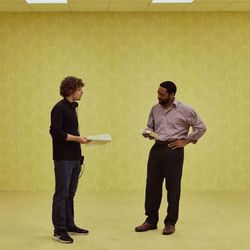
Future Vision: Backrooms proves anyone can make movies
03:38|Hollywood once had the studios, the money and the tools. Not anymore.AI is making visual effects cheaper, professional kit is increasingly accessible and filmmaking is spreading far beyond Los Angeles. Meanwhile, a new generation of directors is honing its craft on YouTube and Instagram rather than working its way through the studio system.So who gets to make a movie now? Does Hollywood still matter? And could the next great director already be building an audience online?From Backrooms to blockbusters made across London, Glasgow and Sydney, Benjamin Wilson reports on the technology, talent and new production hubs reshaping how films are made — and who gets to make them.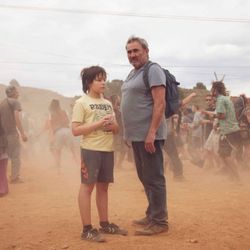
Future Vision: Sirāt and the art of the apocalypse
07:20|What does the end of civilisation look like when you strip away the Hollywood spectacle?In this episode of Future Vision, our special series exploring the future of creativity and filmmaking, film journalist Caspar Salmon examines Sirāt — Oliver Laxe’s haunting vision of a world coming apart at the seams, which won the Jury Prize at Cannes in 2025.Set among ravers travelling through the deserts of North Africa as war unfolds somewhere beyond the horizon, Sirāt approaches the apocalypse at an unusually human scale. There are no collapsing skyscrapers or armies of extras. Instead, Laxe draws on non-professional actors, documentary-style filmmaking, an unforgiving landscape and a story deliberately untethered from conventional geopolitics.From its echoes of Mad Max: Fury Road to the remarkable performance of Sergi López, Caspar explores how Sirāt blurs the boundaries between fiction and reality — and how its small-scale, independent approach creates a depiction of societal collapse that feels all the more immediate, elemental and unsettling.