Share
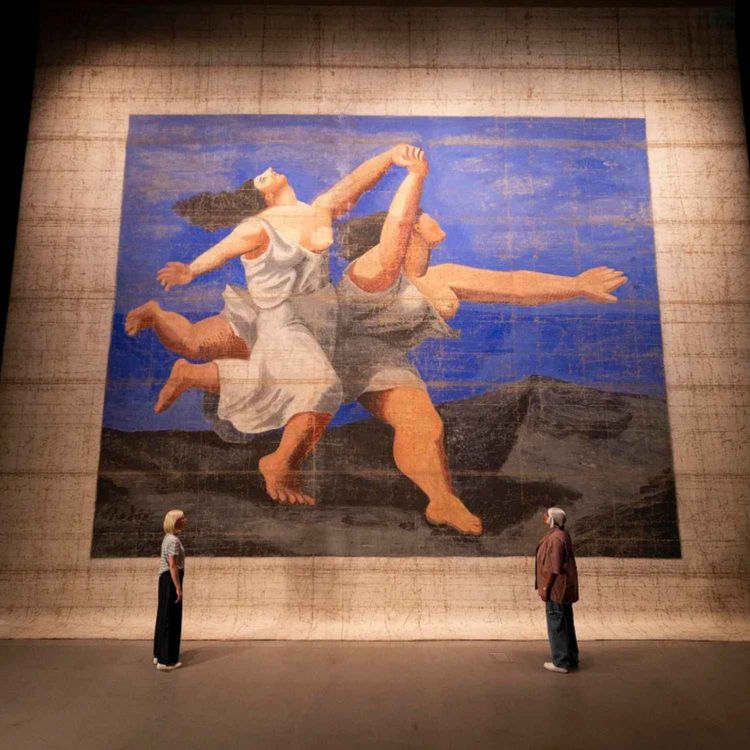
Visionary
Should doctors prescribe arts?
We like to think of the arts as enrichment – something we turn to when there’s spare time. But according to Professor Daisy Fancourt, that framing is historically recent — and biologically wrong.
Speaking with Georgina Godwin at Here East, Daisy explains how the idea of art as leisure emerged in the 19th century alongside the professionalisation of culture and the rise of “art for art’s sake”. Before that, music, storytelling and communal creativity were woven into daily life. Today, we’ve relegated them to the margins — even as the science shows they may be as fundamental to health as diet or exercise.
The evidence was startling enough to inspire Daisy's new book, 'Art Cure: The Science of How the Arts Transform our Health'. Engaging in music activates the same dopaminergic reward pathways as food or sex. Listening to art can lower stress hormones in ways comparable to anti-anxiety medication. Singing can stimulate endogenous opioids that reduce pain. Long-term engagement correlates with slower biological ageing and even longer life. The question, then, is whether we continue to treat creativity as optional — or finally recognise it as essential.
More episodes
View all episodes
45. Beauty is serious business
25:02||Season 1, Ep. 45Britain's beauty industry is worth more than £30 billion, growing at four times the rate of the national economy – and until recently, the government was still classifying it alongside dry cleaners and funeral parlours.That gap between perception and reality is precisely what Millie Kendall has spent her career trying to close. The entrepreneur and co-founder of the British Beauty Council has worked in almost every corner of the industry – from shampoo girl at thirteen to brand founder to policy advocate – and few people understand its contradictions better. An industry where 86% of businesses are owned by women, and yet the top jobs still tend to go to men. An industry that outsizes automobile manufacturing but receives none of the same political attention. An industry that has thrived through financial crisis, pandemic and the cost of living squeeze, but still can't quite shake the charge of being frivolous.In this episode, Georgina Godwin speaks with Kendall about the forces reshaping beauty right now: the rise of aesthetics and what it means for the future of makeup; why fragrance is quietly becoming the category to watch; what heritage brands get wrong in their panic to compete with challengers; and why biotechnology – creating ingredients in labs rather than sourcing them globally – may be the industry's shrewdest hedge against geopolitical instability. Kendall is also blunt about the fight to regulate the aesthetics industry, the limits of social media, and why the lipstick effect, far from being a marketing myth, tells us something true about how people cope.Sharp, funny and unexpectedly political – this is the business of beauty, taken seriously at last.Visionary is brought to you by Here East, London's home of innovation and creativity.
44. Easter Special: Forces Shaping the Global Economy
28:03||Season 1, Ep. 44In a world of economic uncertainty, stagnant growth, and existential risk, what does it take to build something that lasts? This Easter special brings together four sharp thinkers to examine the forces reshaping how we create value, spend it, protect it — and whether any of it will matter in the long run.Paul Krutko makes the case that economic turbulence is often the best time to start something new, explaining why the most resilient regional economies are built through patient "gardening" of local talent rather than chasing headline investments. Dana Thomas revisits her landmark argument that luxury lost its soul the moment it started answering to shareholders instead of customers — and finds the industry has only doubled down since. Tom Ough surveys the researchers and scientists working to prevent civilisation-ending catastrophes, from supervolcanoes to engineered pandemics to runaway AI. And Jeremy Hunt reflects on why the tax and welfare reforms that could genuinely unlock growth are precisely the ones that take the longest to show up in the numbers.Guests:Paul Krutko — President & CEO, Ann Arbor SPARKDana Thomas — Author, Deluxe: How Luxury Lost Its LusterTom Ough — Author and journalistJeremy Hunt — Former UK Chancellor of the ExchequerPresented by Georgina Godwin and Marc Sidwell.
43. What comes after the Olympics?
27:12||Season 1, Ep. 43Where do you put a stadium when the flame goes out? In East London, the answer has been years in the making — and it's still being written.When London won the Olympic bid in 2005, the real prize wasn't the Games themselves. It was the question that followed: what happens next to 560 acres of contaminated, neglected land in one of the most underserved corners of the capital? The answer, slowly and then all at once, has become one of the most ambitious urban transformations in modern British history.In this episode, Georgina Godwin speaks with Shazia Hussain, CEO of the London Legacy Development Corporation, about what it truly means to build an inclusive innovation district from scratch – and why the hardest part isn't the architecture. From the days when the East Bank waterfront was stacked high with dumped fridges to its current incarnation as the home of the V&A, Sadler's Wells, the BBC, UCL and University of the Arts London, Hussain traces the full arc of a project that has survived three mayors, countless competing interests, and the perpetual tension between world-class ambition and community need.She talks candidly about the living wage zone, the health innovation agenda, the drive to make these grand institutions genuinely porous to local people — and why the ten-year-olds of today are the real measure of whether any of it has worked. This is a conversation about growth done differently: not extracted from a community, but built with it.Visionary is brought to you by Here East, London's home of innovation and creativity.
42. From video games to real-world defence tech
21:40||Season 1, Ep. 42The people redesigning European defence aren't coming from the military. They're coming from the gaming world — and they're building it over weekends.Georgina Godwin speaks with Benjamin Wolba, co-founder of the European Defense Tech Hub, about how the age of the drone has fundamentally rewritten the rules of who gets to participate in defence. A cheap quadcopter can now neutralise a million-dollar tank. A weekend hackathon can produce a working interceptor prototype. And the skills that once seemed frivolous — flying drones for sport, writing game code, optimising flight algorithms — are suddenly among the most strategically valuable on the continent.Benjamin charts the journey from Ukraine's improvised drone kitchens to the defence hackathons now running across Europe, from London to Lviv, pulling hundreds of young engineers, physicists and coders into a field they once considered off-limits. So where's Europe's real defence gap? Not hardware, Benjamin says, but mindset. In the future, the most innovative thinking will be the key to keeping us all safe.Visionary is brought to you by Here East, London's home of innovation and creativity.
41. Live at SXSW in Austin, Texas
24:03||Season 1, Ep. 41What comes after ABBA Voyage? The people building the future of creative experience are already at work — in East London.Recorded live at South by Southwest in Austin, Texas, this episode of Visionary ventures to one of the world's great gatherings of technology and culture. Here East CEO Gavin Poole sits down with Graham Hitchen, Director of the Policy Unit at Loughborough University London, to introduce the Creative Experience Lab London (CELL) — a new physical research and innovation space at Here East, born from a partnership between Loughborough University London and University College London.CELL isn't a concept lab or a glossy think tank. It's a working prototyping space — equipped with motion capture, LED screens and high-performance computing — designed to bring together the artists, technologists, academics and investors who will shape how we experience culture over the next decade. With Studio Wayne McGregor, the V&A, Sadler's Wells and Sports Interactive already in the orbit, the ambition is clear: to make Queen Elizabeth Olympic Park the place where the world's next landmark creative experience is conceived.Discover the transatlantic connections being forged at South by Southwest, the role of storytelling in an age of AI, and the enduring promise of the Olympic legacy — asking not just what East London has already become, but what it might yet produce.Visionary is brought to you by Here East, London's home of innovation and creativity.
40. The next big transit hubs
22:10||Season 1, Ep. 40For decades, three gleaming Gulf hubs have quietly governed how the world moves. Dubai, Abu Dhabi and Doha became the great connectors of global travel — efficient, affordable, indispensable. But with Russian airspace already closed to Western carriers and fresh uncertainty rippling out from US strikes on Iran, that narrow corridor linking Europe and Asia is looking suddenly, disconcertingly fragile.Georgina Godwin speaks with travel writer and author Ash Bhardwaj — whose book 'Why We Travel' won Travel Book of the Year in 2024 — about what happens when the geography of flight is redrawn overnight. From the knock-on chaos affecting airline scheduling and aircrew logistics, to the quieter shift in traveller sentiment that may prove just as consequential, Bhardwaj maps out a world in flux. Could Istanbul emerge as the new pivot point? Will Changi step up? And as long-haul routes grow riskier and more complicated, might Europe and North Africa become the new horizon for global travellers?The conversation ranges from the mechanics of airspace closures to the reputational stakes for Dubai — a city that sold itself, above all else, on safety — and what it means for a globally connected world when the systems we took for granted prove far more delicate than we imagined.Visionary is brought to you by Here East, London's home of innovation and creativity.
38. Why is climate science so divisive?
23:21||Season 1, Ep. 38Australia is uniquely exposed to the realities of climate change. This vast continent is already hot and dry, and increasingly vulnerable to extreme weather. And yet, despite the scale of several deadly weather events, climate policy remains one of the most divisive issues in Australian politics. In recent years, the country’s main conservative coalition has been largely forced out of the major cities by a new group of independent MPs — the so-called Teals — all women, all advocating stronger climate action.Political journalist Karen Middleton joins Georgina Godwin to explore how climate change became such a fault line in Australian public life — and whether this hot, dry nation can forge a more unified path forward before the next crisis arrives.
37. How the modern office is changing
22:39||Season 1, Ep. 37It was only a few years ago that the pandemic swept across the world, sending many of us home to work for what felt like an indefinite stretch. For a time, it seemed entirely plausible that the office might fade into irrelevance. But something more nuanced emerged. When people are suddenly told to stay at home, going out and being around others quickly becomes something to value.The same dynamic has shaped the way we work. Flexibility clearly matters, but the evidence increasingly suggests that working alongside others is often better for both productivity and wellbeing.Offices, then, are not disappearing, but they are evolving. Abby Brown, a partner at Knight Frank, joins Georgina Godwin to discuss how the property market is changing — and what it reveals about the workplace of the future.