Latest episode
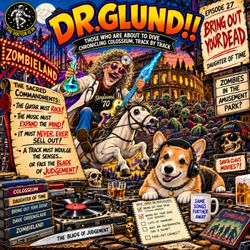
27. Album 4. Track 6. Bring Out Your Dead
39:46||Season 1, Ep. 27THIS WEEK ON THE PROGRAM…Bring out your dead!The feel-good hit of the summer has finally arrived.Chaz Charles and the Voluptuary of Sonic Discernment, Dr. Glund, return to Colosseum's Daughter of Time for a spirited little instrumental that apparently doubles as a soundtrack for unusually athletic zombies.Dave Greenslade brings the Hammond. Clem Clempson brings the guitar. Jon Hiseman brings approximately eight limbs.And the Doctor brings his usual complete disregard for staying on topic.TRACK UNDER THE MICROSCOPE“Bring Out Your Dead” — ColosseumFour minutes and twenty seconds (4:20? Coincidence? We think not. Puff, puff, pass.) of glorious British jazz-rock mischief.The Doctor and Chaz examine the original studio recording before digging up a 1970 live performance, discovering a slightly slower, more aggressive beast with magnificent drumming, shifting rhythms, and some decidedly suspicious studio effects.The verdict?The dead have never sounded so lively.The Blade of Judgment remains sheathed.TRACKS LISTENED TO / DIGRESSION ZONEBecause apparently the dead aren't the only things worth resurrecting…Colosseum — “Bring Out Your Dead”→ Studio and live versions.→ Dave Greenslade's keyboard wizardry.→ Jon Hiseman's extraordinary drumming.→ A fade-out that should probably be prosecuted.Chicago — “25 or 6 to 4” (Live at Tanglewood)→ Terry Kath receives some well-deserved reverence.Gary Moore — “Story of the Blues”→ Blistering guitar, enormous tone, and a heartfelt appreciation of a truly remarkable musician.DBK — “Liberated Blues”→ Our friend Jimmy Kunes and company celebrate a television placement in Gravesend.HIGHLIGHTS YOU DID NOT ASK FOR BUT ARE GETTING ANYWAYZombies dancing like Schroeder from Peanuts.An investigation into the finer points of cranial flatulence.The Doctor's ongoing war against fade-outs.A detour through Zombieland and Woody Harrelson.Gary Moore's guitar tone temporarily rendering both hosts speechless.And Mr. Smith making his presence known.YOUR PRESCRIPTIONAdminister one dose of “Bring Out Your Dead.”Follow with the live version.Recommended accompaniment:A proper stereo.A healthy appreciation for Hammond organ.A complete disregard for conventional time signatures.Possible side effects include:Uncontrollable head-bobbing.An unexpected Gary Moore listening marathon.Arguing with recording engineers who faded out perfectly good jams.And seeing groovy zombies where none previously existed.The Doctor approves.The dead may rest. R.I.P. Mr. Smith 2019 - 2026.Let's go for a walk buddy...
More episodes
View all episodes
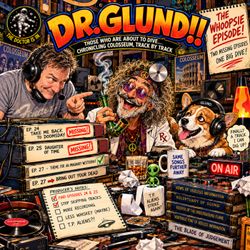
2425. Album 4. Tracks 3 & 4: Take Me Back to Doomsday and Daughter of Time 2-Fer
44:49||Season 1, Ep. 2425THIS WEEK ON THE PROGRAM…We screwed up.While chronicling Colosseum track by bloody track, Chaz and Dr. Glund somehow went from Track 2 to Track 5 on Daughter of Time.Thankfully, Achim Schulz noticed.So this week: The Whoopsie Two-Fer — recovering the missing “Take Me Back to Doomsday” and “Daughter of Time.”TRACKS UNDER THE MICROSCOPE“Take Me Back to Doomsday” is driving, theatrical Colosseum: Clem Clempson on vocals, Jon Hiseman pounding away, Dick Heckstall-Smith doing his thing, and a 1970 Beat Club performance that reminds us just how formidable this band was live.Then “Daughter of Time” — dark, grandiose and surprisingly epic for a song built around essentially one verse. The album version leads us to an April 1970 BBC performance that is radically different, longer and absolutely ferocious.DIGRESSION ZONEDuring that BBC performance, Chaz catches Dave Greenslade playing a keyboard idea that would later surface in “Those About to Die.”So naturally we jump ahead 24 years to the 1994 reunion performance of “Those About to Die” at Zelt-Musik-Festival to hear it again — and end up marveling at a band still playing like their lives depended on it.There’s also the small matter of Chaz once hijacking a wedding with this very recording.YOUR PRESCRIPTIONTwo accidentally skipped tracks. Two killer live performances. One musical idea traveling through Colosseum history.Blame the brain fart.Or the T.P. Aliens.The Blade of Judgment remains sheathed.The Doctor is in.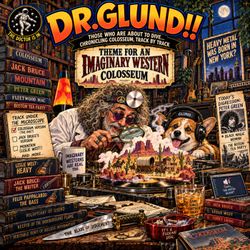
26. Album 4. Track 5. Theme For An Imaginary Western
56:47||Season 1, Ep. 26THIS WEEK ON THE PROGRAM…Some songs are tracks. Some songs become standards. And some songs apparently require Dr. Glund to empty the entire medicine cabinet onto the examining table.This week, Chaz and the Doctor tackle “Theme for an Imaginary Western” — one of the BIG ones. Jack Bruce and Pete Brown’s magnificent song gets the full Colosseum treatment, and naturally that means simply discussing the version on Daughter of Time is nowhere near sufficient. The Doctor has brought evidence. Lots of evidence. TRACK UNDER THE MICROSCOPECOLOSSEUM — “THEME FOR AN IMAGINARY WESTERN”The original assignment is simple: determine what Colosseum does with a song that already seems carved into the side of a mountain.Then Jack Bruce enters the examination room.Then Mountain enters.Then Leslie West turns the amplifiers up until an entirely different investigation breaks out: was heavy metal actually born in New York? Mountain, Cactus and Sir Lord Baltimore are entered into evidence while Leslie’s monstrous guitar tone makes a fairly compelling case for the prosecution.Naturally, we keep going.Jack Bruce. Leslie West. Corky Laing. Felix Pappalardi. Growling bass. Enormous guitars. Live recordings. And the growing realization that “Theme for an Imaginary Western” isn't merely a song being covered — it’s a piece of musical territory every great band seems determined to claim for itself.THE DIGRESSION ZONEEventually somebody mentions Peter Green, which is exactly the sort of thing that causes this program to abandon whatever road it was supposedly traveling.Suddenly we’re at the Boston Tea Party with early Fleetwood Mac, marveling at Green’s guitar tone and discovering all over again that “Black Magic Woman” was Peter Green’s song before most of the planet associated it with Santana.There are questions.There are diversions.There is whiskey.At one point the technology itself apparently decides the show has gone far enough.THE DOCTOR’S PRESCRIPTIONTake one monumental Jack Bruce/Pete Brown composition.Administer Colosseum liberally.Follow with Mountain at considerable volume.Add Peter Green as required.Do not operate heavy machinery while debating the geographical birthplace of heavy metal.And remember:The guitar must rock.The music must expand the mind.It must never, ever sell out.The Doctor is in.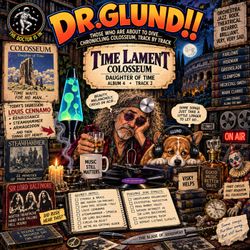
23. Album 4. Track 2. Time Lament
55:52||Season 1, Ep. 23THIS WEEK ON THE PROGRAM…Chaz Charles and the Voluptuary of Sound, Dr. Glund, continue their descent into Colosseum’s Daughter of Time.And apparently nobody told Colosseum that albums are occasionally supposed to cheer you up.This week:“TIME LAMENT”Six minutes and thirteen seconds of strings, brass, jazz, rock, theatrical weirdness and Chris Farlowe singing like the sands of time have personally wronged him.It is ambitious.It is bizarre.It may also require antidepressants.The studio recording piles on the layers: shifting rhythms, pastoral passages, strings, brass and a section Chaz and the Doctor decide sounds suspiciously like a circus on acid. Meanwhile, Chris Farlowe delivers two brief verses about ghosts, bitter memories and the relentless passage of time.You know…Party music.The guys dig into the track’s unusual construction and the increasingly obvious realization that Daughter of Time has a mood—and that mood is roughly:We’re all getting older and everything is terrible.Then come the live versions.An April 1970 BBC performance captures Colosseum during a fascinating personnel transition: no Farlowe, no Mark Clarke, Clem Clempson in place and Barbara Thompson contributing to the proceedings.Then they reach the later John Peel session.Now it’s Hiseman. Greenslade. Clempson. Heckstall-Smith. Clarke. Farlowe.And Chris Farlowe changes everything.The song gets heavier, bigger and considerably more intense. Without the studio strings and brass, Colosseum has to create all that drama themselves—and Farlowe responds by delivering approximately seventeen tons of emotional force.Which leads to another uncomfortable modern observation:AI might imitate the instruments.But good luck manufacturing another Chris Farlowe.And then…THE DIGRESSION.Someone notices that the bass player on the studio recording isn’t Mark Clarke.It’s Louis Cennamo.That sends Chaz and the Doctor wandering through Cennamo’s résumé—Renaissance, Steamhammer and Armageddon—before sampling Steamhammer’s sprawling Speech album.And somehow that leads to…SIR LORD BALTIMORE.A Brooklyn power trio making astonishingly heavy music in 1970.“Master Heartache.”“Hard Rain Falling.”“Hell Hound.”Chaz’s metalhead brain promptly explodes.Suddenly the Colosseum podcast has become an investigation into the origins of American heavy metal, why nobody talks about Sir Lord Baltimore—and whether a certain Canadian power trio might have been paying attention.Uh-oh, Alex.The Doctor has opened a door that probably should have remained closed.Eventually somebody remembers they were discussing “Time Lament.”Along the way: Lawrence Welk in a Dodge, psycho clowns, a circus on acid, 22-minute Steamhammer excursions, Cactus, Dr. Glund remembering the Fillmore, and two old dogs discovering that considerably older dogs can still teach them new tricks.And underneath all the chaos remains one strange, ambitious, melancholy piece of music.“Time Lament” is weird.It’s theatrical.It’s progressive.It’s moody as hell.It’s absolutely Colosseum.The guitar rocks.The mind expands.Nobody sells out.The Blade of Judgment remains sheathed.Now somebody cheer up the Doctor.Let’s go grab a visky.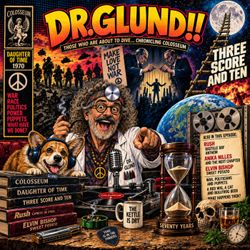
22. Album 4. Track 1. Three Score And Ten
39:03||Season 1, Ep. 22THIS WEEK ON THE PROGRAM…Chaz Charles and the Voluptuary of Sound, Dr. Glund, arrive properly at Daughter of Time.And Colosseum apparently have something to say.Quite a lot, actually.This week’s descent begins with one of the most direct and politically charged tracks the band had recorded to this point…THREE SCORE AND TENWar.Race.East versus West.Politicians dancing while gold pulls the strings.Environmental ruin.Humanity collectively sticking its head in the sand.You know…Light entertainment.TRACK UNDER THE MICROSCOPE“Three Score and Ten” — ColosseumThis is the sound of the next great Colosseum lineup arriving fully armed:Chris Farlowe. Clem Clempson. Mark Clarke. Dave Greenslade. Dick Heckstall-Smith. Jon Hiseman.The production feels bigger. The instruments have room to breathe. Hiseman’s drums absolutely slam, and Farlowe attacks the lyric like someone has personally offended him.But underneath all that power is a surprisingly grim message.“Three score and ten” gives humanity its biblical seventy years, and Colosseum spend the song asking a fairly uncomfortable question:What the hell are we doing with them?Vietnam. The Cold War. Black and white waiting to fight. Medals gleaming in the sunlight. A world choking on the mess it created while the puppets keep dancing.This may be the most overt political statement Colosseum have made yet.And musically?Fucking powerful.DIGRESSION ZONEALL ROADS APPARENTLY LEAD TO RUSHBecause contemplating mankind’s inevitable destruction naturally makes Chaz think of…Rush.First up: “Bastille Day.”Caress of Steel enters the operating theater, Geddy Lee reaches dangerous vocal altitudes, and Alex Lifeson once again demonstrates that tone is in the fingers.Then comes “Anthem,” Neil Peart’s arrival, his enormous legacy, and the impossible question of replacing the irreplaceable.That leads into Rush’s return to the stage and Anika Nilles taking on one of the most scrutinized drum chairs in rock history.Different drummer.Different approach.Same living music.And then Dr. Glund changes direction completely.THE ELVIN BISHOP INCIDENTElvin Bishop Group — “Sweet Potato”Blues. Groove. Gibson guitar tone.And before anyone can regain control, the Doctor has wandered into a story involving gin, bullfrog beer, a red wig, a cat and some deeply questionable decision-making.At which point Chaz finally remembers:“This is a Colosseum show.”Too late.The damage has been done.HIGHLIGHTSJon Hiseman proving that “busy” and “musical” are not remotely the same thing.Chris Farlowe apparently attempting to sing through concrete.The realization that Daughter of Time represents a genuine leap forward in Colosseum’s sound.Chaz attempting to convert Dr. Glund to Caress of Steel.Dr. Glund resisting.Neil Peart receiving the respect he deserves without turning his legacy into a museum exhibit.And an episode that somehow travels from mankind’s impending destruction to Elvin Bishop and bullfrog beer.YOUR PRESCRIPTIONAdminister one full dose of:“Three Score and Ten.”Volume should be sufficient for Jon Hiseman’s drums to rearrange nearby furniture.Listen for Farlowe’s vocal force, Clempson finding his place inside the machine, Mark Clarke reshaping the bottom end, Heckstall-Smith bringing the brass artillery and Greenslade quietly holding the whole thing together.Possible side effects include:Reconsidering Caress of Steel.Defending Neil Peart to strangers.Searching for old Elvin Bishop records.And suddenly asking yourself…What happens then?The guitar rocks.The mind expands.Nobody sells out.The Blade of Judgment remains sheathed.Let’s go grab a visky.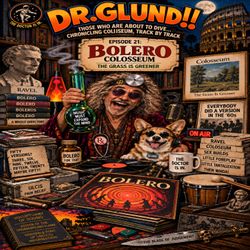
21. Album 3. Track 6. Bolero
37:35||Season 1, Ep. 21THIS WEEK ON THE PROGRAM…Having successfully climbed the Rope Ladder to the Moon, Chaz Charles and the Voluptuary of Sonic Discernment, Dr. Glund, return to The Grass Is Greener for something that sounds suspiciously respectable…“Bolero.”Maurice Ravel had an idea.Start quietly.Repeat the theme.Keep building.Keep building.Keep building.Then Colosseum got hold of it.TRACK UNDER THE MICROSCOPEBolero — ColosseumThe familiar Bolero framework is there—but in the hands of Colosseum it swings, growls, expands and eventually becomes something considerably less polite.The Doctor and Chaz dig into the band's treatment and discover exactly why this seemingly unlikely piece belongs in the Colosseum universe.The rhythm keeps pushing forward.The dynamics keep building.The band keeps adding muscle.And Clem Clempson apparently hears Ravel and thinks:Needs more guitar.But then comes the larger question…What happens when everybody else gets hold of Bolero?TRACKS LISTENED TO / DIGRESSION ZONE(BOLERO APPARENTLY BELONGS TO EVERYBODY)Jeff Beck — “Beck’s Bolero”→ One of the great early monuments to psychedelic electric guitar.→ Huge tone. Huge space.→ Backwards sounds hiding in the mono mix.→ And further evidence that Jeff Beck was already communicating with another planet.SRC→ Detroit psychedelia enters the examination room.→ “In the Hall of the Mountain King” gives way to Bolero.→ MC5 and Stooges territory lurks nearby.→ And the influence of Beck becomes difficult to ignore.The Move→ The future ELO family tree makes an appearance.→ Their Bolero contribution lasts approximately long enough to confirm that it exists.→ Possibly the shortest musical selection ever played on the program.Jimi Hendrix / Buddy Miles→ A mysterious recording supposedly connected to Bolero.→ Jimi noodles.→ Jimi explores.→ Jimi wanders off toward the horizon.→ Nobody particularly wants to stop him.Because even Hendrix noodling is still Hendrix.Benny Goodman→ Bolero goes big band.→ Proof that rock musicians were hardly the first people to look at Ravel’s repeating rhythmic machine and think:We could do something with that.And suddenly the episode becomes less about one Colosseum track and more about the strange gravitational pull of a composition musicians have been bending, stretching and rebuilding for generations.HIGHLIGHTS YOU DID NOT ASK FOR BUT ARE GETTING ANYWAYMaurice Ravel imagined sitting in the audience wondering what the hell Colosseum has done to his composition.Jeff Beck’s guitar tone receives the expected level of worship.The Doctor produces SRC from the Detroit psychedelic archives.Edvard Grieg briefly enters the proceedings through “In the Hall of the Mountain King.”Jimi Hendrix takes an extended scenic route through the fretboard.The practical difficulties of keeping eight, nine or twelve musicians together on a tour bus without a toilet are considered.And the central musicological question of the episode is finally resolved:It’s all about the booty, baby.YOUR PRESCRIPTIONAdminister one dose of Colosseum — “Bolero.”Then compare liberally with:Jeff Beck.SRC.The Move.Jimi Hendrix.Benny Goodman.Recommended conditions:A proper stereo.Enough volume to appreciate the crescendo.A willingness to hear the same basic musical idea mutate repeatedly.And absolutely no expectation that anyone involved will play it the way Maurice Ravel intended.Possible side effects include:Searching for increasingly obscure versions of Bolero.Unexpected appreciation for Detroit psychedelia.Digging through Hendrix bootlegs.Attempting to determine exactly how many musicians can fit aboard a bus before civilization collapses.And discovering that a piece written by a French composer in the 1920s can somehow lead directly to Jeff Beck, Colosseum, Jimi Hendrix and Benny Goodman.The Doctor’s verdict?Every version examined somehow manages to pass the Glundian tests.The Blade of Judgment remains sheathed.Ravel survives.Barely.Here’s to ya, Clay Cole.Let’s go grab a visky...or not??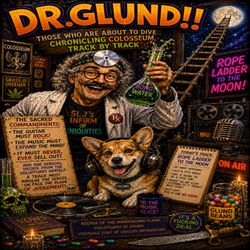
20. Album 3. Track 5. Rope Ladder To The Moon
54:55||Season 1, Ep. 20THIS WEEK ON THE PROGRAM…This week, Chaz Charles and Doctor Glund grab hold of one of Colosseum’s strangest musical excursions…Rope Ladder to the Moon.Written by Jack Bruce and Pete Brown, the song begins as something almost folk-like and becomes, in Colosseum’s hands, a sprawling psychedelic jazz-rock playground of vibraphone, Hammond, saxophones, guitar, bass and Jon Hiseman apparently deciding that conventional song structure is merely a suggestion.And then they hear it live.TRACK UNDER THE MICROSCOPERope Ladder to the Moon — ColosseumOne song.Several decades.Almost no rules.Chaz and the Doctor trace the song from Jack Bruce’s restrained original through Colosseum’s studio treatment, the magnificent 1971 Colosseum Live performance, and the reunited band’s radically different 1994 version.Along the way:Clem Clempson proves he can sound remarkably Farlowe-ish when required.Dick Heckstall-Smith plays two saxophones because apparently one is for amateurs.Dave Greenslade moves effortlessly between piano, Hammond and vibes.Mark Clarke reminds everyone that bass can be a lead instrument.Chris Farlowe attacks the live version with absolutely no regard for human safety.Jon Hiseman repeatedly makes you think the song is ending before starting the whole damned machine again.The Doctor’s diagnosis?“Well-constructed self-indulgence.”The highest possible compliment.TRACKS LISTENED TO / DIGRESSION ZONEJack Bruce – “Rope Ladder to the Moon”→ The original blueprint.→ Shorter, quieter and almost coffeehouse folk.→ Colosseum apparently heard it and thought: Needs another six minutes.Colosseum – “Rope Ladder to the Moon”→ The Grass Is Greener.→ Colosseum Live.→ The 1994 reunion.→ Same song. Completely different animals.Then somebody discovers another rope.Brian Auger & Julie Driscoll→ “Rope Ladder to the Moon.”→ “Indian Rope Man.”→ “The Flesh Failures (Let the Sunshine In).”→ “Season of the Witch.”→ Hammond-heavy British jazz-rock opens another enormous rabbit hole.And suddenly Chaz discovers Julie Driscoll—her unusual phrasing, precise enunciation, soulful delivery and what the Doctor can only describe as her “science-fiction voice.”Naturally, this eventually leads to Driscoll sharing a stage with Chris Farlowe.The predicted mushroom cloud follows.HIGHLIGHTS YOU DID NOT ASK FOR BUT ARE GETTING ANYWAYDick Heckstall-Smith demonstrating that two saxophones are better than one.The possible bondage implications of “Indian Rope Man.”Chaz discovering an entirely new Julie Driscoll rabbit hole.The realization that these shows really do make themselves.YOUR PRESCRIPTIONAdminister one “Rope Ladder to the Moon.”For maximum effectiveness, compare:Jack Bruce’s original.Colosseum’s studio version.The 1971 live monster.The 1994 reunion version.Recommended accompaniment:A proper hi-fi.A questionable beverage.Enough uninterrupted time for Jon Hiseman to finish whatever the hell he’s doing.Possible side effects include:Buying a vibraphone.Developing an unhealthy interest in Brian Auger.Hearing Julie Driscoll’s voice in science-fiction movies that do not actually contain Julie Driscoll.And discovering that nine-and-a-half minutes of well-constructed self-indulgence may not be nearly enough.The Glundian tests are passed on all counts.The Blade of Judgment remains sheathed.Let’s go grab a visky.