Share
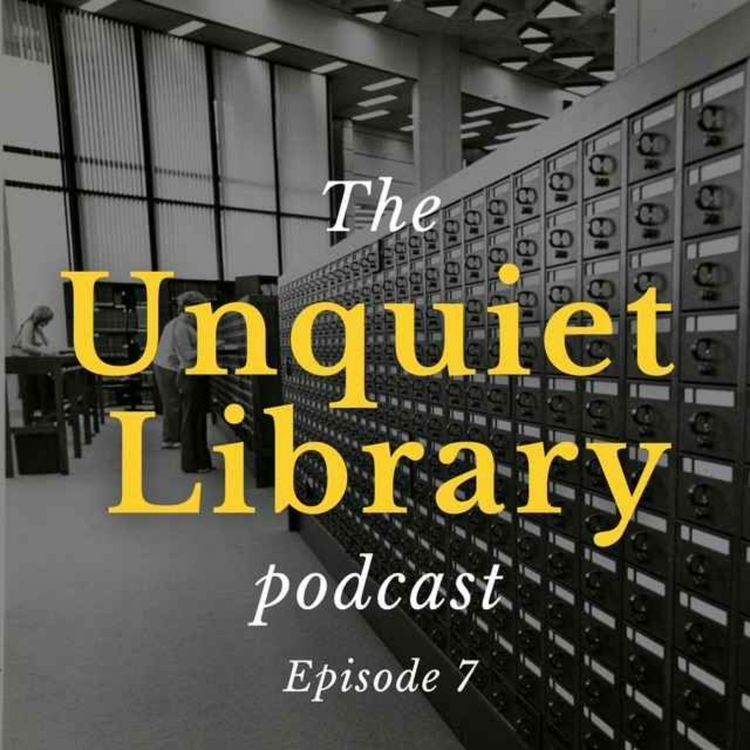
The Unquiet Library: Fifty years of Robarts Library
Ep. 7 The Analogue Era
In this episode of The Unquiet Library: 50 Years of Robarts Library, host Jesse Carliner explores Robarts’ pre-digital era through oral history interviews with current and former librarians. Margaret Wall describes processing 340 legacy CD-ROMs (plus cassettes and floppy disks) and determining whether their contents evolved into print or online databases, noting the convenience of today’s searchable platforms compared with swapping annual discs. Former chief librarian Carole Moore recalls card catalogues wired for phone reference, heavy photocopy demand, and the chaos of shared print journals and interlibrary delivery. Sian Meikle details intensely manual circulation work with charge files, typed loan cards, pneumatic tubes, book elevators, and noisy conveyor belts. Susanne Tabur explains serials “Kardex” tracking of roughly 30,000 journal titles and daily mail processing, while Debbie Green recounts research via print indexes, microfilm/microfiche catalogs, and early staff-mediated online, CD-ROM, and DIALOG searches.
00:00 Opener with Margaret Wall
02:07 Episode Introduction
03:14 Carole Moore- Phone reference and the card catalogue; sharing print journals
07:55 Sian Meikle—Library circulation during the analogue era
14:12 Susanne Tabur—Tracking print journal subscriptions with the Kardex
23:31 Debbie Green—The pre-digital research process
28:55 Conclusion
Robarts Library 50th anniversary exhibit: http://uoft.me/robarts50
Learn more about the pre-digital library
What is a card catalogue? Library catalog - Wikipedia
What is the Kardex system for managing serials? https://lis.academy/management-of-library-and-information-centre/library-serials-management-periodicals-journals/#kardex-system
What is a microfiche/microfilm catalogue? https://lis.academy/organising-and-managing-information/microform-catalogues-space-saving-library-solutions/
What is a periodical (journal) index? What is a periodical index? - LibAnswers
What is the DIALOG search system? Milestones:DIALOG Online Search System, 1966 - Engineering and Technology History Wiki
What is a CD-ROM? CD-ROM - Wikipedia
Theme music:
Felipe Sarro, Bach-Siloti - Prelude BWV 855a
Creative Commons CC0 1.0 Universal Public Domain Dedication
Sound credits:
2 08 Br Lib amb 5.wav by ERH -- https://freesound.org/s/51632/ -- License: Attribution 4.0
More episodes
View all episodes
Bonus Episode: Robarts as Art
41:16|In a special bonus episode of The Unquiet Library: 50 Years of Robarts Library, host Jesse Carliner speaks with artist and filmmaker Eva Kolcze and artist, educator, and curator Jess Thalmann about Robarts as artistic inspiration. Both describe creative projects shaped by Brutalist architecture, including Thalmann’s “Toronto is brutal” tote bag and photographs of Robarts’s exterior lines, coffered ceilings, and lighting, and Kolcze’s 2014 experimental 16mm film All That Is Solid, which uses decay techniques to make concrete feel tactile and vulnerable. Their first encounters with Robarts lead into personal stories of memory, loss, protest, and healing, and they discuss how renovations like added lighting and Robarts Common soften the building’s perceived dehumanizing scale. They consider Robarts as landmark, symbol, friend, and wound, and imagine its future as a continually debated, enduring civic presence. All That Is Solid, a film by Eva Kolcze To learn more about the work of Eva Kolcze visit her website at https://www.evakolcze.com/ To learn more about the work of Jess Thalmann visit her website at https://www.jessicathalmann.com/ To learn more about Jess's uncle, Professor Phoivos Ziogas: https://ieeecanada.org/biography-of-phoivos-ziogas/ And the shooting at Concordia, see: https://www.concordia.ca/offices/archives/stories/fabrikant.html For more on Robarts’ history, visit uoft.me/robarts50 and follow @unquietlibrary on Instagram, Blue Sky, and TikTok. 00:00 Episode Introduction 01:05 Artist Introductions 03:06 Jess and her professional and creative activities involving Robarts 05:24 Eva and her professional and creative activities involving Robarts Library 10:52 Jess's personal connection to Robarts Library 18:45 Eva's first encounter with Robarts Library 23:30 Robarts as a wound 27:22 Robarts as a landmark or..... 29:51 Robarts and light 33:40 About the Robarts Common 36:10 The future of Robarts 40:12 Episode Conclusion Theme music: Felipe Sarro, Bach-Siloti - Prelude BWV 855a Creative Commons CC0 1.0 Universal Public Domain Dedication
Bonus Episode: Building Downsview
15:43|Inside U of T’s Downsview Preservation Facility: High-Density Storage, Shared Stewardship, and Sustainability Kyla Everall, coordinator of the University of Toronto Libraries’ Downsview high-density preservation facility in North Toronto, explains that it stores over four million books in dark, climate-controlled conditions (60°F, 40% humidity) on 35-foot-high shelves, organized by size and arrival order, with staff using lift trucks to retrieve items; users can request physical delivery to U of T campuses or scans, and expansions increased capacity from 2005 to five million in 2015, with a planned expansion next spring to reach eight million. Downsview receives materials from 40+ libraries and is part of the Keep@Downsview partnership with several Canadian universities, allowing shared stewardship without duplication (one copy per item). The episode also recounts how Robarts’ overcrowding prompted Downsview’s creation, addresses early faculty concerns about off-site access, argues it improved access and preservation, and notes sustainability efforts including 1,000 solar panels generating about 80% of annual energy and rainwater collection. More information about the Keep@Downsview partnership: Home | Keep@Downsview For more on Robarts’ history, visit uoft.me/robarts50 and follow @unquietlibrary on Instagram, Blue Sky, and TikTok. 00:00 Episode Opener with Kyla Everall 06:49 Episode Introduction 08:06 The Crisis at Robarts 10:10 Resistance to Downsview 11:15 Why Downsview Actually Improved Access 12:09 Benefits of Downsview 13:01 Downsview becomes the new normal 13:40 Conclusion 14:20 But is Robarts sinking??? The final word on this urban legend. Theme music: Felipe Sarro, Bach-Siloti - Prelude BWV 855a Creative Commons CC0 1.0 Universal Public Domain Dedication Sound credits: 2 08 Br Lib amb 5.wav by ERH -- https://freesound.org/s/51632/ -- License: Attribution 4.0
Bonus Episode: Collections Go Online
10:44|How Robarts Reached Beyond Its Walls: U of T Libraries and the Internet Archive In this bonus episode of “The Unquiet Library: 50 Years of Robarts Library,” host Jesse Carliner introduces how the University of Toronto Libraries began extending access beyond Robarts through early digitization and a partnership with Brewster Kahle’s Internet Archive. Former chief librarian Carol Moore recounts a 1994 proposal to Canada’s “Group of 10” research universities for mass-digitization funding, early 1990s experiments including print-on-demand for out-of-print books for Japanese universities, and lessons from monitoring public-domain use. She describes evaluating Amazon, then launching a 2004 digitization trial with Internet Archive scanning machines, overcoming logistics challenges, and securing about $10 million via a Microsoft-linked project with multiple libraries, enabling roughly 300,000 U of T texts to be digitized. The effort found space on Robarts’ seventh floor and helped keep the library connected to rapid technological change. For more on Robarts’ history, visit uoft.me/robarts50 and follow @unquietlibrary on Instagram, Blue Sky, and TikTok. 00:00 Moving the collections online 01:06 Early Digital Vision 03:01 Early Experiments and Lessons Learned 04:58 The Surprise Hit 05:42 Enter Brewster Kahle 06:26 The Pilot Project and Growth 07:56 Why the 7th floor of Robarts? 08:36 Reflection 09:42 Conclusion Theme music: Felipe Sarro, Bach-Siloti - Prelude BWV 855a Creative Commons CC0 1.0 Universal Public Domain Dedication Sound credits: 2 08 Br Lib amb 5.wav by ERH -- https://freesound.org/s/51632/ -- License: Attribution 4.0
Bonus Episode: WiFi Comes to Robarts
04:29|In this bonus episode of The Unquiet Library: 50 Years of Robarts Library, host Jesse Carliner shares an oral history excerpt in which librarian Sian Meikle recalls the arrival of Wi‑Fi at the John P. Robarts Research Library in the early 2000s. Meikle describes staff concerns about the safety of radio frequency waves, the practical difficulty of providing wireless service in a massive concrete building packed with dense book stacks, and the ongoing, iterative nature of network upgrades managed in partnership with the university’s central IT team. She also notes a pandemic-era lobby bottleneck where hundreds of people using multiple devices required a WiFi hardware swap to handle demand. The episode emphasizes that maintaining access is continuous, often invisible work as devices and expectations evolve. For more on Robarts’ history, visit uoft.me/robarts50 and follow @unquietlibrary on Instagram, Blue Sky, and TikTok. 00:00 Introduction 00:25 Why WiFi Matters 01:16 Early Safety Concerns 01:41 Concrete and Books Block Signals 01:58 Central IT Partnership 02:14 Pandemic Lobby Upgrade 02:52 Rising Demand and Devices 03:19 Conclusion Sound credits: 2 08 Br Lib amb 5.wav by ERH -- https://freesound.org/s/51632/ -- License: Attribution 4.0
10. Ep. 10 The Future of Robarts
32:54||Season 1, Ep. 10The Future of Robarts In the final episode of The Unquiet Library: 50 Years of Robarts Library, host Jesse Carliner looks ahead to what the future holds for the John P. Robarts Research Library at the University of Toronto amid digital access, changing cities, and evolving user needs.Artist Jess Thalmann imagines Robarts as a “glorious futurist ruin,” while urbanist Shawn Micallef argues the building will endure and that libraries are increasingly vital as shared study spaces in a denser Toronto. Professor Siobhan Stevenson highlights the magic of finding books in the stacks and questions how digitization and automation may reshape academic librarianship. Digital humanities pioneer Ian Lancashire warns about long-term digital fragility and advocates keeping print for archival and reading purposes. Librarian Sian Meikle stresses libraries’ role in cultural heritage, digital preservation, and community, while architect Michael McClelland and architectural historian Mary Louise Lobsinger consider Robarts Library as a growing civic hub amid land scarcity. Former chief librarian Carol Moore emphasizes adaptation, preserving artifacts and collections, and challenges around new formats, costs, and intellectual property.For more on Robarts’ history, visit uoft.me/robarts50 and follow @unquietlibrary on Instagram, Blue Sky, and TikTok.00:00 Opening with Jessica Thalman00:51 Episode Introduction and welcome03:05 Shawn Micallef07:13 Siobhan Stevenson08:38 Ian Lancashire13:22 Sian Meikle16:07 Siobhan Stevenson18:25 Michael McClelland21:21 Mary Louise Lobsinger23:23 Carole Moore29:54 ConclusionTheme music: Felipe Sarro, Bach-Siloti - Prelude BWV 855a Creative Commons CC0 1.0 Universal Public Domain Dedication Sound credits: 2 08 Br Lib amb 5.wav by ERH -- https://freesound.org/s/51632/ -- License: Attribution 4.0
Bonus Episode: Back to School
14:11|First Impressions: What Students Really Think of Robarts Library In this back-to-school bonus episode of The Unquiet Library, host Jesse Carliner revisits the long-running debate over Robarts Library’s brutalist design—variously described for decades as a fortress, prison, masterpiece, peacock, or turkey—by interviewing incoming University of Toronto students during orientation week about their first impressions. Students comment on the building’s imposing concrete exterior, unusual geometry, and massive scale, often finding it intimidating from the outside but more welcoming, “human,” and full of varied study and social spaces once inside. Several mention campus stories and TikTok lore about what the building is “supposed” to resemble, while others focus on amenities and the role Robarts will play in their academic lives. To learn more about the architectural history of Robarts Library, including archival photos, visit uoft.me/robarts50
9. Ep. 9 Bringing the University Online
33:35||Season 1, Ep. 9Bringing the University Online: Robarts Library and the expansion of computing access Host Jesse Carliner explores how Robarts Library helped move the University of Toronto into a digital space as computing, the internet, and digital resources reshaped research and access. In the episode opener digital scholarship librarian Leslie Barnes defines digital humanities and describes AI as lowering barriers to coding while increasing the need for AI literacy and technology education in libraries. Then the episode traces early humanities computing through Ian Lancashire, founder of the Centre for Computing in the Humanities in Robarts, and his efforts to introduce word processing and computational methods to humanities graduate students. Former chief librarian Carole Moore recounts the uneven early distribution of email and computers and the push for broader access. Lari Langford describes building the Information Commons, dial-up starter kits, tokens, and campus-wide support. Retired reference librarian Patricia Bellamy and retired information technology service librarian and director Sian Meikle detail the web’s arrival, early UTL site design, local hosting of Elsevier journals, and Representative Poetry Online’s wide impact. 00:00 Unquiet Library Ep. 9 Opener- Leslie Barnes 02:45 Introduction 03:51 Ian Lancashire-Early Digital Humanities Computing 09:31 Carole Moore-- The library provides email and internet access to U of T 13:33 Lari Langford-- Bringing the university online 19:58 Patricia Bellamy-- Reference Department and the birth of the online library 23:05 Sian Meikle- Early university and library websites 26:59 Ian Lancashire- Representative Poetry Online 32:34 Conclusion Robarts Library 50th anniversary exhibit: http://uoft.me/robarts50 Key figures and concepts mentioned in this episode: Adel Sedra - Wikipedia Amrhein, Carl G. - Discover Archives In Memoriam: Professor Emeritus Ian Lancashire | Department of English What is Gopher in Computer? - GeeksforGeeks Graphical user interface - Wikipedia Representative Poetry OnlineTheme music: Felipe Sarro, Bach-Siloti - Prelude BWV 855a Creative Commons CC0 1.0 Universal Public Domain Dedication Sound credits: 2 08 Br Lib amb 5.wav by ERH -- https://freesound.org/s/51632/ -- License: Attribution 4.0
8. Ep. 8 Robarts in the Early Days of Computing and Automation
30:55||Season 1, Ep. 8Discovery Systems librarian Susan Bond explains that the University of Toronto Libraries’ LibrarySearch blends results from Alma (the catalogue for items like books and journals) with a large database that can include chapter- and article-level content, and suggests AI’s most likely near-term impact is enabling natural-language queries instead of Boolean searching, rather than replacing the catalogue. Host Jesse Carliner traces Robarts Library’s technological history from card catalogs to computer output microform (COM) catalogues and the Felix online public catalogue (launched 1987), highlighting early collaborations with Calvin “Kelly” Gottlieb, Ritvars Bregzis, and the IBM Toronto Data Center that helped shape the MARC record and produced the University of Toronto Library Automation System (UTLAS) in the early 1970s. Interviews with Carol Moore, Debbie Green, Patricia Bellamy, and Sian Meikle describe costs, resistance, database challenges, email and office automation, CD-ROM and dial-up searching, and the shift to user self-service. More: uoft.me/robarts50; follow @unquietlibrary on Instagram, Blue Sky, and TikTok. 00:00 Opener- Susan Bond discusses AI and library searching 03:02 Introduction 05:30 Carol Moore- The early days of library automation 08:10 Carole Moore- The closing of the card catalogue 18:02 Debbie Green--The impact of technology on daily library work 21:35 Patricia Bellamy-- Early days of digital research tools 25:06 Sian Meikle- The early days of computing in the library 29:57 Conclusion Robarts Library 50th anniversary exhibit: http://uoft.me/robarts50 Learn more about the history of automation and computing at the University of Toronto Libraries: Access & Discovery · University of Toronto Libraries at 125 · Exhibits Bregzis, Ritvars, Calvin Gotlieb, and Carole Moore. "The beginning of automation in the University of Toronto Library, 1963-1972." IEEE Annals of the History of Computing 24, no. 2 (2002): 50-70.What is a card catalogue? Library catalog - Wikipedia What is a microfiche/microfilm catalogue? https://lis.academy/organising-and-managing-information/microform-catalogues-space-saving-library-solutions/ What is the DIALOG search system? Milestones:DIALOG Online Search System, 1966 - Engineering and Technology History Wiki What is a CD-ROM? CD-ROM - Wikipedia Theme music: Felipe Sarro, Bach-Siloti - Prelude BWV 855a Creative Commons CC0 1.0 Universal Public Domain Dedication Sound credits: 2 08 Br Lib amb 5.wav by ERH -- https://freesound.org/s/51632/ -- License: Attribution 4.0