Share
The Reaching Higher Podcast
Stanford Cardiovascular Institute Director, Dr. Joseph Wu: Stem Cells, Safer Clinical Trials and Bill Gates
Dr. Joseph Wu shares his remarkable journey from Taiwan to becoming a leading cardiologist and professor. He discusses his early aspirations, his pivotal role in managing his family's farm, and how he transitioned into medicine. The conversation delves into his collaboration with NASA on space travel and the effects of microgravity on heart cells, as well as his efforts in drug discovery through the Stanford Drug Discovery Symposium. Dr. Wu also highlights the significance of induced pluripotent stem cells in precision medicine and his leadership role at the American Heart Association. The discussion concludes with insights into the future of cardiology, the impact of AI, and lighthearted personal anecdotes including a surprise answer to who he would like to meet, living or dead.
Special thanks to Sydney Williams for cover art and show intro/outros. James Cain for music. XDS [https://madebyxds.com/] for website design and Ben Strout as assistant executive producer and sound engineer.
More episodes
View all episodes
7. From the International Space Station to the Ballot Box: Astronaut Ron Garan on Civic Duty
51:37||Season 3, Ep. 7Aaron Strout and guest co-host, Nancy Keach, sit down with retired NASA astronaut Ron Garan, who spent about six months aboard the International Space Station.During our conversation, Ron explains the overview effect, the orbital perspective, and why he tries to live a “Dolly Zoom” life that keeps the big picture and the small picture in view at once. He also talks about Mana Energy, a social enterprise that brought clean water to millions of people in Africa, and about Astronauts for America, a nonpartisan group urging civic engagement ahead of the midterms. Along the way, he shares why awe, not fear, drives lasting collaboration.Chapters (approximate)00:00 Welcome and introductions01:23 From Apollo 11 to the space shuttle03:24 The orbital perspective and the Dolly Zoom life13:30 Optimism, tribalism, and “there is no they”19:20 Mana Energy and clean water24:28 Astronauts for America27:41 Reaching college students and getting out the vote34:33 Infinite Simplicity37:33 Awe vs. fear and the lessons of the ISS41:34 Lightning roundShow Links:Astronauts for America: https://astronautsforamerica.org (includes the “Failure Is Not an Option” and “America, We Have a Problem” reports)Ron Garan’s book The Orbital Perspective: https://www.amazon.com/dp/1626562466Ron Garan’s book Floating in Darkness: https://www.amazon.com/Floating-Darkness-Evolution-Ron-Garan-ebook/dp/B09LYYRB52Infinite Simplicity on Substack: https://rongaran.substack.com/Muhammad Yunus, Banker to the Poor: https://www.amazon.com/Banker-Poor-Micro-Lending-Against-Poverty/dp/1586481983/ref=sr_1_1Frank White, The Overview Effect: https://www.amazon.com/Overview-Effect-Space-Exploration-Evolution/dp/197091601X/ref=sr_1_1
6. NFL Coach Derius Swinton II on Athlete Mental Health, Culture and the S.E.R.V.E. Mindset
01:05:49||Season 3, Ep. 6Longtime NFL coach Derius Swinton II joins Aaron Strout to talk about his path from Hampton University safety to special teams coordinator for the 49ers and Chargers. He explains what special teams actually are, what he learned from Pete Carroll, Chip Kelly, John Fox, and Steve Spagnuolo, and why he believes NFL culture needs time to build. Derius also shares the S.E.R.V.E. philosophy behind his work on athlete mental health, how a tragedy in Kansas City in 2012 changed the way he checks in with players, and why he is now moving toward sports media. The conversation ends with a Charles Barkley story from a Home Depot aisle and a few lighter picks.Key takeaways:Hampton and the HBCU experience shaped how Derius communicates with players.Special teams touch every part of a roster, and the coordinator speaks to the whole team.Winning culture takes stability and time, and Derius saw that firsthand across three head coaches in three years in Las Vegas.S.E.R.V.E. stands for Sacrifice ego, Encourage others, Responsibility in relationships, Vision forward, and Enthusiasm.Athletes need emotional and mental training tools, not just physical and tactical preparation.Real connection means asking “how are you?” and meaning it.Chapters:00:00 Welcome and introduction01:34 How Hampton and HBCU roots shaped his leadership03:55 From a Bills cut to coaching at Tennessee08:08 Letting go of the playing dream11:09 What special teams are and why they matter14:31 Lessons from Pete Carroll, John Fox, Chip Kelly, and Steve Spagnuolo18:36 Why culture takes time, from the Raiders to Belichick22:38 Earning trust in a brand new building26:03 S.E.R.V.E. and mental health in sports30:27 Lane Johnson, Stephen A. Smith, social media, and betting pressure35:26 Kansas City in 2012 and learning to ask better questions (a heavy topic, so you may want a content note)41:22 The missing voice in sports media48:19 What “reaching higher” means to Derius51:11 The Charles Barkley Home Depot story53:37 Book, show, and podcast picks55:40 Most impressive people he has met, and working with Josh McDaniels1:01:39 The concert he wishes he’d seen1:03:07 Closing thoughtsMentioned in this episode:Derius Swinton II: Wikipedia | LinkedInSituated by Angela Duckworth: Buy the bookThe Diplomat on NetflixClub 520 Podcast with Jeff TeagueAbout Derius Swinton II: Derius played safety at Hampton University and began coaching as a graduate assistant at Tennessee. He has coached for the Rams, Chiefs, Broncos, Bears, 49ers, Lions, Cardinals, Chargers, and Raiders, including stints as special teams coordinator in San Francisco and Los Angeles and as the Raiders’ interim coordinator in 2025. He was also a Bill Walsh NFL Diversity Coaching Fellow with the Cardinals.About the host: Aaron Strout is the author of Wired for Purpose: Why Humanity Is the Biggest Differentiator in a Digital World and founder of Aardwolf LLC. Reaching Higher features conversations with people doing good in the world.Thanks to Missy Veroniak for the introduction.Subscribe: https://podcasts.apple.com/us/podcast/the-reaching-higher-podcast/id1815857206
5. Judy Stakee on Discovering Sheryl Crow and Jewel: Songwriter Advice From a Warner Chappell Legend
42:15||Season 3, Ep. 5Judy Stakee, the “champion of the songwriter,” joins Aaron Strout on the Reaching Higher Podcast. Her career started as an assistant at Arista under Clive Davis and led to 20 years as Senior VP of Creative at Warner Chappell Music, where she helped launch artists like Sheryl Crow and Jewel. Judy shares how gut instinct and a lifelong love of music guide her, why professionalism and fun belong together, and what she learned from Carole King, Barry Mann, and Cynthia Weil. She explains what separates artists who keep going from those who stall out (hint: cut the word “hard” from your vocabulary), and why a human songwriter’s lived experience can’t be replicated by AI. They also cover music as energy and vibration, the art of mentoring and letting go, and a few book and podcast picks. Thanks to Jenn Greenhut for the introduction.Show LinksJudy Stakee: https://judystakee.comInstagram, Facebook, and TikTok: @judystakeeBook: The Songwriter’s Survival Guide by Judy Stakee - https://www.amazon.com/dp/0692470654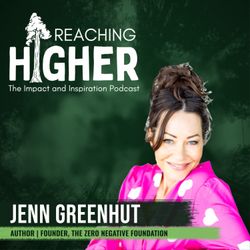
4. Stage 4 Breast Cancer Survivor Jenn Greenhut on Turning Cancer Into a Gift
36:36||Season 3, Ep. 4Former U.S. national team gymnast, actress, and singer-songwriter Jenn Greenhut joins Aaron for an honest, funny, and deeply moving conversation about turning life's hardest moments into purpose. Diagnosed with stage IV triple-negative breast cancer just months after a third failed round of IVF, Jenn was given a 12% chance of surviving five years. Then her oncologist told her something that changed everything: had she gotten pregnant, it likely would have killed her. Jenn shares how that moment helped her see cancer as a gift, how she and her husband Larry wrote Everyone Needs a Larry from both the patient and caregiver perspectives, and why she founded Love, Zero Negative and the Zero Negative Foundation to support patients and fund cancer research. Plus, the wild story of landing a scene alongside her sister in Nancy Meyers' What Women Want, her live storytelling nights, and her new definition of a good life.Show LinksLove, Zero Negative: https://lovezeronegative.comThe Zero Negative Foundation: https://zeronegativefoundation.orgEveryone Needs a Larry (Amazon): https://www.amazon.com/Everyone-Needs-Larry-Twist-Cancer/dp/B09YDZSPBTJenn's Thriver List on WeGotThis.org: https://wegotthis.org/blogs/thriver-list/jenn-greenhutJenn's TEDx Talk: https://www.youtube.com/watch?v=6to49cuSJFE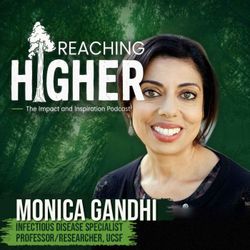
3. Can Public Health Rebuild Trust? UCSF's Dr. Monica Gandhi on Talking Across the Divide
37:51||Season 3, Ep. 3On this episode of the Reaching Higher Podcast, host Aaron Strout talks with Dr. Monica Gandhi, UCSF infectious disease physician, medical director of San Francisco's Ward 86 HIV clinic, and author of Endemic: A Post-Pandemic Playbook. Dr. Gandhi explains how lessons from the HIV epidemic shaped her public voice during the pandemic and why harm reduction, meeting people where they are, should guide public health messaging. She shares how Ward 86 pioneered long-acting injectable HIV therapy for unhoused patients, helping change national DHHS guidelines in 2024. The conversation covers integrating mental health into HIV care, protecting early career NIH scientists, low-cost urine adherence tests for global HIV care, the real-world impact of PEPFAR and USAID cuts, and the Ebola outbreak in DRC. She closes with her best advice for young doctors and researchers: play the long game, stay data driven, and don't succumb to despair.Show LinksEndemic: A Post-Pandemic Playbook (Mayo Clinic Press): https://mcpress.mayoclinic.org/product/endemicDr. Monica Gandhi on X: https://x.com/MonicaGandhi9Dr. Monica Gandhi, UCSF profile: https://profiles.ucsf.edu/monica.gandhiInternational Rescue Committee (IRC): https://www.rescue.orgamfAR, The Foundation for AIDS Research: https://www.amfar.org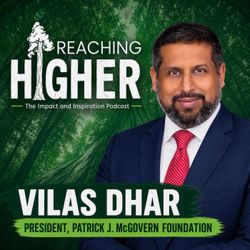
2. Vilas Dhar on Responsible AI: What Leading a $1.5B AI Foundation Taught Him
50:48||Season 3, Ep. 2Vilas Dhar, President of the Patrick J. McGovern Foundation and a member of the UN Secretary-General's High-Level Advisory Body on AI, joins host Aaron Strout to define what responsible AI actually means.A former computer scientist turned human rights lawyer, Dhar now leads a $1.5 billion philanthropy funding AI for public good. He unpacks "system agenticness," the risk of outsourcing moral responsibility to machines and explains why boardrooms need new questions for AI strategy, not just adoption metrics. The conversation covers AI's real-world impact on blood-supply logistics and tax preparation, his global policy work at the UN and World Economic Forum, and why he believes hope, love, and human dignity belong at the center of AI governance. They close with quick-fire picks on favorite shows, mentors, and dream concerts.Show Links:Vilas Dhar bio — Patrick J. McGovern Foundation: https://www.mcgovern.org/about-president-vilas-s-dhar/Patrick J. McGovern Foundation: https://www.mcgovern.orgVilas Dhar — Wikipedia: https://en.wikipedia.org/wiki/Vilas_DharVilas Dhar on LinkedIn: https://www.linkedin.com/in/vilasdhar/ How Change Really Works by Julia Dhar (Vilas's wife, mentioned as his most-admired person): https://bigthink.com/people/julia-dhar/Queen's Live Aid performance at Wembley, 1985 (Vilas's dream concert): https://en.wikipedia.org/wiki/Queen%27s_performance_at_Live_Aid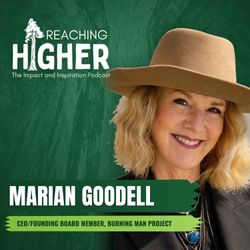
1. What Burning Man Teaches About Human Connection: A Conversation with CEO Marian Goodell
48:42||Season 3, Ep. 1Season 3 of the Reaching Higher Podcast kicks off with Marian Goodell, CEO and Founding Board Member of Burning Man Project. Marian's own journey began in 1995 as a first-time participant drawn in by the desert's radical creativity, and it eventually led her to help formalize the organization alongside co-founder Larry Harvey, guiding its growth into a global movement now spanning 34 countries.Aaron and Marian trace the origin story of the Ten Principles, unpack Decommodification as a "permission engine," and dig into why Radical Self-expression and Leave-No-Trace remain so central to the culture. Marian also shares candid reflections from the new HBO docuseries The Man Will Burn, including leading through the historic 2023 flood, and looks ahead to philanthropy's role in the organization's next decade.They close things out with lighter rounds on books, the most impressive people Marian's met, and the artists she wishes she could've seen live.Show LinksBurning Man Project: https://burningman.orgBurning Man Journal (Marian's writing): https://journal.burningman.orgTickets: https://tickets.burningman.orgDonate: https://donate.burningman.orgMarian Goodell on LinkedIn: https://www.linkedin.com/in/mariangoodell/
Party Coach Evan Cudworth on Sober Partying, Social Fitness, and Healing Post-Pandemic Loneliness
20:20||Season 2Welcome back to a special edition of Reaching Higher. We're between seasons, but I couldn't wait to share this conversation with you. I actually recorded this back in June with the idea that it'd be part of a two-guest episode — that didn't end up coming together, so instead you're getting a shorter episode featuring a genuinely good guy in Evan Cudworth, known to the internet as the world's first party coach. I know how that sounds — and Evan gets it too. But strip away the label and what he's actually doing is treating the loneliness epidemic like a fitness problem: your social muscles atrophy just like any other, and the party is where you train them. We get into his pandemic rock-bottom, his "dopamine detox" method, and years spent partying stone sober.Show linkhttps://partycoach.me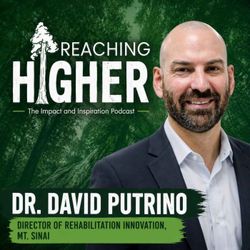
Long COVID, ME/CFS & POTS: Dr. David Putrino on the Treatments Most Doctors Miss
48:14|In this season two finale of the Reaching Higher Podcast, host Aaron Strout explores myalgic encephalomyelitis/chronic fatigue syndrome (ME/CFS), POTS, and long COVID through two powerful conversations.First, patient advocate Shannon Riley shares how a 2012 viral infection led to fourteen years of illness, repeated misdiagnosis, and seven years of near-total isolation—until low-dose tirzepatide, a GLP-1 medication, sparked a partial recovery. Then Dr. David Putrino, PhD—Nash Family Director of Mount Sinai's Cohen Center for Recovery from Complex Chronic Illness—explains why infection-associated chronic conditions like long COVID, ME/CFS, and chronic Lyme are more connected than they appear. Putrino breaks down medical dismissiveness, off-label treatments (GLP-1s, low-dose naltrexone, low-dose rapamycin), and emerging clinical trials, including mitochondrial transplant. Together, they offer hope, science, and practical guidance for patients still searching for answers.This episode is essential listening for anyone navigating chronic illness, misdiagnosis, or the search for a knowledgeable doctor.Key show links:Dr. David Putrino — Mount Sinai profile: https://profiles.icahn.mssm.edu/david-f-putrinoCohen Center for Recovery from Complex Chronic Illness (CoRE): https://icahn.mssm.edu/research/cohenPatient-Led Research Collaborative (Long COVID treatment guide & registry): https://patientresearchcovid19.comILADS — Lyme-literate provider search: https://www.ilads.orgRTHM — virtual care for long COVID, ME/CFS, POTS & MCAS: https://www.rthm.com