Share
The Next Five
Money Movers: Solving The Cross-Border Payment Problem
Despite an interconnected and increasingly digitalised world, a historical black cloud has been hanging over an area of finance relied upon by institutions, retail and a billion people associated with migrant work: Cross-border payments.
Domestic money transfer has seen a dramatic overhaul due to the digital revolution of recent years. But sending money internationally is a whole different ball game. Each country operates their own payment systems at varying levels of technological maturity and regulation. Due to this, historically, sending money has been both time consuming and costly, whether that is B2B, B2C or C2C.
There has been improvements over the last few years, yet the industry still has some work to do. In this episode of The Next Five, Pratik Khowala, Global Head of Transfer Solutions at Mastercard discusses how scale and collaboration can solve some of the key challenges. Emanuela Saccarola, Head of Cross-Border Payments at Citi delves into the B2B landscape, echoes the need for industry collaboration and discusses the increasingly relevant role of digital assets. Josh Gordon-Blake, EVP and GM, MGO at MoneyGram highlights the importance of remittances to the global economy and what an overhaul of the payments system can do for millions of people.
Sources: FT resources, Deloitte, IFAD, World Bank, Mastercard, Deutsche Bank, ECB, FSB, The Payments Association.
This content is paid for by Mastercard and is produced in partnership with the Financial Times' Commercial Department.
More episodes
View all episodes
49. Systems Rewritten: Automotive
37:10||Ep. 49Imagine it’s 2006, not 2026. You’re an automobile factory manager, looking at combustion engine vehicles moving through the assembly line. A sight that has been seen since the Model T Ford, a century earlier.Today, you’re still watching legacy internal combustion engines roll off one side but high-voltage battery packs drop into electric chassis on the other. Electric vehicles could account for just over a quarter of global new car sales this year and as much as half of light vehicles sold worldwide by 2035. 5 years ago, it was just 9%.Across the industry, the ground is shifting under automakers' feet. Yet the rumbling is being felt much more in some countries than others. The map of ICE (Internal Combustion Engine), EV and autonomous dominance is being rewritten.Joining host Tom Parker is Niall Healy, Chief Operating Officer at Trade Nation, Marc Palmer, Head of Strategy & Insights at Autotrader and Professor Peter Wells, Professor of Business and Sustainability, Centre for Automotive Industry Research, Cardiff Business School.This episode was recorded on 23rd September 2026.Sources: FT Resources, IEA, Bloomberg NEF, SQ Magazine, CPCA, ITA, Mercedes Benz, Road to AutonomyThis content is paid for by Trade Nation and is produced in partnership with the Financial Times' Commercial Department. The views and claims expressed are those of the guests alone and have not been independently verified by The Financial Times.
48. Systems Rewritten: AI
42:41||Ep. 48Supply and demand. The foundational backbone of market economies. And we’re in the AI era, where demand and supply is being rewritten. Behind this AI revolution, sits a monumental physical buildout and energy demand. Globally, data centre power consumption will double by 2030 toward 945 terawatt-hours, consuming more power than the entire nation of Japan.In some regions the strain is already visible: data centres accounted for more than a fifth of Ireland's national electricity consumption in 2022 and predicted to reach nearly a third this year. Stateside, in 2023, when less powerful models existed, roughly a quarter of electricity use in the US state of Virginia was sucked up by data centres. And yet, McKinsey estimates that there will still be $7tn in global data-centre infrastructure investment by 2030.Then come the Hyperscalers, Alphabet, Amazon, Meta, Microsoft and Oracle who are expected to spend around $670bn on AI-related capital expenditure this year alone, and nearly $800bn next year. The nine largest AI companies have collectively forecast $4.1tn in capital expenditure through to 2030, a trillion dollars more than the total 2025 Capex of all US non-financial companies combined.So looking at systems being rewritten, are we witnessing the greatest industrial re-tooling in human history, or is it all too much to handle?Joining host Tom Parker is Matthew Wright, Chief Strategy Officer at Trade Nation, Walter Pasquarelli, Researcher at Cambridge University and OECD advisor, and Bernard Marr, Author and Futurist.This episode was recorded on 16th September 2026.Sources: FT Resources, McKinsey, Goldman Sachs, OECD, TTMS, IEA, Hungyichen, SIAThis content is paid for by Trade Nation and is produced in partnership with the Financial Times' Commercial Department. The views and claims expressed are those of the guests alone and have not been independently verified by The Financial Times.
47. Systems Rewritten: Markets
38:38||Ep. 47It’s Q3 2026, the systems that form the global economy are currently being rewritten by the digitally led, fourth industrial revolution and the geopolitical repositioning of power. You’re an investment banker, a portfolio manager or a retail investor looking at trading screens flash red and green. There’s a hive of activity. But what to make of it.The indicators continue to flash, but the signals are conflicting. On one side sits the bull case: real AI driven corporate revenue, strong earnings, record stock prices and the unprecedented cash flow of the Hyperscalers. On the other side sits the bear case: historically concentrated index valuations, an ever widening gap between monetisation and infrastructure spending, and an increasingly fragile global debt landscape.It leaves you, as well as other investors, economists, and central banks asking some big questions: Are we witnessing a durable, tech-driven productivity shift? A once in multiple generation opportunity to transform individual, corporate and societal wealth? Are we re-writing the whole world economy? Or are we sitting giddy and foolishly riding a teflon-coated bubble that will soon burst?Our host Tom Parker is joined by Jon Noble, CEO of Trade Nation, Russ Mould, Investment Director at AJ Bell and Karen Ward, Chief Market Strategist for EMEA at J.P. Morgan Asset Management. This episode was recorded on the 22nd of September 2026.Sources: FT Resources, Harding Loevner, RBC Wealth Management, Slick Charts, Yahoo Finance, Macrotrends, OECD, AI Weekly, IMF, CNBC, IIF.This content is paid for by Trade Nation and is produced in partnership with the Financial Times' Commercial Department. The views and claims expressed are those of the guests alone and have not been independently verified by The Financial Times.
46. Code and Conscience: Intelligence Within and Without Borders
47:31||Ep. 46Sovereignty, by definition, is being updated. Sovereignty 2.0. Under geopolitical tensions, supply chain dependencies and competing regional regulations, the discussion around digital sovereignty is shaping where you're allowed to build, what models you’re allowed to train on, and who's allowed to see the results. Competing lines are being drawn. On one side there are those calling for the democratisation of AI and opening the global doors to innovation. On another is a fragmented map of regional regulations, like the strict mandates of the EU AI Act. Bubbling underneath is the geopolitical chess match, primarily between the US and China, turning data, frontier models and the infrastructure behind them into a matter of national security.All of this offers up some big questions for governments and businesses. One no bigger than this: Can global enterprise innovation really survive in a world of digital borders?Joining host Tom Parker is Stéphane Israël, Managing Director of the AWS European Sovereign Cloud and Digital Sovereignty at AWS, alongside Ali Ustun, Senior Partner from McKinsey’s Middle East Office and co-leader of their global Data and AI Foundations Service Line and Dr. Catherine di Lorenzo, Partner at A&O Shearman. Sources: FT Resources, McKinsey, NASAThis content is paid for by AWS and is produced in partnership with the Financial Times' Commercial Department. The views and claims expressed are those of the guests alone and have not been independently verified by The Financial Times.
45. Code and Conscience: Freedom to Invent
33:21||Ep. 45We’re at the start of Q3 2026. Every day that passes, individuals, managers, executives and boards are crunching their internal numbers. They’re working out if the millions of dollars spent on cutting edge agentic AI deployment over the previous 2 years is showing signs of meaningful ROI. If figures from the first half of 2025 were anything to go on, the juice was not worth the squeeze. MIT’s Gen AI Divide Report 2025 showed that ninety-five percent of generative AI projects in H1 last year failed to deliver demonstrable ROI. Ninety-five percent. But, what happened to that remaining five percent? What secret engine were those elite organisations running that the rest of the market is completely missed? Is it really a gap in technical horsepower? Did they structure innovation better? Manage risk more competently? Or did they grant their teams the power to experiment more freely than the rest?Joining host Tom Parker is Steve Tarcza, Director of AI & Developer Acceleration for Stores at Amazon, alongside Jim Rowan, US Head of AI at Deloitte and Seth Fox, Chief Technology Officer at S&P Global.Sources: FT Resources, MITThis content is paid for by AWS and is produced in partnership with the Financial Times' Commercial Department. The views and claims expressed are those of the guests alone and have not been independently verified by The Financial Times.
44. CFO Futures: Navigating the Real-Time Enterprise
34:25||Ep. 44Thirty years ago, the role of the CFO was vastly different. While they still looked ahead to build budgets, they acted more like historians, studying the past performance to manage the books, taxes and audits, but largely kept out of board level email chains. Today, most CFOs at the top of their game barely recognise the environment they started their careers in. They are now less a historian and more a fortune teller, sitting firmly at the right hand of the CEO and guiding big strategic discussions . AI’s predictive modelling and big data crunching makes wearing the co-pilot hat for a CFO that much more comfortable as they help navigate their companies through global risks and critical business wide decisions.Joining the host,Tom Parker, to discuss the role of the CFO in an AI future is Patrick Villanova, CFO at BlackLine, Olya Brase, EVP of Finance Optimisation and Governance at Highgate and Gina Gutzeit, Senior Managing Director and Global Leader of the Office of the CFO Solutions practice at FTI Consulting.Sources: FT Resources, Deloitte, Bain & Co, Founders Forum Group, HouseblendThis content is paid for by Blackline and is produced in partnership with the Financial Times' Commercial Department. The views and claims expressed are those of the guests alone and have not been independently verified by The Financial Times.
43. Power Shifts: Data Centres, Diplomatic Tensions and the Energy in Between
56:57||Ep. 43We are living in an era defined by a new kind of power shift. It’s not only measured in borders and markets but in Gigawatts and Gigaflops.Every line of code generated and every industrial process optimised by Artificial Intelligence is tethered to a physical reality: the Data Centre. These silent, humming monoliths have become the new cathedrals of the 21st century, and their appetite is unprecedented. How on earth are we going to be able to create and sustain the power demand of AI? But this isn't just a technical challenge; it’s a diplomatic powder keg. With the Strait of Hormuz slowly recovering from a blockade and the global energy market reeling from price hikes, we have entered a world of energy realism. Furthermore, is the machine a monster that will break our grids and stall the transition? Or is it the only navigator capable of steering us through the complexities of a changing climate and the demands of a green transition?Joining the host ,Tom Parker, is José Manuel Durão Barroso, Prime Minister of Portugal from 2002 to 2004 and European Commission President from 2004-2014, alongside Mo Gawdat, a software engineer, entrepreneur, author, podcaster, public speaker and former Chief Business Officer at Google X, and Miguel Stilwell d’Andrade, CEO of EDP, a global energy company.This episode was recorded on July 8th in front of a live audience at EDP Headquarters, LIsbon. Sources: FT Resources, IEA, CNN, Brookings, CNBC, Fortune, Microsoft, CREA.This content is paid for by EDP and is produced in partnership with the Financial Times' Commercial Department. The views and claims expressed are those of the guests alone and have not been independently verified by The Financial Times.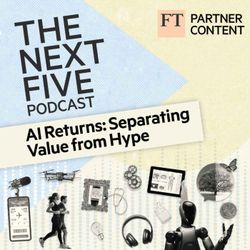
42. AI Returns: Separating Value from Hype
39:30||Ep. 42For the past few years, the corporate world has been boldly surfing the initial wave of AI excitement. Boardrooms worldwide have poured hundreds of billions of dollars into Artificial Intelligence, fueled by grand promises of economic revolution. We were told productivity would skyrocket, costs would vanish, and businesses would effortlessly scale.But as the fiscal years roll over, executives are searching for the next wave of provable returns and exploring what they will need to do to catch it and surf it to the beach of productivity gains. The challenge for this next generation of technology, specifically autonomous Agentic AI, is to prove it can deliver measurable, repeatable business value at scale. But unlocking that value requires a total architectural overhaul. It means completely re-engineering the internal human workforce, and ultimately, altering how the customer experiences an organisation from the outside.Giles Bryan, General Manager CX, NiCE, alongside Chris Herbert, Customer Service Director at Openreach and Zack Kass, Author, Podcaster, and former OpenAI Executive, join host Tom Parker.Sources: FT Resources, McKinsey, MIT, Gartner, GuardianThis content is paid for by NiCE and is produced in partnership with the Financial Times' Commercial Department. The views and claims expressed are those of the guests alone and have not been independently verified by The Financial Times.
41. Code and Conscience: The Logic of Trust
46:34||Ep. 41It’s 2026. You’re the CEO of a global bank or the Head of Surgery at a major hospital. An AI system looks at a complex set of volatile market data, or a patient’s decade-long medical history, and gives you a directive. It doesn’t just give you a percentage of probability. It tells you exactly what to do. But here is the catch: If that decision fails, "the machine told me so" won’t hold up in court, in the boardroom, or at a patient’s bedside. For a few years now, we’ve played a game of ‘black box’ roulette, using AI that predicts the future based on the past. But in a world of sudden market shifts and unprecedented global change, the past is no longer a reliable map. We are entering the era of Automated Reasoning. This is the shift from AI that guesses to AI that proves. It’s a market for explainable systems that is set to hit nearly ten billion dollars this year, doubling by 2032. Because today, leaders don’t just need an answer; they need the logic behind it. They need a ‘glass box’ they can trust. Scott Wiltamuth, Director of Software Development for Agentic AI and Automated Reasoning at AWS, alongside Mary Martin, Managing Director and Senior Partner at BCG and Varun Chitkara, Senior Vice President of Global Product & Technology at ADP join host Tom Parker. Sources: FT ResourcesThis content is paid for by AWS and is produced in partnership with the Financial Times' Commercial Department. The views and claims expressed are those of the guests alone and have not been independently verified by The Financial Times.