Latest episode
1. The Taster Menu
30:21||Season 3, Ep. 1Welcome back to The Migration Menu!! In this week’s episode, James and Luke reflect on the past two seasons of dining out and discussing migration journeys and culinary transformations, and preview what’s on the menu for Season Three…Dig in!See more here:Web: www.themigrationmenu.comYouTube: https://www.youtube.com/@TheMigrationMenu**Starters** (00:18 – 01:40) Welcome to the new series, which takes us beyond our usual stomping ground of London to take in road trips to Newcastle and Edinburgh, and explores the phenomenon of the South Asian diaspora celebrity chef…**Mains** (01:40-26:42) James and Luke offer a behind-the-scenes glimpse of The Migration Menu’s origin story and at what they’ve learnt along the way. They also look back at the restaurants, restaurateurs, and others who have joined them on the journey, with shout-outs to…Series One01:49: Indra Hang Linden at Namaste Gurkha08:12: Al Hyderabadi08:44: Madhus10:56: Sri Krishna Vada Pau11:09: London Food Company12:10: YAKO12:31: Saravanaa Bhavan*16:56: Shout out for our fellow anthropology podcast, The Anthropology Podcast!*Series Two18:03: London Buddhist Vihara18:37: Guru Nanak Sikh Academy (GNSA) annual Langar20:14: Graam Bangla20:29: Maldivian Supper Club21:10: The Kokum22:53: Takharistan (Shepherd’s Bush) and Shiraz (Uxbridge Road)23:42: GIFTOs23:45: Behesht24:25: Sohini Banerjee & Debbie Weekes-Bernard at Pitzhanger Gallery24:46: The Vegetarian Brown Girls25:21: Sathnam Sanghera at GNSA25:35: The Gaze – the hidden lives of food entrepreneurs**Dessert** (26:42-29:46)James and Luke wrap up this week’s show with a round-up of what’s in store this series, where their interviews with celebrity South Asian diaspora chefs reveal some of the creative ways in which restaurateurs survive in a tough environment. Shout-outs to…27:22: Tony Singh at Kalpna, live from Edinburgh27.46: Asma Khan of Darjeeling Express, London27.56: Asma Khan at the SOAS Food Studies’ Centre Annual Distinguished Lecture28:04: Ravinder Bhogal of Jikoni, London28:38: Aida Khan of Shola Karachi Kitchen28:53: Special live recording from ClassicsFest, Newcastle, with food at The Lubber Kitchen and The Seven Bridges Café29:30: Cyrus Todiwala of Café Spice NamasteWorks Cited: Baumann, G. (1996) Contesting culture: Discourses of identity in multi-ethnic London. Cambridge: Cambridge University Press.
More episodes
View all episodes
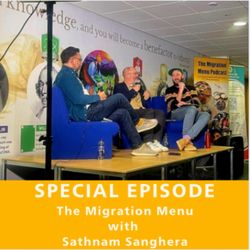
Sathnam Sanghera and The Migration Menu
37:50||Season 2In this special episode, James and Luke interview acclaimed author and Times journalist Sathnam Sanghera in front of a live audience at the Guru Nanak Sikh Academy in Hayes **Starters** (01.14-02.49) A quick introduction to Sathnam Sanghera and his work ahead of our live-recording. **Mains** (02:50-30.58) James and Luke discover what Sathnam ate growing up in Wolverhampton in the early 1980s, the intriguing ways in which British influences affected Punjabi food in the diaspora, and why his mother purposely didn’t teach him how to cook. We also discuss food and identity, and how it is used to express both love and anger; how Empire has left its indelible mark on how we eat the world over today; and why Sathnam doesn’t like the term “cultural appropriation.” Our conversation also explores Sathnam’s quest to find the perfect curry, why he once named Pizza Express as his favourite restaurant, and he favours Gymkhana and Jikoni over Dishoom. **Dessert** (30.59-36.00) Back in the studio, James and Luke reflect on their conversation with Sathnam and the discussion that followed it with the audience. They also gave a shoutout to Dr John Perkins of the Guru Nanak Sikh Academy – without whose help they couldn’t have held the event there – and the school’s catering team for laying on dal and rice, samosa and chai Works Cited: Collingham, Lizzie. 2017. The Taste of Empire: How Britain’s Quest for Food Shaped the Modern World. New York: Basic Books. Jegathesan, Mythri. 2019. Tea and Solidarity: Tamil Women and Work in Post-War Sri Lanka. Seattle: University of Washington Press. Mintz, Sidney W. 1986. Sweetness and Power: The Place of Sugar in Modern History. Manchester: University of Manchester Press. Sanghera, Sathnam. 2008. The Boy with the Topknot: A Memoir of Love, Secrets and Lies in Wolverhampton. Penguin Books. Sanghera, Sathnam. 2016. Marriage Material. Europa Editions, 2016. Sanghera, Sathnam. 2021. Empireland: How Imperialism Has Shaped Modern Britain. Viking. Sanghera, Sathnam. 2023. Stolen History: the Truth About the British Empire and How It Shaped Us. Penguin Books. Sanghera, Sathnam. 2024. Empireworld: How British Imperialism Has Shaped the Globe. Penguin Books.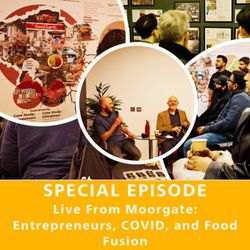
Live From Moorgate: Entrepreneurs, COVID, and Food Fusion
35:58||Season 2This week James and Luke were in Moorgate as panelists for 'The Gaze', organised by Middlesex University in collaboration with Small Business Research + Enterprise Centre and the HOMELandS Research Centre at the University of Westminster. They were there to discuss the often-hidden lives of immigrant food entrepreneurs in London. Through oral histories, memories and everyday business, the event explores how entrepreneurship becomes more than a means of survival. It is a way to build belonging, community, and city’s cultural and economic fabrics.The event was chaired by Dr. Rui Su, Senior Lecturer in Tourism and Middlesex Universiy.Panelists:Abdul Komor, Street Trading Service Manager, London Borough of Waltham Forest.Baron Deschauer, Market Manager, Tooting Market.So Mang Ham, Founder of the SoJu
10. A Sweet Aftertaste with James and Luke
33:51||Season 2, Ep. 10In this Episode James and Luke recap the series and answer some of the question and comments they have receieved throughout. They also reintroduce Sohini Banerjee and play a section of the Q&A from their sell out show at Pitzhanger Manor and Gallery.
9. Amer-Indians
33:46||Season 2, Ep. 9TheAmer-Indians In this week’s episode, Luke travels to the outer reaches of London’s underground train network to meet James in Little Chalfont, to explore the places that increasing numbers of South Asian diasporas go when they move on from West London, and how they help transform those places and their cuisines. **Starters** (01.29-12-12) Ahead of their lunch with Vimal Dalal – a production editor on The Migration Menu and a one-time Southallian – James and Luke outline the history of post-World War II settlement in the suburbs and semi-rural towns that surround London. They discuss the appeal of such places – including the lure of selective school education – to those who first travelled from South Asia to London, settling in places like Southall, and the impact of these more recent movements on the suburban culinatry landscape. **Mains** (12:12-25:52) James and Luke meet Vimal outside The Kokum (www.thekokum.co.uk) for a pan-Indian inspired lunch, during which they hear the migration story of Vimal’s family, from Gujarat and Tanzania, to Southall in the 1980s and, via Hayes, to Little Chalfont, a village near Amersham, in Buckinghamshire. **Dessert** (25:52-33:05) After lunch chat reflects on how the suburban curry house has been transformed by more recent waves of migration out from the inner cities, which have also expanded the range of South Asian groceries and vegetables available in local shops. New arrivals also find themselves supported by groups like the Amer-Indians, through which social events and business networks are co-ordinated. James and Luke also reflect on how a nostalgic vision of pre-war Britain came to be shared by some members of the South Asian diasporas who came to settle here. **The Menu** Masala Papad Palak Patta Chaat Tandoori Soya Chaap Mumbai Prawns Koliwada Malai Kofta Vegetable Handi Kombdi Rassa Jackfruit Dum Biryani Chilli Garlic Coriander Naan Works Cited: Baumann, Gerd. 1996. Contesting Culture: Discourse of Identity in Multi-Ethnic London. Cambridge University Press. Caplan, Lionel. 1999. “Gifting and receiving: Anglo-Indian Charity and its Beneficiaries in Madras”. In Tradition, Pluralism and Identity: In Honour of T. N. Madan, edited by V. Das, D. Gupta and P. Uberoi, 283–305. New Delhi: Sage Publications.
8. Measure with the Heart
30:16||Season 2, Ep. 8In this week’s episode, James and Luke try out the food of The Maldives, an archipelago of coraline islands in the Indian Ocean. The Maldivian diaspora in the UK, compared to other South Asian groups, is tiny; consequently there are no Maldivian restaurants, but there is at least one Maldivian Supper Club (@maldiviansupperclub on Instagram), run by host Mie Ali Didi, who prepares the food eaten in this episode. **Starters** ( 1:15 – 12:00) James and Luke sketch out the historical background of Maldivian cuisine, including Sri Lankan influences since around the 1970s. Although the Maldives are often idealised as remote desert islands, they have played a role in Indian Ocean trading networks for more than 2,000 years, were colonised by the Portuguese, and became a British protectorate from 1887 to 1965, finally becoming a Republic in 1968. **Mains** (12:00-22:10) James and Luke join Mie Ali Didi and her friends for dinner at the Maldivian Supper Club, discussing with their guests what food from their homeland means to them and why. **Dessert** (20:12-29:40) After dinner chat includes a discussion of gender politics in the catering business (and why most supper clubs are run by women and restaurants by men); the history of Indian Ocean cuisine and the importance of family and food sharing to culinary traditions; and what it means to be part of one of the smallest South Asian diasporas in the UK. If you have any questions or comments for us, send them in and we will address them in a future show, you can get in touch at info@themigrationmenu.com. Or on ‘X’ - formerly Twitter: @migration_menu and Instagram @themigrationmenu The Maldivian Supper Club Menu Appetisers of smoked tuna, coconut and dates Roshi and Mashuni Pumpkin curry Aubergine dry curry Dal Rice Bananas, sugar, coconut, rice flakes and smoked fish/ Works Cited: Heslop, L. and Lubna, H. (2024) 'Infrastructure, circulation, and ecology in the Maldives'. Oxford Research Encyclopedia of Asian History. Heslop, L. and Jeffery, L. (2023) 'Roadwork: expertise at work building roads in the Maldives'. Journal of the Royal Anthropological Institute, 26 (2). pp. 284 - 301. Heslop, L. and Jeffery, L. (2021) 'Encountering Chinese development in the Maldives: gifts, hospitality, and rumours', in Heslop, L. and Murton, G. (eds.) Highways and Hierarchies: ethnographies of mobility from the Himalaya to the Indian Ocean. Amsterdam : Amsterdam University Press. pp. 175 - 196. Maloney, Clarence. 1976. The Maldives: New Stresses in an Old Nation. Asian Survey, Vol. 16, No. 7 (Jul., 1976), pp. 654-671.
7. A hunger to succeed
24:15||Season 2, Ep. 7This week, James and Luke visit the Broadway in Southall to share a meal with Faisal Ali, co-owner of Giftos Lahore Karahi. As they eat, Faisal reflects on how food brings people together, especially within Southall’s Pakistani community. **Introduction** (0:00 – 3:14) (Starter) Luke introduces the Giftos Lahore Karahi franchise and James and Luke discuss whether there is a significant difference between food that claims to be ‘Pakistani” and food that claims to be ‘Indian’ **Interview** (3:14 – 17:29) (Main Course) Faisal Ali reflects on how food sharing has particular significance for Muslim communities, whilst sharing his father Ashad Mohammed’s migration story – including developing a successful business in 1960s Southall – and its ties to their family’s journey from South Asia to West London. **Post-Interview** (17:30–23:26) (Dessert) Luke and James reflect on Southall’s history of resistance and how it has shaped the success of Southall residents. **Closing remarks and acknowledgments** (23:29 - 24:10) If you have any questions or comments for us, send them in and we will address them in a future show, you can get in touch at info@themigrationmenu.com. Or on ‘X’ - formerly Twitter: @migration_menu and Instagram @themigrationmenu Menu – Food eaten Dai Puri Samosa Chaat Peshwari Naan Lamb shish kebab Chicken tikka Paneer tikka Lamb chops Tadka dal Mango lassi Literature mentioned: Education, Aspiration and Social Mobility - Uncertain Futures for Rural Youth in India by Peggy Froerer (coming out soon!)