Share
The Migration Menu
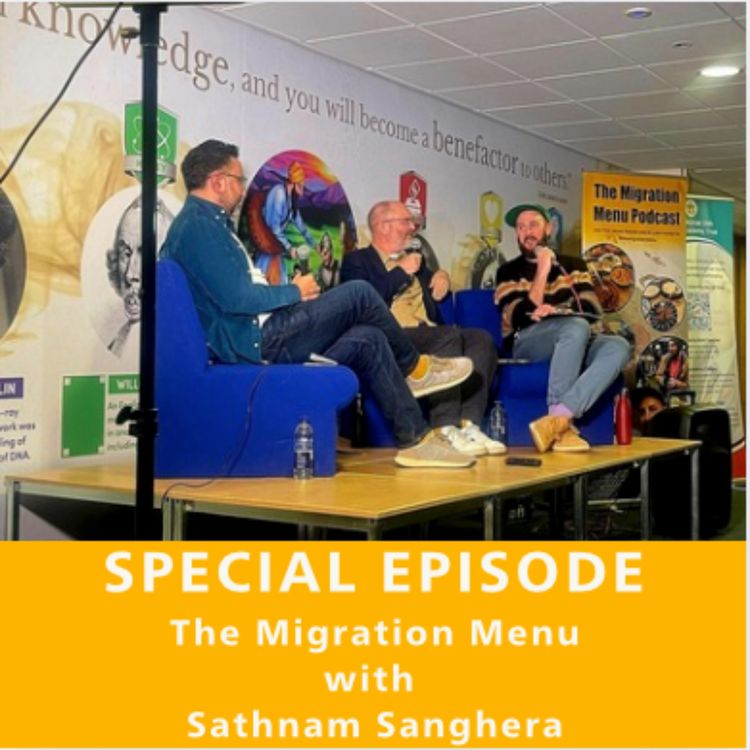
Sathnam Sanghera and The Migration Menu
In this special episode, James and Luke interview acclaimed author and Times journalist Sathnam Sanghera in front of a live audience at the Guru Nanak Sikh Academy in Hayes
**Starters** (01.14-02.49)
A quick introduction to Sathnam Sanghera and his work ahead of our live-recording.
**Mains** (02:50-30.58)
James and Luke discover what Sathnam ate growing up in Wolverhampton in the early 1980s, the intriguing ways in which British influences affected Punjabi food in the diaspora, and why his mother purposely didn’t teach him how to cook. We also discuss food and identity, and how it is used to express both love and anger; how Empire has left its indelible mark on how we eat the world over today; and why Sathnam doesn’t like the term “cultural appropriation.” Our conversation also explores Sathnam’s quest to find the perfect curry, why he once named Pizza Express as his favourite restaurant, and he favours Gymkhana and Jikoni over Dishoom.
**Dessert** (30.59-36.00)
Back in the studio, James and Luke reflect on their conversation with Sathnam and the discussion that followed it with the audience. They also gave a shoutout to Dr John Perkins of the Guru Nanak Sikh Academy – without whose help they couldn’t have held the event there – and the school’s catering team for laying on dal and rice, samosa and chai
Works Cited:
Collingham, Lizzie. 2017. The Taste of Empire: How Britain’s Quest for Food Shaped the Modern World. New York: Basic Books.
Jegathesan, Mythri. 2019. Tea and Solidarity: Tamil Women and Work in Post-War Sri Lanka. Seattle: University of Washington Press.
Mintz, Sidney W. 1986. Sweetness and Power: The Place of Sugar in Modern History. Manchester: University of Manchester Press.
Sanghera, Sathnam. 2008. The Boy with the Topknot: A Memoir of Love, Secrets and Lies in Wolverhampton. Penguin Books.
Sanghera, Sathnam. 2016. Marriage Material. Europa Editions, 2016.
Sanghera, Sathnam. 2021. Empireland: How Imperialism Has Shaped Modern Britain. Viking.
Sanghera, Sathnam. 2023. Stolen History: the Truth About the British Empire and How It Shaped Us. Penguin Books.
Sanghera, Sathnam. 2024. Empireworld: How British Imperialism Has Shaped the Globe. Penguin Books.
More episodes
View all episodes

4. Asma Khan: Darjeeling Express
37:22||Season 3, Ep. 4Join us as we board the Darjeeling Express with Asma Khan to chart her journey from maligned second daughter of a Rajput royal family who couldn’t cook, to celebrated feeder of Hollywood A-listers in London’s Soho. Along the way – in addition to sampling some of the restaurant’s signature dishes – we contemplate the importance of storytelling to good food; why cooks from South Asia are more attuned to the spiritual aspects of feeding; and the significance of running an all women kitchen. ** 00:50-01:10: A reminder to sign-up to our newsletter Listen To The Migration Menu Podcast – The Migration Menu, and get some great discount offers from eateries featured on the show! **Starters** (01:10 – 04:55) James and Luke discuss why the Darjeeling Express is a restaurant with a difference: not only does it run a women-only, all South Asian diaspora kitchen, but none of the women who work there with Asma are formally trained chefs. Asma herself is also a different kind of restaurant patron: unlike the men who dominate the industry, most of whom are trained in what she describes as “stainless steel empires”, she has a PhD in constitutional law, and learned to cook from Bengali aunts who were afraid that if they didn’t share their secret recipes, she’d leave her husband. Since then, she’s been listed in Time magazine as one of the world’s 100 most influential people, and has been a cheerleader for food justice. **04.55-05.14: A shout-out from Mike Crawley, co-host of The Anthropology Podcast, to have a listen to one of our sibling shows! **Mains** (08:24-20:23) James and Luke join Asma for masala chai between services at her Soho-based restaurant, where she recounts her story from a childhood spent in Chennai, Hyderabad and Kolkata – the second daughter of a Rajput royal family – to Cambridge and then London in the UK. Food was always an important part of the tale: her mother set up her own catering business, and her father regaled them with stories he made-up about the origins of different dishes. It was, however, her struggles for recognition in the wider extended family – where girls always ate last and ate least – that really informed her approach to business. Starting off with a supper club, run from her own home, the restaurant, she explains, is not just a business – even though it’s Michelin guide listed – but “a battle cry for justice.” **Dessert** (27:49-37:09) James and Luke draw out the key takeaways from their interview. Gender politics, of course, was a major theme, leading them to reflect on why women in catering seem so much more likely to take less conventional approaches – from running supper clubs and tiffin services to restaurants with a political message – than their male counterparts. But so, too, was the importance of storytelling, and the power of Asma’s rhetoric to get across a narrative that challenges sexism as well as racism within the industry and beyond. The binary split between the sacred and the profane, so common in Western discourses, has been challenged through many of the interviews for The Migration Menu, and this was no exception: Asma, in common with many South Asian diaspora restaurateurs, and particularly the women, makes no radical distinction between the spiritual and the everyday aspects of food and cooking. **On the Menu** Puchkas (wheat shells filled with spiced chickpeas, potatoes and tamarind water) Channa chaat (chickpeas, fresh herbs, spices, tamarind, yogurt) Badami Baingan (aubergine with coconut, peanut and tamarind) Prawn Malaikari (traditional Bengali dish with a coconut milk base) Tamarind dal Pulao rice Paratha Khoobani Ka Meetha (a pudding of slow-cooked apricots served with cream and finished with pistachios Masala chai
3. Tony Singh: Live in Edinburgh
41:35||Season 3, Ep. 3Cross the border with us into Scotland as we embark on the first leg of The Migration Menu’s road trip, and listen in to our interview with celebrity chef, author, and TV cook Tony Singh, in front of a live audience at Kalpna Restaurant in Edinburgh. The event was part of the public anthropology festival PeopleFest, and included a Q&A from the audience who packed the restaurant. ** 00:40-00:58: A reminder to sign-up to our newsletter Listen To The Migration Menu Podcast – The Migration Menu, and get some great discount offers from eateries featured on the show! **Starters** (01:09 –05.23) James and Luke discuss The Migration Menu’s pioneering role in taking anthropology to public audiences, capturing stories about migration from South Asia through food in ways that challenge public discourse, and promote the value of anthropology. They set the scene for their live interview with Sikh chef Tony Singh – the son of migrants from India and a regular on British TV screens – who, with Cyrus Todiwala, was one half of the Incredible Spice Men on BBC2. He currently runs a super club in Edinburgh. **05.24-05.40: A shout-out from Mike Crawley, co-host of The Anthropology Podcast, to have a listen to one of our sibling shows! **Mains** (05:57-22:24) As a packed restaurant tucks into Kalpna’s brunch buffer, Tony shares his family’s journey from Punjab to Leith, in Edinburgh. There, his Scottish-born Punjabi mother pared the best of Scottish and Punjabi cuisines, and provided the inspiration for Tony’s famous haggis pakora. He talks about racism, getting quality South Asian food on to British menus, and the influence of Empire on what we eat today. The discussion also extends to cultural appropriation, fusion, authenticity, and why narrative is important to the taste of a good dish. And James and Luke end the interview with their time honored question: what does Tony have for breakfast? **Dessert** (22:36-41.24) Q&A, followed by James and Luke’s reflections on the discussion. 23.12-33.12: The audience get their chance to ask Tony questions, and learn about square sausage, K-pop, his favorite foods, and what ingredient he couldn’t live without. 33.21-41.24: Apart from a massive bag of pakoras, James & Luke had plenty of other takeaways from the interview, including Tony’s insights on food, empire, the politics of food, and the challenge of defining the boundaries of South Asian cuisine. They also take about the role of celebrity in making a cuisine, and the social aspirations that cookery shows draw upon and shape. References Lengyel, Ariane and Gatley, Andy (2016) Celebrity chefs and the construction of taste: from über macho to culinary crusader. In: CHME Annual Research Conference 2016, 4-6 May 2016, Belfast. (Unpublished)
2. Sohini Banerjee: From Kolkata with Love
28:03||Season 3, Ep. 2Join us as we head south of the river to Sohini Banerjee’s Smoke and Lime supper club in Kennington, eat some great food, meet a bunch of interesting people, and ponder questions about authenticity, fusion, identity and gender. ** 00:50-01:08: A reminder to sign-up to our newsletter Listen To The Migration Menu Podcast – The Migration Menu, and get some great discount offers from eateries featured on the show! **Starters** (01:09 – 08:03) How do supper clubs work? How are they different to restaurants, and why – in particular – are they growing in popularity among diners from South Asian diasporas? These are some of the questions on James and Luke’s minds enroute to Smoke and Lime supper club, keen to expand their understanding of the South Asian food scene beyond the restaurant space. In addition to supper clubs, they encounter a rich array of services, from Vegetarian Brown Girls’ deliveries of chilled chai to Ajji’s Ghee. **08.04-08.23: A shout-out from Mike Crawley, co-host of The Anthropology Podcast, to have a listen to one of our sibling shows! **Mains** (08:24-20:23) James and Luke join eight other guests for dinner in Sohini’s apartment, capturing some of the Bengali adda – hanging out for informal conversation – as well as the culinary experience. Rijil, Sohini’s husband and co-host of the supper club, takes us, course-by-course, through the menu, rooted in the foodscape of West Bengal, with influences from China, Malaysia, and the couple’s recent trip to Vietnam. One of their favourite London restaurants, SMOKING GOAT | Shoreditch | Thai Bar & Grill, has also made a mark on the menu. **Dessert** (20:28-27:33) James and Luke reflect on their supper club experience, consider the ways in which they blur the boundaries between domestic hospitality and business, friendship and networking, and public and private in interesting – and often delightful – ways. A focus on supper clubs also allows them to dig down into the gendered dimensions of the food industry, with women’s labor, in particular, often invisibilised **On the Menu** Phuchka (A South Kolkata street food special – served at the kitchen counter) Chicken liver larb, with herbs and peach Pumpkin bhorta, pickled mooli Winter vegetables chochori Wild seabass with turmeric and galangal Schezwan prawns and sambal butter Cardamom pannacotta with cocoa and saffron
1. The Taster Menu
30:21||Season 3, Ep. 1Welcome back to The Migration Menu!! In this week’s episode, James and Luke reflect on the past two seasons of dining out and discussing migration journeys and culinary transformations, and preview what’s on the menu for Season Three…Dig in!See more here:Web: www.themigrationmenu.comYouTube: https://www.youtube.com/@TheMigrationMenu**Starters** (00:18 – 01:40) Welcome to the new series, which takes us beyond our usual stomping ground of London to take in road trips to Newcastle and Edinburgh, and explores the phenomenon of the South Asian diaspora celebrity chef…**Mains** (01:40-26:42) James and Luke offer a behind-the-scenes glimpse of The Migration Menu’s origin story and at what they’ve learnt along the way. They also look back at the restaurants, restaurateurs, and others who have joined them on the journey, with shout-outs to…Series One01:49: Indra Hang Linden at Namaste Gurkha08:12: Al Hyderabadi08:44: Madhus10:56: Sri Krishna Vada Pau11:09: London Food Company12:10: YAKO12:31: Saravanaa Bhavan*16:56: Shout out for our fellow anthropology podcast, The Anthropology Podcast!*Series Two18:03: London Buddhist Vihara18:37: Guru Nanak Sikh Academy (GNSA) annual Langar20:14: Graam Bangla20:29: Maldivian Supper Club21:10: The Kokum22:53: Takharistan (Shepherd’s Bush) and Shiraz (Uxbridge Road)23:42: GIFTOs23:45: Behesht24:25: Sohini Banerjee & Debbie Weekes-Bernard at Pitzhanger Gallery24:46: The Vegetarian Brown Girls25:21: Sathnam Sanghera at GNSA25:35: The Gaze – the hidden lives of food entrepreneurs**Dessert** (26:42-29:46)James and Luke wrap up this week’s show with a round-up of what’s in store this series, where their interviews with celebrity South Asian diaspora chefs reveal some of the creative ways in which restaurateurs survive in a tough environment. Shout-outs to…27:22: Tony Singh at Kalpna, live from Edinburgh27.46: Asma Khan of Darjeeling Express, London27.56: Asma Khan at the SOAS Food Studies’ Centre Annual Distinguished Lecture28:04: Ravinder Bhogal of Jikoni, London28:38: Aida Khan of Shola Karachi Kitchen28:53: Special live recording from ClassicsFest, Newcastle, with food at The Lubber Kitchen and The Seven Bridges Café29:30: Cyrus Todiwala of Café Spice NamasteWorks Cited: Baumann, G. (1996) Contesting culture: Discourses of identity in multi-ethnic London. Cambridge: Cambridge University Press.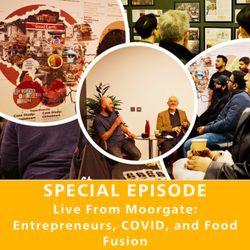
Live From Moorgate: Entrepreneurs, COVID, and Food Fusion
35:58||Season 2This week James and Luke were in Moorgate as panelists for 'The Gaze', organised by Middlesex University in collaboration with Small Business Research + Enterprise Centre and the HOMELandS Research Centre at the University of Westminster. They were there to discuss the often-hidden lives of immigrant food entrepreneurs in London. Through oral histories, memories and everyday business, the event explores how entrepreneurship becomes more than a means of survival. It is a way to build belonging, community, and city’s cultural and economic fabrics.The event was chaired by Dr. Rui Su, Senior Lecturer in Tourism and Middlesex Universiy.Panelists:Abdul Komor, Street Trading Service Manager, London Borough of Waltham Forest.Baron Deschauer, Market Manager, Tooting Market.So Mang Ham, Founder of the SoJu
10. A Sweet Aftertaste with James and Luke
33:51||Season 2, Ep. 10In this Episode James and Luke recap the series and answer some of the question and comments they have receieved throughout. They also reintroduce Sohini Banerjee and play a section of the Q&A from their sell out show at Pitzhanger Manor and Gallery.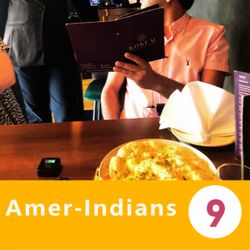
9. Amer-Indians
33:46||Season 2, Ep. 9TheAmer-Indians In this week’s episode, Luke travels to the outer reaches of London’s underground train network to meet James in Little Chalfont, to explore the places that increasing numbers of South Asian diasporas go when they move on from West London, and how they help transform those places and their cuisines. **Starters** (01.29-12-12) Ahead of their lunch with Vimal Dalal – a production editor on The Migration Menu and a one-time Southallian – James and Luke outline the history of post-World War II settlement in the suburbs and semi-rural towns that surround London. They discuss the appeal of such places – including the lure of selective school education – to those who first travelled from South Asia to London, settling in places like Southall, and the impact of these more recent movements on the suburban culinatry landscape. **Mains** (12:12-25:52) James and Luke meet Vimal outside The Kokum (www.thekokum.co.uk) for a pan-Indian inspired lunch, during which they hear the migration story of Vimal’s family, from Gujarat and Tanzania, to Southall in the 1980s and, via Hayes, to Little Chalfont, a village near Amersham, in Buckinghamshire. **Dessert** (25:52-33:05) After lunch chat reflects on how the suburban curry house has been transformed by more recent waves of migration out from the inner cities, which have also expanded the range of South Asian groceries and vegetables available in local shops. New arrivals also find themselves supported by groups like the Amer-Indians, through which social events and business networks are co-ordinated. James and Luke also reflect on how a nostalgic vision of pre-war Britain came to be shared by some members of the South Asian diasporas who came to settle here. **The Menu** Masala Papad Palak Patta Chaat Tandoori Soya Chaap Mumbai Prawns Koliwada Malai Kofta Vegetable Handi Kombdi Rassa Jackfruit Dum Biryani Chilli Garlic Coriander Naan Works Cited: Baumann, Gerd. 1996. Contesting Culture: Discourse of Identity in Multi-Ethnic London. Cambridge University Press. Caplan, Lionel. 1999. “Gifting and receiving: Anglo-Indian Charity and its Beneficiaries in Madras”. In Tradition, Pluralism and Identity: In Honour of T. N. Madan, edited by V. Das, D. Gupta and P. Uberoi, 283–305. New Delhi: Sage Publications.
8. Measure with the Heart
30:16||Season 2, Ep. 8In this week’s episode, James and Luke try out the food of The Maldives, an archipelago of coraline islands in the Indian Ocean. The Maldivian diaspora in the UK, compared to other South Asian groups, is tiny; consequently there are no Maldivian restaurants, but there is at least one Maldivian Supper Club (@maldiviansupperclub on Instagram), run by host Mie Ali Didi, who prepares the food eaten in this episode. **Starters** ( 1:15 – 12:00) James and Luke sketch out the historical background of Maldivian cuisine, including Sri Lankan influences since around the 1970s. Although the Maldives are often idealised as remote desert islands, they have played a role in Indian Ocean trading networks for more than 2,000 years, were colonised by the Portuguese, and became a British protectorate from 1887 to 1965, finally becoming a Republic in 1968. **Mains** (12:00-22:10) James and Luke join Mie Ali Didi and her friends for dinner at the Maldivian Supper Club, discussing with their guests what food from their homeland means to them and why. **Dessert** (20:12-29:40) After dinner chat includes a discussion of gender politics in the catering business (and why most supper clubs are run by women and restaurants by men); the history of Indian Ocean cuisine and the importance of family and food sharing to culinary traditions; and what it means to be part of one of the smallest South Asian diasporas in the UK. If you have any questions or comments for us, send them in and we will address them in a future show, you can get in touch at info@themigrationmenu.com. Or on ‘X’ - formerly Twitter: @migration_menu and Instagram @themigrationmenu The Maldivian Supper Club Menu Appetisers of smoked tuna, coconut and dates Roshi and Mashuni Pumpkin curry Aubergine dry curry Dal Rice Bananas, sugar, coconut, rice flakes and smoked fish/ Works Cited: Heslop, L. and Lubna, H. (2024) 'Infrastructure, circulation, and ecology in the Maldives'. Oxford Research Encyclopedia of Asian History. Heslop, L. and Jeffery, L. (2023) 'Roadwork: expertise at work building roads in the Maldives'. Journal of the Royal Anthropological Institute, 26 (2). pp. 284 - 301. Heslop, L. and Jeffery, L. (2021) 'Encountering Chinese development in the Maldives: gifts, hospitality, and rumours', in Heslop, L. and Murton, G. (eds.) Highways and Hierarchies: ethnographies of mobility from the Himalaya to the Indian Ocean. Amsterdam : Amsterdam University Press. pp. 175 - 196. Maloney, Clarence. 1976. The Maldives: New Stresses in an Old Nation. Asian Survey, Vol. 16, No. 7 (Jul., 1976), pp. 654-671.