Latest episode
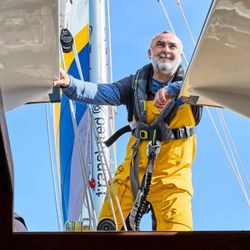
25. Trombetti, the Roman who taught machines to translate with the heart of Translated
11:06||Season 1, Ep. 25We speak to entrepreneur Marco Trombetti just days after being named one of Italy's newest Cavalieri del Lavoro honourees. He tells us how he went from studying astrophysics in France whilst chasing the origin of the universe, to building Translated with his wife Isabelle Andrieu in 1999, right when nobody else thought internet translation was worth building.What makes his story stand out is his refusal to pick sides in the AI versus human debate. While giants like Google and DeepL race to replace translators, Trombetti built something else, a system where machines learn from human corrections and get smarter every time, while people focus on the parts only they can do. It's why the company now supports 237 languages, works with over 700,000 translators worldwide, and counts Google, Airbnb and Uber among its clients.He's also convinced this could only have happened in Italy, where language barriers are felt every single day, not once you cross an ocean. This is a story about patience, naivety, and building a global business by keeping people at the centre of it.
More episodes
View all episodes
- 07:56||Season 1, Ep. 24In the lobby of Rome's Hotel Mediterraneo, guests check in under the gaze of a second-century marble goddess, hidden for decades. She spent over thirty years locked in a museum storeroom before anyone thought to bring her out. We meet Tracy Roberts, founder of Love Italy, who's on a mission to get Italy's hidden art off dusty shelves and into daily life through her project Arte Fuori dal Museo.The scale of the problem is wild. About 85 per cent of Italy's state-owned art sits in storage, unseen, while everyone crowds into the Colosseum and the Vatican. Tracy's solution is simple: hotels adopt a forgotten piece, pay to restore it, and display it around the clock, no ticket, no closing time. The goddess in the Mediterraneo was the first, discovered tucked in a corner of the National Roman Museum's storerooms. Tracy talks about finding her almost like meeting someone, not just uncovering an object.Ten hotels in Rome are already on board. Tracy's dream is bigger, though, with more museums, more cities, eventually banks, post offices, and maybe even hotels abroad. This is a story about art that's been waiting in the dark and one woman's case for finally letting it out.
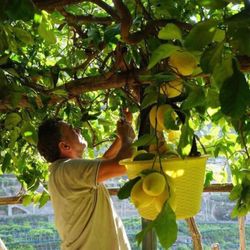
23. Lemons, cliffs & drones, the future of Amalfi's terraces since 1825 takes flight
06:02||Season 1, Ep. 23We climb to a terrace clinging to a cliff high above Amalfi, in the Valle dei Mulini, where Italy's brightest lemons are still picked by hand. Italy's brightest lemons are still picked by hand, knee and back. We meet Salvatore Aceto, whose family has worked these near-vertical slopes since 1825, seven generations of a job so steep and punishing that he sometimes struggles to explain how it was ever possible, and how it still is.The prize at the top of all that climbing is the Sfusato Amalfitano, the coast's yellow gold, prized for its huge fragrant zest and its wealth of essential oils, grown organically with a few closely guarded secrets. Now Salvatore is preparing something new for the harvest. Drones. After a first demonstration just weeks ago, he believes he is ready to deploy them within the year to carry loads up and down terraces too steep for any machinery, a change he calls a revolution not only for growers but for the coast's many abandoned buildings.From spaghetti al limone and scialatielli to his wife's lemon cake and a properly served limoncello, poured cold like a white wine rather than frozen into a bomb of alcohol, this is the story of a fruit, a family and a vertical world finding a way to keep going.Climb up here once, taste the zest, and you will understand why they refuse to let go.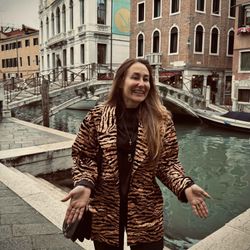
19. Frescoes, algorithms & monsters, inside Venice's Palazzo Diedo art show
09:50||Season 1, Ep. 19We step inside Palazzo Diedo in Cannaregio with curator Adriana Rispoli, where Berggruen Arts and Culture has staged Strange Rules. Berggruen Arts and Culture has staged Strange Rules there, the first curatorial reflection on protocol art ever mounted in Italy. Beneath restored 18th-century frescoes, algorithms run underfoot.Adriana walks us through new commissions from Matt Dryhurst and Holly Herndon, Trevor Paglen's 25-minute AI hypnosis piece, and the wider conversation behind the show. She explains why the new medium is the protocol, where the artist sits in a co-production with AI, and what Gramsci's monsters have to do with the algorithms shaping our lives.Running alongside the 61st Venice Biennale, it is a show about the strange rules of our technological epoch, and the people still trying to keep hold of the controls.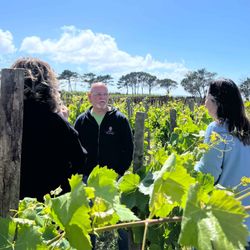
21. Sea, stone & vines, the rebirth of Aeolian wine one windblown harvest at a time
09:30||Season 1, Ep. 21We climb to Tenuta di Castellaro, 350 metres above the sea, where founder Massimo Lentsch rebuilds Aeolian wine vine by vine. Founder Massimo Lentsch is rebuilding Aeolian viticulture here, vine by vine.He tells us how a volcanic archipelago once known for its wines came close to losing them altogether, and what it has taken to bring the vineyards back to life on this windblown stretch of rock and sea.It is the story of an estate, an archipelago, and a quiet act of restoration carried out one harvest at a time.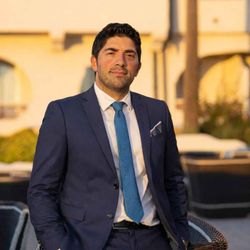
22. Sunsets, sulphur & silence, inside Vulcano's most discreetly luxurious hotel
07:45||Season 1, Ep. 22We meet Pierpaolo Tiretti on the Vulcanello promontory at Therasia Resort, Sea and Spa, a design-led Aeolian retreat with a storied past. The design-led Aeolian retreat occupies a piece of Italian television history. The villa was once the hideaway of Mike Bongiorno, the man who effectively invented Italian TV, and his celebrity rolodex laid the groundwork for what is today one of the islands' most discreet hotels.Pierpaolo, himself from Ischia, runs the property for the Polito family, who began at Parco Maria in the late 1960s and arrived on Vulcano in 2001. He tells us about Michelin-starred dining on a volcano, the raw chaos of the sulphurous fanghi baths where heads bob in the mud as the sea bubbles nearby, and the season Michael Jordan dropped anchor in the bay.It is a story of an island, a family and the quiet conviction that the real luxury is time, space and a sunset that falls differently every day of the year.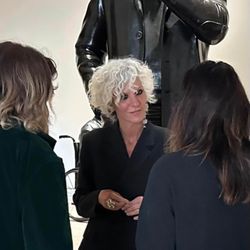
20. Bread, voices & emotion, the family that gives Italy's monuments a voice
10:16||Season 1, Ep. 20We meet Ilaria D'Uva in Venice, where she has just given a voice to the city's Naval Museum, work heard by two million people a year. Two million people a year already hear her words at the Duomo of Milan, the Pantheon, Pompeii and Assisi. She grew up, as she puts it, on bread and audio guides, the daughter of the man who created Italy's very first audio guide in 1959, after Florence said no and the future Pope Paul VI in Milan said yes.Ilaria tells us how one Florentine family came to hold the keys to so many of Italy's most iconic sites, why she now writes every narration herself as a piece of theatre set to original music, and how she uses AI all day long while remaining certain it can never reproduce the one thing her work lives on. Emotion.From a café on the island of San Giorgio to the Treasure of San Gennaro in Naples, and now the audio guide she is writing for Villa Adriana, where she has quietly fallen in love with the Emperor Hadrian, this is the story of how Italy finds the words to speak to the world, one voice at a time.