Share
The Delicious Legacy
The History of Sugar from Ancient India to the Caribbean Slave Plantations
How would our modern day to day life would be like, in a world without sugar?
I’m very pleased to have Neil Buttery on the podcast today, the food historian and author of “A dark history of sugar”, who’s book is out now and traces the origins of all the above, sugar’s production and consumption especially during its darkest parts between the 16th and 19th century.
Once, it was called Indian Salt. Or white salt. The Chinese lay claim to be the first to make it; among their many inventions.
It seems the art of making it though, came from India.
Sugar cane is a giant grass that once was native to the island of New Guinea.
This is the history of sugar, and sugar cane, the plant Saccharum officinarum which today is found growing in many places around the world, but crucially used in so many of our foods that it certainly makes it ubiquitous …
Darius the Persian King is said to have discovered in India a reed that gives honey without the aid of bees. And brought it home with him.
A spice -as it was considered in the ancient world- more expensive than any other, and used for medicinal primarily purposes.
Dioscorides, a Greek contemporary of Augustus, remarks that: ‘There is a kind of solid honey called saccharon, which is found in the reeds of India and Arabia the fortunate. It resembles salt in consistency, and crunches in the mouth.’
Sweet foods are very rare in nature indeed. And exactly why before the age of sugar, honey was the no1 sweetener in the world, eaten and used by people all over.
Energy giving, it was the only sweetener available in a pure and natural state.
We describe people as sweet when they’re nice, polite and so on.
Clearly sweetness is something we desire, something we need, something we revered as sacred since our deep ancient past. Honey and sugar have religious connotations too.
But we also need high energy for our development. As a species our need for sweet and sugar led us to develop ingenious ways to make things sweeter. From the development of sophisticated apiculture to agriculture and breeding selectively fruit bearing plants that have more sugar.
But how did sugar as we know today come to the forefront of our lives? And how it created and was shaped by the transantlantic slave trade, colonialism and exploitation of humans and nature?
If you want more archaeogastronomical content, and the extra bits from our conversation with Neil, please subscribe to the Patreon page here:
https://www.patreon.com/thedeliciouslegacy
You can buy Neil Buttery's "A Dark History of Sugar" book in every good bookshop.
Music by Pavlos Kapralos.
If you want to get your hands on some delicious Greek products go to Maltby and Greek website and use the code "delicious" at the checkout to get a lovely 15% discount!
Enjoy!
The Delicious Legacy
Support the podcast on Ko-Fi and Patreon for ad-free episodes!
More episodes
View all episodes

What's on the menu of Serve It Forth 2026?
24:01|Hello!Here's the little teaser of what will the 2nd Serve it Forth Food History festival include on Saturday 17th of October 2026! Me and my colleagues Sam Bilton Neil Buttery and Alessandra Pino discuss some elements from our planned festive day!There’s a little taster of the other courses of my co-curators ( A Curious Appetite, Neil Buttery and Sam Bilton ) are serving up during the festival which features Eleanor Barnett, Paul Couchman, Sally Grainger, Sudi Pigott and and of course me and Alexandra Sills. Tickets for the online festival are available here.The Serve It Forth Food History Festival is made possible with the generous support of our sponsors ckbk, Steenbergs, Regency Fiction Writers, Replica, Blackfriars Restaurant and Lindisfarne Mead.Also in this pod episode, Sam Bilton, ahead of her discussion with Jennie Hood and Professor Giles Gasper about how the Normans changed the way we eat, she had a chat with Kevin Booth, English Heritage’s Head Curator of Collections, about what the skeleton of ‘Conquest Man’ can tell us about the diet and health of the English at the time of the Norman invasion.If you happen to be in or near Barton on Humber in Lincolnshire on 20 September 2026 between 12pm and 4pm you can see Conquest Man’s skeleton and find out more about this project at St Peter’s Church.If you’d like to get a sense of what life was like for Conquest Man and his contemporaries during the Norman Conquest, Battle Abbey in East Sussex is hosting its annual reenactment of the Battle of Hastings on 10 and 11 October 2026, the week before Serve It Forth. Hundreds of reenactors take part, recreating Norman and Saxon camps and giving visitors an insight into everyday life for people almost 1,000 years ago. Tickets are now available from www.english-heritage.org.uk/battle Right, I'm off for some seafood!Enjoy!xThom
22. A Traditional Jewish Greek Recipe from Thessaloniki
18:13||Season 8, Ep. 22Hello!Today's episode explores just a little the Jewish Greek community, culture and food through the centuries.OK recommendations of the week: Let’s start with the Cookbook of the Jews of Greece by Stavroulakis, Nicholas which you can find on the internet archive dot org and it has been released in 1986. Lots of useful history, cultural context and recipes with the Shepardic names and english translations too. Link in the show notes:https://archive.org/details/cookbookofjewsof0000nich/mode/2upAt libcom.org the article The Making of the Caribbean PeopleThis lecture was delivered in 1966 in Canada at the Second Montreal Conference on West Indian Affairs.https://libcom.org/article/making-caribbean-peopleArchaeological news from my hometown:Greece's Ministry of Culture Restores Veria’s Orta Mosque and 15th-Century Twin Ottoman Bath:https://greekreporter.com/2026/09/05/greece-restores-veria-orta-mosque-twin-ottoman-bath/Enjoy!The Delicious LegacyDon't forget the 2nd Serve It Forth Food History Festival is taking place on Saturday 17th of October 2026. Check this from our sponsor CKBK:https://app.ckbk.com/features/serve-it-forth-an-online-festival-of-food-history
21. To Season, To Cure, Το Heal: A Briny History
48:49||Season 8, Ep. 21In the year 1734 three miners were taken aback when they discovered a male body inside Hallstatt salt mine. The body was very well preserved, having been mummified by salt. Accounts of the time say that the dead body, completely embedded into the rock salt deposits, was discovered following a collapse in the Kilbwerk. His shoes and traces of his clothes had been preserved: 'One can even see a bit of cloth on his dress, and the remains of the shoes on his feet'. The mine workers assumed that it was the long-dead body of a miner who had lived before the first official records, that is, more than 400 years earlier, but after thorough analysis and investigation, today’s assumption is that this man was the victim of a mining accident approximately 1000 BCE. The heyday of prehistoric mining was in the late Iron Age between 800 and ca. 400 BCE. At that time, miners would penetrate as much as 200 metres into the mountain, in the Austrian Alps, extracting not gold or precious metals but copious amounts of salt, about half a tonne a day with hand tools, supplying salt to half of Europe 2000 years ago!Hello!Today we are busting all the old myths about the salt!What and how the Romans used it?What did the Greeks say about it?Humans, like other mammals, relied on the small amounts of salt naturally present in food to regulate the amount of fluid in the body. Very powerful mechanisms for conserving salt within the body were developed. For 5 million years, our ancestors added no salt to their diet. The addition of salt to food began relatively recently, about 5000 years ago. As people became increasingly addicted to it, salt became the most important object of trade and the economic foundation of several empires. It was used by authoritarian governments to control their people and as the main source of tax revenue.Join me on another archaeogastronomical adventure!The Delicious Legacy Podcast
20. Naxos, Weeds, Cheese and Patience Gray
33:21||Season 8, Ep. 20Hello!Welcome back to another adventure my curious archaeogastronomers!Honey from a Weed, Fasting and Feasting in Tuscany, Catalonia the Cyclades and Apulia by Patience Gray is an iconic book about Mediterranean food, traditions centred around the simplest and most common dishes of everyday people.Patience Gray was an English cookery and travel writer of the mid-20th century. Her two most popular books were Plats Du Jour (1957) – written with Primrose Boyd, about French cooking – and Honey From A Weed (1986), an account of the Mediterranean way of life.In my opinion this book has to be more universally known and celebrated so here's a start. I will be coming back to explore the author's life and recipes in another episode!For this episode I explore quickly a few recipes from the book that are Greek and a couple of them more from the island of Naxos.I hope you'll enjoy!You can buy Honey from a Weed:Fasting and feasting in Tuscany, Catalonia, the Cyclades and Apuliaby Patience Gray (1917-2005), Food and Travel WriterContributor: Illustrated by Corinna Sargood, Artisat Equinox Publishing website, digital, print or ebook here: https://www.equinoxpub.com/projects/honey-from-weedMy recommendations for the week include:Endangered Eating: America’s Vanishing Foodshttps://sarahlohman.com/endangered-eating-book/The Ancient Magic of Malt: Making Malt Sugars and Ale from Grain Using Traditional Techniques:https://exarc.net/issue-2021-2/at/ancient-magic-malt-makingLove & Fish SoupThom & The Delicious Legacy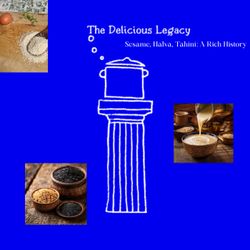
19. Sesame, Halva and Tahini: A Rich Complicated History
41:29||Season 8, Ep. 19Hello!New episode is out and it's all about, the history of sesame seeds, their use in ancient cuisines, especially Greek, their symbolism and spread across the ancient world...And what is halva anyway?! Hint: Tahini & honey...So today we are travelling to the source of sesame seeds in India, then to Ancient Mesopotamia, and Egypt, and we are examining ancient Greek desserts, and from there we are going all the way to China too!We are also looking at the role that trade between Arabia-India-China played to the spread of goods in the ancient world.Enjoy!The Delicious Legacy
Recipe of the week on a Sunday: Two Traditional Onion Recipes
13:32|Hello! Welcome to the recipe of the week on a Sunday by The Delicious Legacy!Two Greek recipes with onion as the star ingredient one way or another!Enjoy!Thom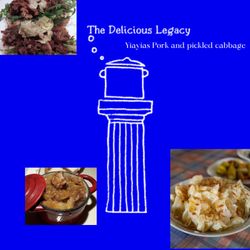
My Grandmother's slow cooked pork & pickled cabbage
16:34|This is a recipe and a short story that I wrote about six years ago, which you'll find out listening as to what it is and why, I hope you will enjoy it!Love,The Delicious Legacy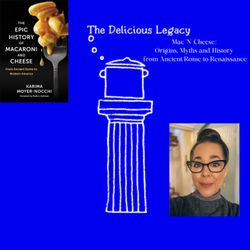
18. Macaroni and Cheese: Origins, Myths and History, from Ancient Rome to Renaissance
58:25||Season 8, Ep. 18Hello!Brand new episode is out!I’m talking with food historian Karima Moyer Nocchi. Earlier this year she published a brand new fascinating book titled THE EPIC HISTORY OF MACARONI AND CHEESE: FROM ANCIENT ROME TO MODERN AMERICA by Columbia University Press, which I devoured from start to finish. I was made aware late last year and I could not wait for its publication. So the honour talking with her and the excitement is even bigger than normally guys and girls!Before we go to the interview with my excellent and erudite guest, let me make an exciting announcement …!The online Serve it Forth Food History Festival will be returning on Saturday 17th of October 2026. Curated by the guild of food writers members and podcasters, historians, writers and all around hyper talented humans, Sam Bilton, Neil Buttery, Alessandra Pino alongside with me, Thom Ntinas. The festival will explore many different aspects of historical food featuring fascinating discussions and historical cookery demos. Details on the full line up will be coming soon but you can view the summary of the day’s “menu” on our website. https://serveitforthfest.wixsite.com/info/bill-of-fareLet me just tell you that for our amuse bouche introduction course we have none other than the amazing food historian Eleanor Barnett! I’ll be exploring the diet and lifestyle of ancient olympians and gladiators in the Greek and Roman world with historian Alexandra Sills.Tickets are available on eventbrite and I’ll put a link below:https://www.eventbrite.com/e/serve-it-forth-food-history-festival-2026-tickets-1992224789976?aff=ebdsoporgprofile My recommendations for the week:Glorious Exploits by Ferdia Lennon – classical tragedy as a Celtic caperhttps://www.theguardian.com/books/2024/jan/06/glorious-exploits-by-ferdia-lennon-review-classical-tragedy-as-a-celtic-caperAmerican farmers slid solar panels over 62,000 acres of farmland, and the biggest payoff had almost nothing to do with electricity.https://energiesmedia.com/solar-panels-farmland-crops-agrivoltaics/The English Olive Co, the original english olive oil:https://www.englisholive.co.uk/. You can get Karima's book here:https://cup.columbia.edu/book/the-epic-history-of-macaroni-and-cheese/9780231215312/More about Karima:https://www.theeternaltable.com/. Love,Thom & The Delicious Legacy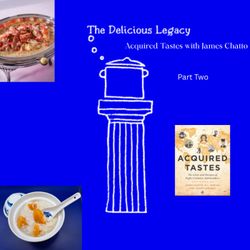
17. Acquired Tastes: An Interview With James Chatto Part Two
39:13||Season 8, Ep. 17Hello!Here's part two of my delightful conversation with James Chatto where we delve into the main characters of his fabulous book!Enjoy!Thom