Share
The Delicious Legacy
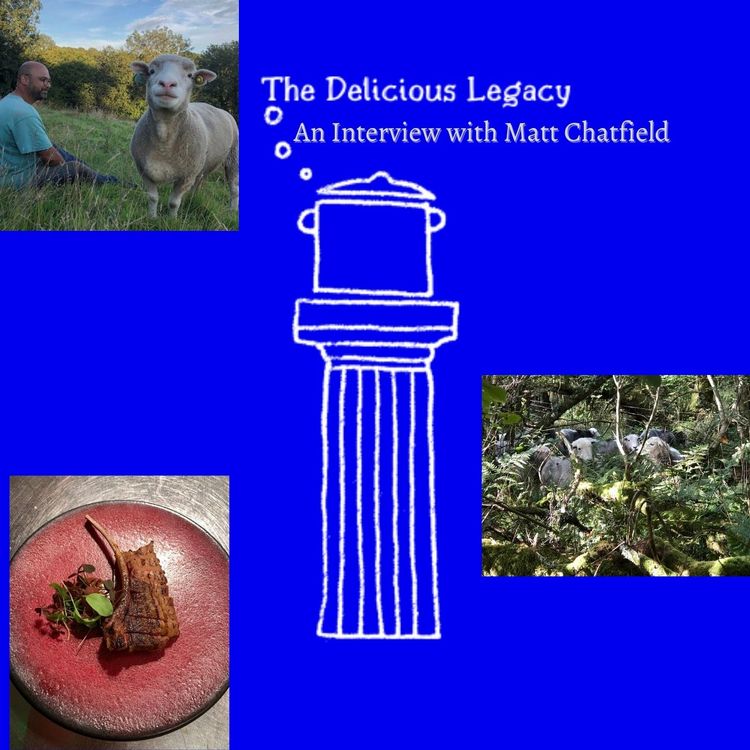
The Cornwall Project - An Interview with Matt Chatfield
Today's episode is taking a little bit of turn; I always wanted to know more about the Cornwall Project and Cull Yaw mutton, a meat not so popular in UK but there's a man that is fighting to change this: Matt Chatfield. We talk about traditional farming, timeless ancient techniques, Silvopasture and how this will help humankind for the future too.
Our online interview was very challenging as Matt is obviously down in Cornwall in his caravan somewhere in a field with only a mobile phone and sporadic 4G signal. We were regularly losing connection due to wind apparently and the quality of the audio is not the best one I'm afraid, but nevertheless I think you will enjoy the knowledge that Matt kindly offered here and shared with all of us! Matt highlights the fact that there are many farmers that are doing an excellent work both to feed the people but also care for nature.
Anyway I hope you enjoy Matt's thoughts and actions, and buy his lovely aged mutton! Incredibly tasty and versatile!
Some brilliant quotes:
- "If you look after nature, flavour looks after itself."
- "I just look after nature by using the sheep and incredible things happen."
- "I detest factory farming especially what we do to the chickens and pigs."
His Cull Yew meat is some of the tastiest mutton I have ever tried, and of course is extremely ethical, done with love and care and according to ancient methods and traditions of rearing animals that help the environment and nature, wildlife and as an added bonus sequester carbon into the ground, so help combat climate change too!
According to many farmers nowadays this is the future. Top quality meat from really happy animals grazing in woodlands.
Silvopasture is the term that's used and we talk with Matt about it quite extensively.
We are chatting about farming and farmers in general, how can they make a living and also get some younger people into farming, why the current talk of rewilding is such a con, and why it would be great to rewild Kensington with bears and wolves (!!!)
And of course the need to feed the nation and do it from our soil and land, and not make it impossible for farmers to grow meat here. How offsetting our meat production it is a form of colonial future which isn't not so far removed from the horrors of the colonial past.
And many, many other subjects!
Fascinating talk, very pleased with it, I hope you will enjoy it too!
Thanks to Maltby and Greek for their support. I'm delighted to say that the listeners get a 15% discount from the deli in London,
when you shop online using the code "delicious" here: maltbyandgreek.com/delicious
The Delicious Legacy
Support the podcast on Ko-Fi and Patreon for ad-free episodes!
More episodes
View all episodes
20. Naxos, Weeds, Cheese and Patience Gray
32:19||Season 8, Ep. 20Hello!Welcome back to another adventure my curious archaeogastronomers!Honey from a Weed, Fasting and Feasting in Tuscany, Catalonia the Cyclades and Apulia by Patience Gray is an iconic book about Mediterranean food, traditions centred around the simplest and most common dishes of everyday people.Patience Gray was an English cookery and travel writer of the mid-20th century. Her two most popular books were Plats Du Jour (1957) – written with Primrose Boyd, about French cooking – and Honey From A Weed (1986), an account of the Mediterranean way of life.In my opinion this book has to be more universally known and celebrated so here's a start. I will be coming back to explore the author's life and recipes in another episode!For this episode I explore quickly a few recipes from the book that are Greek and a couple of them more from the island of Naxos.I hope you'll enjoy!My recommendations for the week include:Endangered Eating: America’s Vanishing Foodshttps://sarahlohman.com/endangered-eating-book/The Ancient Magic of Malt: Making Malt Sugars and Ale from Grain Using Traditional Techniques:https://exarc.net/issue-2021-2/at/ancient-magic-malt-makingLove & Fish SoupThom & The Delicious Legacy
19. Sesame, Halva and Tahini: A Rich Complicated History
41:29||Season 8, Ep. 19Hello!New episode is out and it's all about, the history of sesame seeds, their use in ancient cuisines, especially Greek, their symbolism and spread across the ancient world...And what is halva anyway?! Hint: Tahini & honey...So today we are travelling to the source of sesame seeds in India, then to Ancient Mesopotamia, and Egypt, and we are examining ancient Greek desserts, and from there we are going all the way to China too!We are also looking at the role that trade between Arabia-India-China played to the spread of goods in the ancient world.Enjoy!The Delicious Legacy
Recipe of the week on a Sunday: Two Traditional Onion Recipes
13:32|Hello! Welcome to the recipe of the week on a Sunday by The Delicious Legacy!Two Greek recipes with onion as the star ingredient one way or another!Enjoy!Thom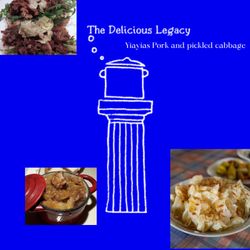
My Grandmother's slow cooked pork & pickled cabbage
16:34|This is a recipe and a short story that I wrote about six years ago, which you'll find out listening as to what it is and why, I hope you will enjoy it!Love,The Delicious Legacy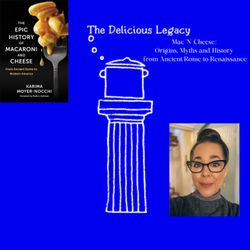
18. Macaroni and Cheese: Origins, Myths and History, from Ancient Rome to Renaissance
58:25||Season 8, Ep. 18Hello!Brand new episode is out!I’m talking with food historian Karima Moyer Nocchi. Earlier this year she published a brand new fascinating book titled THE EPIC HISTORY OF MACARONI AND CHEESE: FROM ANCIENT ROME TO MODERN AMERICA by Columbia University Press, which I devoured from start to finish. I was made aware late last year and I could not wait for its publication. So the honour talking with her and the excitement is even bigger than normally guys and girls!Before we go to the interview with my excellent and erudite guest, let me make an exciting announcement …!The online Serve it Forth Food History Festival will be returning on Saturday 17th of October 2026. Curated by the guild of food writers members and podcasters, historians, writers and all around hyper talented humans, Sam Bilton, Neil Buttery, Alessandra Pino alongside with me, Thom Ntinas. The festival will explore many different aspects of historical food featuring fascinating discussions and historical cookery demos. Details on the full line up will be coming soon but you can view the summary of the day’s “menu” on our website. https://serveitforthfest.wixsite.com/info/bill-of-fareLet me just tell you that for our amuse bouche introduction course we have none other than the amazing food historian Eleanor Barnett! I’ll be exploring the diet and lifestyle of ancient olympians and gladiators in the Greek and Roman world with historian Alexandra Sills.Tickets are available on eventbrite and I’ll put a link below:https://www.eventbrite.com/e/serve-it-forth-food-history-festival-2026-tickets-1992224789976?aff=ebdsoporgprofile My recommendations for the week:Glorious Exploits by Ferdia Lennon – classical tragedy as a Celtic caperhttps://www.theguardian.com/books/2024/jan/06/glorious-exploits-by-ferdia-lennon-review-classical-tragedy-as-a-celtic-caperAmerican farmers slid solar panels over 62,000 acres of farmland, and the biggest payoff had almost nothing to do with electricity.https://energiesmedia.com/solar-panels-farmland-crops-agrivoltaics/The English Olive Co, the original english olive oil:https://www.englisholive.co.uk/. You can get Karima's book here:https://cup.columbia.edu/book/the-epic-history-of-macaroni-and-cheese/9780231215312/More about Karima:https://www.theeternaltable.com/. Love,Thom & The Delicious Legacy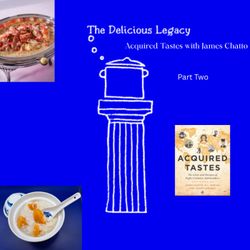
17. Acquired Tastes: An Interview With James Chatto Part Two
39:13||Season 8, Ep. 17Hello!Here's part two of my delightful conversation with James Chatto where we delve into the main characters of his fabulous book!Enjoy!Thom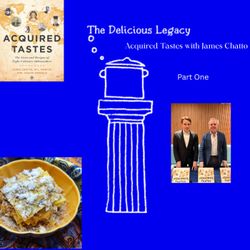
16. Acquired Tastes an Interview with James Chatto Part One
39:57||Season 8, Ep. 16James Chatto. Actor, puppet maker, author, food writer and journalist. A truly multi-talented, one would say even a renaissance man! He is my honoured guest on The Delicious Legacy today, to tell us all about his latest book “Acquired Tastes” a food history book, which explores the extraordinary journeys of specific recipes as they moved from one culture to another—carried and transmitted by eight remarkable individuals...Hello! Welcome back to another episode of the Delicious Legacy!You can get James' book here:https://utppublishing.com/doi/book/10.3138/9781487566609Enjoy!LoveThom
15. Odyssey: Food, Feasting and the meaning of 'Xenia'
46:18||Season 8, Ep. 15Hello!Welcome back to another archaeogastronomical adventure!I couldn't help myself but having Odyssey as my inspiration for this week's episode!As you probably have heard Christopher Nolan has his epic film Odyssey in official release this Friday 17th of July 2026 so I thought what better way to dive into the ancient Homeric epic poem than exploring their foods, cooking, dishes and the meaning of xenia, hospitality, kindness to strangers and welcoming others into ones house?We will also dive into the real Bronze Age Greece and the archaeological discoveries there. What do these tell about feasting, communal eating and the food of the people in the Helladic world, three thousand years ago?Enjoy!The recommendations for this week are:Did Roman Britain Ever End?Nicholas J. Higham writes about the long death of Roman Britainhttps://www.unseenhistories.com/did-roman-britain-ever-end-nicholas-j-higham/Alexandra Sills:https://www.waterstones.com/book/gladiators-in-the-greek-world/alexandra-sills//9781036130480Welsh Smokery and shop:https://welshsmokery.co.uk/about-us/our-story/Love and wineThom & The Delicious Legacy
14. Flint Dibble: Zooarchaeology, Ancient Greece and Food
01:19:59||Season 8, Ep. 14Hello!Ugly stuff? Broken Bones? The earliest archaeologists a century ago ignored these. But not my guest today! Flint Dibble is an ancient historian and archaeological scientist who studies people, animals, and the environment in the ancient Greek world. According to his words, his goal is to make real archaeological research accessible to everyone.With the publication of "The agropastoral debate in context: the relationship between the consumption and management of animals at Azoria on Crete" I wanted to share this conversation I had with Flint about the food in Ancient Greece. What do we know? What does the archaeological evidence tells us that is the same, similar or diverges, from the literary sources that survived the passage of time?What animals were eaten in ancient Greece? How did the ancient Greeks prepared them? And what was the difference between home cooking and sacrificial, professional butchering and cooking for public feasts? How were the poor and the elite different in their eating habits, and how was the food cooked at home and in mobile situations? What does the isotope analysis of teeth and bones tells us about the climate through a millennia of ancient greek history, and how that affected the agropastoralism and transhumanism? When were the first chickens eaten in the Greek context? All the above and a lot more are discussed in our conversation with the fantastic Flint Dibble!The write up about Flint's article can be found here:A goat’s tooth may have solved a 100‑year debate about ancient Greek farminghttps://theconversation.com/a-goats-tooth-may-have-solved-a-100-year-debate-about-ancient-greek-farming-285839The article:https://link.springer.com/article/10.1007/s12520-026-02512-7Flint's YouTube channel:www.youtube.com/@flintdibbleMusic by Pavlos KapralosEnjoy!Thom & The Delicious Legacy Podcast