Share
The Delicious Legacy
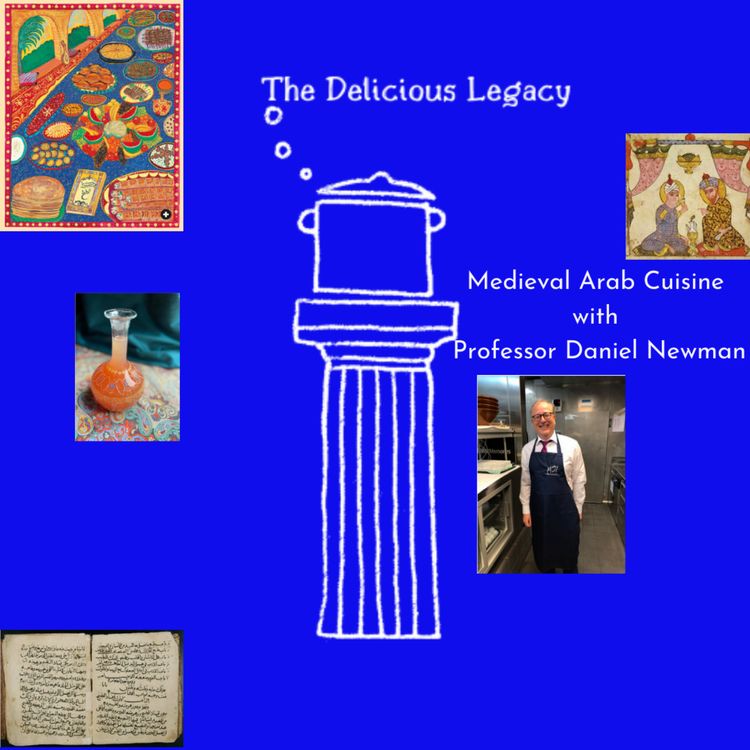
Medieval Arab Cuisine with Professor Daniel Newman Pt1
The Islamic Golden Age...
What does it come to one's mind when hears the above words?
Do you think of the 'Arabian Nights' ? Or as it is properly called as 'One Thousand and One Nights'?
Is your imagination also filled with other Middle Eastern Folk tales of Aladdin and Ali Baba and Sinbad the Sailor?
Or, maybe, the flourishing of scientific, cultural, economic activities in the near middle east and the centre of the worlds knowledge in the largest city then in the world, Baghdad?
Well so you should; these are superbly important aspects of the medieval Arab world, but for me equally important was the flourishing of an extremely delicious, complex culinary tradition, a cuisine with one foot in the Arab peninsula and the other in ancient Persia! Mouth watering rich stews and elaborate banquets, feasts for kings and caliphs that lasted weeks on end...
In other words, food! Food glorious food, food that we've never heard of, food and recipes that influenced the European medieval cuisine and to this day we find echoes of them in recipes across the known world,-without exaggeration- from India to South America!
For this reason I have invited on today's episode Professor Daniel Newman; an academic from Durham University specialising in Arabic literature, to talk to us about the medieval Arab cuisine. He is also known for his blog "Eat like a Sultan" where he brings the medieval recipes to our modern world with some mouth watering creations, professor Newman shares with us his unique insight of a rich and wonderful world!
This was such a fun interview and I thoroughly enjoyed our chat. He is such a passionate and knowledgeable man who loves sharing his wisdom with us! If I had such lecturers when I was at University doubtless my time there would have been much, much more worthwhile!
Today's music Nihavend peşrev is kindly performed by Pavlos Kapralos and it's by Petros Peloponnesios a great cantor, composer and teacher of Byzantine and Ottoman music (born c. 1735 Tripolis– died in 1778 Constantinople) the music is influenced obviously by Persian motifs and the song is played with a santur which is a hammered dulcimer of Iranian or Mesopotamian origins.
Prof Daniel Newman's blog, Eat Like A Sultan: http://eatlikeasultan.com/
Thank you and enjoy!
Thom & The Delicious Legacy
Support the podcast on Ko-Fi and Patreon for ad-free episodes!
More episodes
View all episodes
26. Egypt's Long Food History
01:03:11||Season 8, Ep. 26Hello!Brand new episode for you my curious archaeogastronomers!On this episode we explore the traditional foods of Egypt. My recent interview with Suzanne Zeidy and Rawah Badrawi is about their journey across Egypt tasting and discovering the ancient and traditional tastes of the various Egyptian cuisines!From the Mediterranean zone of Alexandria to the Monastic mountains of Sinai, across the Nile and down to the Nubian tribes in the southern borders with Sudan! A culinary exploration of Egypt that haven't happened in such scale and ambition before!Get the lovely book by Rawah and Suzanne here:https://www.waterstones.com/book/egypt/rawah-badrawi/suzanne-zeidy/9781848994478?sv1=affiliate&sv_campaign_id=626889&awc=3787_1792617498_697af4441e5d1aae2ec6d8f3183ac991&utm_source=626889&utm_medium=affiliate&utm_campaign=adstrongEnjoy!Love and bottargaThom & The Delicious Legacy
25. The Lost Perry Cider Cultures of Central Europe
57:23||Season 8, Ep. 25Hello!A brand new archaeogastronomical adventure beckons! Welcome back my curious archaeogastronomers!What is perry? How is it made? Where do we hear about it firstly? And crucially, why has been almost lost, and now rediscovered, what does the future hold?Listen and enjoy our latest episode here! With perry and cider maker Barry Masterson!Links to Barry's work:Perry: A Drinker's Guide by Adam Wells - published by CAMRA Books - https://shop1.camra.org.uk/product/perry-a-drinkers-guide/and all good book stores.On Bluesky, spamming about pears and border collie pics: https://bsky.app/profile/barmas.bsky.socialOn Instagram: https://www.instagram.com/kertelreiter_cider/Cider Review: https://cider-review.com/CR on Insta: https://www.instagram.com/cider_review/Love and pears,Thom & The Delicious Legacy
24. Blood as Food Through Ireland’s History
57:04||Season 8, Ep. 24Morcilla in Spain, Stornoway Black Pudding in Scotland, Mustamakkara in Finland, Sângerete in Romania...This ancient tradition of using the blood as an ingredient in food and dishes persists in our modern world, despite the rules, regulations and war against artisanal produce from the modern food industry...Hello!I'm excited to give you the latest episode of The Delicious Legacy!And what an epic adventure it is!I'm talking to Kate Ryan author of "Blood, Guts, and Black Pudding; Ireland’s Dying Art of Blood As Food" a new, comprehensive and the first of it's kind! Documenting the Irish tradition and food history, of consuming blood as nutritious, sustainable food source!I tell you I was surprised to know many of the facts in the book. I thought live bleeding was a technique that only existed in nomadic cultures of Africa. But apparently it was alive and kicking in Ireland too, till very, very recently!Join me and Kate and find out all about blood, black pudding, the different variations of pudding (what is dirsheen?) and how this ancient tradition, started dying slowly, and where are we now!You can get Kate's book and find out more here:https://ninebeanrowsbooks.com/en-gb/products/blood-guts-and-black-puddingLove and guts and blood and glory!Thom
23. Did Ancient Greek Women Have Parties?
48:22||Season 8, Ep. 23Hello my curious archaeogastronomers!New episode is out!Did women in the ancient Greek world had parties? Dinner gatherings? Symposia? Alone or with their men? And what did they do on their own? Especially in those famous festivals?So many questions to answer! Enjoy!Links for this episode:https://www.hellenic.org.au/post/the-thesmophoria-women-s-ritual-in-the-ancient-worldhttps://en.wikipedia.org/wiki/Ares_GynaecothoenasHipparchia of Maroneia:https://en.wikipedia.org/wiki/Hipparchia_of_Maroneiahttps://thestoicmom.substack.com/p/a-role-model-for-saying-no-and-doinghttps://www.worldhistory.org/Hipparchia_of_Maroneia/Seclusion, Separation, and the Status of Women in Classical AthensDavid Cohen https://www.jstor.org/stable/643180This episode was also heavily influenced and drew info from these two papers:WOMEN'S COMMENSALITY IN THE ANCIENT GREEK WORLD By JOAN BURTON 1998DINING LIKE DIVINITIES: EVIDENCE FOR RITUAL AND MARITAL DINING BY WOMEN IN ANCIENT GREECE Laurie Ann Kilker 2008Recommendations for the week:Gareth Eoin Storey's substack: https://garethstorey.substack.com/p/we-work-in-marketingHow apple detectives solved the mystery of an ancient tree—and rewrote the history of fruithttps://www.scientificamerican.com/article/how-apple-detectives-solved-the-mystery-of-an-ancient-tree-and-rewrote-the-history-of-fruit/UN report: Global hunger levels ease for third consecutive year as regional disparities persisthttps://www.who.int/news/item/21-07-2026-un-report--global-hunger-levels-ease-for-third-consecutive-year-as-regional-disparities-persistDarren Turpin from orchard notes, has links library, to highlight the work of fellow fruit-focused writers, organisations, food and drink producers, and anything else of interest he might find out there on t’Internet. Anyway go here:https://orchardnotes.com/about-notes-from-the-orchard/Love and lentil soupThom & The Delicious Legacy
What's on the menu of Serve It Forth 2026?
24:01|Hello!Here's the little teaser of what will the 2nd Serve it Forth Food History festival include on Saturday 17th of October 2026! Me and my colleagues Sam Bilton Neil Buttery and Alessandra Pino discuss some elements from our planned festive day!There’s a little taster of the other courses of my co-curators ( A Curious Appetite, Neil Buttery and Sam Bilton ) are serving up during the festival which features Eleanor Barnett, Paul Couchman, Sally Grainger, Sudi Pigott and and of course me and Alexandra Sills. Tickets for the online festival are available here.The Serve It Forth Food History Festival is made possible with the generous support of our sponsors ckbk, Steenbergs, Regency Fiction Writers, Replica, Blackfriars Restaurant and Lindisfarne Mead.Also in this pod episode, Sam Bilton, ahead of her discussion with Jennie Hood and Professor Giles Gasper about how the Normans changed the way we eat, she had a chat with Kevin Booth, English Heritage’s Head Curator of Collections, about what the skeleton of ‘Conquest Man’ can tell us about the diet and health of the English at the time of the Norman invasion.If you happen to be in or near Barton on Humber in Lincolnshire on 20 September 2026 between 12pm and 4pm you can see Conquest Man’s skeleton and find out more about this project at St Peter’s Church.If you’d like to get a sense of what life was like for Conquest Man and his contemporaries during the Norman Conquest, Battle Abbey in East Sussex is hosting its annual reenactment of the Battle of Hastings on 10 and 11 October 2026, the week before Serve It Forth. Hundreds of reenactors take part, recreating Norman and Saxon camps and giving visitors an insight into everyday life for people almost 1,000 years ago. Tickets are now available from www.english-heritage.org.uk/battle Right, I'm off for some seafood!Enjoy!xThom
22. A Traditional Jewish Greek Recipe from Thessaloniki
18:13||Season 8, Ep. 22Hello!Today's episode explores just a little the Jewish Greek community, culture and food through the centuries.OK recommendations of the week: Let’s start with the Cookbook of the Jews of Greece by Stavroulakis, Nicholas which you can find on the internet archive dot org and it has been released in 1986. Lots of useful history, cultural context and recipes with the Shepardic names and english translations too. Link in the show notes:https://archive.org/details/cookbookofjewsof0000nich/mode/2upAt libcom.org the article The Making of the Caribbean PeopleThis lecture was delivered in 1966 in Canada at the Second Montreal Conference on West Indian Affairs.https://libcom.org/article/making-caribbean-peopleArchaeological news from my hometown:Greece's Ministry of Culture Restores Veria’s Orta Mosque and 15th-Century Twin Ottoman Bath:https://greekreporter.com/2026/09/05/greece-restores-veria-orta-mosque-twin-ottoman-bath/Enjoy!The Delicious LegacyDon't forget the 2nd Serve It Forth Food History Festival is taking place on Saturday 17th of October 2026. Check this from our sponsor CKBK:https://app.ckbk.com/features/serve-it-forth-an-online-festival-of-food-history
21. To Season, To Cure, To Heal: A Briny History
48:49||Season 8, Ep. 21In the year 1734 three miners were taken aback when they discovered a male body inside Hallstatt salt mine. The body was very well preserved, having been mummified by salt. Accounts of the time say that the dead body, completely embedded into the rock salt deposits, was discovered following a collapse in the Kilbwerk. His shoes and traces of his clothes had been preserved: 'One can even see a bit of cloth on his dress, and the remains of the shoes on his feet'. The mine workers assumed that it was the long-dead body of a miner who had lived before the first official records, that is, more than 400 years earlier, but after thorough analysis and investigation, today’s assumption is that this man was the victim of a mining accident approximately 1000 BCE. The heyday of prehistoric mining was in the late Iron Age between 800 and ca. 400 BCE. At that time, miners would penetrate as much as 200 metres into the mountain, in the Austrian Alps, extracting not gold or precious metals but copious amounts of salt, about half a tonne a day with hand tools, supplying salt to half of Europe 2000 years ago!Hello!Today we are busting all the old myths about the salt!What and how the Romans used it?What did the Greeks say about it?Humans, like other mammals, relied on the small amounts of salt naturally present in food to regulate the amount of fluid in the body. Very powerful mechanisms for conserving salt within the body were developed. For 5 million years, our ancestors added no salt to their diet. The addition of salt to food began relatively recently, about 5000 years ago. As people became increasingly addicted to it, salt became the most important object of trade and the economic foundation of several empires. It was used by authoritarian governments to control their people and as the main source of tax revenue.Join me on another archaeogastronomical adventure!The Delicious Legacy Podcast
20. Naxos, Weeds, Cheese and Patience Gray
33:21||Season 8, Ep. 20Hello!Welcome back to another adventure my curious archaeogastronomers!Honey from a Weed, Fasting and Feasting in Tuscany, Catalonia the Cyclades and Apulia by Patience Gray is an iconic book about Mediterranean food, traditions centred around the simplest and most common dishes of everyday people.Patience Gray was an English cookery and travel writer of the mid-20th century. Her two most popular books were Plats Du Jour (1957) – written with Primrose Boyd, about French cooking – and Honey From A Weed (1986), an account of the Mediterranean way of life.In my opinion this book has to be more universally known and celebrated so here's a start. I will be coming back to explore the author's life and recipes in another episode!For this episode I explore quickly a few recipes from the book that are Greek and a couple of them more from the island of Naxos.I hope you'll enjoy!You can buy Honey from a Weed:Fasting and feasting in Tuscany, Catalonia, the Cyclades and Apuliaby Patience Gray (1917-2005), Food and Travel WriterContributor: Illustrated by Corinna Sargood, Artisat Equinox Publishing website, digital, print or ebook here: https://www.equinoxpub.com/projects/honey-from-weedMy recommendations for the week include:Endangered Eating: America’s Vanishing Foodshttps://sarahlohman.com/endangered-eating-book/The Ancient Magic of Malt: Making Malt Sugars and Ale from Grain Using Traditional Techniques:https://exarc.net/issue-2021-2/at/ancient-magic-malt-makingLove & Fish SoupThom & The Delicious Legacy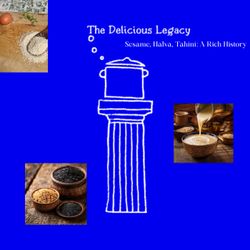
19. Sesame, Halva and Tahini: A Rich & Complicated History
41:29||Season 8, Ep. 19Hello!New episode is out and it's all about, the history of sesame seeds, their use in ancient cuisines, especially Greek, their symbolism and spread across the ancient world...And what is halva anyway?! Hint: Tahini & honey...So today we are travelling to the source of sesame seeds in India, then to Ancient Mesopotamia, and Egypt, and we are examining ancient Greek desserts, and from there we are going all the way to China too!We are also looking at the role that trade between Arabia-India-China played to the spread of goods in the ancient world.Enjoy!The Delicious Legacy