Share
Sweat Your Assets Podcast
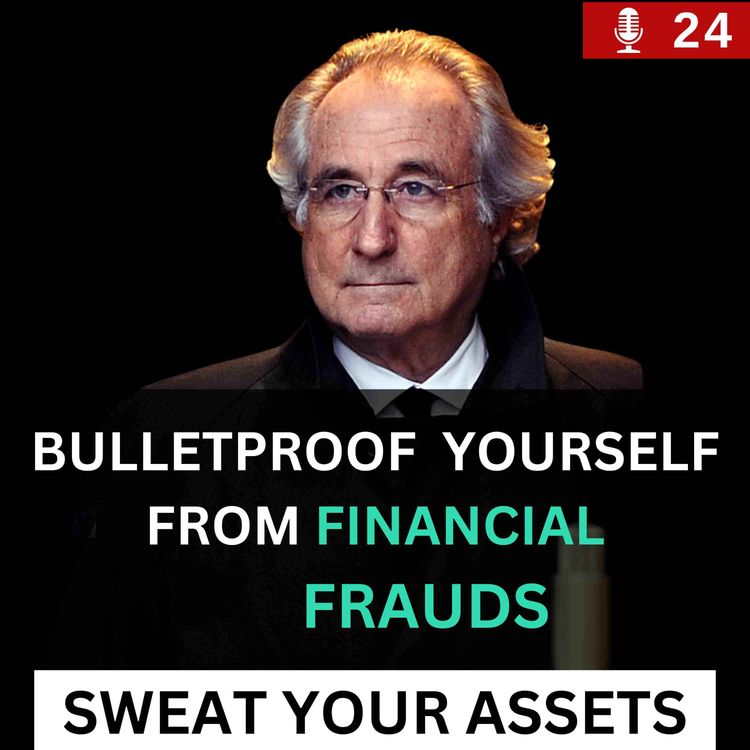
Bulletproof Yourself from Financial Scams
🎙️ Welcome to Another Episode of the Sweat Your Assets Financial Diary!
Investing can feel like a treasure hunt—everyone wants to find the smartest opportunity, the next big thing, or an exclusive deal. But here’s the hard truth: by the time you realize you’ve walked into a financial trap, it’s often too late.
Instead of chasing the impossible, let's take a page from Warren Buffett’s playbook:
“Rule number one: never lose money. Rule number two: don’t forget rule number one.”
His longtime partner, Charlie Munger, put it even more bluntly:
“It’s remarkable how much long-term advantage people like us have gotten by trying to be consistently not stupid, instead of trying to be very smart.”
So today, we’re not here to find the next golden opportunity. We’re here to learn how to avoid being the next victim.
Join me as we explore some of history’s most infamous financial frauds, from Charles Ponzi’s original pyramid scheme to Bernie Madoff’s multi-billion dollar deception.
These cases weren’t just the work of criminals—they thrived because of weak financial controls, unchecked investor greed, and a dangerous lack of financial education.
If you want to bulletproof your investments, you need to know what to watch out for.
🔎 Rule #1: If it sounds too good to be true, it probably is. Stay away.
🔎 Rule #2: Never invest in something you don’t understand.
So, grab a coffee and let’s dive into the world of financial fraud—so you can spot the red flags before it’s too late.
💡 And don’t forget—subscribe to our Monthly Newsletter to stay ahead with smart financial insights.
If you want to dig deeper, check out detailed article.
Let’s get started! 🚀
Alessandro BARONI - Sweat Your Assets
Disclaimer: this episode was produced as an edutainment resource. While the contents are based on a blog post article, the discussion and narration have been generated using AI tools. The purpose of this podcast is to inform and engage, but listeners should be aware that the dialogue is AI-assisted and may not fully reflect Sweat Your Assets opinions or real-time updates. Contact the office for customized guidance.
Sweat Your Assets is a financial education platform built on one idea: anyone can learn to manage money wisely, build wealth steadily, and make decisions that hold up over time.
The podcast is one piece of a larger sandbox — alongside a blog, YouTube channel, and monthly newsletter. Everything comes from what I read, test, and apply about money, investing, and financial freedom.
No sponsorships. No shortcuts. Just honest, evidence-based thinking.
Each episode covers what actually matters: financial mindset, money psychology, investing principles, building income, and avoiding the traps that keep people broke.
The conversations the mainstream media rarely has, because they don't sell.
If you want to think more clearly about money, you're in the right place.
Sweat Your Assets — Alessandro Baroni 🌐 sweatyourassets.biz ▶️ youtube.com/c/SweatYourAssets 📩 Newsletter: sweatyourassets.aweb.page/financial-growth-newsletter
More episodes
View all episodes
54. What Sting Gets Right About Kids Financial Independence
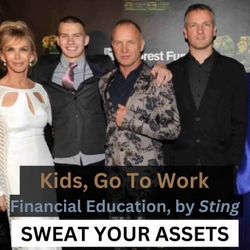
10:31||Season 3, Ep. 54Kids financial independence is built at the kitchen table, not in a will. Today´s article uses Sting’s much-discussed stance on inheritance to explore what parents actually pass on to their children, and why the most valuable financial gift has nothing to do with money.Reading a recent interview with Sting, I came across a line that stopped me. Asked again whether his six children would inherit his fortune, the 74-year-old singer laughed, then said something worth sitting with: telling your children they do not have to work is “a form of abuse that I hope I’m never guilty of.”This article is about what he means, why I believe he is right, and what it actually looks like in practice.Enjoy the episode, Sweat Your Assets.
53. The Pale Blue Dot: A Compass for Chaotic Times
17:43||Season 3, Ep. 53In 1990, a spacecraft four billion miles from Earth turned its camera back toward home. What it captured was almost nothing — a pale blue crescent, less than a pixel, adrift in darkness. Carl Sagan spent years fighting to make that photograph happen. He knew it would change something about how we see ourselves.In chaotic times, that image remains one of the most useful things any of us can look at. Not for comfort — for proportion. For the kind of clarity that only comes when you zoom out far enough to see where you actually are.In this episode, we explore what the pale blue dot really asks of us: from Ptolemy to Copernicus, from Pascal's terror to Marcus Aurelius's view from above, from Camus's absurd to Sagan's quiet, unambiguous conclusion — this is the only world we have, and it is where we make our stand.A conversation about ego, perspective, stewardship, and what it means to care about the right things, in the right proportion, with the right degree of urgency.Enjoy the episode. Alessandro BARONI - Sweat Your Assets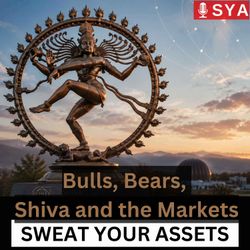
52. The Bull, the Bear and the Dance of Shiva
13:46||Season 3, Ep. 52Walk through Bowling Green at the southern tip of Manhattan and you will find the Charging Bull — 3.5 tonnes of bronze installed in the dark of night in December 1989 by Sicilian sculptor Arturo Di Modica, without permission, as a personal gift to a city shaken by the 1987 crash. It was removed by police within hours and returned by public demand within days. It has stood there ever since on a temporary permit that has now lasted more than thirty years.The bull and the bear are the two dominant symbols of capital markets. They describe direction: prices rising, prices falling. They are useful shorthand. But they are also incomplete, because what they do not capture is the underlying rhythm that connects them — the pattern beneath the price chart.That pattern has an unlikely visual expression: a two-metre bronze statue of the Hindu deity Shiva, in his form as Nataraja, the Lord of the Dance, standing on the campus of CERN in Geneva. Gifted by the Indian government in 2004, it was placed there because CERN's physicists recognised in it a metaphor for what they study: the continuous creation, transformation, and destruction of matter at the subatomic level. The physicist Fritjof Capra first drew this parallel in 1972, and the plaque beside the statue quotes him directly.In this episode, we explore what happens when you bring these three images together. The bull and the bear show you the visible motion of markets. The Nataraja shows you the deeper structure: a cycle without a final destination, in which creation and destruction are not opposites but the same dance. And understanding that rhythm — rather than projecting current conditions forward in a straight line — is arguably the most practical skill available to a long-term investor.Topics covered include the story behind Di Modica's guerrilla installation, the iconography of the Nataraja and why it ended up at CERN, the cognitive error of linear thinking in markets, Howard Marks on cycles, and what composure actually looks like as an investment practice.Alessandro BARONI
51. Practice Makes Perfect. Reps First. Mastery Follows.
11:40||Season 3, Ep. 51What separates people who build real skills — in life, business, and investing — from those who only ever plan to? A pottery class parable, a filmmaker who posted a video every day for 534 days, and a personal finance writer who turned creative discipline into an investment philosophy all point to the same answer: reps come first, and mastery follows.In this episode, we look at the pottery experiment from Art and Fear, Nick Maggiulli's lessons from 500 blog posts and his book Just Keep Buying, Casey Neistat's legendary daily vlog streak, and what Arnold Schwarzenegger, Anders Ericsson, and Seth Godin all have to say about how mastery is actually built. We also explore what this means for your financial independence journey — because the reps-first principle applies just as powerfully to saving, investing, and building wealth as it does to throwing clay.The cost of inactivity compounds just as surely as the returns on consistent action. The only question is how many pots you're willing to make before you start worrying about perfection.Read the full article and explore more episodes at sweatyourassets.biz.Alessandro BARONI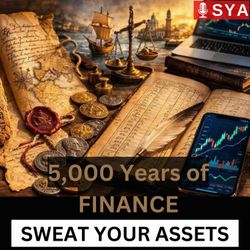
50. The History of Finance Through Fresh Eyes. The Untold Story, and Why It Matters More Than Ever
19:36||Season 3, Ep. 50Most people think finance begins with capitalism. It doesn't. It begins with a neighbour helping you bring in the harvest, and the unspoken obligation that follows.In this episode of Sweat Your Assets, we travel five thousand years of financial history — from Sumerian clay tablets and Lydian coins, through medieval Italian merchants and Islamic risk-sharing contracts, to the bridge in Amsterdam where the world's first stock exchange was born.Along the way, we discover that writing was invented to track debt, that mathematics was built to serve commerce, and that the logic behind modern venture capital was already alive in a Genoese trading contract from eleven fifty-six.This is not a story about capitalism. It is a story about human cooperation — and understanding it is the first step toward your own financial freedom.Enjoy. Sweat Your Assets. Alessandro BARONI
49. Are You Risk Averse? By Aswath Damodaran
14:22||Season 3, Ep. 49We're wired to avoid risk. It's biological — built into us long before financial markets existed.In this Sweat Your Assets episode, Professor Aswath Damodaran — the Dean of Valuation — traces risk aversion all the way back to Bernoulli's 18th century experiment, and explains why understanding why we fear risk is just as important as understanding risk itself.Enjoy.Sweat Your Assets, Alessandro BARONI
48. What is Risk in Investing, by Aswath Damodaran
04:13||Season 3, Ep. 48The Chinese word for risk is made of two characters: danger and opportunity. And that tension is exactly what most investors get wrong. In this Sweat Your Assets episode, Professor Aswath Damodaran — known as the Dean of Valuation — breaks down what risk really is, why we can't fully measure it, and why that's not a problem to solve but a reality to understand. Enjoy.SWEAT YOUR ASSETS, Alessandro Baroni
47. How to Guarantee a Life of Misery - 7 Prescription for Life, by Charlie Munger
08:55||Season 3, Ep. 47In 1986, Charlie Munger — vice chairman of Berkshire Hathaway and Warren Buffett's long-time partner — delivered one of the most unconventional commencement speeches ever given.Instead of telling the graduating class how to be happy, he told them exactly how to guarantee misery. The logic? Simple. If you know what destroys a life, just avoid those things — and your odds of a good one go way up.The idea was borrowed from Johnny Carson — legendary host of The Tonight Show — who had done the same years earlier. Munger liked it so much, he expanded it with four prescriptions of his own.The original audio does not exist, so it is delivered here in another voice. This is an abridged version of that speech. Every prescription. Every key quote. Nothing essential left out.Read the full original speech: 👉https://sweatyourassets.biz/guarantee-a-life-of-misery/Invert. Endure. Compound.Sweat Your Assets —You are not separated from your goals by a number of years, but by a number of decisions.📩 Subscribe for more: https://sweatyourassets.aweb.page/financial-growth-newsletter
46. The Most Important Thing in Investing
29:22||Season 3, Ep. 46Let's talk about something most investors never stop to question. Not which stocks to pick. Not which sector is hot right now. But the way they actually think about investing... and whether that way of thinking is working against them. Welcome to a new episode of Sweat Your Assets. I'm Alessandro, and today I want to take you back to a conversation that happened in 2013... but honestly could have been recorded yesterday. It's a sit-down between two people who have shaped modern finance more than almost anyone else. On one side... Howard Marks. Co-founder and co-chairman of Oaktree Capital Management... a firm built on a very specific corner of the market. High-yield bonds. Private credit. Distressed debt. In other words... the companies most investors won't touch. The ones that look broken on the surface. And yet... that's exactly where Oaktree has quietly built one of the best long-term track records in the industry. Marks is also the author of The Most Important Thing... a book Warren Buffett called... and I quote... a useful book. Which from Buffett... is basically a standing ovation. On the other side... Michael Milken. Chairman of the Milken Institute... and one of the most controversial and consequential figures in the history of capital markets. The man who essentially invented the high-yield bond market... and who, years earlier, had a meeting with a young analyst named Howard Marks that would shape Marks' entire investment philosophy. Think about that for a moment. These two didn't just meet for an interview. They go back decades. Now... I'm not going to pass you straight to the recording. Instead, I want to share some of the highlights with you... the moments that I think matter most... and give you some context along the way so you can really absorb what's being said. Because here's the thing. The ideas Marks discusses in this conversation... second-level thinking... the relationship between risk and price... why most investors are playing the wrong game... none of that has an expiry date. Markets change. Headlines change. The psychology driving those markets? Barely moves at all. So let's get into it. And as always... you can find more at sweatyourassets.biz.Alessandro