Share
Sweat Your Assets Podcast
The Matthew Effect. Why the rich get richer
In this episode, we explore The Matthew Principle through the lens of the Parable of the Talents, one of the most powerful and misunderstood stories ever told about growth, responsibility, and inequality.
Often quoted as “to those who have, more will be given”, the parable is usually treated as a religious or moral lesson. But taken at face value, it reveals a surprisingly modern financial and economic logic: resources grow when used productively and disappear when left idle.
We unpack the parable as an early model of capital allocation, risk, incentives, and compounding, showing how action, responsibility, and decision-making shape long-term outcomes—both in finance and in life. We also examine why fear and inaction are not neutral choices, and how the cost of doing nothing often exceeds the cost of taking informed risks.
This episode connects biblical wisdom with modern personal finance, behavioural economics, and investing, offering a timeless framework for understanding wealth creation, opportunity, and the mechanics that lead to the compounding of advantages over time.
If you’re interested in financial education, investing, compounding, inequality, incentives, and long-term thinking, this episode offers a fresh and practical perspective on a 2,000-year-old insight that still governs how money—and life—works today.
Enjoy the Episode. Sweat Your Assets.
Sweat Your Assets is a financial education platform built on one idea: anyone can learn to manage money wisely, build wealth steadily, and make decisions that hold up over time.
The podcast is one piece of a larger sandbox — alongside a blog, YouTube channel, and monthly newsletter. Everything comes from what I read, test, and apply about money, investing, and financial freedom.
No sponsorships. No shortcuts. Just honest, evidence-based thinking.
Each episode covers what actually matters: financial mindset, money psychology, investing principles, building income, and avoiding the traps that keep people broke.
The conversations the mainstream media rarely has, because they don't sell.
If you want to think more clearly about money, you're in the right place.
Sweat Your Assets — Alessandro Baroni 🌐 sweatyourassets.biz ▶️ youtube.com/c/SweatYourAssets 📩 Newsletter: sweatyourassets.aweb.page/financial-growth-newsletter
More episodes
View all episodes
44. The Actual Fraud Behind Think and Grow Rich by Napoleon Hill
21:50||Season 3, Ep. 44Think and Grow Rich is one of the most recommended books in personal finance. It has sold over a hundred million copies, sits on every entrepreneur reading list, and is endorsed by some of the most successful people in the world. There is just one problem. The man who wrote it was a professional conman, the credentials were fabricated, the famous mentors were invented, and the book contains an entire chapter on channelling sexual energy into wealth... backed by the example of a castrated bull. In this episode, Alessandro cuts through ninety years of hype to ask the question nobody in the self-help world wants to answer honestly: is there anything real underneath the con? What does the science actually say about mindset, positive thinking, and the Law of Attraction? And why does a wrong mindset guarantee failure... while the right one still cannot guarantee success? Welcome to a new episode of the Sweat Your Assets podcast.Tune in and Enjoy the episode. Alessandro
43. The 2X rule. If you cannot afford to buy it twice, you cannot afford it at all
09:19||Season 3, Ep. 43What does it really mean to afford something? Most of us answer with a simple check: do I have enough to buy it? But one of the oldest rules in personal finance sets a stricter standard.The 2× Rule says: if you cannot afford to buy it twice, you cannot afford it at all.Rooted in Talmudic wisdom, echoed by Buffett and Taleb, and illustrated unforgettably by Gogol’s tragic clerk who lost everything when his coat was stolen — this rule is less about money than about what it means to truly own something. And in a world built around Buy Now Pay Later, it may be the most countercultural financial idea you’ll read today. Thank you for tuning in. Until next time, Sweat Your AssetsAlessandro Baroni
42. Financial Responsibility is not GREED
16:00||Season 3, Ep. 42Financial responsibility is universally praised — by policymakers, educators, and personal finance advocates alike. Saving, investing, and planning ahead are essential, not just for individual well-being, but for the health of society as a whole.And yet, something curious happens in practice. In certain circles, those who save diligently, invest wisely, and live below their means are met with mockery and quiet circumspection. The disciplined are cast as cold and calculating. The carefree spender is the one people warm to.This episode examines that inversion honestly — where it comes from, why it persists, and what it costs us. It is a deliberately provocative conversation, tackling a subject where misplaced guilt, social pressure, and paternalism dressed as compassion do real damage.The goal is not to shame anyone. It is to have the honest conversation that too many circles make difficult.Keep it real. Sweat Your Assets.
41. Investment Wisdom, by Howard Marks
31:42||Season 3, Ep. 41Welcome to a new episode of the Sweat Your Assets podcast.Howard Marks is the co-founder of Oaktree Capital Management and author of "The Most Important Thing" and "Mastering the Market's Cycles".In this 2022 Q&A, he shares his investment wisdom covering these subjects:How to measure the temperature of the marketsThe danger of weaving a narrative. The case of tech and bitcoinMaking money by lending to crap companiesThe logic behind market callsThe value of idiosyncratic positionsDare to be greatWe don't value quantitative analysis and modelsBe a sceptic (the case of Bernie Madoff)Learn your lessons inexpensivelySuccess carries the seeds of failureIt is all about BalanceHow to rely (or NOT) on DATAFixed Income Investing is the Negative ArtIf we avoid the losers, the winners take care of themselvesKnow what you don't know & know something other people don't knowThank you for tuning in.Until next time.Sweat Your Assets
40. Why Financial Education Is Really About Freedom
04:10||Season 3, Ep. 40In this episode of Sweat Your Assets, we explores why education is the true foundation of financial freedom. Inspired by a powerful story from Italian intellectual Corrado Augias, and drawing insights from thinkers like Charlie Munger and the iconic red-pill metaphor from The Matrix, this conversation goes beyond money tactics and investment strategies.In an age of artificial intelligence, information overload, and financial noise, the real competitive advantage is not access to data — it is judgment. This episode examines how critical thinking, lifelong learning, and intellectual discipline protect you from manipulation, poor financial decisions, and passive conformity.If you care about financial education, independent thinking, wealth building, and long-term personal freedom, this episode will challenge you to rethink what it truly means to be “financially free.”Because financial freedom does not begin with assets.It begins with escaping ignorance.
39. What is your financial freedom Number?
08:03||Season 3, Ep. 39In this episode of Sweat Your Assets, we tackle one of the most important — and often avoided — questions in personal finance: How much money do you actually need to be financially secure or financially free?Most people have vague goals. “One million.” “A lot.” “Enough.”But without a concrete number, financial freedom remains a wish — not a plan.We break down:The difference between financial security and financial freedomWhy measuring your expenses is the starting point of clarityThe power of active income and passive income working togetherHow the 4% rule (Trinity Study framework) helps you estimate your target numberWhy your Financial Freedom Number is roughly 25 times your annual expensesAnd why mindset and discipline matter more than technical complexityThrough practical examples and simple math, you’ll learn how to calculate your own number and understand what it truly means to have your assets working for you — instead of the other way around.Financial freedom isn’t mystical. It’s measurable. And once you measure it, you can build toward it.If you’re serious about intentional money management, long-term investing, and building real financial independence, this episode gives you the framework to start.🎯 Action step: Calculate your annual expenses and multiply by 25. That’s your first draft Financial Freedom Number.Thank you for listening. Alessandro Baroni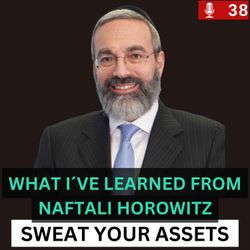
38. What I have learned from Naftali Horowitz
10:56||Season 3, Ep. 38In this episode of Sweat Your Assets, I explore the timeless financial wisdom of Naftali Horowitz — a voice of uncommon clarity in a world dominated by financial noise. Far from the culture of instant gratification, debt-fueled lifestyles, and performative wealth, Horowitz advocates discipline, responsibility, intergenerational thinking, and moral courage in money decisions.Through practical examples — from teaching young couples how to manage money before mistakes become irreversible, to questioning today’s “everything-now” culture of holidays, takeaway food, private cars, and lifestyle inflation — this episode connects old-world prudence with modern financial challenges.This is not about extreme frugality. It is about intentionality. It is about understanding that wealth is built quietly, through habits, values, and long-term thinking.If you care about financial education, personal responsibility, and building durable wealth without illusions, this conversation will give you a framework that goes beyond tactics — and touches character.Enjoy, SWEAT YOUR ASSETS - Alessandro Baroni
36. One More Move: What Chess Teaches Us About Not Giving Up
06:21||Season 3, Ep. 36In this episode of the Sweat Your Assets Podcast, Alessandro explores chess as a powerful metaphor for fate, responsibility, and human agency.From a medieval mural in Täby Church, to Ingmar Bergman’s iconic film The Seventh Seal, and a mysterious 19th-century engraving by Moritz Retzsch, this episode traces how chess has been used for centuries to frame our relationship with destiny and choice.At the center of the story is a haunting question: what if a position that looks like checkmate isn’t actually over?Drawing on a famous chess anecdote involving Paul Morphy, the episode challenges the idea that fate is always final — and suggests that resignation often arrives before necessity.This is not an episode about winning. It’s about attention. About responsibility. And about checking the board one more time before accepting the verdict.A reflective episode on decision-making, agency, and why sometimes what we call destiny is simply an unexamined position.