Latest episode

10. Stacey Smith on Flower Color Evolution and Life as a Botanist
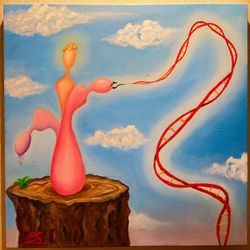
01:02:43||Season 4, Ep. 10Please click below to fill out the survey for this episode:Science Fare Podcast Feedback FormScience Fare Podcast website Online resources mentioned in this episode: Stacey’s flower petal image on the Howard Hughes Medical Institute Biointeractive site Stacey’s essay, With Bated Breath Stacey’s lab websiteScientific American article, “DNA Studies Uncover Unexpected Evolutionary Changes in Modern Humans”Paúl Gonzáles social media on plants Our guest today Stacey Smith. Stacey is an associate professor in the Ecology and Evolutionary Biology department at the University of Colorado in Boulder. Her lab studies the evolution and genetics of flowers with a focus on the tomato family.Recent work in her lab has focused on the evolution of flower color, as this trait has a relatively simple genetic basis and is ecologically important. Results of the lab’s studies suggest that flower color changes can involve a range of genetic mechanisms and may often be driven by competition for pollinators.Highlights of the episode:*Susan introduces the Science Fare podcast and opens with a quote from our guest who describes the surprising and unintuitive way flowers make the color red [0:01];*Susan introduces guest Stacey Smith, a botanist at UC Boulder [1:31]; *Stacey tells us about her path to becoming a scientist, including how when she went to college she asked, What major is for people who like wildflowers? [3:38];*Listener question! From Megan, age 16, a senior in high school — How do plant pigments such as chlorophyll, Anthocyanins, and carotenoids work with the visible light spectrum and absorb certain wavelengths of light and then appear as a certain color? [6:27];*Why is flower color simple genetically? [9:31];*Why is flower color important ecologically? [12:00];*What would a landscape of flower colors have looked like way back when flowers first came on the scene? [15:02];*How do you start in the search for plant fossils? [16:53];*Yes, we need more botanists to go outside and make new discoveries in plants — AI cannot do it alone! [19:56];*Stacey’s lab’s work on convergent evolution [21:30];*Interesting examples of convergent evolution in the development of red pigments in flowers and other examples [26:10];*What does Stacey’s research process look like? [30:30];*An especially beautiful image under the microscope of petals — the image looked like a carpet of pink cells with orange globs and it was a picture of the day at Howard Hughes Medical Institute [35:30];*Another listener question! This is from Sam, age 16, in Lafayette, CO and he asks, What evolutionary pressures are responsible for the evolution of plant pigments? [36:40];*What does Stacey like most about her job and what surprises her? [41:33];*The importance of writing in being a successful scientist [42:52];*What is like having so many undergraduate and high school students in Stacey’s lab? [45:47]*Stacey’s essay “With Bated Breath” and the importance of basic science because you don’t know what incredible discoveries it can lead to [48:22];*What path would a high school student interested in plants take? What advice do you have? [56:05];*Stacey’s suggestions for online resources on plants [59:50]
More episodes
View all episodes

9. Why is Flower Color Important Ecologically? With Stacey Smith
04:11||Season 4, Ep. 9Please click below to fill out the survey for this episode:Science Fare Podcast Feedback FormScience Fare Podcast website Our guest today Stacey Smith. Stacey is an associate professor in the Ecology and Evolutionary Biology department at the University of Colorado in Boulder. Her lab studies the evolution and genetics of flowers with a focus on the tomato family.Recent work in her lab has focused on the evolution of flower color, as this trait has a relatively simple genetic basis and is ecologically important. Results of the lab’s studies suggest that flower color changes can involve a range of genetic mechanisms and may often be driven by competition for pollinators.In this mini episode, Stacey answers the question, “Why is flower color important ecologically?”
8. David C. Schwartz on the Beginnings of Genomics and What the Future Holds
43:53||Season 4, Ep. 8Please click below to fill out the survey for this episode:Science Fare Podcast Feedback FormScience Fare Podcast website Our guest today is David Schwartz, who is a genomic scientist and emeritus professor of chemistry and genetics at the University of Wisconsin-Madison. Dave received his Ph.D. from Columbia University in 1985 and he invented an important method for separating large DNA molecules called pulsed field gel electrophoresis. Dave was a professor at NYU in the chemistry department until 1999 when he moved to UW-Madison, where he founded and directed the Genomic Sciences Training Program.In this full-length interview, Dave talks about his life growing up and interest in science, his early research developing pulsed field gel electrophoresis, then his move into imaging single DNA molecules through the optical mapping system, and where genomics has come and where it’s going. He also gives advice to students interested in science — spoiler alert — run toward those hard problems! Highlights of the episode:*Susan introduces the Science Fare podcast and opens with a quote from our guest who says scientists are the intellectual fire fighters - they run toward the hard problems [0:01]; *Susan introduces guest David Schwartz, a genomic scientist and emeritus professor of chemistry and genetics at the University of Wisconsin - Madison and he was also Susan’s Ph.D. advisor [1:07]; *Dave tells us about his life growing up and how Mr. Wizard and his older brother sparked his interest in science [3:42];*His experience going to Bronx Science in NYC — “the most competitive academic environment” [6:36];*The beginning of the idea of pulsed field gel electrophoresis during his senior year of college — he was at Hampshire College but spent senior year at college [7:40];*Dave went to UCSD to pursue this idea more [11:28];*Dave moved back east, transfers to Columbia University to continue his Ph.D. program and refined pulsed field gel electrophoresis there [13:02];*Dave became very interested in the genetics and biology — what were the new problems that physical science could solve? [14:30];*Susan makes the point that Dave’s new genomic approach was hitting this middle scale — in between the sequence of DNA fragments and cytogenetic approaches [17:28];*Dave talks about why certain parts of the genome were originally called junk, and the importance of running toward hard problems and doing “dangerous science” [18:50];*Dave moved on to a research position at the Carnegie Institution of Washington (now Carnegie Science) and began using microscopy to image DNA molecules [20:20];*The beginnings of optical mapping and Dave’s move to NYU [24:00];*Why working with large DNA molecules was so hard [29:29];*The link between single molecules and what happens in meiosis, something students learn about in high school science [31:37];*When will the “perfect genome” be cheap and easy? [35:40];*Dave’s advice for high school students interested in science [40:40]
7. Meiosis at the Level of Single DNA Molecule with David Schwartz
03:40||Season 4, Ep. 7Please click below to fill out the survey for this episode:Science Fare Podcast Feedback FormScience Fare Podcast website In this mini episode, host Susan Keatley gives an overview of what happens in meiosis and genomic scientist David Schwartz talks about how genomics enabled biologists to make discoveries through, in part, visualizing single DNA molecules. Schwartz connects the ability to visualize single DNA molecules to what is going on when a cell goes through meiosis.
6. Jan Drgona on Solving Problems with Energy Sustainability in Buildings Using Scientific Machine Learning and Engineering
47:23||Season 4, Ep. 6Please click below to fill out the survey for this episode:Science Fare Podcast Feedback FormAnd, check out the Science Fare Podcast website! Our guest today is Jan Drgona, who joins us today from Johns Hopkins University. Jan is an associate professor in the department of civil and systems engineering, and is also at the Ralph S O’Connor Sustainable Energy Institute. In this full-length interview, Jan talks with us about the challenges in sustainably heating and cooling buildings, and how physics and scientific machine learning can help. Highlights of the episode:*Susan introduces the Science Fare podcast and frames the idea that a building’s materials play a role in the ubiquitous challenge of fighting the second law of thermodynamics [0:01]; *Susan introduces guest Jan Drgona, an engineering professor at Johns Hopkins University who is studying sustainable energy use in buildings [1:30]; *Jan shares his “winding” path to becoming a scientist, from wide-ranging interests in science as a kid to knowing he wanted to be a scientist due to a great high school chemistry experience and interests in math and computers [2:29]; *A lucky encounter conversing with another Ph.D. student during the coffee break at a scientific workshop who was working in modeling physical processes in buildings and was looking to collaborate with someone with Jan’s background and skills [5:12]; *Susan reflects on the power of in-person scientist meetings leading to multi-decade collaborations [7:28]; *Jan talks about the fascinating and important interdisciplinary research going on at the Ralph S O’Connor Sustainable Energy Institute [8:30]; *Susan sets up the problem Jan is working on — the difficulty in sustainably heating and cooling buildings — and Jan explains why building energy use is often inefficient and what the problem-solving opportunities are [9:20]; *The hundreds or thousands degrees of freedom in building HVAC — far higher than in driving a car (more like 12 degrees of freedom)! And how one human can’t really manage this in a static rules-based way [12:23]; *Why we often need to wear sweaters in buildings in summer and other problems with the current, more conservative approach to HVAC [14:30]; *Let’s talk about these problems in terms of something high school students are learning — the second law of thermodynamics [15:30]; *Combining thermal mass and thermal resistance of building materials can help make operation more efficient [19:00]; *HVAC type — electrification and coefficient of performance [19:31]; *Susan introduces Next Generation High School Science Standard PS 3-4, which states that students should be able to plan and conduct an investigation to provide evidence that when two components of different temperature are combined within a closed system, transfer of thermal energy results in a more uniform energy distribution among the components in the system — buildings can be a great setting for this kind of investigation! [21:49]; *Jan describes scientific machine learning and how it’s different from regular machine learning and illustrates with a concrete example of a building he worked on [23:30]; *Jan explains that scientific machine learning combines the guarantees of the physics with the adaptability of machine learning [30:16]; *Susan asks what would be the most complicated building to deal with in terms HVAC? One kind, Jan explains, are data centers [31:55];*Jan’s hopes for the near future [34:27];*Susan asks, what do you enjoy most about working in science? Jan says the people and the community, and the chance to live in many different places and countries and meet many different kinds of people. [39:39];*Jan’s advice for high school students interested in science — follow your passion — your path is important! [43:20]; *Closing remarks, listener feedback information, and acknowledgment of the Science Fare team [45:47]
5. Physics and Machine Learning in Building Temperature Control with Jan Drgona
03:24||Season 4, Ep. 5Please click below to fill out the survey for this episode:Science Fare Podcast Feedback FormScience Fare Podcast website Our guest today is Jan Drgona, who joins us today from Johns Hopkins University. Jan is an associate professor in the department of civil and systems engineering, and is also at the Ralph S O’Connor Sustainable Energy Institute. Jan’s research focuses on energy management in buildings and he’s working on developing scientific machine learning methods to model energy management which turns out is very complex. In this mini episode, I ask Jan about what makes a building complicated to heat and cool, and describes the various factors that make temperature control a challenge, and hints at how physics and machine learning can help. Tune in next week for the full-length interview when Jan talks about making energy use in buildings sustainable and how scientific machine learning and problem solving with an engineering approach and mindset can help.
4. Tris Hann on How Police Use Physics to Investigate Motor Vehicle Crashes
40:52||Season 4, Ep. 4Please click below to fill out the survey for this episode:Science Fare Podcast Feedback FormAnd, check out the Science Fare Podcast website! In this full-length interview, Baltimore City police officer and education doctorate holder Tris Hann talks about his background in math education and explains how physics is used to investigate motor vehicle crashes.Highlights of the episode:*Susan introduces the Science Fare podcast and frames the idea of “physics world vs. real world” where ideal equations meet messy reality [0:01]; *Susan introduces guest Tris Hahn, a Baltimore City police officer and former math teacher and will tell us about how police officers use physics to investigate motor vehicle crashes [1:34]; *Tris shares his background in education and his transition from teaching math to becoming a police officer and why real-world applications of math and physics were central to his teaching philosophy [2:16]; *A listener question from a physics teacher — he asks about which actual measurements are taken at accident scenes and Tris explains [3:37]; *What investigators measure: area of impact, final rest positions, skid marks, and debris patterns [5:10]; *Why crash reconstruction often relies on calculating minimum speeds, not exact speeds [6:10]; *The equations the police use are essentially the same kinematics equations students learn in high school physics [7:32]; *Deep dive into skid marks: what they reveal about braking, vehicle motion, and driver behavior [8:46]; *A real-world crash example involving extreme speeding and how physics overturned assumptions about fault [13:38]; *Determining area of impact and danger of pedestrian being struck [17:55]; *A student listener question highlights the gap between idealized physics problems and messy real-world conditions [19:49]; *A full worked example: reconstructing a pedestrian crash using physics principles [25:03]; *Comparing outcomes at 66 mph vs. 30 mph—how speed exponentially affects stopping distance [32:44]; *The dangers of distracted driving, including statistics on phone use and crash risk [37:30]; *Closing remarks, listener feedback information, and acknowledgment of the Science Fare team [39:00]