Share
The Shakespeare and Company Interview
On Friendship, with Hollie McNish and Michael Pedersen
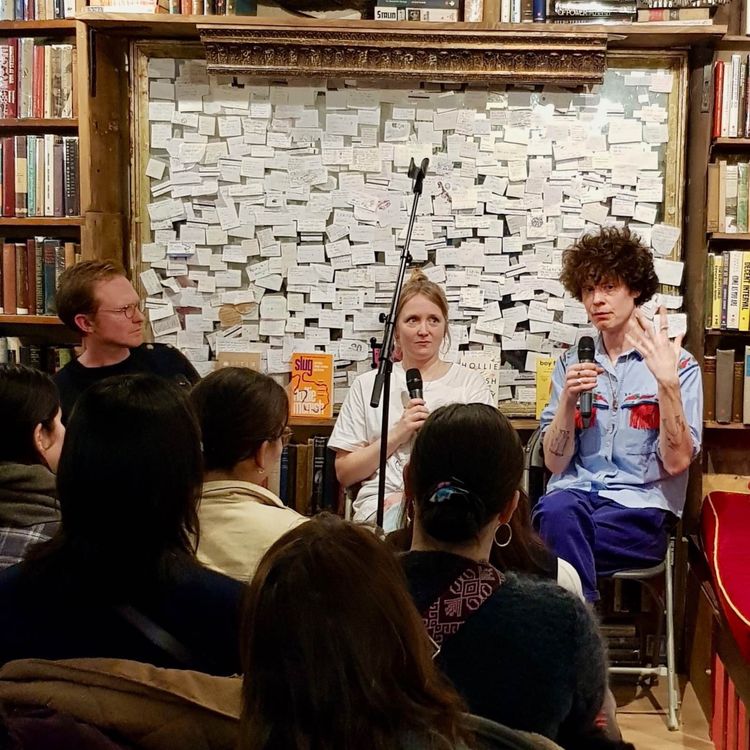
In early February, we hosted a riotous, tender, enchanting and uplifting evening of poetry and prose with the irrepressible Hollie McNish and Michael Pedersen. After their readings they sat down with Adam Biles for a chat about friendship, a theme that unites their work.
Buy Hollie McNish’s Lobster here: https://www.shakespeareandcompany.com/books/lobster
Buy Michael Pedersen’s Boy Friends here: https://www.shakespeareandcompany.com/books/boy-friends-2
*
Hollie McNish is a poet, author and lover based between Glasgow and Cambridge. She won the Ted Hughes Award for New Work in Poetry for her poetic parenting memoir – Nobody Told Me – of which The Scotsman stated ‘the world needs this book’. She has published four further lovely collections of poetry –Papers, Cherry Pie, Plum, and Slug, which was a Sunday Times bestseller, and was published in French by Le Castor Astral under the title Je souhaite seulement que tu fasses quelque chose de toi. Her new book, Lobster and other things I'm learning to love, is out now and according to her dad is 'her best work yet'. She loves writing.
Michael Pedersen is a prize-winning Scottish poet and author, and the Writer in Residence at The University of Edinburgh. His prose debut, Boy Friends, was published by Faber & Faber in 2022 to rave reviews and was a Sunday Times Critics Choice. He’s unfurled three collections of poetry, the most recent being The Cat Prince & Other Poems—which won the Books Are My Bag Readers Award for Best Poetry 2023. Pedersen has been shortlisted for the Forward Prizes for Poetry and The Saltire National Book Awards, and won a Robert Louis Stevenson Fellowship. His work has attracted praise from the likes of: Stephen Fry, Irvine Welsh, Kae Tempest, Jackie Kay, Sara Pascoe, Nicola Sturgeon & many more.
Adam Biles is Literary Director at Shakespeare and Company. His latest novel, Beasts of England, a sequel of sorts to Animal Farm, is available now. Buy a signed copy here: https://www.shakespeareandcompany.com/books/beasts-of-england
Listen to Alex Freiman’s latest EP, In The Beginning: https://open.spotify.com/album/5iZYPMCUnG7xiCtsFCBlVa?si=h5x3FK1URq6SwH9Kb_SO3w
More episodes
View all episodes
Editions - Episode 2 - Illusions with Megan Nolan
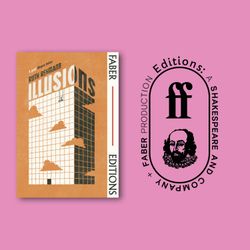
55:29|In the second episode of Editions, a podcast from Shakespeare and Company and Faber, literary director Adam Biles and Faber Editions curator Ella Griffiths are joined by novelist Megan Nolan to discuss Illusions by Ruth Rehmann, in a new translation by Rob Madole, the latest title in the Faber Editions imprint.First published in Germany in 1959 and lost to English-language readers for decades, the novel follows four employees of a vast West German corporation across a single weekend. Cinematic, fragmented, and seductively modernist, it is at once an intimate and hypnotic portrait of four inner lives and an incisive state-of-the-nation novel about West Germany's postwar "economic miracle" - and the illusions that sustain it.Our conversation covers Rehmann's place in the influential German postwar literary movement Gruppe 47, the novel's debts to and divergences from Virginia Woolf's Mrs Dalloway and James Joyce's Ulysses, the way that the war haunts a generation trying to forget it, the mischievous omniscient window cleaner who watches over the story, and what it means for a woman writer to be faulted, as contemporary reviewers said of Rehmann, for "an excess of contemporaneity."Buy IllusionsUK: https://www.faber.co.uk/product/9780571396580-illusions-faber-editions/Rest of World: https://www.shakespeareandcompany.com/books/illusions-faber-editions Megan Nolan's novels Acts of Desperation and Ordinary Human Failings are also available from Shakespeare and Company, and your local independent bookstore.Sign up to Faber's Heritage Subscription, featuring all Faber Editions titles: Subscribers get a book in the post each month for just £9 alongside a curated email with exclusive extra content about the book and its author. https://tr.ee/DsDYp5Books & Authors DiscussedThe Tin Drum — Günter GrassMrs Dalloway — Virginia WoolfUlysses — James JoyceThe Forged Coupon — Leo TolstoyPerfection — Vincenzo LatronicoAmerican Psycho — Bret Easton EllisActs of Desperation — Megan NolanOrdinary Human Failings — Megan NolanFilms/TV Shows DiscussedJeanne Dielman, 23 Quai du Commerce, 1080 Bruxelles — dir. Chantal AkermanPlaytime — dir. Jacques TatiThe White Ribbon — dir. Michael HanekeFrozen Land — dir. Aku LouhimiesBiosMegan Nolan is an Irish writer based in New York. Her most recent novel is Ordinary Human Failings (Little, Brown and Company, 2024), chosen as one of the best books of the year by The Guardian, The Times, and Sunday Times. It was shortlisted for the Orwell Prize for Political Fiction, the Nero Prize for Fiction, The Gordon Burn Prize, The Royal Society of Literature Encore Award, and longlisted for the Women's Prize. Her debut novel, Acts of Desperation (Little, Brown and Company, 2021) was an international bestseller, and was chosen as a best book of the year by Time. Nolan was also among The Observer’s Best Debut Novelists of 2021.Ella Griffiths is Faber's Head of Classics & HeritageAdam Biles is Literary Director at Shakespeare and CompanyListen to Alex Freiman Spotify: https://open.spotify.com/artist/3dbKbpFyqPbklwEdeLYYZR?si=Q5vy9KkRTrqf1BqU1v33cg Insta: @alex.guitarfreiman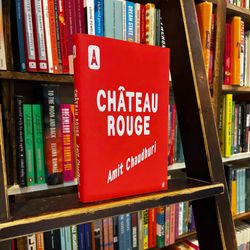
Paris, Deconstructed: Amit Chaudhuri’s Château Rouge
46:46|Amit Chaudhuri joins Adam Biles to discuss his new novel Chateau Rouge, set not in the postcard Paris of Hemingway and Midnight in Paris, but in the neighbourhood around Gare du Nord — a Paris that resists being known, curated, or confirmed.Chaudhuri talks about writing against the "already known" city, drawing on Roland Barthes and the idea of "heritage modernity" to explain why he wanted to deconstruct Paris's status as a museum-piece rather than a lived-in place. He discusses his narrator's disorientation on arrival, the subtle presence of race and visibility in the book, and how global events — the Gilets Jaunes, the Notre Dame fire — pass through the novel as lived, unfinished moments rather than history. The conversation turns, too, to marriage: how a decades-old, unread copy of A Moveable Feast, gifted by his wife, becomes a quiet emotional throughline.Buy Château Rouge: https://www.shakespeareandcompany.com/books/chateau-rouge*Amit Chaudhuri is the author of nine novels, whose ‘languorous, elliptical, beautiful prose is impressively impossible to put in any category at all’ (Salman Rushdie). He is also an essayist, poet, short story writer, singer and composer.Adam Biles is Literary Director at Shakespeare and Company.Listen to Alex Freiman’s latest EP, In The Beginning: https://open.spotify.com/album/5iZYPMCUnG7xiCtsFCBlVa?si=h5x3FK1URq6SwH9Kb_SO3w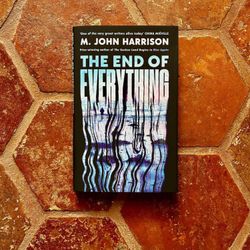
The End of Everything, with M. John Harrison
52:58|M. John Harrison returns to the Shakespeare and Company Podcast to talk with Adam Biles about his new novel, The End of Everything, a disaster story set in a "wrong UK" where societal collapse coincides with the arrival of an alien presence, and the strange shape-shifting "artefacts" it leaves behind.Harrison discusses writing an "epistemological" catastrophe rather than a physical one, the decades of discipline it took to trust readers without over-explaining, and how the book's permacrisis mirrors post-2008 Britain and Brexit. He talks character-building from "bits and pieces" of real people, why he refuses to fully reveal his monsters, and how AI anxieties seeped into a book largely conceived before ChatGPT. Buy The End of Everything: https://www.shakespeareandcompany.com/books/anabasis-2*MICHAEL JOHN HARRISON is the author of, among others, the Viriconium stories, The Centauri Device, Climbers, The Course of the Heart, The Sunken Land Begins to Rise Again, Signs of Life, Light and Nova Swing. He has won the Boardman Tasker Prize (Climbers), the James Tiptree Jr Award (Light), the Arthur C. Clarke Award (Nova Swing) and the Goldsmiths Prize (The Sunken Land Begins to Rise Again). He lives in Shropshire.Adam Biles is Literary Director at Shakespeare and Company.Listen to Alex Freiman’s latest EP, In The Beginning: https://open.spotify.com/album/5iZYPMCUnG7xiCtsFCBlVa?si=h5x3FK1URq6SwH9Kb_SO3w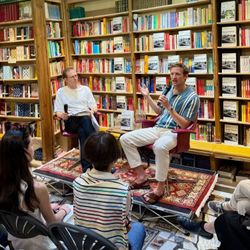
Alain Delon, Murder and Paris ’68, with Edward Chisholm
59:33|Edward Chisholm joins Adam Biles to discuss Murder in Paris '68, his deep-dive into the Markovic Affair, one of the most explosive scandals of postwar France. In October 1968, the dismembered body of Stevan Markovic, a Yugoslav immigrant and bodyguard to Alain Delon, was found on the outskirts of Paris. The case implicated France's most iconic film star, the Corsican “milieu”, and eventually the Élysée Palace itself.Chisholm traces how he stumbled onto the story in an obscure Parisian crime library, and what followed: years of obsessive research, classified archives in the suburbs of Versailles, and a surveillance-heavy reading desk watched over by attentive archivists. The conversation covers Delon's impenetrable persona, the Ripley parallels, France's Resistance-era ties between politicians and gangsters, and why a murder nobody solved still can't be fully declassified today.Buy Murder in Paris ’68: https://www.shakespeareandcompany.com/books/murder-in-paris-68-2*Edward Chisholm was born in Dorset, England, and moved to Paris in 2012 where he worked all manner of low-paid jobs, from waiting and bar work to museum security and market hand, while trying to build a career as a writer. His memoir, A Waiter In Paris has sold over 100,000 copies and has been translated into several languages. Now, Chisholm makes a living as a creative director, author and screenwriter, based in Switzerland. His writing has appeared in the New York Times, the Guardian and the Financial Times magazine.Adam Biles is Literary Director at Shakespeare and Company.Listen to Alex Freiman’s latest EP, In The Beginning: https://open.spotify.com/album/5iZYPMCUnG7xiCtsFCBlVa?si=h5x3FK1URq6SwH9Kb_SO3w
BLOOMCAST: 🎬Ulysses Movie Watch-along Special🎬
02:40:35|Recorded for Bloomsday 2026. If you're in Paris and it's still June 16th, join us between 2pm and 5pm at Shakespeare and Company, 37 Rue de la Bûcherie, Paris.Find the film here: https://vimeo.com/408613317https://www.youtube.com/watch?v=h7xAM_eXuukAdam Biles and Lex Paulson reunite after an eighteen-month hiatus for a live commentary on the 1967 Joseph Strick film adaptation of Ulysses. They discuss Joyce's real-life role launching Dublin's first cinema, the film's scandalous festival history (Cannes brawl, Irish ban, New Zealand sex-segregated screenings), and Milo O'Shea's towering performance as Leopold Bloom. Along the way: Circe's Monty Python energy, the "Me Too" moment, and why Joyce (thanks to Nora) remains decades ahead of us all.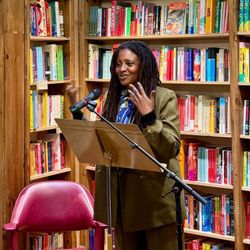
Fear Less: Tracy K. Smith on Poetry in Perilous Times
57:38|Tracy K. Smith comes to Shakespeare and Company for a conversation with Adam Biles. They discuss her book Fear Less: Poetry in Perilous Times, a bold manifesto on poetry as a tool for deeper living, clearer thinking, and more compassionate citizenship. Drawing on her time as US Poet Laureate, Smith reflects on taking poetry to rural America, and how poems, unlike political debate, can open rather than entrench. She talks about the origins of Fear Less, and why she chose to write a love letter to the art form rather than a polemic. Smith also reads from her forthcoming collection The Forest, sharing new poems on war, complicity, the divine feminine, and an expansive, unsettling "us" that includes those we revile.Buy Fear Less: https://www.shakespeareandcompany.com/books/fear-less-4Tracy K. Smith was born in Massachusetts and raised in northern California. She earned a BA from Harvard University and an MFA in creative writing from Columbia University. From 1997 to 1999 she held a Stegner fellowship at Stanford University. Smith is the author of four books of poetry: The Body's Question (2003), which won the Cave Canem prize for the best first book by an African-American poet; Duende (2007), winner of the James Laughlin Award and the Essense Literary Award; Life on Mars (2011), winner of the Pulitzer Prize for Poetry; and Wade in the Water (2018). In 2014 she was awarded the Academy of American Poets fellowship. She has also written a memoir, Ordinary Light (2015), which was a finalist for the National Book Award in nonfiction. Her latest book is Fear Less: Poetry in Perilous Times (2025). In June 2017, Smith was named U.S. poet laureate. She teaches at Harvard University, where she is a professor of English and of African and African American Studies and the Susan S. and Kenneth L. Wallach Professor at the Harvard Radcliffe Institute. Adam Biles is Literary Director at Shakespeare and Company.Listen to Alex Freiman’s latest EP, In The Beginning: https://open.spotify.com/album/5iZYPMCUnG7xiCtsFCBlVa?si=h5x3FK1URq6SwH9Kb_SO3w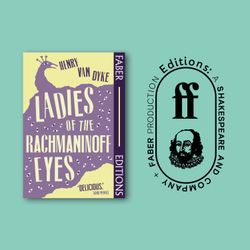
Editions - Episode 1 - Ladies of the Rachmaninoff Eyes with Taìno Mendez
01:03:23|In the debut episode of Editions, a podcast from Shakespeare and Company and Faber, literary director Adam Biles and Faber Editions curator Ella Griffiths are joined by novelist and performer Taìno Mendez to discuss Ladies of the Rachmaninoff Eyes by Henry Van Dyke, the twentieth title in the Faber Editions imprint.Published in 1965 and long out of print, the novel follows Oliver, a Black teenager spending a final summer before college in the eccentric Michigan household of his wealthy patron Etta Klein and his aunt Harriet. Witty, camp, and shot through with tragedy, it defies easy categorisation; a drawing-room satire, a coming-of-age story, and a quietly radical work of civil rights era fiction.The conversation covers the novel's Wildean wit, its oblique engagement with race and queerness, the role of photographer Carl Van Vechten in the Harlem Renaissance, and what it means to write against expectation.Buy Ladies of the Rachmaninoff EyesUK: https://www.faber.co.uk/product/9780571391783-ladies-of-the-rachmaninoff-eyes-faber-editions/Rest of World: https://www.shakespeareandcompany.com/books/ladies-of-the-rachmaninoff-eyes-faber-editionsBuy Rainbow Milk: https://www.shakespeareandcompany.com/books/rainbow-milkSign up to Faber’s Heritage Subscription, featuring all Faber Editions titles: Subscribers get a book in the post each month for just £9 alongside a curated email with exclusive extra content about the book and its author.https://tr.ee/DsDYp5Books & Authors DiscussedThe Daring Young Man on the Flying Trapeze — William Saroyan (foreword by Stephen Fry)Mrs Caliban — Rachel IngallsPalace of the Peacock — Wilson HarrisOmeros — Derek WalcottThe Flower Beneath the Foot — Ronald FirbankSorrow in Sunlight (retitled Prancing N-) — Ronald FirbankGo Tell It on the Mountain — James BaldwinGiovanni's Room — James BaldwinAnother Country — James BaldwinÀ rebours (Against Nature) — Joris-Karl HuysmansEn rade (Stranded) — Joris-Karl HuysmansCheckout 19 — Claire-Louise BennettRainbow Milk — Taìno MendezUlysses — James Joyce Works by Ivy Compton-Burnett, Brigid Brophy and Iris Murdoch also mentionedIllusions— Ruth Lehmann (upcoming Faber Editions title, discussed with Megan Nolan on our next podcast episode)Films/TV Shows DiscussedGet Out — dir. Jordan PeeleLovers Rock — dir. Steve McQueenThe Defiant Ones — starring Sidney PoitierPlaytime — dir. Jacques TatiSeveranceBiosTaíno Mendez is a novelist based in the southern English town of Margate. Their first novel, Rainbow Milk, was an Observer Top Ten Best Debuts choice for 2020 and widely named as one of the best novels of the year, being shortlisted for a British Book Award and for the Jhalak Prize, Polari Prize and Gordon Burn Prize. Their non-fiction has been published in a variety of outlets including the WritersMosaic, the London Review of Books, Esquire, the Guardian and British Vogue. They are currently working on their second novel. Ella Griffiths is Faber's Head of Classics & HeritageAdam Biles is Literary Director at Shakespeare and CompanyListen to Alex FreimanSpotify: https://open.spotify.com/artist/3dbKbpFyqPbklwEdeLYYZR?si=Q5vy9KkRTrqf1BqU1v33cgInsta : @alex.guitarfreiman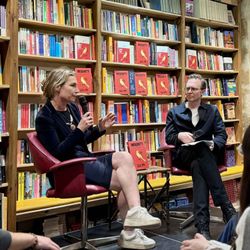
Lea Ypi: Dignity, Fiction, and the Lives History Erases
59:52|Philosopher and author Lea Ypi joins Adam Biles at Shakespeare and Company Paris to discuss her latest book Indignity: A Life Reimagined, an extraordinary work blending biography, history, and fiction. When a photo of her grandparents' 1941 honeymoon went viral in Albania, sparking online abuse, Ypi found herself compelled to investigate her grandmother Leman's life in full. The search took her into the Albanian Secret Service archives, back to the collapse of the Ottoman Empire, and deep into questions of memory, belonging, and what it means to preserve dignity in a world that conspires against it. Ypi discusses the dual narrative voices of the book, the "silence of the archives," the ethics of fictionalising real lives, and how writing as a novelist rather than a philosopher transformed her understanding of her subject. A conversation about history, imagination, and the moral necessity of hope.Buy Indignity: https://www.shakespeareandcompany.com/books/indignity-2*Lea Ypi holds the Ralph Miliband Chair in Politics and Philosophy at the London School of Economics. Her first trade book, Free: Coming of Age at the End of History won the Ondaatje Prize and the Slightly Foxed Best First Biography Prize and was shortlisted for the Baillie Gifford Prize and the Costa Biography Award. It is translated into over thirty languages.Adam Biles is Literary Director at Shakespeare and Company.Listen to Alex Freiman’s latest EP, In The Beginning: https://open.spotify.com/album/5iZYPMCUnG7xiCtsFCBlVa?si=h5x3FK1URq6SwH9Kb_SO3w
Shelter and Storm: Arundhati Roy on Writing Her Mother
49:26|An edited version of this conversation is now available as part of our collaboration with The Yale Review. Read it here: https://yalereview.org/article/shakespeare-and-company-interview-arundhati-royRecorded live at Shakespeare and Company, Paris, Adam Biles sits down with Arundhati Roy to discuss her memoir Mother Mary Comes to Me. Roy reflects on writing a “novelist’s memoir,” where memory and imagination blur, and explores her complex relationship with her mother, Mary Roy. The conversation moves from Roy’s unconventional childhood in Kerala to her formative years in architecture, activism, and the aftermath of The God of Small Things. She discusses resisting literary celebrity, embracing political responsibility, and finding strength in chosen families and friendship networks. With candour and wit, Roy rejects reductive “therapy narratives,” instead offering a portrait of identity shaped by contradiction, resilience, and love.Buy Mother Mary Comes to Me: https://www.shakespeareandcompany.com/books/mother-mary-comes-to-meArundhati Roy is the author of the novels The God of Small Things, which won the Booker Prize in 1997, and The Ministry of Utmost Happiness, which was longlisted for the Booker Prize in 2017. She is the author of various works of non-fiction including My Seditious Heart, Azadi and The Architecture of Modern Empire.Adam Biles is Literary Director at Shakespeare and Company, Paris