Share
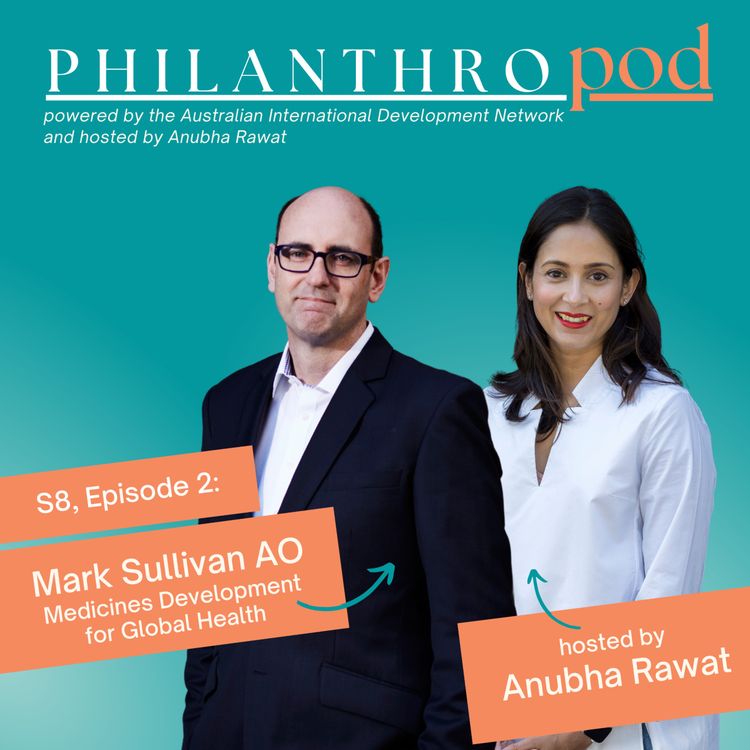
Philanthropod
Pharma for Good: Inside Medicines Development for Global Health
Is there such a thing as a not-for-profit pharmaceutical company?
What are “neglected tropical diseases”?
How can you address global health inequities in access to medicines?
These are just a few of the many incisive questions that our latest episode of Philanthropod explores.
In episode 2 of Season 8 meet Mark Sullivan AO, Managing Director and Founder of Medicines Development for Global Health (MDGH). MDGH is an independent not-for-profit company dedicated to the development of medicines for neglected diseases that primarily affect people living in poverty.
The majority of new medicines are developed for diseases that are prevalent in high-income countries as the potential returns on an approved medicine offset the high cost and risk of development. This model disadvantages the world’s poorest populations – according to the WHO, an estimated two billion people do not have access to even the most basic of essential medicines.
Responding to this deep inequity in global health, in 2005, Mark founded MDGH. Since its inception MDGH has demonstrated that it is possible to assemble the resources, collaborators and financing required to develop and register new medicines for infectious diseases in a not-for-profit company. In fact, in 2018, MDGH became the first solo not-for-profit company to achieve FDA approval for a novel medicine when they registered moxidectin, the first new treatment for river blindness (onchocerciasis) in 20 years.
Join Philanthropod’s host, Anubha Rawat, in conversation with Mark as they discuss Mark’s pioneering journey throughout the pharmaceutical industry, the importance of working with local NGOs, communities and health providers to distribute medicines, and navigating critical regulatory systems with major global health bodies such as the FDA (US Food and Drug Administration) and WHO (World Health Organisation).
To learn more about MDGH follow the link: https://www.medicinesdevelopment.com/
More episodes
View all episodes
1. Strong Women, Strong Nation: From Listening to Lasting Change in Timor-Leste
29:56||Season 15, Ep. 1Dr Kirsty Sword Gusmão has been a long-time advocate for women, children, education, and dignity in Timor-Leste, giving her a front-row seat to the evolution of one of Australia’s closest neighbours. As Kirsty’s own children grew alongside Timor-Leste as a nation post-independence, she witnessed the unthinkable violence and trauma experienced by Timorese women. Kirsty resolved to travel the country asking women directly what their priorities were, listening and learning.In the first episode of Season 15, Philanthropod host Anubha Rawat sits down with Dr Kirsty Sword Gusmão, founder and Chair of Alola Foundation, founder of the Xanana Gusmão Reading Room, and former first lady of Timor-Leste. Together, Anubha and Kirsty take stock of the last quarter century of development for Timor-Leste and explore the vital role of strong women in creating a strong nation. From the opening of a reading room in Dili, the Alola Foundation was born. What began with a focus on economic empowerment – training women in business skills to make a living – soon grew to include a maternal health program, and children’s and girls’ education programs. Alola’s work sits firmly within the longer arc of rebuilding a country, not only through physical infrastructure, but by nurturing women’s confidence, children’s education, maternal health, livelihoods, leadership and dignity. Because when women are safe, educated, healthy, economically secure, and able to lead, the whole nation is stronger. Take a deeper dive into their impact via Alola’s Annual Report: https://www.alolafoundation.org/wp-content/uploads/2026/07/Alola-AR2025-Eng-Distwebvers.pdf Visit the Alola Foundation website here: https://www.alolafoundation.org/If you are interested in joining the upcoming AIDN Insight Tour to Timor-Leste, find out more information and register your interest here: https://aidnetwork.org.au/insight-tour-timor-leste-2026/
3. The Power of Professionalising Community Health Workers
36:15||Season 14, Ep. 3‘In pandemics… it’s disruptions to essential health services which can ultimately kill more people than the outbreak itself’ In this episode of Philanthropod, host Anubha Rawat speaks with CHIC CEO, Dr. Madeleine Ballard, a Rhodes Scholar and evaluation scientist. Dr. Ballard helped launch Liberia's first national professional Community Health Workers (CHWs) program and now leads the Community Health Impact Coalition (CHIC)’s mission to turn evidence-based community health into global policy.CHIC is a global coalition professionalising CHWs at scale. What began between six community health organisations has evolved into a movement activating governments, NGOs and implementers to ensure CHWs are salaried, skilled, supervised and integrated into national health systems.Anubha and Madeleine discuss the 1978 Alma-Ata Declaration that centered CHWs as the key to universal healthcare. While that vision was sidelined by the sovereign debt crisis and shifting international priorities, CHIC addresses a critical oversight: the original model relied on unsupported volunteers. CHWs were not paid, nor did they have supplies, supervision or training to properly benefit the system. By identifying specific barriers holding governments back, such as lack of start-up capital and the absence of global delivery guidelines, CHIC has stepped in to be the unified professional voice and evidence base needed to transform community health into a formal, national priority.Today, CHIC’s pro-CHW policy dashboard tracks accreditation and pay across over 100 countries. Dr. Ballard views this “scoreboard” as a catalyst to double the number of nations adopting professional policies. While the concept of a CHW isn’t new, CHIC is securing the financial and delivery frameworks necessary to empower the“backbone” of primary healthcare to reach its full potential.This episode is recommended listening for anyone interested in global health equity and how to move evidence-based ideas into national policy.
2. Durable Bicycles For A Durable Future: World Bicycle Relief is Engineering an Ecosystem of Mobility
29:14||Season 14, Ep. 2For many of us, transport is a background detail: a car in the driveway or a bus at the corner. But for millions in the Majority World, the distance between home and a healthcare appointment or a child’s school is prohibitive. Without safe and affordable transport, access to essential services can become impossible.In this episode of Philanthropod, host Anubha Rawat sits down with Diana Mason, Managing Director Australia at World Bicycle Relief. Born out of the 2004 tsunami response in Asia, World Bicycle Relief has evolved from a bicycle distributor into a pioneer in rural mobility for low-income communities. For the past 22 years, World Bicycle Relief has proven how a reliable and cost-effective bicycle can unlock significant opportunities for economic empowerment, education and healthcare in communities globally.Together, Diana and Anubha track the evolution of World Bicycle Relief’s development model. They dive into the initial challenges of operating in environments where standard bicycles often lack the durability for rugged terrain, quickly becoming “bicycle-shaped objects” without spare parts or trained mechanics. In response, the team at World Bicycle Relief created the Buffalo Bicycle: a strong, purpose-built tool supported by an ecosystem of trained mechanics and access to high quality spare parts, designed to last a lifetime. With one million bicycles distributed across seven countries, World Bicycle Relief has moved beyond simple delivery to integrating mobility into school transport and healthcare systems at scale.Ultimately, this conversation reminds us that with mobility comes possibility, and that by providing a robust tool and a supporting ecosystem, more people will have the freedom and autonomy to plan their own future.Learn more about World Bicycle Relief here: worldbicyclerelief.org/
1. Intentional Collaboration in a Changing Global Health Landscape
43:21||Season 14, Ep. 12025 marked real pressure across the global aid landscape, and the effects continue to emerge. Funding cuts. Programs paused or closed. Organisations asking hard questions about how to keep essential services running. But alongside that disruption, something else is emerging: a genuine sense of possibility.In this conversation, host Anubha Rawat sits down with Neil Buddy Shah, CEO of the Clinton Health Access Initiative (CHAI), to take stock of where global health has landed after a difficult year, and to look seriously at what comes next.CHAI works as a technical and strategic partner to governments in over 35 countries, sitting at the intersection of governments, business and health, negotiating the conditions that drive more equitable access to lifesaving medicines, vaccines, and diagnostics. It's a model with deep roots: CHAI was founded in 2002 at the height of the HIV/AIDS epidemic, and its early work negotiating drug prices is a case study in what's possible when the right stakeholders align around a clear goal. Crucially, CHAI only ever works at the invitation of governments, and that distinction shapes everything about how the partnership functions.Buddy brings his expertise and CHAI's history to bear in this conversation, while staying firmly focused on what's ahead. He describes the current moment as defined by paradox: crisis on one side, and some of the most exciting scientific and biomedical developments in a generation on the other. And he's optimistic: periods of disruption, he reflects, are also opportunities to take stock, think differently, and do things differently.From there, the conversation ranges widely. Buddy talks about the discipline of doing more with less, finding efficiencies without sacrificing coverage, helping ministries reanalyse budgets, and leveraging new sources of financing. He reflects on scientific breakthroughs as the thing that gives him the most hope, and what it takes to translate discovery into access for the people who need it most. As Chair of Anthropic AI's Long-Term Benefit Trust, he makes a case for why global health leaders should be thinking about AI's potential: not as a fix-all, but as a genuinely powerful technology that low-income countries could use to build healthcare models at scale. And because CHAI only ever enters a country at the invitation of its government, Buddy is attuned to what trust between implementers, governments, and funders actually looks like in practice, starting with humility, and with the conviction that the people closest to a problem are best placed to find its solutions.On the future and what success looks like, he's both grounded and aspirational: ending the AIDS epidemic in Africa, driving real reductions in malaria mortality, and reaching a point where national governments are genuinely in charge of their own health systems. With better tools, more capital, and more technical knowledge than ever before, he believes these aspirations are within reach, if we're disciplined and intentional enough to pursue them.
3. From Tote Bags to Transformation: How the Cotton On Foundation Is Redefining the Role of Corporate Foundations in International Development
34:57||Season 13, Ep. 3Cotton On is Australia’s largest fashion retailer, but it is their commitment to education, youth mental health, and climate action that sets them apart from a typical business.From selling $5 tote bags, water bottles or reusable face masks to their youth-based market, the Cotton On Foundation has become a model for how Australian businesses can make a transformative impact in international development.In this episode, Philanthropod’s host, Anubha Rawat, sits down with Logan Whitaker: Global Engagement Manager at the Cotton On Foundation. Together, they explore the Cotton On Foundation’s journey, model and aspirations moving forward. Beginning in 2007 with the reconstruction of a single classroom in Uganda, the Cotton On Foundation now supports 22 schools in Uganda, alongside climate and mental health initiatives across four continents.At the centre of their model is a commitment to partnering with government schools and fostering their financial independence through trust-based relationships and mobile money systems for fee collection. They also take a whole-of-systems approach - including focusing on leadership and identifying opportunities to support students past primary school, to high school, and even to vocational studies where possible. In many ways, the Cotton On Foundation occupies a unique space between international development funder and implementer.Looking ahead, the Cotton On Foundation is now aiming to complete its mission in Uganda - a vision that requires the construction of 19 additional schools. Presenting a unique opportunity for the sector, they are now seeking businesses, corporates, and funders to partner with them to ensure that Uganda’s rapidly growing population has access to quality education for generations to come.This episode is recommended listening for anyone interested in the evolving role of corporate foundations within Australia’s changing international development and philanthropic landscape.Learn more about the Cotton On Foundation here: https://cottonongroup.com.au/the-good-we-do/cotton-on-foundation/
2. The Courage to Found and the Humility to Hand Over
41:02||Season 13, Ep. 2What role can NGOs play as “learning labs” for public policy in the Majority World?How can Community Health Workers (CHWs) help scale locally-led health programs?And why are leadership succession plans so vital for founder-led organisations?In this episode of Philanthropod, host Anubha Rawat sits down with Jennifer Schechter (Co-Founder & CEO) and Emily Benson (Chief Partnerships Officer) of Integrate Health. Founded in Togo in 2004 with a focus on HIV healthcare, Integrate Health has since expanded to partner with the Togolese and Guinean governments to improve access to quality primary care by integrating CHWs into national systems. Holding over 700 community meetings each year, Integrate Health uses community-led data and digital tools to strengthen health outcomes. They collect 13,000 household surveys and track 150,000+ CHW visits annually, creating a vital feedback loop for continuous improvement - from maternal health to child mortality to vaccine delivery.Throughout the episode, Anubha, Jennifer and Emily discuss the role that NGOs can play as “learning labs” for governments. Often facilitated by philanthropic funding, NGOs can take more risks, test ideas and generate evidence in ways governments can't. In turn, this provides evidence-based models that governments can adopt, ensuring long-term sustainability in line with national health policies.The episode also explores the importance of leadership transitions in founder-led NFPs. After two decades as CEO, Jennifer will step back to join the Board in December 2025 and Emily will step in as CEO. This has been a deliberate and strategic decision to demonstrate both Integrate Health’s organisational resilience but also commitment to employee growth.👉 Learn more about Integrate Health here: integratehealth.org
1. When Every Second Counts: Kenya’s Emergency Care Revolution
33:22||Season 13, Ep. 1In this episode, Anubha speaks with Dr. Benjamin Wachira, Kenya’s first emergency physician and the visionary behind the Emergency Medicine Kenya Foundation (EMKF).Ben reflects on his journey from a bright-eyed medical student eager to save lives, to recognising a devastating gap in his training: there was no structured preparation for handling patients in life-or-death situations. During his years studying in South Africa, he witnessed trauma cases from stabbings, shootings, and road accidents being treated every day - cases he realised he had never seen in Kenya. The reason was stark: most Kenyan patients in emergencies never made it to the hospital at all.That realisation set him on a mission to transform emergency care back home. Through EMKF, Ben has worked alongside government and healthcare providers to build a system that was once non-existent. From drafting Kenya’s first national emergency healthcare policy (now enshrined in law) to creating emergency protocols, training frontline providers, and expanding public ambulance services from zero to ten, his work has started to reshape the system. Emergency departments in counties across the country are being renovated and equipped, and thousands of patients are now receiving lifesaving care each year who otherwise would not have had a chance.As EMKF has grown, its work has reached beyond Kenya, offering research, tools, and lessons to support neighbouring countries as they develop their own systems. Ben’s story is one of persistence and vision, showing how one determined physician can not only save lives at the bedside, but reimagine an entire nation’s approach to emergency care.Tune in to hear how emergency medicine is being transformed in Kenya, and why Ben believes access to timely care must be recognised as a basic right.Philanthropod is powered by the Australian International Development Network and hosted by Anubha Rawat. Thank you to Compact Sound for editing and mixing. For more information about AIDN, and for more episodes, visit: www.aidnetwork.org.au. For more information about Emergency Medicine Kenya Foundation, visit: https://www.emergencymedicinekenya.org/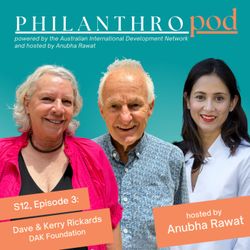
3. The Business of Bold Philanthropy
42:16||Season 12, Ep. 3What happens when two entrepreneurs turn decades of business grit into bold, practical philanthropy? In this warm and engaging conversation, host Anubha Rawat sits down with Dave and Kerry Rickards, founders of the DAK Foundation and the DAK International Network. Having worked alongside them for more than a decade, Anubha brings out both the personal and practical sides of their remarkable journey.Dave and Kerry married in 1971, dropped out of university, and soon after started a small market stall in Sydney. By 1973 they had moved into opals and jewellery, and in 1979 with another couple they co-founded Clints Crazy Bargains. Over the next two decades the discount variety store grew to more than 100 outlets before being sold in June 2000. With four children and a lifetime of entrepreneurial lessons behind them, they turned their attention to giving.The Rickards then spent ten years travelling the world, meeting hundreds of NGOs across dozens of countries. They saw duplication, wastage and an overemphasis on capacity development rather than capacity utilisation. Most of all, they realised the striking difference in costs, where meaningful change in low- and middle-income countries could be achieved at a fraction of the price. Those insights shaped their philanthropic philosophy: find existing infrastructure, resource it, and get the job done.Today, through the DAK Foundation and the DAK International Network, their giving focuses on restorative eye surgery, essential medical equipment, women’s health and family planning. In this episode, Dave and Kerry reflect on how they got started, the lessons they learned along the way, and the people who inspired their giving, including the legendary Chuck Feeney. With warmth and humour, they show that philanthropy can be bold, deeply human, and guided by a simple truth: it’s not just about where your money goes, but how it can create lasting change.Thank you to Ian at Compact Sound for recording and mixing and our host Anubha Rawat. Philanthropod is powered by the Australian International Development Network - www.aidnetwork.org.auTo find out more about the DAK Foundation and DAK International Network, visit: https://dak.org.au/ and https://dakinternational.org/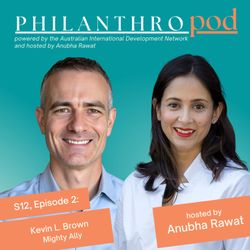
2. Unlocking growth: Branding, storytelling and the future of fundraising
35:21||Season 12, Ep. 2What does it really mean to be “funder ready”?What makes an impactful storyteller?And is there a risk that funders might become skeptical if your marketing is “too slick?”These are just a few of the thought-provoking questions we explore in the second episode of Season 12 of #Philanthropod.Host Anubha Rawat sits down with Kevin L. Brown, CEO of Mighty Ally. In a world where only one in 1,000 non-profit organisations grow beyond a small business, Mighty Ally builds brands to maximise funding through its Fundable & Findable Framework. Kevin is also a leading voice on LinkedIn and Substack and just released his first book: Fundable & Findable: The Brand-New Way to Fix Your Nonprofit Fundraising.Anubha and Kevin discuss Kevin’s transition from the advertising agency world to international development and the non-profit sector. Deeply influenced by the orphan crisis and his own experience as a father to three daughters from Uganda and China, Kevin began his journey in the sector by shadowing Lwala Community Alliance. Since then, his team has led some of the most powerful brand strategies for leading organisations including Food4Education and CHIC.Throughout the episode, Anubha and Kevin unpack:Why positioning and clarity are critical for all non-profit organisations;How to scale without losing the “soul” of your organisation;What funders are really looking for and how to stand out; and The simple, essential steps every organisation should take to strengthen its brand today.If your organisation is looking to scale, feeling “stuck” in its fundraising, or hoping to diversify its donor base, this conversation is for you.Learn more about Mighty Ally here: https://mightyally.org/about