Share
Optimisten, Pessimisten & Realisten
EXTRA-EPISODE REGARDING IRAN-ATTACK - our prior conversation with SANAM ANDERLINI
This is a republisihing of our conversation wiht Sanam Sanderlini from January 13. this year. On how to understand Iran at a decisive moment in history—from the streets of today’s protests to the long arc of opposition politics, regional consequences, and global power dynamics. Now we know Trump never came to support the protests and that he attacked Iran with Israel less than 24 hours ago.
As we said then: This is for listeners who want more than breaking news— for those who want understanding, restraint, courage, and a future-facing view of Iran’s place in the world. Sanam Anderlini—quite simply one of the most authoritative and clear-eyed voices on Iran, peacebuilding, and democratic transformation anywhere in the world today. And with her own podcast "If you were in charge". Born in Iran and forced to leave during the 1978–79 revolution, Sanam has spent nearly three decades working at the highest levels of international diplomacy, civil society, and the United Nations. She was a key architect of UN Security Council Resolution 1325 on Women, Peace and Security, has advised governments and mediators across conflict zones from Syria to Sudan, and founded the International Civil Society Action Network (ICAN), supporting women-led peace movements in over 40 countries. Few people combine lived Iranian experience, scholarly depth, and real-world policy influence with such precision—and moral clarity. We invited Sanam on short notice, and she joins us to help answer the hardest questions now confronting Iran and the international community. And for our Norwwegian audience we also asked to turn the lens toward us and other European coutnries, and in the spirit of Sanam’s own podcast If You Were in Charge, we asked her directly: What should Norway, Europe, and the wider pro-democratic community actually do now? Not rhetorically—but practically, responsibly, and with long-term consequences in mind.
Kåre Aas is driving the conversation, a former ambassador to Washinngton DC under both Obama and Trump, also in Kabul and Tel Aviv the last 15 years. Gjermund Eriksen has his expertise in US. - and right wing-populist Europe politics, but has for 10 years + also tried to develop tv-series with Persian main characters
In this conversation, we explore:
- What it feels like to witness yet another wave of protests, repression, and calls for regime change—especially in the aftermath of Israeli attacks and rising regional tension.
- How accurately international media is portraying what is happening inside Iran right now—and where it misses crucial nuances.
- Why people are taking to the streets, whether this is a national uprising, and what truly distinguishes this moment from previous cycles of revolt and crackdown.
- The Iranian opposition: who they are, who they are not, and why leadership in exile is far more complex than it appears.
- The role of the Revolutionary Guard as the regime’s real power center—and how it might act under sustained pressure.
- How Iranians themselves perceive U.S. and Israeli involvement, and the risks of external actors misreading internal dynamics.
- What a regime change in Iran would mean for the region—and for the global balance of power.
And we end where Iran itself so often does: with hope, poetry, and perspective. The poem she introduces is "Conference of Birds" by a well known Sufi poet from 1177 and can be heard here: https://www.youtube.com/watch?v=yXNflEixRx4
Sanam shares what gives her hope—and recommends a Persian poem that captures the soul of Iranian culture beyond headlines and geopolitics, reminding us that transformation is as much moral and cultural as it is political.
More episodes
View all episodes

70. Hungarian election and Europe's future with Lord of ExplaiNings Andras Simonyi
01:15:37||Season 1, Ep. 70Who better to explain Hungary’s election—and America’s growing fixation with it—than András Simonyi?A former Hungarian ambassador to the United States and one of the most compelling figures in modern diplomacy, Simonyi is a man whose life reads like a cross-continental novel: ambassador, strategist, rock guitarist, cultural bridge-builder, and a witness to some of the most consequential shifts in global power over the past four decades.From Washington’s ideological pivots to Europe’s recurring identity crises, he has been both a participant in—and an interpreter of—history. His multidisciplinary work—spanning diplomacy, writing, and music—is not a detour from politics, but an extension of it. As he argues in his memoir Rocking Toward a Free World: When the Stratocaster Beat the Kalashnikov, culture is not merely the soundtrack to geopolitics; it is often the engine.In this episode, we are joined by András Simonyi, former Hungarian ambassador to the United States and a rare voice at the intersection of diplomacy, culture, and power politics.We examine Viktor Orbán’s political model, the logic behind his enduring appeal, and what much of Europe has misunderstood about his rise. The conversation also explores Hungary’s unexpected role in the intellectual orbit of the MAGA movement, and what binds—or divides—Budapest and Washington today.If Hungary’s trajectory continues, what are the consequences for Europe—and for the broader Western alliance?We begin by asking Andras if he had to explain to a Norwegian audience why Hungary matters—what is the one consequence we would feel if its current trajectory continues unchecked? And obviously we move between Budapest, Europe, Nato and DC. Why does the MAGA movement matter so much here—beyond your personal perspective as both an American and a Hungarian?Who are the major contenders for Hungary’s leadership?What did Viktor Orbán understand about power in the 2010s that much of Europe missed?And there is a nerd-sequence too about his relationship to Stephen Colbert and our common fandom of Lord of the Rings.
69. Israel & USA after the Iran War: Power, Pressure, and Political Crossroads WITH NADAV TAMIR
47:32||Season 1, Ep. 69A conversation about not only the Middle East, where our star guest, Nadav Tamir — veteran diplomat, former advisor to President Shimon Peres, and one of Israel’s clearest progressive voices — joins us to map the patths forwward after Donald Trump & Benjamin Netanyahu launched their attack on Iran, what are the politics & pressures, and the stubborn hope inside the progressive parts of Israeli and palestinian people. Nadav Tamir is a former Israeli diplomat and currently Executive Director of J Street Israel and senior advisor at the Peres Center for Peace. A former adviser to President Shimon Peres, Tamir brings decades of experience from Israel’s foreign policy establishment.We also examine Israel in the aftermath of confrontation with Iran: how war shapes everyday life, political priorities, and national cohesion. The conversation explores growing internal pressures within Israeli society, the strategic tension between Israel’s interests and those of Donald Trump and the MAGA movement, and what lies ahead in Israel’s upcoming election.A grounded discussion of power, politics, and uncertainty at a critical moment.
68. IRAN WAR, US' & TRUMP'S CHOICES with JONATHAN PANIKOFF
55:24||Season 1, Ep. 68onathan Panikoff on escalation, intelligence failure, Israel, and the limits of American powerIn this episode, we are joined by Jonathan Panikoff, Director of the Scowcroft Middle East Security Initiative at Atlantic Council and former Deputy National Intelligence Officer for the Near East.With more than a decade inside the U.S. intelligence community, Panikoff has advised senior policymakers — including at the highest levels — on the political, military, and strategic dynamics shaping the Middle East.Drawing on that experience, he breaks down three realistic endgames to the Israel–Iran conflict, the true risk of escalation, and how intelligence failures can occur even in the most sophisticated systems.We also explore U.S. leverage over Israel, the strategic importance of the Strait of Hormuz, and how economic pressure — including the risk of stagflation — may ultimately shape the path to a political resolution.A conversation grounded in insight, not speculation — about power, limits, and what comes nexWars often begin with clear objectives.They rarely end that way.A must-listen
67. FRA MANHATTEN TIL MOSKVA med ambassadør HEIDI OLUFSEN
49:15||Season 1, Ep. 67I en tid der Russland igjen står i sentrum for global politikk, sikkerhet og konflikt, er førstehåndskunnskap mer verdifull enn noen gang.I denne episoden møter vi Norges ambassadør i Moskva, Heidi Olufsen – en av landets mest erfarne Russland-diplomater. Med bakgrunn fra russisk språk og litteratur, flere tiår i utenrikstjenesten og fersk erfaring som generalkonsul i New York, bringer hun et sjeldent bredt perspektiv inn i samtalen. Hun har fulgt utviklingen i Russland tett – fra perioder med optimisme og samarbeid til dagens dype geopolitiske brudd etter krigen i Ukraina.Hva preger hverdagen i Russland nå? Hvordan tenker russere flest om Norge, Vesten og krigen? Hvor store er forskjellene mellom Moskva og regionene? Og hvordan utøves diplomati i et stadig mer lukket og krevende politisk landskap?Dette er en samtale om Russland, russere, geopolitikk og norsk utenrikspolitikk – sett fra innsiden. En nødvendig episode for alle som vil forstå hva som faktisk skjer bak overskriftene.
66. MESTERMØTE! Mennesket, Makten og Markedene med Kåre & Harald Magnus
50:26||Season 1, Ep. 66Iran-krigen, geopolitikk og verdensøkonomi: hvordan henger det egentlig sammen – og hva står på spill nå?I denne episoden av Optimisten, Pessimisten og Realisten samler vi Harald Magnus Andreassen og Kåre Aas til en dyptpløyende samtale om makt, markeder og mennesker. Med utgangspunkt i erfaringene fra Irak-krigen analyserer vi de viktigste økonomiske konsekvensene av dagens Iran-konflikt – fra energi og inflasjon til kapitalstrømmer og geopolitisk risiko.Vi går tett på Donald Trump og vurderer hans økonomiske handlingsrom i USA – både nå og de neste ni månedene. Videre diskuterer vi Europas sterke og svake sider i møte med økt usikkerhet, og hva som gjør Norge unikt eksponert – men også potensielt godt posisjonert.Til slutt: en skarp «taco-battle». Er taco-teorien fortsatt et relevant analyseverktøy i finansmarkedene – eller er det nå politikken som styrer markedet, ikke omvendt?En innsiktsfull, underholdende og faglig tung episode om Iran, USA, Europa, Norge og verdensøkonomien – med to av Norges fremste stemmer innen økonomi og diplomati. Her er outline. FOR VERDEN: Overordnet: Irak-krigens viktigste effekt inn i verdensøkonomien. FOR USA og FOR TRUMP Hva er Trumps muligheter - og hva er utfordringene i USAs økonomi NÅ og 9 måneder fram. FOR EUROPA Hva er EUROPAS sterke og svake kort i denne situasjonen FOR NORGE Og hva er Norges unike risiko og oppsider? Og hva er modererende? FOR TACO: Til slutt TACO-BATTLE: (om begrepet er godt eller dårlig til analyse ller rapporteriing)= Taco fenomet som analyseverktøy fra Økonomer - er det blitt FEIL eller har det fortsatt gyldighet for markeder. Eller er det som Eriksen mener - at TACO er hva markedet ønsker og at markedet ikke forutsier hva Trump vil gjøre, det er Trump som dikterer markedet. Og del episodene med venenr og kjente!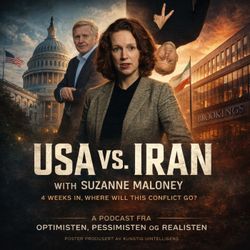
65. Iran-war, Trump and the Limits of Power with SUZANNE MALONEY
42:21||Season 1, Ep. 65In this extra episode, we are joined by Suzanne Maloney, one of the leading analysts of Iran’s political system, economy, and relationship with the West. Vice President and senior fellow at the Brookings Institution, she brings historical depth and strategic clarity to a fast-moving situation.Suzanne Maloney is one of the leading voices on Iran, U.S. foreign policy, and the broader dynamics shaping the Middle East today. She’s a senior fellow at the Brookings Institution, and if you’ve ever tried to make sense of Iran’s politics, its economy, or its relationship with the West — chances are, you’ve encountered her work. But what makes Suzanne particularly compelling is that she doesn’t just analyze events — she contextualizes them. She connects the historical depth, the political strategy, and the human reality behind headlines that too often feel distant or abstract. We examine where the conflict stands, the credibility of military threats, and whether this is best understood as an Israeli war with US backing—or something more.The conversation also explores domestic US reactions, transatlantic tensions, economic pressure, and the role of asymmetric warfare.A discussion aimed at clarity—before events outpace understanding.Iran is not just a conflict—it’s a system shaped by history, pressure, and strategic adaptation. With Suzanne Maloney, we examine escalation risks, US credibility, and what may come next.ran is often reduced to a headline. But to understand the current conflict, you need history, structure, and strategy.In this episode, Suzanne Maloney helps unpack what is actually happening—and what signals matter.A conversation about understanding, choices and empathy, not snapshots. Please enjoy and share.
64. NY VERSJON: TAPER TRUMP NÅ? Iran, Ukraina og Florida. Og verdensøkonomien er påført langtidsskade
44:37||Season 1, Ep. 64NY, uten EN SANG som spilte MITT I PRATEN. Hva skjer når tre av verdens mest brennbare utviklinger peker mot samme sentrum?Med tidligere ambassadør Kåre Aas og redaktør Gjermund S. Eriksen ved bordet, tar vi deg gjennom en episode som spenner fra det absurde til det dypt alvorlige.Vi starter lett: Meta får sitt “tobacco moment”, flyplasskaos med politiske undertoner, og en kulturverden som tilsynelatende har mistet all bakkekontakt. Men så strammes alvoret.Iran presser USA og verdensøkonomien, og signalene spriker: Snakkes det faktisk sammen – eller ikke? Hva er Irans strategi, og hvorfor reagerer markedene så kraftig? Og ikke minst: hvordan merker vi dette i Norge?Samtidig kommer en sjelden positiv utvikling for Ukraina, som nå rammer kjernen i Russlands krigsøkonomi. Kan det endre krigens retning?Til slutt vender vi blikket mot USA: politisk uro i California, overraskende håp for Demokratene i Florida – og hva det sier om landet som fortsatt binder alt sammen.Vi avslutter med det viktigste spørsmålet: Finnes det fortsatt grunn til optimisme?Følg oss videre – de neste dagene slipper vi fem sterke gjester du ikke vil gå glipp av.Hosted on Acast. See acast.com/privacy for more information.
63. Taper Trump nå? Iran dominerer, Ukraina imponerer, Trump vakler og USA...?
44:37||Season 1, Ep. 63Hva skjer når tre av verdens mest brennbare utviklinger peker mot samme sentrum?Med tidligere ambassadør Kåre Aas og redaktør Gjermund S. Eriksen ved bordet, tar vi deg gjennom en episode som spenner fra det absurde til det dypt alvorlige.Vi starter lett: Meta får sitt “tobacco moment”, flyplasskaos med politiske undertoner, og en kulturverden som tilsynelatende har mistet all bakkekontakt. Men så strammes alvoret.Iran presser USA og verdensøkonomien, og signalene spriker: Snakkes det faktisk sammen – eller ikke? Hva er Irans strategi, og hvorfor reagerer markedene så kraftig? Og ikke minst: hvordan merker vi dette i Norge?Samtidig kommer en sjelden positiv utvikling for Ukraina, som nå rammer kjernen i Russlands krigsøkonomi. Kan det endre krigens retning?Til slutt vender vi blikket mot USA: politisk uro i California, overraskende håp for Demokratene i Florida – og hva det sier om landet som fortsatt binder alt sammen.Vi avslutter med det viktigste spørsmålet: Finnes det fortsatt grunn til optimisme?Følg oss videre – de neste dagene slipper vi fem sterke gjester du ikke vil gå glipp av.
62. MANDAGSOPTIMISTEN: Kort om Iran, Økonomien og Muellers død
35:52||Season 1, Ep. 62Det er sjelden verden blir enklere – men noen uker blir den merkbart mer komplisert.Trump gir Iran en 48-timers deadline. Samtidig bygges det opp militær kapasitet i regionen. Men dette skjer ikke i et vakuum.Økonomien i USA viser tegn til svakhet: inflasjonspress, usikre arbeidsmarkeder og investeringer som kan ligne bobler.Og midt i dette dør Robert Mueller – symbolet på en av de mest betente politiske konfliktene i moderne amerikansk historie.Hva er strategi – og hva er samtidige kriser som forsterker hverandre?Vi rydder i bildet.Donald Trump setter en 48-timers deadline overfor Iran og åpner for militær eskalering. Sammen med tidligere toppdiplomat Kåre Aas og USA-analytiker Gjermund Eriksen diskuterer vi hva slags handlingsrom Trump faktisk har – og hva en mulig exit-strategi kan være. Hvor samstemte er USA og Israel? Og hvilke juridiske og strategiske konsekvenser kan et angrep på Irans sivile oljeanlegg få?Samtidig presses USA økonomisk: stigende inflasjon, svakere arbeidsmarked og tegn til bobletendenser i AI-investeringer. Alt skjer parallelt.Vi runder av med dødsfallet til Robert Mueller og hva det betyr i en amerikansk politisk kontekst preget av dyp mistillit.Torsdag får vi også besøk av israelske Nadav Tamir.