ON_Discourse
All Episodes
53. How to sell AI
26:01||Ep. 53Toby spent the week taking apart four AI-native companies that crossed $100 million in ARR — Writer, Legora, Sierra, and Clay — looking for the shared playbook. There isn't one. Each got there a different way, and none of the routes look much like traditional SaaS. Dan, Toby, and Chmiel work through what that means for anyone selling AI right now, including themselves.Details of the show:Why did Clay spend six years blowing minds in demos without closing deals?Did Sierra sell a product or did Bret Taylor sell his phone book?Is outcome-based pricing real or is it a press release?What's the pitch when "wow" stops working?What is up with Toby's standing zoom face?Learn more about ON_Discourse.com.
52. Apps vs Agents
17:06||Ep. 52Dan, Toby, and Chmiel have a short argument about the difference between an app and an agent. Apps are deterministic, agents are probabilistic. In the curious language of AI that might mean that when an app fails it's a bug, when an agent fails it's part of the experience. Along the way they compare Google Calendar to Howie, stress-test the agentic browser, and try to figure out why consumer agents barely exist.Details of the show:What's the difference between an app and an agent?Why does the definition matter for anyone designing or investing in AI?Is an agentic browser an agent, or just better search?Is the consumer agent shortage a supply problem or a demand problem?Why do we forgive human mistakes but not agent mistakes?Learn more at ON_Discourse.com.
51. Cannes Platitudes
37:35||Season 1, Ep. 51Ten days out from Cannes Lions, Dan, Toby, and Chmiel try to work out whether anything has changed in the year since AI took over every panel and pitch deck. Their answer: not really. To make the point, they ran hundreds of Cannes sessions through Doma and pulled the ten platitudes the industry is about to repeat for a week straight — "AI will augment, not replace creativity," "trust is the new currency," "the future is human plus the machine." Dan does a lot of groaning. Under the groaning is a question worth sitting with: at a festival built on creativity, where did the creativity go?Details of the show:Whether anything material has shifted in the year since AI swallowed every panel and pitch, and Toby's case that the tech mostly forced the industry to look at its own dysfunctionThe ten platitudes Doma pulled from hundreds of Cannes sessions, and why a week of hearing them on a loop is its own kind of exhaustionDan on the missing creativity — Flash, mobile, even NFTs had real creative energy, and AI so far hasn'tAgentic shopping carts, Google "closing the internet," and why people trust a brand's cart more than a tech company'sHuman plus machine sounds good and often plays worse than either one alone, from NBA refs to Premier League VARLearn more at ON_Discourse.com
50. The Internet Still Sucks
38:27||Season 1, Ep. 50For the 50th episode of ON_Discourse, Dan, Toby, and Chmiel walk back through the running arguments that have shaped the show — and check which ones aged well, which got dumber, and which still don't have an answer. The smart fridge is still a bad idea, but the home-as-interface thesis underneath it looks better than ever. Bordy is an elegant solution to a problem that may not exist. The internet still sucks, though now we can at least see the agentic layer that might fix it. And somehow, against all odds, someone on LinkedIn this morning declared that we are living in its golden era.Details of the show:What is an agentic internet?Did Bordy solve a real problem?Can a two-person company be worth a billion dollars?Is voice ever going to be the interface?Have we hit peak LinkedIn?Can ChatGPT actually read your mind?Will Vision Pro make more sense when we're old?
49. AI in the Loop
30:30||Season 1, Ep. 49Dan, Toby, and Chmiel get riled by a LinkedIn post that contributes to the AI exhaustion it claims to diagnose, and use it as a jumping-off point to ask why everything in the AI conversation is starting to sound the same. They flip the "human in the loop" framing on its head, argue Anthropic's recent Claude Code throttling is just the latest in a long lineage of platform rug pulls (RIP Facebook organic reach), and stumble into Reed Hastings' line that nobody's ever going to want to watch robots play basketball — which Dan immediately tries to dismantle.Details of the show:The "AI exhaustion loop" guy and what's wrong with performing overwhelm on LinkedInWhy Toby thinks Cannes is going to offer nothing new this yearDan's three (or four) categories of AI users and the missing agentic layer of the internetThe Hollywood writer using Domain to run a virtual writers room and why "elevated use cases" matter more than agent-stacking"Slop that shit up"Toby's therapist on slowing down, and why none of them are going to do it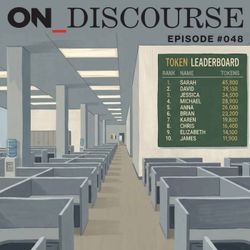
48. Tokenmaxxing
36:46||Season 1, Ep. 48Dan, Toby, and Chmiel break down the Silicon Valley flex nobody's asking enough questions about: burning tokens as a workplace KPI. Is maxing your token usage a signal of genuine AI-first thinking — or just a new way to dress up the same old productivity theater?Details of the show:Jensen Huang's "$500K in tokens or you're not doing it right" interview and why it's both a marketing stunt and a real cultural shiftWhy Meta's internal token leaderboard (they called it Clawdynamics) collapsed when employees just built bots to game itThe NBER study: 90% of firms reporting zero productivity from AI initiatives — and what it says about the gap between token burning and actual outcomes"Refounding" vs. transformation — a new word for the same old fuzzy concept, or something actually different?Why the billion-dollar one-person company is probably wrong — and the five-person version might be right
47. Can AI Make Art?
58:56||Season 1, Ep. 47Dan, Toby, and Chmiel are joined by Carlos "Mare139" Rodriguez — OG ON_Discourse member, graffiti pioneer, fine artist, and cultural theorist — to dig into the question that lit up the ON_Discourse WhatsApp group: when a member called an AI-generated Spotify track the work of "a new artist," it set off a debate about art, authorship, economics, and who gets to hold the gate. Carlos brings five decades of perspective — from NYC hip hop and Style Wars to digital sculpture and 3D-printed B-Boys — to argue that this moment is less a threat to art than the latest in a long line of tools that expand what's possible. Marcel Duchamp's latrine makes an appearance. So does Questlove.Details of the show:Why the word "artist" sparked the debateCarlos traces the lineage: from Cubism to graffiti to jumbotrons to AIThe turntable as instrument — and what that tells us about AI as a creative toolAre we heading toward more great artists, fewer, or the same? (The hosts don't agree)Why Carlos thinks young people, not institutions, will decide what happens next
46. Vibecoding Returns
39:14||Season 1, Ep. 46In this episode, Dan, Toby, and Chmiel try to explain what it actually feels like when AI stops being a tool you use in isolation and starts being the connective tissue of how a team works together. The conversation wanders through vibe coding failures, the difference between content and context, what it means to actually be an AI-first company (spoiler: not what most people think), and why the right question isn't "how do we get more efficient?"Details of the ShowProductive vs performative vibecodingIt is very hard to describe and very easy to experienceHow MyFitnessPal vibecoded its way to success without Under ArmourThis moment in history is lacking language to adequately describe it
45. It’s Not Real, But It’s Important
39:32||Season 1, Ep. 45Dan, Toby, and Chmiel confront a hard truth: a listener reached out last week and said they were completely lost. So this week, the trio tries to strip away the gobbledygook and explain — in plain language — what OpenClaw actually means, why it matters even though it barely works, and why none of them can confidently explain what they're building anymore. Along the way, Toby uses his therapist as a test case for AI integration, Dan admits he might have been wrong about prompt engineering for three years, and Chmiel says something he never expected to say: everything feels broken.Details of the Show:The difference between talking to AI on a website and talking to your computer at the system level — and why the distinction mattersWhy Toby's therapist tried AI on their sessions and they both decided it was terribleDan's flip: after years of rejecting "direction work," he spent the last week doing nothing but promptingThe vibe-coded prototype problem — when a client shows up with something they built in two minutes and thinks the hard work is doneChmiel's confession: a lifetime of limitations trained his imagination to think small — and the last five weeks broke that
loading...