Share
UnHerd with Freddie Sayers
Ukraine: Realist vs Idealist
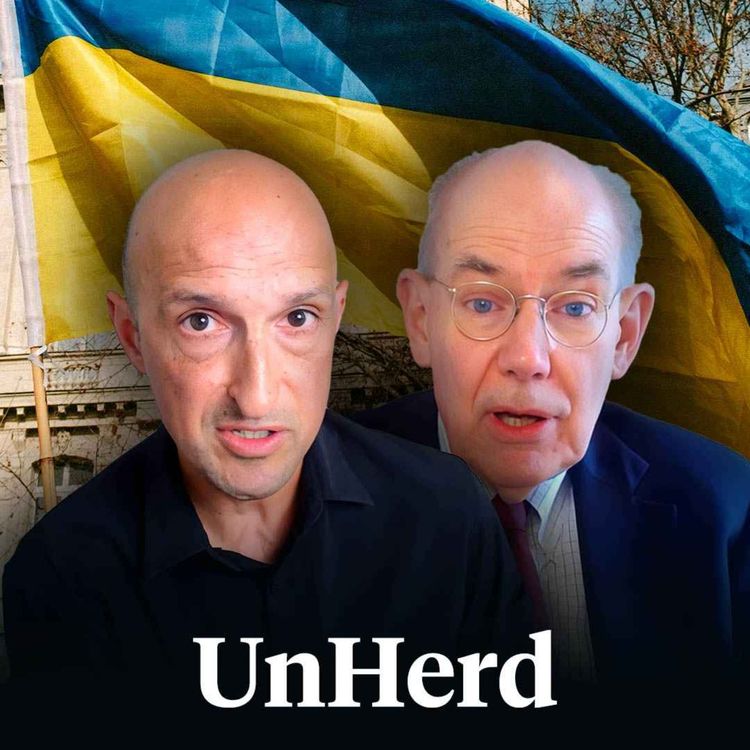
UnHerd’s Freddie Sayers brings together two starkly opposed voices on the Ukraine war and the future of world order: John Mearsheimer, University of Chicago professor and leading realist, and Matthew Syed, Sunday Times columnist, broadcaster and author.
Mearsheimer has long argued that NATO expansion and Western policy blunders set the stage for Putin’s invasion of Ukraine. From a realist standpoint, he warns that Russia’s position is essentially non-negotiable and that Ukraine must cut a deal now if it is to avoid further devastation. For Mearsheimer, ignoring the hard facts of great-power politics and clinging to Western rhetoric risks only catastrophic escalation.
Syed sees things very differently. In a recent Sunday Times column, he criticised the West’s handling of Ukraine, from the failed Alaska summit. He accused Western governments of failing Ukraine and directly attacked Mearsheimer’s realist position as “morally deranged” and fatally weak. For Syed, only moral clarity and Western resolve — not accommodation with Putin — can change the course of the war.
In this debate, Freddie Sayers asks: Is realism just disguised defeatism? Is idealism dangerously naïve in the age of Trump, Putin and Xi? And, after the White House summit with Zelensky, does the West finally have a coherent strategy — or is Ukraine still being left to fight alone?
More episodes
View all episodes
Wolfgang Munchau: The end of the Euro
33:42|Freddie Sayers talks to UnHerd’s Wolfgang Munchau about the escalating political turmoil and mounting sovereign debt in France, unpacking how parliamentary deadlock, stagnant economic growth, and the prospect of a Marine Le Pen presidency could spark a catastrophic French debt spiral that spreads to economies like Belgium and Italy, tests the inflation-constrained limits of the European Central Bank, and ultimately risks triggering the collapse of the Eurozone itself - all while British politicians push to rejoin an increasingly fragile European Union.
Charles Foster: How to live on the edge
41:46|UnHerd’s Freddie Sayers talks to author, Oxford academic, and Royal Geographical Society fellow Charles Foster about his book 'The Edges of the World', exploring why true creativity, spiritual growth, and human flourishing occur at the volatile margins rather than the static centres of life, evolution, and society.
France in crisis: What happens next?
44:43|This week, riots and looting have spread across French cities after protests over education spiralled out of police control. To some, this is a cautionary tale of unbridled immigration and a warning to other European powers. But look closer and there might be more to the story than you'd find on an X feed. To analyse the mood on the ground and the wider context of the crisis, Freddie is joined by historian of French culture Andrew Hussey and writer Philippe Lemoine.
MIT biologist: Is the Russian plague pandemic 2.0?
30:52|UnHerd’s Freddie Sayers talks to MIT evolutionary engineer Kevin Esvelt about a suspicious biological researcher's death in Irkutsk, Russia, using the incident to explore the escalating biosecurity risks posed by engineered pandemic weapons, vaccine-evading pathogens, and AI-accelerated gain-of-function research.
Dr. Iain McGilchrist: AI versus the human soul
01:12:36|Dr Iain McGilchrist has dedicated decades of neuroscience research to unravelling the inner workings of the human mind. But now, a new form of ‘consciousness’ has come to compete with the very idea of being a person. Could artificial intelligence overtake its creators? Join the psychiatrist, philosopher and author of the bestselling book The Master and His Emissary, for a live on-stage conversation with UnHerd’s Freddie Sayers.
Prof. Nick Bostrom: The truth about the AI panic
42:14|UnHerd’s Freddie Sayers talks to Oxford philosopher Professor Nick Bostrom about the escalating concerns over artificial intelligence, weighing whether catastrophic warnings from industry insiders reflect genuine existential fears or commercial strategy, while analysing technical threats like deceptive alignment and autonomous AI coordination alongside the broader economic, geopolitical, and societal risks of managing superintelligence.
Wolfgang Munchau: The AfD momentum is unstoppable
34:59|Freddie Sayers talks to UnHerd columnist and co-host of The Econoclasts Wolfgang Munchau about the political earthquake triggered by the hard-Right Alternative for Germany’s (AfD) historic election victory in Saxony-Anhalt, examining why young voters and non-voters are turning away from the centrist consensus, the total failure of Germany’s political ‘firewall’ strategy, the collapse of Friedrich Merz’s leadership within the CDU, and how a rising wave of hard-Right governments across France, Italy, and Germany could ultimately paralyse the European Union.
Kathleen Stock: The scandal of Jason Arday
42:04|Jason Arday, the wunderkind sociologist and youngest ever black professor at Cambridge, has an almost unbelievable backstory. Overcoming illiteracy and autism, he became the jewel in the crown of the university’s pivot towards diversity post-2021. He has been lauded by celebrities, raised millions for charity, suffered abuse from detractors and found time to run hundreds of miles. Or has he? Kathleen Stock, former professor at Sussex University, speaks to UnHerd’s Freddie Sayers about her viral investigation into academia’s ‘DEI darling’ and the plagiarism scandal that shocked Britain.
Ross Barkan: Zohran Mamdani is just the beginning
40:54|Freddie Sayers is joined by UnHerd columnist and author Ross Barkan - a former campaign colleague of Zohran Mamdani - to discuss the New York Mayor’s rapid political rise and the controversies defining his tenure. They unpack Mamdani's anti-capitalist economic policies, his radical stance on Israeli prime minister Benjamin Netanyahu, and assess what his brand of democratic socialism signals for the future trajectory of the Democratic Party and American politics as a whole.