
Latest episode
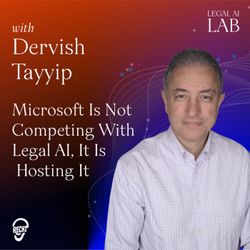
4. Dervish Tayyip - Microsoft Is Not Competing With Legal AI, It Is Hosting It
59:36||Season 2, Ep. 4Microsoft is not trying to win the legal AI market. It wants to be the layer underneath it.Dervish Tayyip is Assistant General Counsel for EMEA at Microsoft. The strategy he describes has little to do with building the best model. Embed intelligence into the workflows lawyers already use, then wrap enterprise governance around it. The legal agent inside Word is the visible part. The orchestration layer, where a lawyer pulls down whichever model suits the task, is where Tayyip says legal AI value actually sits.For general counsel the pressure is coming from somewhere else entirely. CFOs have heard that legal is about to be disrupted. Management consultants are telling the CEO they can deliver the same legal department at a third of the cost. Tayyip explains what he hears in Microsoft's roundtables with general counsel, and how a GC takes control of that narrative before someone else writes it for them.He also covers where horizontal platforms end and jurisdiction specific legal AI begins, what Microsoft commits to if a government ever demands a shutdown, and what junior lawyers should be learning now the groundwork is automated.You'll learnwhy Microsoft says the frontier model is not where legal AI value sitshow the legal agent inside Word removes the friction of changing behaviourwhat enterprise governance adds on top of a model: confidentiality, auditability, privilegehow a general counsel builds the investment case when the CFO wants headcount downwhy horizontal platforms and vertical legal AI are no longer an either or choicewhat Microsoft commits to contractually if a government demands a shutdownPowered by ZenoThis episode is powered by Zeno. Zeno is an AI native legal workspace built for Dutch and EU law.Its AI navigates law like a human legal professional. Secure, transparent and grounded in authoritative sources.Visit zeno.law and make deep thinking your competitive edge.Chapters00:00 Introduction02:18 Why the legal profession adapts slower than technology10:39 Automate, innovate or eliminate your workflows14:14 The legal agent in Word and an operating system for legal work17:11 Why the model is not where legal AI value sits22:39 Competing and partnering in the legal AI market25:56 Inside Microsoft's roundtables with general counsel29:59 What if someone pulls the plug on Europe33:48 200 data centres and Microsoft's promise to Europe43:10 The general counsel's case to the CFO46:30 Where horizontal and vertical legal AI meet52:43 How junior lawyers learn when the groundwork is gone58:23 Efficiency versus effectiveness
More episodes
View all episodes
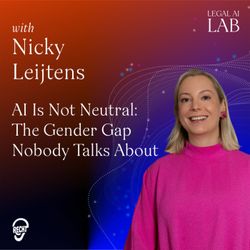
3. Nicky Leijtens - AI Is Not Neutral: The Gender Gap Nobody Talks About
53:04||Season 2, Ep. 3AI is not neutral. The gender gap in AI runs through the data it is trained on, the people who build it and the people who use it. And in legal, almost nobody talks about it.Nicky Leijtens, co-founder of She Breaks the Law and part of Bird & Bird, joins Hidde Bruinsma with examples that stick. Ask ChatGPT for career advice as a girl and the answer is less encouraging than the one a boy gets. Women make up 22% of AI development teams, a number that has not moved in ten years of Stanford research. At the M&A Awards, 42 nominations included exactly one woman.Why does the gender gap in AI stay off the agenda while every conference talks adoption and implementation? And what can you do tomorrow, whether you build, buy or simply use legal AI?Powered by ZenoThis episode is powered by Zeno. Zeno is an AI native legal workspace built for Dutch and EU law.Its AI navigates law like a human legal professional. Secure, transparent and grounded in authoritative sources.Visit zeno.law and make deep thinking your competitive edge.You'll learnwhy AI reflects the people who build it, and who is missing from that roomwhat happens when biased models start influencing legal decisions and access to justicehow visibility creates permission for other women to experimentwhy women adopt AI less and are judged more harshly when they do use itwhat closes the gender gap in AI according to Nicky: small actions that add upChapters00:00 Introduction00:05 She Breaks the Law: 4,000 women in 50 countries07:43 Rechtwijzer and better justice journeys13:51 The gender gap in AI nobody talks about14:39 AI is not neutral: data, users, builders16:39 Airbags, heart attacks and the male default18:08 Only 22% of AI builders are women20:25 Closing the gender gap in AI: where to start25:30 The Rik de Groot moment at Legal Geek29:14 Zeno question: auditing legal AI tools for bias34:27 42 nominations, one woman at the M&A Awards42:54 Antibodies: who is blocking the change50:39 What you can do tomorrow about the gender gap in AI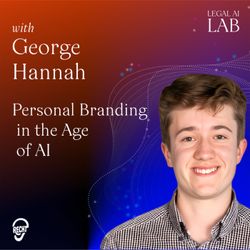
2. George Hannah - Personal Branding in the Age of AI
52:41||Season 2, Ep. 2Personal branding is career insurance for lawyers. That is how George Hannah treats it, and it is paying off.George is a solicitor apprentice at Lewis Silkin and the founder of Best Practice, the legal AI newsletter he started in January 2025 with one viral LinkedIn post. Today it is a media company with a podcast and a personal brand of more than 12,000 LinkedIn followers, run entirely next to his day job.We get into his personal branding playbook: why perfectionism keeps lawyers invisible, why an email list beats a rented audience, and why he posts at 80 percent and walks away. Then the legal AI market: Jude Law fronting Legora, Gabriel Macht fronting Harvey, Claude for Legal, the Freshfields deal and the Gartner hype cycle.And the question every firm is wrestling with: what is left for junior lawyers when AI does the grunt work? George's answer: build the agents.Powered by ZenoThis episode is powered by Zeno. Zeno is an AI native legal workspace built for Dutch and EU law.Its AI navigates law like a human legal professional. Secure, transparent and grounded in authoritative sources.Visit zeno.law and make deep thinking your competitive edge.You'll learnwhy a personal brand works as career insurancehow one viral post grew into a legal media companywhy perfectionism keeps lawyers invisible on LinkedInwhat the celebrity brand war says about the legal AI marketwhether legal AI has reached the peak of the hype cyclehow junior lawyers stay valuable by building AI agentsChapters00:00 Introduction02:21 One viral post starts Best Practice04:49 Email lists and the discipline of weekly content08:09 From Sunday newsletter to legal media company11:19 Personal branding is not luck12:22 Why lawyers fail at personal branding16:03 Personal branding in the age of AI slop18:07 Your personal brand as career insurance22:01 The TBD Marketing LinkedIn leaderboard23:39 Post at 80 percent and put your phone away26:06 Jude Law, Gabriel Macht and the legal AI brand war28:58 Have we reached the peak of the hype cycle30:30 Claude for Legal, Microsoft and the Freshfields deal35:47 Access to justice and Lawhive's AI lawyer Lawrence40:32 What junior lawyers do when AI takes the grunt work47:08 Portfolio careers and weekly check-ins50:50 Advice for lawyers finding their voice
1. Bjarne Tellmann - Law Firm Disruption: It Always Starts With the Client
01:05:28||Season 2, Ep. 1Law firm disruption won't start with technology. It starts with the client. Bjarne Tellmann spent 25 years as general counsel at Coca-Cola, Pearson, and GSK. His book "Law in the Era of AI" maps how the changes inside corporations will force the legal industry to adapt or vanish.Firms are posting record profits. But 100% of GCs in a recent Axiom survey regret their law firm engagements. 89% no longer consider them adequate. Bjarne draws on Nokia, Kodak, and Clayton Christensen's disruption theory to show why the most profitable incumbents are the most exposed to law firm disruption.He also offers paths forward. ClearyX funded its own disruption. The gazelle elephant model shows GCs how to rebuild their teams. And a warning: agentic AI is already making autonomous decisions inside corporations. If general counsels don't step into governance now, they'll be cleaning up the mess later.You'll learnwhy law firm disruption always starts with the client, not technologywhat the milkshake analogy teaches about law firm blind spotswhy no law firm has ever gone under while still profitablehow ClearyX funded its own disruption on purposewhat the gazelle elephant model means for legal team designPowered by ZenoThis episode is powered by Zeno. Zeno is an AI native legal workspace built for Dutch and EU law.Its AI navigates law like a human legal professional. Secure, transparent and grounded in authoritative sources.Visit zeno.law and make deep thinking your competitive edge.Chapters00:00 Introduction02:15 Why innovation needs ideas from unexpected places08:50 Record profits but law firm disruption is coming12:20 The AI factory driving law firm disruption17:10 The profession with zero curiosity about its clients23:00 Jobs to be done: what clients actually hire lawyers for32:00 Why law firm disruption is structurally impossible38:20 What if tech companies answer legal questions42:15 Kodak invented digital photography and still failed46:30 ClearyX: a firm that funded its own disruption53:10 The gazelle elephant model for legal teams57:30 Agentic AI and why governance cannot wait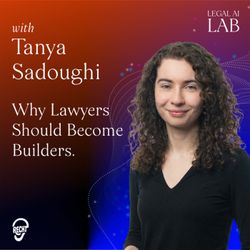
10. Tanya Sadoughi - Why Lawyers Should Become Builders. A story on vibe coding
55:55||Season 1, Ep. 10A banking lawyer at one of the world's largest law firms teaches herself Python on weekends. She builds an AI-powered billing tool in a Jupyter notebook. Months later, that tool is rolled out across the entire firm.Tanya Sadoughi is Linklaters' AI and Innovation Lead Lawyer for Global Banking. When ChatGPT launched one month into her innovation secondment, she saw the opportunity before most others did. She talked to every lawyer in the banking practice, mapped every pain point, and built a working prototype herself.That prototype became the WIP Summariser, now deployed firmwide. Today she leads a team of five AI lawyers inside a global network of twenty.Vibe coding is changing how lawyers work. Not by replacing them, but by turning them into builders. Tanya explains what that looks like inside a major international law firm. From hackathons that spark curiosity to agentic systems that solve problems at scale.You'll learnWhy the AI lawyer role should always be filled internallyHow a weekend prototype became an enterprise tool at LinklatersWhat vibecoding means for the legal professionWhy hackathons are the best way to spark AI curiosity at law firmsHow Linklaters scaled from one to twenty AI lawyersWhat lawyers and engineers can learn from each otherPowered by ZenoThis episode is powered by Zeno. Zeno is an AI native legal workspace built for Dutch and EU law.Its AI navigates law like a human legal professional. Secure, transparent and grounded in authoritative sources.Visit zeno.law and make deep thinking your competitive edge.Chapters0:00 Introduction2:04 Will lawyers become builders4:53 Growing up in a pizza shop in South Yorkshire9:17 A viral YouTube channel at 1511:16 Why she chose law13:29 Becoming a banking lawyer at Linklaters15:42 The itch for something different17:35 ChatGPT launches one month into her innovation role19:28 First experiments with large language models23:18 The billing problem nobody could solve27:26 Learning Python on weekends31:31 The moment the prototype worked35:31 Hackathons and sparking curiosity at law firms40:23 From one AI lawyer to twenty43:47 Vibecoding five apps in one week46:31 What engineers and lawyers can learn from each other51:23 Why every law firm needs an AI lawyer53:01 More builders not more tools
9. Soledad Atienza - Why Lawyers Are Architects of Society in the Age of AI
47:33||Season 1, Ep. 9Lawyers are architects of society. But what happens when AI changes how law is accessed, practiced and understood?In this episode of Legal AI Lab, Soledad Atienza, Dean of IE Law School, explains why legal education must move beyond national systems and embrace a global legal mindset.AI makes legal knowledge more accessible than ever. That means law schools must shift their focus. From memorising content to developing critical thinking. From national silos to comparative principles. From narrow specialisation to multidisciplinary awareness.We discuss:• Why law schools should not ban AI but guide its use• How assessments must change in an AI world• Why students must learn to question AI outputs• Why demand for legal services is growing, not shrinking• The importance of human skills such as empathy, negotiation and teamworkPowered by ZenoThis episode is powered by Zeno. Zeno is an AI native legal workspace built for Dutch and EU law.Its AI navigates law like a human legal professional. Secure, transparent and grounded in authoritative sources.Visit zeno.law and make deep thinking your competitive edge.hoofdstukken00:00 Lawyers as architects of society02:47 National regulation vs global practice06:18 From systems to principles09:42 Knowledge vs judgment in the AI era14:11 Growing demand for legal services17:36 Embedding AI across the curriculum22:04 Teaching students to question AI26:53 Rethinking assessment in an AI world32:27 Generalists and multidisciplinary thinking37:12 Human skills in a tech driven profession41:05 Experiential learning and VR44:38 Habits future lawyers must build
8. Elgar Weijtmans - Experimenteren met AI is geen keuze meer voor advocatenkantoren
58:04||Season 1, Ep. 8AI verandert de advocatuur fundamenteel. Niet alleen technisch, maar ook cultureel.In deze aflevering van Legal AI Lab spreekt Hidde Bruinsma met Elgar Weijtmans over wat het betekent om jurist te zijn in een tijdperk van generatieve AI.Elgar vertelt waarom hij zichzelf een generalist noemt. Waarom juist die brede blik steeds waardevoller wordt. En waarom advocatenkantoren die wachten op perfect beleid of volledige zekerheid zichzelf in de weg zitten.Het gesprek gaat over experimenteren. Over kleine teams. Over sandboxes in plaats van olietankers. En over waarom training, cultuur en menselijk gedrag uiteindelijk belangrijker zijn dan de technologie zelf.Ook bespreken we hoe advocatenkantoren omgaan met weerstand. Waarom vroege adoptie soms vooral geluk is. En waarom AI niet vraagt om minder mensen, maar om andere vaardigheden.Een aflevering voor studenten. Voor jonge juristen. Voor partners. En voor iedereen die voelt dat het klassieke carrièrepad schuurt.Powered by ZenoThis episode is powered by Zeno. Zeno is an AI native legal workspace built for Dutch and EU law.Its AI navigates law like a human legal professional. Secure, transparent and grounded in authoritative sources.Visit zeno.law and make deep thinking your competitive edge.hoofdstukken0:00 Introductie en het pad van Elgar1:10 Generalist zijn in de advocatuur2:59 Waarom AI een kans is voor generalisten4:14 Het klassieke carrièrepad onder druk6:08 Waarom experimenteren essentieel is9:20 De eerste kennismaking met ChatGPT11:28 Verandering organiseren binnen een groot kantoor13:52 Waarom timing soms geluk is15:15 Training is belangrijker dan technologie18:56 Worden advocatenkantoren techbedrijven21:53 Een nieuw profiel voor jonge juristen24:40 Zichtbaarheid. Kennis delen. Cultuur27:23 Waarom hyperpersoonlijk werkt30:48 De zoektocht naar juridische AI tools33:24 De trechter. Niet het resultaat maar het proces36:24 Waarom testen altijd contextafhankelijk is40:23 Van generieke AI naar juridisch onderzoek45:22 Richtlijnen en onzekerheid in de markt48:52 Open benchmarks en samenwerking51:44 Voorspellingen voor 202654:31 Advies aan jonge juristen55:55 Afsluiting