Share
Inspired Evolution with Amrit Sandhu 🙏🏻
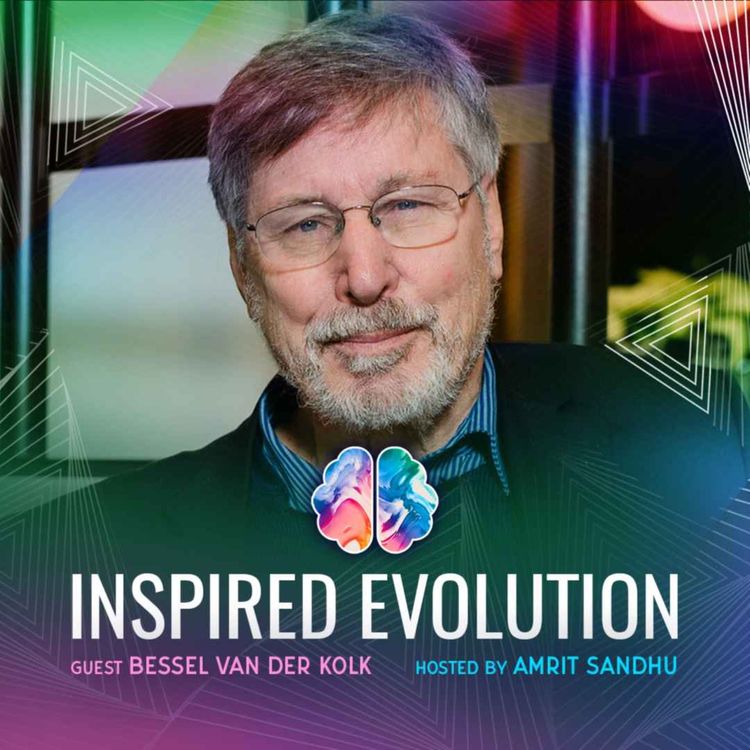
IE162 Dr. Bessel van der Kolk: Transforming Trauma: How to Heal the Body that Keeps The Score
In this week’s episode, Amrit interviews Dr. Bessel van der Kolk, a psychiatrist, author, researcher and educator based in Boston, USA. He was previously the president for the International Society for Traumatic stress Studies, former co-director of the National Child Traumatic Stress Network, professor of Psychiatry at Boston University School of Medicine and president of the Trauma Research Foundation in Brookline, Massachusetts.
Dr. Bessel has published over 150 peer reviewed scientific articles on trauma and how to heal from trauma. He is the author of “Post-traumatic Stress Disorder”, “Psychological Trauma”, Traumatic Stress with Alexander C. McFarlane and Lars Weisæth, and the New York Times best seller, The Body Keeps the Score.
In this episode, Amrit and Dr. Bessel have a profound conversation about trauma and healing. They dive deep into what causes trauma, how and why it gets stored in the body, and effective healing modalities to recover from it.
If you would like to have access to Dr. Bessel’s best seller “The Body Keeps the Score” and learn more about how to heal a body that stores trauma, please go to: https://amz.run/4I8M
In the first part of this chapter, Amrit and Dr. Bessel talk about what is trauma, what goes on in our brain when we hold on to things that we can't let go of, how we navigate the world with stored traumatic experiences, experiences that can prevent you from living a life and the importance of having people around you when feeling overwhelmed.
They converse about the changes in your brain when you go through a dramatic experience, different parts of the body related to traumatic experiences, the role of helplessness when trying to get out of a traumatic experience we can’t get out of and the role of our nervous system when processing trauma.
They cave into a dialogue around the link between our rational mind and the trauma we experience and where the trauma is stored.
In regards to this modern society in which people have in their heads what their bodies should look like; they talk about whether this is potentially creating more of a disconnection rather than a connection to their bodies.
Furthermore, in the second half of the episode, they dive deep into healing with a short parable of the raft and how once helpful things can become a burden instead.
They talk about how to begin with healing, how every culture has their own indigenous ways of dealing with trauma, the importance of some modalities of healing having someone around, modalities for healing with no one around, different healing therapies, western culture’s therapies, and promising neurofeedback and psychedelic therapy with it’s different perspectives.
In this chapter you will discover what trauma is, how it makes you feel, how it is formed and created, how it changes your brain, why people experiencing trauma keep behaving and reacting as if they were stuck in that experience, why you get stuck in a state of hyper alertness and why your body, mind and entire system gets frozen or stuck in “fight or flight” mode.
You will understand why people try to shut the feeling down and end up shutting down their ability to feel turning to drugs, alcohol, pharmaceuticals and compulsive behaviour.
You also will have access to different modalities and therapies for healing trauma, promising research around psychotropics and psychedelic therapy and neurofeedback.
You will learn the importance of taking care of your body, feeling safe and being surrounded by your loved ones.
You will master the most effective healing modalities to recover from trauma!
“Take care of your body”
“Develop a loving relationship to take care of your body”
About Dr. Bessel van der Kolk:
Bessel van der Kolk MD spends his career studying how children and adults adapt to traumatic experiences, and has translated emerging findings from neuroscience and attachment research to develop and study a range of treatments for traumatic stress in children and adults.
In 1984, he set up one of the first clinical/research centers in the US dedicated to study and treatment of traumatic stress in civilian populations, which has trained numerous researchers and clinicians specializing in the study and treatment of traumatic stress, and which has been continually funded to research the impact of traumatic stress and effective treatment interventions.
He did the first studies on the effects of SSRIs on PTSD; was a member of the first neuroimaging team to investigate how trauma changes brain processes, and did the first research linking BPD and deliberate self-injury to trauma and neglect in early childhood.
Much of his research has focused on how trauma has a different impact at different stages of development, and that disruptions in care-giving systems have additional deleterious effects that need to be addressed for effective intervention.
In order to promote a deeper understanding of the impact of childhood trauma and to foster the development and execution of effective treatment interventions, he initiated the process that led to the establishment of the National Child Traumatic Stress Network (NCTSN), a Congressionally mandated initiative that now funds approximately 150 centers specializing in developing effective treatment interventions, and implementing them in a wide array of settings, from juvenile detention centers to tribal agencies, nationwide.
He has focused on studying treatments that stabilize physiology, increase executive functioning and help traumatized individuals to feel fully alert to the present. This has included an NIMH funded study on EMDR and NCCAM funded study of yoga, and, in recent years, the study of neurofeedback to investigate whether attentional and perceptual systems (and the neural tracks responsible for them) can be altered by changing EEG patterns.
His efforts resulted in the establishment of Trauma Center (now the Trauma Research Foundation) that consisted of a well-trained clinical team specializing in the treatment of children and adults with histories of child maltreatment, that applied treatment models that are widely taught and implemented nationwide, a research lab that studied the effects of neurofeedback and MDMA on behavior, mood, and executive functioning, and numerous trainings nationwide to a variety of mental health professional, educators, parent groups, policy makers, and law enforcement personnel.
Tune In:
Welcome Dr. Bessel van der Kolk to the Inspired Evolution!: (00:00)
How Dr. Bessel defines Trauma: (02:59)
“Trauma is an experience that overwhelms your system”
Process in the brain when holding onto things and not letting go: (04:10)
“We have systems in the brain that create the map of where we need to go”
Navigating the world with traumatic experiences that drop in: (07:44)
“What originally was protecting you becomes a deferment and prevents you from living”
Traumatic experiences have to be extreme or can they be everyday experiences?: (08:41)
“Humans need each other to make themselves feel safe”
Community as an instrumental part of the coping system: (11:27)
“The deepest hurt is to be brutalized by the people we love”
About the brain having gone through a traumatic experience: (12:27)
“If you cannot fight or flee, your system may get stuck and keep on producing stress hormones”
Different parts of the body related to different traumatic experiences?: (13:55)
The role of helplessness when trying to get out of traumatic experiences you can't get out of: (15:24)
The role of the nervous system in processing trauma: (16:32)
“The function of the brain is to have a functioning body”
“Your body sends signals that need to be attended”
The link between a rational mind and a traumatic experience. Is trauma rational: (19:27)
“A rational brain explains things, your body speaks the truth”
Parts of the head connected to the body responsible for storing trauma: (22:22)
“You have to love the relationship to your body”
Does worrying about the way we must look create more of a disconnection than a connection to our body?:(25:40)
About a raft parable referring to the things we hold on to: (27:15)
“People have been very ingenious in being able to survive horrendous situations but they have their draft on their shoulders”
From trauma to healing: (31:06)
“Healing trauma becomes helping people be insync with people around them”
Research uncovering indigenous modalities for healing?: (37:46)
“Research can do only what is socially acceptable”
About collective trauma in modern society: (39:02)
“You can make misery anywhere and you can make happiness anywhere, it all depends on how respectful, insync and how open people are to each other”
Self healing modalities where others don't need to be involved: (40:58)
“None of us do things by ourselves”
About Psychedelic Therapy and it’s different perspective: (45:23)
“You transport into a different reality where you see yourself in a much larger perspective”
Dr. Bessel van der Kolk’s books and articles:
- “The body keeps the score: Brain, mind, and body in the healing of trauma” by Dr. Bessel van der Kolk: https://amz.run/4I8M “Traumatic Stress: The Effects of Overwhelming Experience on Mind, Body, and Society” by Dr. Bessel van der Kolk & Alexander C. McFarlane and Lars Weisaeth: https://amz.run/4I8O
- “Psychological Trauma” by Dr. Bessel van der Kolk: https://amz.run/4I8Q
- “Post-Traumatic Stress Disorder: Psychological and Biological Sequelae” (Clinical Insights) by Dr. Bessel van der Kolk
- Dr. van der Kolk’s Google Scholar: https://scholar.google.com/citations?user=1oHBFlMAAAAJ&hl=en
Mentioned resources:
- Dave Asprey: https://www.youtube.com/watch?v=cS9MBM2rvA8&t=115s
Connect with Dr. Bessel van der Kolk:
- Website: https://www.besselvanderkolk.com/
- Facebook The Body Keeps The Score: https://www.facebook.com/thebodykeepsthescore/
- Instagram: https://www.instagram.com/bessel_van/
- Instagram The Body Keeps The Score: https://www.instagram.com/thebodykeepsthescore/
- Wiki page: https://en.wikipedia.org/wiki/Bessel_van_der_Kolk
Join the Inspired Evolution Community:
- Facebook: https://www.facebook.com/InspiredEvolution/
- Instagram: https://www.instagram.com/InspiredEvo/
- YouTube: https://www.youtube.com/InspiredEvolution/
- Website: https://inspiredevolution.com/
More episodes
View all episodes

632. John Vervaeke on the Meta-Crisis, the Scarcity Mindset and AI Chatbots
08:37||Ep. 632Watch the full episode with John Vervaeke: https://youtu.be/5EoTWKFz_awCognitive scientist Dr. John Vervaeke explains how the meaning crisis feeds the wider meta-crisis: starving for meaning pushes us into a scarcity mindset — short-term, impulsive, narrow and aggressive — exactly the wrong mind for complex problems like AI. He shares his view of the growing evidence that heavy chatbot use is cognitively harmful, why he says we should treat chatbots like "radioactive cigarettes," and why he believes AI doom headlines distract from the harms we can address right now.Find your people inside the Inspired Evolution Community Circle 👉 https://inspiredevolution.com/circleDo you have people you can go truly deep with about this stuff? For some of you, it's no one - it can feel like living a secret life. For others, you have people, but the conversations stay at the surface.Inside The Circle: weekly gatherings, guided meditations, unrecorded deep dives where you can be fully yourself... and once a month, you sit down with the podcast guests like Ismael, and I hand you the mic to have your personal questions answered.Walking alone, or ready to go deeper... come find your people 👉 https://inspiredevolution.com/circleWe're looking forward to welcoming you Home on the Inside. See you soon.
632. John Vervaeke on Plato's Cave, The Matrix and Turning Toward Reality
08:47||Ep. 632Watch the full episode with John Vervaeke: https://youtu.be/5EoTWKFz_awCognitive scientist Dr. John Vervaeke walks through Plato's Allegory of the Cave step by step — the chains, the fire, the climb into the light, and the return — and explains why The Matrix is a modern retelling of it (Neo, "the One"). He shows why seeing reality is not about changing your beliefs but turning your whole perspective, and why the person who comes back is so often called insane.Find your people inside the Inspired Evolution Community Circle 👉 https://inspiredevolution.com/circleDo you have people you can go truly deep with about this stuff? For some of you, it's no one - it can feel like living a secret life. For others, you have people, but the conversations stay at the surface.Inside The Circle: weekly gatherings, guided meditations, unrecorded deep dives where you can be fully yourself... and once a month, you sit down with the podcast guests like Ismael, and I hand you the mic to have your personal questions answered.Walking alone, or ready to go deeper... come find your people 👉 https://inspiredevolution.com/circleWe're looking forward to welcoming you Home on the Inside. See you soon.
632. #632 John Vervaeke: The Meaning Crisis, Loneliness and the Collapse of Trust
01:55:19||Ep. 632Our brains are starving for meaning — and it’s making us lonely, distrustful, and sick.In this episode, cognitive scientist Dr. John Vervaeke (University of Toronto, creator of the acclaimed Awakening from the Meaning Crisis series) joins Amrit to map the crisis hiding underneath our loneliness epidemic, our collapse of trust in institutions, and our hunger for transcendence that nothing in modern life seems to feed.John explains why trust requires shared meaning, why the tech bros building AI have no idea where it’s going, and what happens to your psychological, social, and physiological health when you don’t have a sense of belonging. More importantly: what we can actually do about it — the practices, communities, and ways of knowing that reconnect us to what’s real.🔥 In this conversation:Why loneliness is an epidemic — and still growingThe real reason trust in every institution is at an all-time lowThe “toxic” cultural programming that keeps us isolatedTranscendence, God, and consciousness — and cutting through delusionWhy no one is leading the AI revolution (and why that should wake us up)Belonging as a biological need, not a luxury🎙 CONNECT WITH JOHN VERVAEKEWebsite: https://johnvervaeke.com/YouTube: https://www.youtube.com/@johnvervaekeX: https://twitter.com/DrJohnVervaekeFacebook: https://www.facebook.com/VervaekeJohn/🌱 CONNECT WITH INSPIRED EVOLUTIONSubscribe for weekly conversations on consciousness, meaning, and human flourishing.#JohnVervaeke #MeaningCrisis #InspiredEvolution🪐 BOOK YOUR PERSONAL 1-1 ASTROLOGY READINGThese collective shifts affect each of us differently.Explore how this moment is appearing in your chart, what season of life you are moving through, and how to work with your current astrology consciously and practically.Debra Silverman personally recommends booking a reading with Amrit.Still at introductory pricing...👉 BOOK YOUR 1–1 ASTROLOGY READING HERE:https://amritsandhu.com/reading___🌀 JOIN THE INSPIRED EVOLUTION CIRCLE The Inspired Evolution Circle is our private community for conscious souls who want to ground spiritual wisdom into everyday life, connect deeply/Inside the Circle:• Weekly live gatherings and guided practices• Intimate Q&As with guests like Kelly• Sharing circles and conscious community• Early invitations to retreats and live experiences• A sacred space to connect, evolve and belong👉 JOIN THE CIRCLE NOW:https://inspiredevolution.com/circle___A Note of Gratitude: Thank you for your presence. Sharing this journey with you, your comments, and your willingness to dive into these deep conversations are what make the movement move. We are navigating these profound times and questions together, and I am deeply honored to walk this path with you. If this episode helped you find even a moment of clarity today, then our mission is fulfilled. I hope you'll feel inspired to share this with your loved ones and fellow inspired evolutionaries.Inspired, and in loving service to evolution,Amrit 🙏🏻🌈 STAY INSPIRED & KEEP EVOLVING ! 👀 SEE YOU IN THE NEXT ONE ! 🙌 YEW !


631. #631 Gary Zukav: The New Human Consciousness and Authentic Power
01:41:23||Ep. 631
630. Shi Heng Yi on Growing Up Feeling He Had to Earn Love
08:44||Ep. 630Watch the full episode with Shi Heng Yi: https://youtu.be/_DrHUkloE5UShi Heng Yi reflects on growing up with strict parents, how good grades became tied to feeling loved, and how that shaped his drive to achieve.Find your people inside the Inspired Evolution Community Circle 👉 https://inspiredevolution.com/circleDo you have people you can go truly deep with about this stuff?For some of you, it's no one - it can feel like living a secret life.For others, you have people, but the conversations stay at the surface.Inside The Circle: weekly gatherings, guided meditations, unrecorded deep dives where you can be fully yourself... and once a month, you sit down with the podcast guests like Ismael, and I hand you the mic to have your personal questions answered.Walking alone, or ready to go deeper... come find your people 👉 https://inspiredevolution.com/circleWe're looking forward to welcoming you Home on the Inside. See you soon.
630. Shi Heng Yi on Overthinking and Noticing Your Thoughts
08:13||Ep. 630Watch the full episode with Shi Heng Yi: https://youtu.be/_DrHUkloE5UShi Heng Yi explains how the mind gets pulled into memories and imagined futures, and what changes when you notice a thought without following it.Find your people inside the Inspired Evolution Community Circle 👉 https://inspiredevolution.com/circleDo you have people you can go truly deep with about this stuff?For some of you, it's no one - it can feel like living a secret life.For others, you have people, but the conversations stay at the surface.Inside The Circle: weekly gatherings, guided meditations, unrecorded deep dives where you can be fully yourself... and once a month, you sit down with the podcast guests like Ismael, and I hand you the mic to have your personal questions answered.Walking alone, or ready to go deeper... come find your people 👉 https://inspiredevolution.com/circleWe're looking forward to welcoming you Home on the Inside. See you soon.
630. #630 Shi Heng Yi: Overthinking, Awareness & Letting Go
02:04:03||Ep. 630If you’ve ever replayed a conversation for hours or lain awake worrying about something that hasn’t happened, this episode is for you.Shaolin master Shi Heng Yi joins Amrit Sandhu on Inspired Evolution to explore why thoughts can feel like facts, how an imagined future can create real worry, and what changes when you notice a thought without following it.Shi also shares how growing up equating good grades with love shaped his drive to achieve. That story opens up a bigger question at the heart of the conversation. Who are you beneath the roles you’ve learned to play and the things you’ve worked so hard to achieve?In this conversation, we explore:- Why the mind keeps replaying the past and rehearsing the future- How Zen approaches awareness in everyday life- What happens when achievement becomes part of your identity- Why an old hurt can still feel fresh years laterIf this conversation resonates, tell us in the comments. What does your mind keep coming back to?**Connect with Shi Heng Yi**Facebook — https://www.facebook.com/shihengyi.onlineInstagram — https://www.instagram.com/shihengyi.onlineYouTube — https://www.youtube.com/c/ShiHengYiOnline📖 Discover Shaolin Spirit: Master Your Life by Shi Heng YiExplore the ancient practices of Shaolin philosophy for cultivating greater discipline, resilience, focus, and balance: https://www.amazon.com/Shaolin-Spirit-Self-Mastery-Shi-Heng/dp/1250427495/🪐 BOOK YOUR PERSONAL 1-1 ASTROLOGY READINGThese collective shifts affect each of us differently.Explore how this moment is appearing in your chart, what season of life you are moving through, and how to work with your current astrology consciously and practically.Debra Silverman personally recommends booking a reading with Amrit.Still at introductory pricing...👉 BOOK YOUR 1–1 ASTROLOGY READING HERE:https://amritsandhu.com/reading___🌀 JOIN THE INSPIRED EVOLUTION CIRCLEThe Inspired Evolution Circle is our private community for conscious souls who want to ground spiritual wisdom into everyday life, connect deeply/Inside the Circle:• Weekly live gatherings and guided practices• Intimate Q&As with guests like Kelly• Sharing circles and conscious community• Early invitations to retreats and live experiences• A sacred space to connect, evolve and belong👉 JOIN THE CIRCLE NOW:https://inspiredevolution.com/circle___A Note of Gratitude: Thank you for your presence. Sharing this journey with you, your comments, and your willingness to dive into these deep conversations are what make the movement move. We are navigating these profound times and questions together, and I am deeply honored to walk this path with you. If this episode helped you find even a moment of clarity today, then our mission is fulfilled. I hope you'll feel inspired to share this with your loved ones and fellow inspired evolutionaries.Inspired, and in loving service to evolution,Amrit 🙏🏻🌈 STAY INSPIRED & KEEP EVOLVING !👀 SEE YOU IN THE NEXT ONE !🙌 YEW !