Share
IFS Zooms In: The Economy
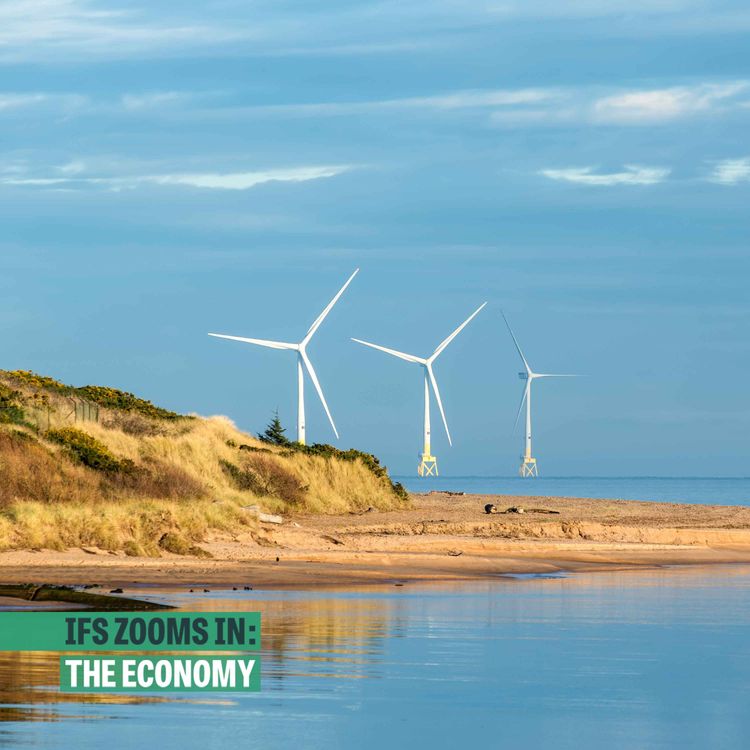
Why is UK electricity so expensive?
Conflict in the Middle East has pushed up energy prices in the UK. Even if the war ends soon, prices may not return to pre-war levels, and government could still face pressure to support households.
But the problem runs deeper than the current crisis. Even before the latest shock, the UK had some of the highest electricity prices in the developed world. Why is electricity so expensive here? How much of the problem is down to gas? Are renewables making bills cheaper or more expensive? And if government wants to cut electricity prices, what can it actually do?
Helen Miller is joined by Dieter Helm, Professor of Economic Policy at the University of Oxford, and Peter Levell, Deputy Research Director at IFS, to discuss Britain’s energy mix, the costs of renewables, net zero targets, and how policy should respond to energy price shocks.
Become a member: https://ifs.org.uk/individual-membership
Find out more: https://ifs.org.uk/podcasts-explainers-and-calculators/podcasts
More episodes
View all episodes
22. Who really benefits from university?
41:20||Season 7, Ep. 22More young people than ever are going to university, but the financial stakes have also risen. Many graduates begin their careers with around £50,000 of student debt and could make repayments for up to 40 years. While some degrees deliver substantial lifetime earnings gains, others may leave graduates financially worse off than if they had not attended university.Helen Miller is joined by IFS economists Christine Farquharson and Kate Ogden to examine what the evidence tells us about the financial returns to higher education.They discuss why graduate outcomes vary so widely across subjects, institutions and students; whether low-earning courses provide value to taxpayers; and whether government should restrict funding for degrees with poor financial outcomes.They also consider how artificial intelligence and wider labour-market disruption could affect today’s students, and whether historic earnings data can reliably guide decisions about careers that may last into the 2070s.Become a member: https://ifs.org.uk/individual-membershipFind out more: https://ifs.org.uk/podcasts-explainers-and-calculators/podcasts
21. Are people saving enough for retirement?
50:31||Season 7, Ep. 21The government has launched a new Pensions Commission, raising the prospect of significant changes to how people save for retirement.Are people currently saving enough? Should minimum workplace pension contributions rise? And what should the government do about low pension saving among the self-employed?Christine Farquharson is joined by IFS researchers Jonathan Cribb and Heidi Karjalainen to examine what future pensioners can expect. They discuss what counts as an adequate retirement income, how housing and inheritances affect people’s needs, and why the right policy may differ across generations.They also explore whether people should be encouraged to save more at particular stages of their working lives, and whether policymakers should be concerned about people drawing on their pension wealth before reaching state pension age.Become a member: https://ifs.org.uk/individual-membershipFind out more: https://ifs.org.uk/podcasts-explainers-and-calculators/podcasts
20. The tax and spending choices facing Andy Burnham
48:40||Season 7, Ep. 20Andy Burnham is preparing to enter Downing Street, but he will inherit a government facing tight fiscal constraints and a series of difficult decisions.The public finances remain under pressure, debt interest spending is high, and commitments not to raise the main rates of income tax, National Insurance or VAT limit some of the most obvious ways of raising revenue. At the same time, the new Prime Minister will need to make choices about departmental spending, defence, welfare, social care and the cost of living.How much flexibility will Burnham have over taxes, borrowing and public spending? Which commitments could be maintained, and which might need to be scaled back? And will a change of Prime Minister create space for a different economic strategy - or reveal the same underlying constraints?Christine Farquharson is joined by IFS colleagues Max Warner and Tom Waters to examine the economic choices facing the incoming Prime Minister.Become a member: https://ifs.org.uk/individual-membershipFind out more: https://ifs.org.uk/podcasts-explainers-and-calculators/podcasts
19. Will devolution solve the UK’s economic woes?
49:59||Season 7, Ep. 19Over the past few weeks, devolution has moved back to the centre of British politics. Andy Burnham has made the case for a “rewired Britain”: shifting power away from Westminster and Whitehall, creating a new “No 10 North” in Manchester, and giving local leaders a much bigger role in shaping economic policy.But what does devolution actually mean? Who would power be devolved to? What responsibilities could local leaders take on? How would they be funded? And could devolution really help the UK economy grow?Christine Farquharson is joined by Tony Travers, Professor in Practice in the LSE Department of Government, Associate Dean of the LSE School of Public Policy and Director of LSE London, and David Phillips, Associate Director at the IFS, to discuss what devolution means, how England compares internationally, whether “Manchesterism” offers lessons for the rest of the country, and what risks come with giving places more fiscal responsibility.Become a member: https://ifs.org.uk/individual-membershipFind out more: https://ifs.org.uk/podcasts-explainers-and-calculators/podcasts
18. The inequality of 'good jobs'
45:07||Season 7, Ep. 18What makes a job “good”? Is it pay, flexibility, progression, security, purpose, autonomy, or the people you work with?Policy debates about inequality often focus on wages and getting people into work. But jobs are about much more than income. The quality of work affects people’s health, wellbeing, productivity, family life and future opportunities.In this episode, Helen Miller is joined by Jonathan Cribb and Naomi Clayton, Chief Executive of the Institute for Employment Studies, to explore what good work really means, who gets access to good jobs, and what government can do to improve the quality of work in the UK.They discuss inequalities in pay, gender and geography, the importance of progression and training, the rise of flexible and insecure work, the role of employment rights, and how trends such as AI could shape the future of jobs.This is the fourth and final episode in our series on inequality.This episode draws on work done as part of the IFS-Deaton Review, funded by the Nuffield Foundation.Become a member: https://ifs.org.uk/individual-membershipFind out more: https://ifs.org.uk/podcasts-explainers-and-calculators/podcasts
17. Why is the UK so geographically unequal?
37:37||Season 7, Ep. 17The UK is one of the most geographically unequal countries in the developed world. People living in London and the South East tend to have higher incomes, higher levels of education and better health outcomes than people elsewhere in the country.But why did Britain become so regionally unequal? How much of the divide is driven by the shift away from industry and towards services? What role has public investment, infrastructure and decades of regional policy played? And what can policymakers realistically do to change things?In this episode, part of our mini-series on inequalities, we look at the scale of the UK’s regional divides, why London has become so dominant, and whether stronger cities, devolution, better coordination and more stable policy could help narrow the gap.Helen speaks with IFS economists Jonathan Cribb and Xiaowei Xu to ask what “levelling up” should mean in practice, whether improving opportunities outside London could boost national productivity, and how politicians should think about places that may not benefit directly from big-city growth.This episode draws on work done as part of the IFS-Deaton Review, funded by the Nuffield Foundation.Become a member: https://ifs.org.uk/individual-membershipFind out more: https://ifs.org.uk/podcasts-explainers-and-calculators/podcasts
16. What does Britain think about inequality?
47:31||Season 7, Ep. 16Around 80% of people think the gap between those on high and low incomes is too big. But only around 40% think the government should redistribute income from the rich to the poor.Why is there such a gap between concern about inequality and support for action to reduce it?In the second episode of our mini-series on inequality, we ask why people care about inequality, whether they distinguish it from poverty, and how views about luck, hard work, wealth and power shape attitudes to policy.Helen Miller is joined by Jonathan Cribb, Deputy Director at IFS, and Bobby Duffy, Professor of Public Policy and Director of the Policy Institute at King’s College London. They draw on work for the IFS Deaton Review of Inequalities, funded by the Nuffield Foundation, to explore what the British public thinks about inequality, what kinds of inequality worry people most, and what they want government to do about it.Become a member: https://ifs.org.uk/individual-membershipFind out more: https://ifs.org.uk/podcasts-explainers-and-calculators/podcasts
15. How unequal is Britain?
47:56||Season 7, Ep. 15In the first episode of our new series, we set out the big picture on inequality in the UK. We look at what has happened to income and wealth inequality and how Britain compares with other countries.But inequality is not just about money. It shapes people’s opportunities, education, health, family life and where they live. Some gaps have narrowed over time, while others remain stubbornly wide - and some inequalities in one generation can shape the chances of the next.Helen speaks with Paul Johnson and Jonathan Cribb to explore what the key facts tell us about modern Britain, what kinds of inequality we should worry about most, and where trade-offs with growth, fairness and redistribution become unavoidable.This episode draws on work done as part of the IFS-Deaton Review, funded by the Nuffield Foundation.Become a member: https://ifs.org.uk/individual-membershipFind out more: https://ifs.org.uk/podcasts-explainers-and-calculators/podcasts
14. The tough fiscal reality facing the UK government
47:27||Season 7, Ep. 14Britain’s public finances are under pressure. Public debt is high, borrowing remains high, and the government is spending far more on debt interest than in the past. Taxes are heading towards historic highs, while public services remain under strain and demand on the state continues to rise. In this episode, we set out the fiscal backdrop that will shape British politics over the coming years. Whoever is Prime Minister or Chancellor will face many of the same constraints: expensive borrowing, difficult spending choices and the need to get debt on a more sustainable path. Helen Miller is joined by IFS colleague Max Warner and Chris Giles, economics commentator at the Financial Times, to explain the state of the public finances, why borrowing costs matter, what the government’s fiscal rules do, how realistic current spending plans are, and whether there is any room for a future government to do things differently.Become a member: https://ifs.org.uk/individual-membershipFind out more: https://ifs.org.uk/podcasts-explainers-and-calculators/podcasts