Share
IFS Zooms In: The Economy
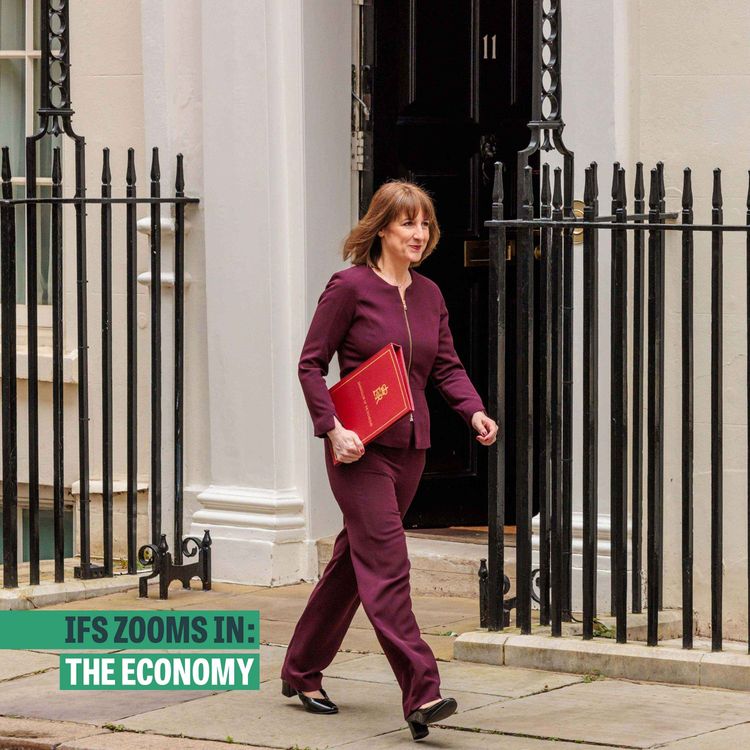
How could the Chancellor raise more tax?
Season 6, Ep. 29
•
As the Chancellor prepares for her next Budget, attention is turning to how more tax revenue could be raised. What options are on the table - and what would they mean for households, businesses and the wider economy?
Helen Miller is joined by IFS colleague Stuart Adam and tax expert Dan Neidle to explore the choices facing the Treasury. They discuss options from income tax and frozen thresholds to landlords, partnerships, pensions, and property taxes, asking which levers make sense and which should be left well alone.
Recorded live as part of the ESRC Festival of Social Science.
Become a member: https://ifs.org.uk/individual-membership
Find out more: https://ifs.org.uk/podcasts-explainers-and-calculators/podcasts
More episodes
View all episodes
6. How to fix the fiscal rules
47:30||Season 7, Ep. 6Fiscal rules can sound technical, but they shape some of the biggest choices in economic policy: what we spend today, what we invest for tomorrow, and how we share costs across generations.In this episode of IFS Zooms In, Helen is joined by Ben Zaranko to unpack why governments use fiscal rules, what the UK’s current rules are designed to do, and why - despite repeated promises - debt has continued to ratchet upwards. They discuss how a narrow, pass–fail approach has encouraged a fixation on “headroom”, contributed to last-minute policy changes driven by forecast movements, and crowded out wider debate about long-run sustainability.They then set out an alternative approach: a clearer fiscal strategy at the start of each parliament, assessed against a broader dashboard of indicators rather than a single bright-line test, using a traffic-light style system to support a more transparent and nuanced public conversation about the state of the public finances.Become a member: https://ifs.org.uk/individual-membershipFind out more: https://ifs.org.uk/podcasts-explainers-and-calculators/podcasts
5. Are Plan 2 student loans 'unfair'?
49:30||Season 7, Ep. 5On average, students now leave university with just over £50,000 in student loan debt. Repayments are income-contingent: many graduates will repay little or nothing, while others repay 9% of their income above a threshold for decades, often watching the outstanding balance rise. That design has led some to argue the system is unfair and to argue that students were mis-sold loans whose terms have shifted over time.In this episode, Helen is joined by Nick Hillman, Director of the Higher Education Policy Institute and a former government adviser during the introduction of Plan 2 in the early 2010s, alongside Kate Ogen, Senior Research Economist at IFS, to unpack how the student loan system works in practice. We explain how the system has evolved across cohorts, how it differs across the UK, and when it makes sense to think of student finance as a loan versus a graduate tax. We also look at who repays what across the earnings distribution, how repayment thresholds shape lifetime payments, what changed with the move to Plan 5, and what recent policy choices mean for graduates and for the public finances.Finally, we discuss competing claims about “fairness”, between graduates and taxpayers, among graduates, and across generations, and ask the core question: who should pay for higher education?Become a member: https://ifs.org.uk/individual-membershipFind out more: https://ifs.org.uk/podcasts-explainers-and-calculators/podcasts
4. Did inflation cause the cost of living crisis?
52:11||Season 7, Ep. 4Inflation has fallen a long way from its peak - but many people still feel worse off, and price rises have remained stubbornly above the Bank of England’s 2% target. So what actually caused the big inflation spike, how close are we to “normal”, and what does that mean for households? Helen is joined by David Miles (OBR and former member of the Bank of England’s Monetary Policy Committee) and Peter Levell (IFS) to break down the basics: what inflation is, why central banks target 2% rather than 0%, and what drove prices up so sharply in recent years. We also dig into who inflation hits hardest, how much of the cost-of-living crisis is really about inflation, and why the Bank raises interest rates even though it can make life feel tougher in the short run. Become a member: https://ifs.org.uk/individual-membershipFind out more: https://ifs.org.uk/podcasts-explainers-and-calculators/podcasts
3. Does the minimum wage cost jobs?
37:54||Season 7, Ep. 3The UK minimum wage is one of the biggest economic policy changes of the past few decades. Introduced in 1999 at £3.60 an hour, it’s now over £12 and it shapes pay for a large share of the workforce. But what has it done to jobs? And if firms pay higher wages, where does the money come from - higher prices, lower profits, or higher productivity?In this episode, Helen is joined by Eduin Latimer (IFS) and Professor Alan Manning (LSE) to unpack what we do and don’t know about the minimum wage. We look at the evidence on employment effects, the knock-on impacts on pay compression, and whether the current minimum wage is set too high. Finally, we look ahead to the government’s ambitions, including faster rises for younger workers, and the trade-offs involved.Become a member: https://ifs.org.uk/individual-membershipFind out more: https://ifs.org.uk/podcasts-explainers-and-calculators/podcasts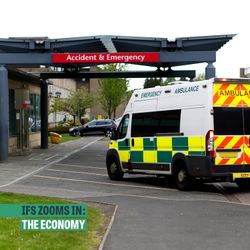
2. Why isn’t the NHS improving faster?
37:44||Season 7, Ep. 2The NHS holds a unique place in British life: a source of national pride, and the single biggest public service in England. This year it’s set to cost over £200 billion, around £3,500 per person, more than we spend on education, defence, justice and transport combined. And yet, despite sustained funding increases and around a quarter of a million more staff than in 2019, concerns about performance haven’t gone away.Labour came into office promising to get a grip on record waiting times, but progress so far looks limited. The waiting list stands at 7.3 million, only slightly down from around 7.6 million when the government took office a year and a half ago. With winter pressures, flu surges, and resident doctors taking strike action, it raises a big question: what’s actually going on inside the system, and is improvement realistically on the horizon?In this episode, Helen is joined by IFS colleagues Olly Harvey-Rich and Max Warner to unpack the data and the trade-offs. We look at winter pressures and capacity, what the latest performance metrics tell us, and the real constraints facing the NHS in England - money, productivity and system design. Finally, we look ahead to the rest of the parliament: should we be hopeful about meaningful change, or are the obstacles bigger than the plans?Become a member: https://ifs.org.uk/individual-membershipFind out more: https://ifs.org.uk/podcasts-explainers-and-calculators/podcasts
1. What really matters for the UK economy in 2026
42:45||Season 7, Ep. 1Moving into 2026, the government faces a critical period of delivery. After 18 months in power and several major fiscal events behind them, the focus is shifting from setting policy to seeing it through. However, with unemployment reaching 5.1% and a series of high-stakes reviews underway, the road ahead remains complex.In this episode, we are joined by Christine Farquharson and Tom Waters to examine the economic landscape for the year ahead. We look at the rising pressures on the public purse, from health-related benefits to the "national conversation" on SEND, and ask what the upcoming fiscal events might reveal about the government’s long-term strategy. We also look at what could shift the outlook, for better or worse, from public sector productivity to the economic impact of new technologies like AI and GLP-1 drugs.Become a member: https://ifs.org.uk/individual-membershipFind out more: https://ifs.org.uk/podcasts-explainers-and-calculators/podcasts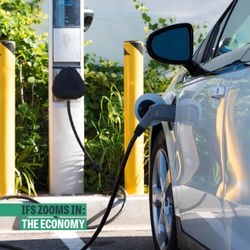
33. Tax changes in the Budget
39:22||Season 6, Ep. 33As ever the big-picture choices in the Budget dominated media coverage - but some of the most interesting changes were buried in the detail. From electric vehicles to tourist tax, how much do these quieter tax shifts really matter?In this episode, we dig into the lesser-noticed policies: why the government is offering upfront EV grants while planning a per-mile tax, how tweaks to salary sacrifice and cash ISAs could shape saving behaviour, and what the changes to EIS and EMI mean for investment and entrepreneurship. Joining Helen are Stuart Adam and Ben Zaranko from the IFS to break down what’s changed, why it matters, and what the “devil in the detail” tells us about the government’s tax strategy.Become a member: https://ifs.org.uk/individual-membershipFind out more: https://ifs.org.uk/podcasts-explainers-and-calculators/podcasts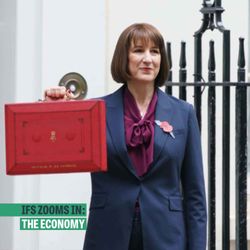
32. The Autumn Budget explained
45:47||Season 6, Ep. 32This week on IFS Zooms In, host Helen Miller is joined by IFS economists Ben Zaranko and Christine Farquharson to unpack one of the biggest Autumn Budgets in years. With seventy-five policy measures, major tax and spending changes, and a striking shift in the economic forecasts, this was a Budget that surprised almost everyone.Helen, Ben and Christine break down:Why the expected “fiscal repair job” never arrivedHow a “lucky” surge in forecast tax receipts reshaped the Chancellor’s optionsThe major spending stories: abolishing the two-child limit, rising welfare pressures, SEND funding reform, and tighter departmental plansThe government’s tax decisions - from threshold freezes to the new ‘mansion tax’Whether any of this adds up to a credible long-term strategy for growthBecome a member: https://ifs.org.uk/individual-membershipFind out more: https://ifs.org.uk/podcasts-explainers-and-calculators/podcasts
31. How could the Chancellor cut spending?
41:20||Season 6, Ep. 31As the Chancellor prepares her Budget, attention is turning not just to how she could raise more tax - but how she might cut spending. Where does the government actually spend its money? Why is it so difficult to reduce that spending in practice? And what would it take to genuinely pare back the size of the state?Helen Miller is joined by IFS colleagues Ben Zaranko and Tom Waters to unpack the realities behind public spending. They look at how the government’s budget is divided across welfare, public services, and investment; how pressures such as an ageing population, defence commitments and struggling services constrain choices; and whether efficiencies or productivity gains could ever plug the gap.Become a member: https://ifs.org.uk/individual-membershipFind out more: https://ifs.org.uk/podcasts-explainers-and-calculators/podcasts