Share
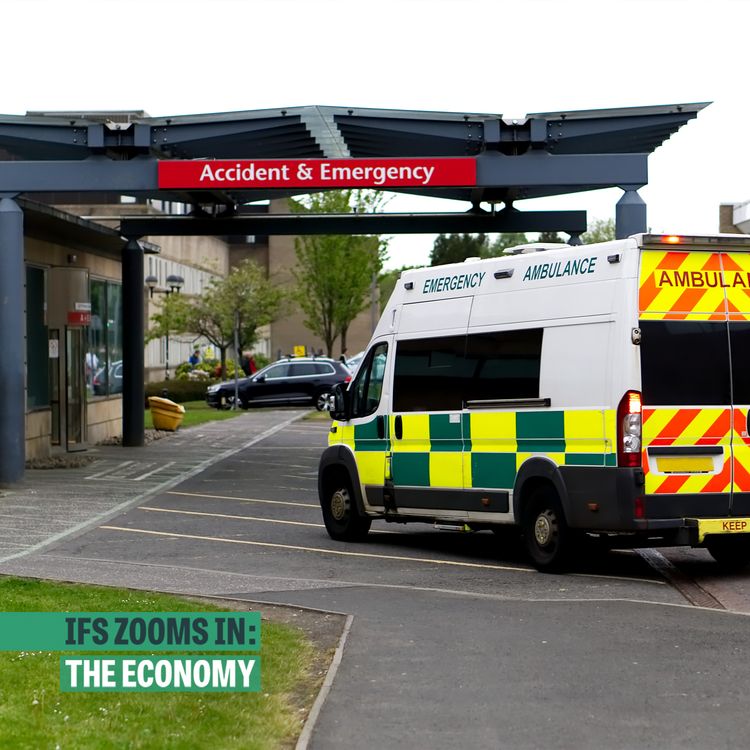
IFS Zooms In: The Economy
Why isn’t the NHS improving faster?
The NHS holds a unique place in British life: a source of national pride, and the single biggest public service in England. This year it’s set to cost over £200 billion, around £3,500 per person, more than we spend on education, defence, justice and transport combined. And yet, despite sustained funding increases and around a quarter of a million more staff than in 2019, concerns about performance haven’t gone away.
Labour came into office promising to get a grip on record waiting times, but progress so far looks limited. The waiting list stands at 7.3 million, only slightly down from around 7.6 million when the government took office a year and a half ago. With winter pressures, flu surges, and resident doctors taking strike action, it raises a big question: what’s actually going on inside the system, and is improvement realistically on the horizon?
In this episode, Helen is joined by IFS colleagues Olly Harvey-Rich and Max Warner to unpack the data and the trade-offs. We look at winter pressures and capacity, what the latest performance metrics tell us, and the real constraints facing the NHS in England - money, productivity and system design. Finally, we look ahead to the rest of the parliament: should we be hopeful about meaningful change, or are the obstacles bigger than the plans?
Become a member: https://ifs.org.uk/individual-membership
Find out more: https://ifs.org.uk/podcasts-explainers-and-calculators/podcasts
More episodes
View all episodes
11. The tough choices facing Wales’s next government
44:59||Season 7, Ep. 11In a few weeks, voters in Wales will choose the next Welsh Government in what could be a historic election. With Labour’s long dominance under pressure, this episode examines the fiscal backdrop to the campaign and the difficult choices facing whoever takes power.Helen is joined by Joe Rossiter, Co-Director of the Institute of Welsh Affairs, and IFS economist David Phillips, to discuss how Wales is funded, how the block grant from Westminster has changed over time, and how devolved tax powers have — and have not — been used. They assess the state of Welsh public services, ask whether Wales should have more powers over tax, spending and borrowing, and explore the constraints facing the next Senedd.They also look at what the parties are promising, where the main dividing lines lie, and why many of the biggest trade-offs are still not being clearly spelled out.Become a member: https://ifs.org.uk/individual-membershipFind out more: https://ifs.org.uk/podcasts-explainers-and-calculators/podcasts
10. Why Scotland’s next government faces tough choices
46:57||Season 7, Ep. 10Scotland receives significantly more funding per person for devolved public services than England, helping to pay for policies like free university tuition and smaller school class sizes. But despite that advantage, performance in parts of health and education remains under pressure, and Scotland’s fiscal outlook is becoming tighter.In this episode, Helen is joined by Mairi Spowage of the Fraser of Allander Institute and IFS Associate Director David Phillips to unpack the big economic and fiscal questions hanging over the Scottish Parliament election. They explain what powers are devolved, where Scotland’s money comes from, how tax and benefit choices have made the system more progressive, and why the next Scottish Government will face difficult trade-offs.They also discuss Scotland’s public service performance after Covid, the risks created by recent budgeting habits, and the issues politicians may prefer not to talk about as manifesto season begins.Become a member: https://ifs.org.uk/individual-membershipFind out more: https://ifs.org.uk/podcasts-explainers-and-calculators/podcasts
9. Will everyone have to work until they are 67?
44:24||Season 7, Ep. 9The state pension age is rising. It is currently 66, and by 2028 it will reach 67. But what does that actually mean for the people approaching retirement, and does it really mean everyone will have to work longer?In this episode, Helen is joined by Jonathan Cribb and Heidi Karjalainen to examine one of the biggest questions facing the pensions system: how high should the state pension age be? They discuss why it has been rising, what the state pension is designed to do, and how changes to the pension age affect work, retirement and government spending.They also look at who is able to keep working into their late 60s, who is not, and whether a single state pension age makes sense for everyone. Along the way, they explore how the UK compares with other countries, what happens to people who cannot work up to pension age, and whether the state pension system is financially sustainable in the long run.Become a member: https://ifs.org.uk/individual-membershipFind out more: https://ifs.org.uk/podcasts-explainers-and-calculators/podcasts
8. Are pensioners richer than everyone else?
40:39||Season 7, Ep. 8For decades, pensioners were one of the poorest groups in Britain. That is no longer true. Today, the average pensioner is at least as well off as the average working-age person, and in wealth terms many are far better off.In this episode, Helen Miller is joined by Jonathan Cribb and Heidi Karjalainen to examine what the data really say about pensioner incomes, wealth and living standards. Where does pensioners’ money come from? How much is driven by the state pension, private pensions and housing wealth? Which pensioners are still struggling? And how do today’s retirees compare both with their parents’ generation and with younger people who are still working?They also look ahead to the future: will younger generations enjoy the same living standards in retirement, or are higher house prices, lower homeownership and the decline of defined benefit pensions changing the picture? This episode sets out the big story of how pensioners’ finances have changed, and what it means for the future.Become a member: https://ifs.org.uk/individual-membershipFind out more: https://ifs.org.uk/podcasts-explainers-and-calculators/podcasts
7. The Spring Forecast explained
40:47||Season 7, Ep. 7Helen Miller is joined by IFS colleagues Ben Zaranko and Bee Boileau to discuss the Spring Forecast. The headline numbers haven’t moved much since the autumn, but that stability may not last. With conflict in the Middle East pushing up oil and gas prices, the UK faces a potential negative shock: higher inflation, pressure on interest rates, and a tougher outlook for households, businesses and the public finances.We discuss what higher energy prices could mean for government policy (from fuel duty to targeted support), why calls to raise defence spending are growing, and the scale of the trade-offs involved. We also look at three key forecast uncertainties: unemployment, migration, and volatile capital gains tax receipts. Finally, we ask how realistic tight future spending plans look ahead of the next Spending Review.Become a member: https://ifs.org.uk/individual-membershipFind out more: https://ifs.org.uk/podcasts-explainers-and-calculators/podcasts
6. How to fix the fiscal rules
47:30||Season 7, Ep. 6Fiscal rules can sound technical, but they shape some of the biggest choices in economic policy: what we spend today, what we invest for tomorrow, and how we share costs across generations.In this episode of IFS Zooms In, Helen is joined by Ben Zaranko to unpack why governments use fiscal rules, what the UK’s current rules are designed to do, and why - despite repeated promises - debt has continued to ratchet upwards. They discuss how a narrow, pass–fail approach has encouraged a fixation on “headroom”, contributed to last-minute policy changes driven by forecast movements, and crowded out wider debate about long-run sustainability.They then set out an alternative approach: a clearer fiscal strategy at the start of each parliament, assessed against a broader dashboard of indicators rather than a single bright-line test, using a traffic-light style system to support a more transparent and nuanced public conversation about the state of the public finances.Become a member: https://ifs.org.uk/individual-membershipFind out more: https://ifs.org.uk/podcasts-explainers-and-calculators/podcasts
5. Are Plan 2 student loans 'unfair'?
49:30||Season 7, Ep. 5On average, students now leave university with just over £50,000 in student loan debt. Repayments are income-contingent: many graduates will repay little or nothing, while others repay 9% of their income above a threshold for decades, often watching the outstanding balance rise. That design has led some to argue the system is unfair and to argue that students were mis-sold loans whose terms have shifted over time.In this episode, Helen is joined by Nick Hillman, Director of the Higher Education Policy Institute and a former government adviser during the introduction of Plan 2 in the early 2010s, alongside Kate Ogen, Senior Research Economist at IFS, to unpack how the student loan system works in practice. We explain how the system has evolved across cohorts, how it differs across the UK, and when it makes sense to think of student finance as a loan versus a graduate tax. We also look at who repays what across the earnings distribution, how repayment thresholds shape lifetime payments, what changed with the move to Plan 5, and what recent policy choices mean for graduates and for the public finances.Finally, we discuss competing claims about “fairness”, between graduates and taxpayers, among graduates, and across generations, and ask the core question: who should pay for higher education?Become a member: https://ifs.org.uk/individual-membershipFind out more: https://ifs.org.uk/podcasts-explainers-and-calculators/podcasts
4. Did inflation cause the cost of living crisis?
52:11||Season 7, Ep. 4Inflation has fallen a long way from its peak - but many people still feel worse off, and price rises have remained stubbornly above the Bank of England’s 2% target. So what actually caused the big inflation spike, how close are we to “normal”, and what does that mean for households? Helen is joined by David Miles (OBR and former member of the Bank of England’s Monetary Policy Committee) and Peter Levell (IFS) to break down the basics: what inflation is, why central banks target 2% rather than 0%, and what drove prices up so sharply in recent years. We also dig into who inflation hits hardest, how much of the cost-of-living crisis is really about inflation, and why the Bank raises interest rates even though it can make life feel tougher in the short run. Become a member: https://ifs.org.uk/individual-membershipFind out more: https://ifs.org.uk/podcasts-explainers-and-calculators/podcasts
3. Does the minimum wage cost jobs?
37:54||Season 7, Ep. 3The UK minimum wage is one of the biggest economic policy changes of the past few decades. Introduced in 1999 at £3.60 an hour, it’s now over £12 and it shapes pay for a large share of the workforce. But what has it done to jobs? And if firms pay higher wages, where does the money come from - higher prices, lower profits, or higher productivity?In this episode, Helen is joined by Eduin Latimer (IFS) and Professor Alan Manning (LSE) to unpack what we do and don’t know about the minimum wage. We look at the evidence on employment effects, the knock-on impacts on pay compression, and whether the current minimum wage is set too high. Finally, we look ahead to the government’s ambitions, including faster rises for younger workers, and the trade-offs involved.Become a member: https://ifs.org.uk/individual-membershipFind out more: https://ifs.org.uk/podcasts-explainers-and-calculators/podcasts