Share
Hey Change Podcast
Finding Happiness in New Realities with Anne Therese Gennari
Latest episode
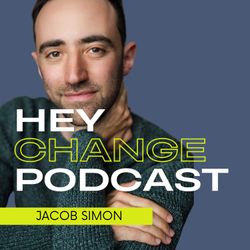
119. What if the Future Goes Right? With Jacob Simon
01:05:45||Ep. 119Less than 1% of climate media coverage talks about solutions. Jacob Simon is working to change that.Jacob trained as a pairs figure skater and spent five years on Team USA chasing the Olympics, until a dislocated shoulder ended his career overnight. Out of that loss he found a new path. A college newsletter of positive climate headlines grew into a full-time career, and today he spends half of every day hunting for what’s going right in the world and sharing it with millions.Anne Therese and Jacob talk about why doom and gloom freezes us instead of moving us, and how negativity bias and the algorithm keep bad news on top. They get into solarpunk, the vision of “growing a beautiful new world in the cracks of the old one.” Jacob shares the “everyday heroes” behind his new series Hope Makers, some of the 16,000 new species discovered every year, and how skating taught him that change comes in inches.It’s a conversation about agency, fulfillment and imagining the future we actually want, because we can’t build what we can’t picture first.Find Jacob at @JacobSimonSays on all platforms and YouTube, and sign up for his newsletter at thehopemakers.org.---Hey Change is a space for the conversations shaping a better future — where climate, culture, systems, and human potential meet. Hosted by Anne Therese GennariWebsite: annetheresegennari.comInstagram: @heychangepodcastInstagram: @annetheresegennariYouTube: @AnneThereseGennariHeyChangeProudly produced by Good Mess MediaWebsite: goodmessmedia.comInstagram: @goodmessmediaMusic: Jackson Whalan
More episodes
View all episodes
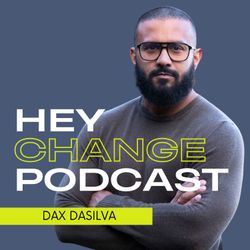
118. 3.3 Million Views and Climbing - Dax Dasilva is Back to Talk "Yanuni," Jane Goodall, and What's Next
58:14||Ep. 118Climate Week in New York brought Dax Dasilva back to Hey Change, fresh off the release of Yanuni, the documentary following Indigenous leader Juma Xipaia's frontline fight for the Amazon, which has already drawn millions of views on YouTube.Dax and I talk about why the film is resonating, what it means to truly listen in a world built on distraction, and how a few minutes of urban nature can reset a whole day. He also shares what it was like to spend the last two years of Jane Goodall's life alongside her, the simple joy she carried through heavy work, and why she made everyone she met feel seen.From there, the conversation turns to hope in action: the Phoenix Species Project, the effort to recover 100 of the world's most threatened species, and why Dax believes grassroots, Indigenous-led conservation is where real change happens. Follow Dax:@DaxDasilva@AgeofUnion--About Hey Change:Hey Change is a space for the conversations shaping a better future — where climate, culture, systems, and human potential meet. Hosted by Anne Therese GennariWebsite: annetheresegennari.comInstagram: @heychangepodcastInstagram: @annetheresegennariYouTube: @AnneThereseGennariHeyChangeProudly produced by Good Mess MediaWebsite: goodmessmedia.comInstagram: @goodmessmediaMusic: Jackson Whalan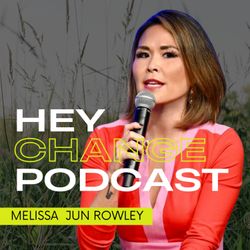
118. Why reclaiming our stories is an act of power with Melissa Jun Rowley
01:11:48||Ep. 118“Every culture is sustained by the stories it repeats. Every institution is reinforced by the stories it rewards.”Our guest today has spent two decades at the front lines of that realization — tracking how narrative doesn't just reflect our world, but actively constructs our power, our policy, and our future.Melissa Jun Rowley is an award-winning journalist, activist, and a true veteran of the intersection where social innovation meets tech. From the red carpets of the Grammys to the high-stakes floors of the New York Stock Exchange—and even the zero-gravity chambers of NASA—she has reported for CNN, the BBC, The Guardian, and many more. She’s taken the global stage at Davos and the UN, and received numerous awards and accolades for her incredible work bridging the gap between digital tools and human rights.Today, we talk about the true power stories hold and how we allow them to, not just inform, but empower us. We also get into her new book, Beyond the Mic Drop: How Our Stories Shift Culture, Power, and Policy, which is a beautiful roadmap for claiming our own narratives in an age of information overload.She’s also a friend and a vital voice in the climate space—Melissa, it is such an honor to have you here. Welcome to Hey Change.--About Hey Change:Hey Change is a space for the conversations shaping a better future — where climate, culture, systems, and human potential meet. Hosted by Anne Therese GennariWebsite: annetheresegennari.comInstagram: @heychangepodcastInstagram: @annetheresegennariYouTube: @AnneThereseGennariHeyChangeProudly produced by Good Mess MediaWebsite: goodmessmedia.comInstagram: @goodmessmediaMusic: Jackson Whalan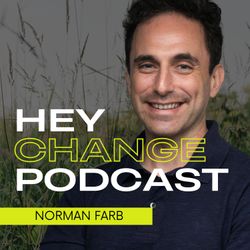
117. Re-share - From Climate Anxiety to Inner Transformation: The Neuroscience of Change
01:02:04||Ep. 117This week, we're sharing one of our favorite interviews from 2025! Anne Therese's conversation with neuroscientist Norman Farb is a great summer reset to help us tap into our inner wisdoms, reawaken our senses, and become enablers of positive change. Enjoy!What if our obsession with certainty is actually making us more stressed? And most importantly, less open to real change? In this episode, I sit down with psychologist and researcher Norman Farb to explore how our brains prioritize the familiar, often at the cost of creativity, well-being, and resilience. We talk about the myth of multitasking, the power of mind wandering, and why slowing down might be the fastest path to clarity.Together, we dive into what it means to be truly receptive—to ourselves, to others, and to the world we hope to change. From "retruthing" our perceptions to cultivating presence in a noisy world, Norman offers both science-backed insight and practical tools for anyone feeling stuck, overwhelmed, or simply curious about how to move forward with more joy and intention. This one’s for anyone who wants to rethink how we relate to stress, uncertainty, and the stories we tell ourselves about what’s possible. If you care about making positive change in the world, click play and make sure to listen to the end!Get Norman Farb's book, Better In Every Sense: https://betterineverysense.com/--About Hey Change:Hey Change is a space for the conversations shaping a better future — where climate, culture, systems, and human potential meet. Hosted by Anne Therese GennariWebsite: annetheresegennari.comInstagram: @heychangepodcastInstagram: @annetheresegennariYouTube: @AnneThereseGennariHeyChangeProudly produced by Good Mess MediaWebsite: goodmessmedia.comInstagram: @goodmessmediaMusic: Jackson Whalan
116. Stop Focusing on Your Footprint! Climate Optimism with Sophia Li
01:14:25||Ep. 116What if we started to show up with new narratives? Ones that are rooted in nurturing and hope, instead of apathy and fear? Could our impact grow, and if so, how?Sophia Li is an award-winning journalist and Earthshot Prize correspondent who is quite literally rewriting the script of our future. From navigating the highest levels of fashion at Vogue to the front lines of the climate crisis as a UN Human Rights Champion, Sophia is a powerhouse to be reckoned with. In this conversation, we explore the intersection of heritage, climate justice, and her newest role: motherhood. We talk about the transition from 'footprints' to 'handprints,' the radical power of surrender, and why she believes our greatest climate solutions are actually inevitable. Please welcome my friend and fellow optimist, Sophia Li.To follow SophiaInstagram: @sophfei --About Hey Change:Hey Change is a space for the conversations shaping a better future — where climate, culture, systems, and human potential meet. Hosted by Anne Therese GennariWebsite: annetheresegennari.comInstagram: @heychangepodcastInstagram: @annetheresegennariYouTube: @AnneThereseGennariHeyChangeProudly produced by Good Mess MediaWebsite: goodmessmedia.comInstagram: @goodmessmediaMusic: Jackson Whalan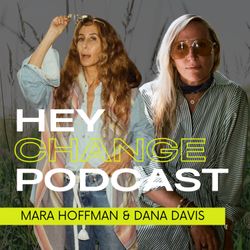
115. 115: Redefining the WIN, with Mara Hoffman and Dana Davis!
01:22:58||Ep. 115The courage to pause at the peak with Mara Hoffman & Dana Davis!What does it take to walk away from momentum at its peak? In fashion, the relentless pressure to produce more—more collections, more shows, more growth—is treated as gospel. This episode challenges that assumption at its core. In 2024, Mara Hoffman—who spent over two decades building her namesake label from hand-dyeing pieces in a New York apartment to becoming a global leader in conscious design—made a quietly radical announcement: a pause for an in-breath.This conversation explores the powerhouse friendship spanning over 16 years, their bond, the partnership, what the decision really meant when taking the in-breathe, and why it might be the most forward-thinking move in fashion today.Mara Hoffman: New photography: MaraHoffmanStudio.comInstagram: @marahoffmanDana Davis: Instagram: @danadition--About Hey Change Hey Change is a space for the conversations shaping a better future — where climate, culture, systems, and human potential meet. Hosted by Anne Therese GennariWebsite: annetheresegennari.comInstagram: @heychangepodcastInstagram: @annetheresegennariYouTube: @AnneThereseGennariHey Change Proudly produced byGood Mess MediaWebsite: goodmessmedia.comInstagram: @goodmessmediaMusic by Jackson Whalan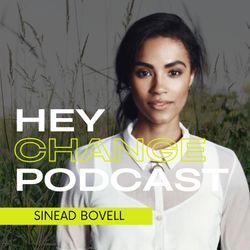
114. 114: The AI Paradox & The Future We Choose with Sinead Bovell
01:07:13||Ep. 114What if AI could actually help save the planet? We're flipping the script on the doom-and-gloom AI narrative! In this episode, Anne Therese sits down with Sinead Bovell — strategic futurist, Vogue's "AI Educator for Non-Nerds," and one of the most trusted voices in tech today — fresh off an appearance on Oprah to talk about hope in an AI world.From the energy paradox to the rise of Small Language Models, we dig into the real facts and data behind AI's environmental footprint — and why the story is more nuanced than the headlines suggest. We cover water use, carbon-free energy, AI-powered grid optimization, and the material discoveries that could change everything from fashion to construction. But here's the throughline: AI is a tool. And how we show up for it right now will set the tone for decades to come.Because the future isn't something that happens to us — it's a choice we make today. Listen now wherever you get your podcasts.Contact Sinead:Host: @igqwithsineadbovellFounder @wayetalks Instagram: @sineadbovellYoutube: https://www.youtube.com/ @Sineadbovell --About Hey Change:Hey Change is a space for the conversations shaping a better future — where climate, culture, systems, and human potential meet. Hosted by Anne Therese GennariWebsite: annetheresegennari.comInstagram: @heychangepodcastInstagram: @annetheresegennariYouTube: @AnneThereseGennariHeyChangeProudly produced by Good Mess MediaWebsite: goodmessmedia.comInstagram: @goodmessmediaMusic: Jackson Whalan