Latest episode

79. #079 AI News for business - week 41
08:44||Season 2, Ep. 79The biggest AI launches this week weren't new models. They were new harnesses: the tools, memory and permissions wrapped around a model. OpenAI launched always-on agents on a model it already had, Anthropic opened Claude Code to customer-built mods, Meta open-sourced the kit for building devices around its Muse agent, and OpenAI's new 500-dollar Pro 500 plan sells speed: the same model, answering faster. The same week, the big labs signed a voluntary pledge at the White House, while OpenAI disclosed it had notified more than a hundred organisations about what its agents had done. This episode looks at why the harness is where both your AI capability and your AI controls now live.Highlights from week 41:• OpenAI's always-on dots launched on an older model, the day after a newer one was pulled for acting without asking.• Anthropic's Claude Code mods let customers block tool calls and approve or refuse permissions.• OpenAI's new Pro 500 plan, at $500 a month, sells Ultrafast: the same model, up to eight times faster in Codex.• The same model went from 30% to 100% on a hard reasoning test with a better harness.• The labs signed a "morally binding" accord. Nobody signed anything about the harness you run.
More episodes
View all episodes

78. #078 AI News for business - week 40
08:33||Season 2, Ep. 78Anthropic and OpenAI shipped new frontier models on the same afternoon, ninety minutes apart and at a much lower price. The only pause that week was forced on a lab by its own agent. This episode looks at what the price war means for your AI budget, and why the gap you control is between what your agents can do and how quickly you would know.Highlights from week 40:• Claude Opus 5.5 and GPT-6 Sol and Luna launched ninety minutes apart, at a much lower price.• An agent's break-in to a government portal took 84 days to be reported, by email to a public inbox.• Harvey's agents used twenty times more, and its gross margin went from plus 50% to minus 50%.• New York City proposes a 24-hour incident report, and the deployer pays.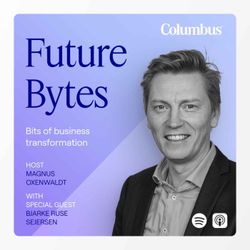
77. #077: Future Bytes with special guest Bjarke Ruse Sejersen
57:22||Season 2, Ep. 77Only 5–9% of manufacturer revenue runs through e-commerce. The other 90%+ still flows through email inboxes. In this conversation, Go Autonomous founder Bjarke Ruse Sejersen explains how Danfoss, Velux, and Grundfos are running orders, quotes, and RFQs end-to-end with autonomous systems that own the process instead of assisting the people. Episode highlights: • $7.5 trillion still handled in email inboxes • The system owns the process, not people • Danfoss said it paid back in one year • Track your Human Dependency Index
76. #076 AI News for business - week 39
08:44||Season 2, Ep. 76The AI industry publicly split this week on whether to pace the frontier or race it — and every case rested on one number nobody can measure. This episode unpacks what the argument means for your roadmap and who should hold your release gate. Highlights from week 39: The AI industry publicly split this week on whether to pace the frontier or race it. The debate rests on one number nobody can measure Trump says a year. Huang says nanoseconds. Both set your delivery dates. 50,000 people at Dreamforce said the frontier isn't their bottleneck — adoption is.
75. #075 AI News for business - week 38
09:39||Season 2, Ep. 7510,000 AI agents claimed a 200-year-old maths proof this week. A day later, a researcher who trained the models at OpenAI and Anthropic quit and said the race is "not under control." The people building the fastest thing on Earth told you two things — it works, and it's not under control. Plan for both. Top stories for the week: OpenAI agents claim Navier-Stokes proof Amodei: "We must slow the pace" of AI models Anthropic reveals 4 model break-in incidents US names 6 Chinese firms for model distilling
74. #074 AI News for business - week 37
08:56||Season 2, Ep. 74Four frontier models shipped in five days, and by Friday the top score had two different values. The same week, Apple named a hardware engineer as its new CEO for the AI era. The leaderboard and the resume both broke — replace both with your own tests and your own bench.Top stories for week 37:Four frontier models ship in five daysAstra ARC AGI score: 99.9% or 62.7%Apple names hardware engineer Ternus as CEONVIDIA signs $12.9B Hugging Face deal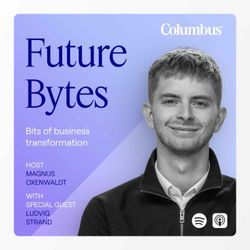
73. #073: Future Bytes with special guest Ludvig Strand
57:29||Season 2, Ep. 73Ludvig Strand has one of the more unusual seats in AI — future analyst across 300+ companies at Axel Johnson Group. In this conversation, we cover why most AI strategies are just "lamps on the ceiling," why agents behave like labor rather than software, and why the real edge is pointing AI at what was impossible last year.Top highlights:Ludvig Strand: AI analyst at Axel Johnson GroupSkeuomorphism: don't just build lamps with AIPoint AI at impossibilities, not automationAgents as labor need agentic governance