Share
Future Bytes
#030: AI news for business - week 51
Season 1, Ep. 30
•
This week’s AI News by Future Bytes covers two stories that reveal where enterprise AI is heading. Major AI providers formed a foundation to set standards for agent communication. OpenAI released GPT-5.2 after an internal “code red”. The focus is shifting from models to orchestration.
Top stories this week - cooperation vs. competition:
- OpenAI, Microsoft, Google, Amazon and others formed the Agentic AI Foundation to create open standards for how AI agents communicate.
- OpenAI released GPT-5.2, fast-tracked after Google Gemini and Anthropic gained ground, highlighting the limits of benchmark comparisons.
More episodes
View all episodes
46. #046: AI News for business - week 14
08:43||Season 1, Ep. 46We are heading into Easter break with a new episode of Future Bytes News, your weekly updates on AI in business. This time, host, Magnus Oxenwaldt, VP Group AI at Columbus covers these top stories: OpenAI abandons a billion-dollar Disney deal to focus on enterprise. Anthropic advances with AI coworkers and cybersecurity-grade models. The shift signals that AI is moving from consumer hype to business-critical infrastructure.
45. #045: AI News for business - week 13
07:41||Season 1, Ep. 45AI is moving beyond models and into workflows. In this episode, host Magnus Oxenwaldt, take a closer look at OpenClaw’s rapid rise and what it signals about the shift toward agent platforms and orchestration layers. We also explore the gap to enterprise deployment, and what it means for your business and AI strategy.Highlights from week 13:· OpenClaw becomes the most starred project in GitHub history, signaling rapid adoption of AI agents.· Value shifts from models to agent layers that connect AI to tools and workflows.· Security risks expose the gap between experimental agents and enterprise readiness.· Big tech shifts strategy toward platforms, workflows, and AI infrastructure.
44. #044: AI News for business - week 12
08:53||Season 1, Ep. 44Four companies launched AI coworkers in a single week, all designed to sit alongside the world’s knowledge workers. At the same time, new data from OpenAI co-founder Andrej Karpathy maps which roles are most exposed. Is this where the shift begins? Hosted by Magnus Oxenwaldt, VP Group AI at Columbus. Highlights week 12: Microsoft, Google, Anthropic and Perplexity launched AI coworkers built for knowledge workers. These systems execute tasks across tools, moving from assistance to workflow automation. New data shows 42% of jobs are highly exposed, especially high-paid, screen-based roles. Enterprise software is being repriced as AI reduces the need for multiple tools and licences. AI vendor choice is becoming a strategic and geopolitical consideration.
42. #043: AI News for business - week 11
09:57||Season 1, Ep. 42Trust is becoming a competitive advantage in AI. Claude surged as users switched from ChatGPT, even as OpenAI launched a powerful new model. Magnus Oxenwaldt breaks down why values, portability, and governance are quickly becoming key factors in choosing an AI provider. Highlights - week 11: Claude overtakes ChatGPT in the App Store. OpenAI launches GPT-5.4 with computer-use capabilities. Deloitte warns most companies lack AI agent governance. A lawsuit involving Gemini raises new safety questions.
#042: AI news for business - week 10
09:35|In this episode, host Magnus Oxenwaldt, looks at a week where AI strategy collided with geopolitics. The US government blacklisted Anthropic as a supply-chain risk, OpenAI closed the largest private funding round in history, and the gap between European AI ambitions and American infrastructure became impossible to ignore.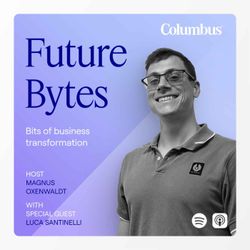
41. #041: Future Bytes with special guest Luca Santinelli
50:47||Season 1, Ep. 41In this episode of Future Bytes, host Magnus Oxenwaldt speaks with Luca Sanitelli, Senior Partner Solutions Engineer, from Shopify about AI-driven discovery, infrastructure and why clean, machine-readable product data is becoming the new competitive edge. "Future-proof your tech stack. Invest in infrastructure. Be ready to flip the switch." Links:Shopify.com Find Luca´s LinkedIn here
40. #040: AI news for business - week 9
07:47||Season 1, Ep. 40Accenture now ties promotions to AI tool usage. Anthropic cuts model costs to one-fifth. Every enterprise surveyed plan to expand AI agents. Regulation is moving fast across US states. The risk in 2026 is no longer moving too fast. It’s standing still. Highlights for week 9: Accenture ties senior promotions to measurable AI tool usage Anthropic’s Claude Sonnet 4.6 delivers near-flagship capability at one-fifth the former cost. 100% of surveyed enterprises plan to expand agentic AI this year US states advance AI regulation as global adoption accelerates
39. #039: AI news for business - week 8
08:42||Season 1, Ep. 39This time, host Magnus Oxenwaldt examines a recent UC Berkeley study that links heavy AI use to rising burnout, as saved time quickly turns into more work. A familiar pattern is emerging across industries. Many firms are reducing headcount based on expected AI gains. OpenAI has introduced ads in ChatGPT's free tier. A global safety report calls for layered controls as vendor safety teams shift. The tools work. The real question is how we use them. Highlights for week 8: Heavy AI use increases speed but also raises the risk of burnout. Workforce cuts are being made based on expected, not yet proven, AI gains. Ad-supported AI models introduce new incentive questions for enterprises. Safety experts call for layered controls as vendor teams evolve.
38. #038: AI news for business - week 7
07:07||Season 1, Ep. 38A simple AI plugin wiped billions off legal tech valuations. Agent platforms moved from demos to production. Apple set a new standard for how software is built. The signal is clear: AI is no longer assisting work. It is starting to do it. Host Magnus Oxenwaldt explains the meaning behind the headlines. Top stories for week 7:A Claude contract-review plugin triggered a 10-20% sell-off across major legal software firms. Enterprise AI agents move into production: OpenAI’s Frontier platform lets agents operate across multiple enterprise systems, not inside one app. Apple redefines how software is built. Xcode now supports autonomous AI agents that write, test, and verify code end to end. Models get cheaper and more reliable. New releases focus on sustained work with lower compute, cutting usage costs for businesses. Voice AI becomes a serious channel Anthropic commits to subscriptions only. OpenAI begins testing ads. Incentives now matter.