Share
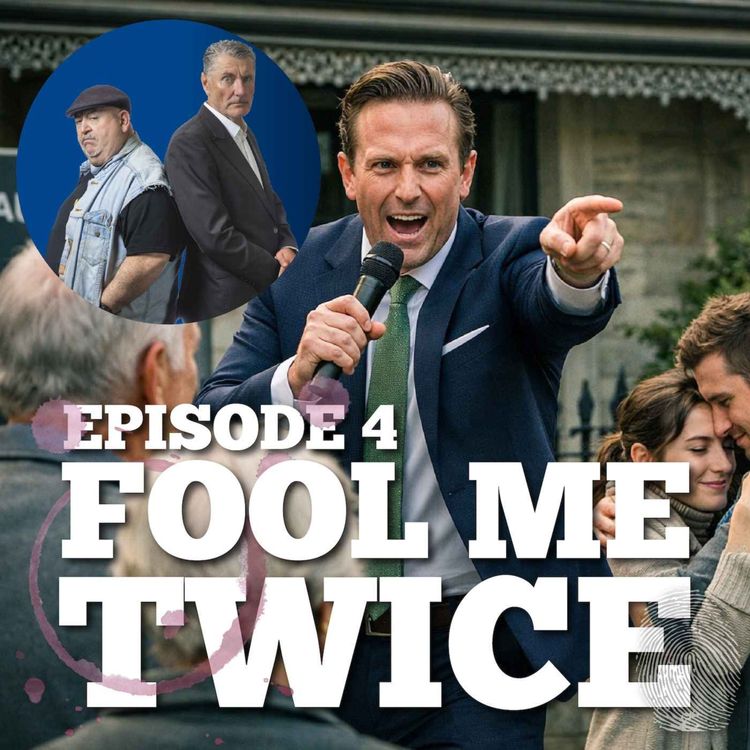
Fool Me Twice
Episode 4: Selling, spruiking and deception
Episode 4 of Fool Me Twice dives deep into the messy, uncomfortable, and often humorous reality of lies, particularly in selling. Steve and Brad begin by defining a lie as a deliberate attempt to mislead someone while knowing the truth, that lying is often professionally useful. From there, the conversation moves fluidly between comedy, psychology, ethics, and lived experience.
A major focus of the episode is lying in advertising and marketing. The hosts explore how modern consumers are bombarded with misleading promises. This can be hundreds of times per day, through billboards, television, social media, and influencers. Drawing on Brad's background in observation, they unpack how advertising works not just on logic, but on emotion, social proof, and subconscious triggers. From weight-loss endorsements to celebrity spruiking, they question why large-scale, profitable deception is often tolerated, while small individual lies are punished.
The discussion broadens into influencers and social manipulation, tracing the concept back centuries to paid audience members at operas and plays. Social proof, scarcity tactics, and perceived popularity are shown to be powerful drivers of human behaviour, illustrated through real-world examples such as supermarket pricing tricks and influencer culture during COVID.
The episode then takes a more serious turn. Brad and Steve examine ethical lies in policing and medicine. Steve reflects on his time delivering death notifications as a police officer, explaining why he sometimes lied to spare grieving families unnecessary pain. This opens a nuanced debate, "When does honesty become cruel, and when does lying become compassionate?" Similar ethical grey areas are explored in medical settings, where doctors may withhold certainty, patients lie out of embarrassment or fear, and “service lies” like appointment times quietly shape expectations.
AI generated content, fake imagery, and non-existent online personas are highlighted as the next frontier of deception. Reality is further blurred and raising questions about accountability and harm. Yet despite the gravity of the topic, humour remains constant—used not to trivialise lying, but to expose how deeply woven it is into social life.
The episode concludes with a reminder that while lying is part of human nature, intent, impact, and ethics matter. Steve and Brad invite listeners to reflect on the lies they tell, the lies they accept, and the stories they want to share.
LINKS
Book Steve Van Aperen as your next keynote speaker: Click here
Get coached in stand-up comedy with Brad Oakes: Click here
Learn more about Fool Me Twice by visiting www.foolmetwice.com.au
More episodes
View all episodes
11. Episode 11: The playbook of dating scams and catfishing
30:58||Season 2026, Ep. 11Episode 11 of Fool Me Twice with Brad Oakes and Steve Van Aperen explores the growing problem of online dating scams and the psychology behind how scammers manipulate people into giving away money. The conversation focuses on deception, catfishing, love bombing, and the playbook commonly used by fraudsters to exploit loneliness and trust.The episode opens with some light conversation during Grand Prix week, which leads Steve to share a story from his time in the South Australia Police when the Formula One Grand Prix was held in Adelaide before the race later moved to Melbourne. While working night shift near the Adelaide street circuit, Steve and his police partner decided to take a police car for a quick lap around the empty track. The fun quickly turned into trouble when Steve lost control and the police car slid sideways into the sand trap, becoming stuck up to the axles. Hoping to avoid embarrassment, they enlisted help from nearby army personnel to tow the car out. Unfortunately the rope was attached to the plastic bumper, which was ripped off as the truck drove away, leaving the damaged police car still buried in the sand. The story sets a humorous tone before the hosts move into the main topic of scams and deception.Brad and Steve explain that scams are fundamentally built on lies and manipulation. In the case of dating scams, criminals often create fake identities online and pretend to be attractive romantic partners. This process is known as catfishing. Victims believe they are communicating with a real person, when in reality the scammer may be someone entirely different, often operating from overseas.Steve outlines the typical playbook used by scammers. The first step is love bombing, where the scammer overwhelms the victim with affection and attention to create emotional attachment. Once trust is established, the scammer introduces a backstory designed to build sympathy, such as a sick relative, financial hardship, or travel problems. Eventually the relationship shifts to the “ask,” where the scammer requests money, investment opportunities, or financial assistance.The hosts also discuss how these scams can continue for long periods, sometimes months or even years, as scammers carefully build rapport with their victims. Even intelligent and experienced people can fall for these schemes because the tactics exploit powerful psychological triggers such as loneliness, trust, greed, and emotional connection.Brad and Steve highlight the challenges police face investigating these crimes because many scammers operate internationally, making enforcement difficult. They also emphasize that victims are often embarrassed and reluctant to report the crime, which allows scammers to continue targeting others.The episode concludes with practical advice: never send money to someone you have never met, be cautious of online relationships that avoid video calls or in person meetings, and consider using reverse image searches to check whether profile photos are genuine. Ultimately, the hosts remind listeners that most scams share the same goal: separating people from their money through deception.LINKSBook Steve Van Aperen as your next keynote speaker: Click hereGet coached in stand-up comedy with Brad Oakes: Click here
10. Episode 10: Art fraud, Pam Bondi and Steve goes under cover
31:04||Season 2026, Ep. 10In Episode 10 of Fool Me Twice, Steve Van Aperen and Bradford Oakes dive headfirst into the murky worlds of art fraud, AI deception, political deflection, and undercover policing—unpacking how lies work, why they succeed, and what ultimately exposes them.The episode opens with a light-hearted exchange about names, identity, and misdirection, setting the tone for a deeper conversation about how perception shapes belief. From there, the hosts revisit the concept of amygdala hijacking, the neurological fight-or-flight response, that can override rational thought. Steve explains how emotional overload, often seen in road rage or explosive confrontations, can cloud judgment. Importantly, he reveals why provoking anger during an interrogation is counterproductive. The conversation pivots to artificial intelligence and so-called AI “hallucinations.” As machines begin producing confident but inaccurate information, the hosts explore a chilling possibility: what happens when technology learns not just to be wrong, but to deceive?Political theatre also comes under scrutiny, particularly when public figures, specifically Pam Bondi, respond to accusations with outrage rather than answers. Steve breaks down this classic deflection tactic: attack the interviewer, shift the pressure, avoid the substance. It’s a familiar behavioural pattern in deceptive personalities.The heart of the episode focuses on art fraud and memorabilia scams, where massive sums of money change hands based on signatures, provenance, and trust. From forged masterpieces to fake sports collectibles, the hosts examine how greed, ego, and opportunity drive deception. Steve contrasts high-risk crimes like drug trafficking with lower-visibility fraud schemes that can net millions with less immediate scrutiny. He shares gripping stories from his undercover policing days, including controlled buys and elaborate sting operations involving the bedsheets, illustrating how criminals often get caught not because they’re reckless, but because they’re habitual.Brad adds perspective from the entertainment world, where joke theft and inferred deception mirror larger fraud dynamics. Whether it’s forged paintings, counterfeit signatures, or prison artwork attributed to notorious criminals, the formula remains the same: notoriety plus narrative equals perceived value.LINKSBook Steve Van Aperen as your next keynote speaker: Click hereGet coached in stand-up comedy with Brad Oakes: Click here
9. Episode 9: Cheating in sports and why it happens
30:19||Season 2026, Ep. 9Episode 9 of Fool Me Twice dives deep into the many shades of deceit in sport, with Brad Oakes and Steve Van Aperen exploring how dishonesty can range from subtle strategy to outright corruption.The episode opens with a broader discussion about lying, including how deception is often embedded in everyday life and even professional roles. From there, the conversation shifts into the sporting arena, where the stakes are high and the incentives to bend the rules can be enormous. Brad and Steve identify two main streams of deceit in sport. The first is tactical deception, the kind that is considered part of the game. Teams disguise strategies, bluff opponents and conceal intent. This form of deceit is often accepted as legitimate competition.The second stream is more troubling. It involves cheating, performance enhancing drugs, match fixing and financial corruption. Steve recounts his experience being approached by the International Cricket Council to conduct integrity testing aimed at stamping out corruption in cricket. He explains the difference between match fixing and spot fixing, and reflects on the challenges of investigating sporting dishonesty without whistleblowers or hard evidence.The discussion broadens to high profile scandals, including Lance Armstrong and the infamous 1919 Black Sox baseball scandal. Both examples highlight how deception can be sustained for years when money, reputation and power are at stake. The hosts explore how group complicity makes corruption complex but also fragile, as it often takes only one insider to expose the truth.They also touch on doping in racing and other sports, noting the constant tension between reactive investigations and proactive prevention. Steve draws on his law enforcement background to explain that most crimes are only investigated once they are reported, and without evidence or insiders coming forward, many suspicious outcomes remain just that, suspicions.Episode 9 ultimately examines how money, ego, status and opportunity intersect in sport. It reinforces the podcast’s central theme: deceit is rarely simple, often rationalised, and almost always driven by motive.LINKSBook Steve Van Aperen as your next keynote speaker: Click hereGet coached in stand-up comedy with Brad Oakes: Click here
8. Episode 8: Mis-recollections, police lineups and fake wives
33:57||Season 2026, Ep. 8In episode 8 of the Fool Me Twice Podcast, comedian Brad Oakes is joined by former police detective Steve Van Aperen for an in depth discussion on lying deception memory and investigative interviewing. The episode examines how professionals distinguish between deliberate dishonesty and genuine human error and why this distinction matters.Steve Van Aperen defines a lie as the intentional act of misleading someone while knowing the information is false. He contrasts this with common memory failures where people unknowingly provide incorrect information. The discussion opens with a light hearted clarification after a previous episode caused confusion when Steve accidentally implied he had been married. He explains this was a misstatement rather than a lie and uses it as a practical example of how easily memory and language can mislead without malice.A central theme of episode 8 is the unreliability of eyewitness testimony. Steve recounts a robbery investigation where several witnesses described completely different getaway vehicles despite observing the same incident only minutes earlier. The inconsistencies were later traced to the witnesses speaking with each other and unintentionally influencing their recollections. CCTV footage ultimately confirmed the true vehicle demonstrating why corroboration is essential.Brad Oakes questions how investigators decide which witness is most accurate. Steve explains that confidence detail and certainty do not equal truth and that every account must be supported by independent evidence. He highlights how mistaken identification has contributed to wrongful convictions including cases involving the death penalty.The episode then shifts to police interviewing techniques. Steve explains that closed yes or no questions give deceptive people an advantage by limiting what they must say. Open questions such as asking someone to explain events from beginning to end require the speaker to construct a narrative. Truthful people tend to recall events using sensory and emotional detail while liars struggle due to increased cognitive effort which often reveals itself through hesitation filler language and inconsistencies.Steve also introduces behavioural benchmarking where investigators observe how a person responds to neutral questions and compare that behaviour to responses during sensitive topics. While changes may indicate deception he stresses the importance of accounting for stress fear and normal memory lapses.The episode concludes with examples of people lying for self protection rather than criminal guilt and a discussion of carefully worded denials using a famous athlete case. Episode 8 reinforces that while lying is universal exposing deception is not always useful particularly outside formal investigations.LINKSBook Steve Van Aperen as your next keynote speaker: Click hereGet coached in stand-up comedy with Brad Oakes: Click here
7. Episode 7: Forging notes, poison and lead laughers
36:15||Season 2026, Ep. 7Episode 7 of the Fool Me Twice podcast dives deeply into the nature of lying, deception, and the psychology behind why people mislead others, sometimes deliberately, sometimes by omission, and often for self preservation.The episode opens with light hearted banter between hosts Brad and Steve, touching on everyday complaints, injuries, and humour around masculinity, before quickly shifting into the core theme of the episode: what actually constitutes a lie. Steve defines a lie as wilfully misleading someone while knowing the information is factually incorrect. This definition is immediately tested through the idea of lying by omission, where a person withholds key information while still technically telling the truth.Brad shares several vivid personal stories from his school years to illustrate this concept. One standout anecdote involves accidentally setting a classmate’s hair on fire, then truthfully stating that the hair caught fire while conveniently leaving out his own role in causing it. The story demonstrates how omission can be just as deceptive as an outright falsehood. Further stories about hypnotising classmates and forging parental notes reveal how quickly young people learn to exploit authority structures, especially when questioned poorly.A major theme of the episode is the importance of questioning technique. Steve argues there is no such thing as a bad interviewee, only bad interviewers. Closed yes or no questions often allow deception to continue, while open ended questions encourage detail, expose inconsistencies, and reveal motive. This idea is reinforced through real investigative examples involving document examination, handwriting analysis, and forensic techniques.One particularly sobering case involves a fabricated sexual assault allegation uncovered through document analysis, highlighting how lies must be carefully constructed, maintained, and emotionally supported to remain believable. Motive, such as revenge or jealousy, is repeatedly emphasised as the key to understanding deceptive behaviour.The discussion expands into micro expressions, contempt, and behavioural cues, drawing on psychological research to explain how fleeting facial movements can reveal underlying emotion. These insights are linked to comedy, public speaking, and leadership, showing how reading a room and identifying who others take cues from can be critical.Overall, Episode 7 blends humour, personal confession, psychology, and investigative insight to show that deception is a deeply human behaviour, and that understanding why people lie is often more revealing than simply catching them out.LINKSBook Steve Van Aperen as your next keynote speaker: Click hereGet coached in stand-up comedy with Brad Oakes: Click here
6. Episode 6: Petty Theft, Ponzi Scams and Anatomy of a Smile
35:20||Season 2026, Ep. 6Episode 6 of Fool Me Twice explores deception in its many everyday and extreme forms, blending humour, criminology and behavioural science. The conversation opens with a lighthearted discussion about lying what it is, how common it is and how easily people rationalise small deceptions. This theme quickly shifts to modern petty crime, particularly self serve supermarket checkouts, where customers mislabel produce or snack while shopping. What begins as comedy becomes a broader commentary on how removing oversight, such as checkout staff or tram conductors, subtly encourages dishonest behaviour.Steve, drawing on his policing background, explains that studies show most people will steal if they believe there are no consequences. The hosts reflect on how visible authority once regulated behaviour and how its absence has led to widespread fare evasion, retail theft and even organised swarming, where large groups overwhelm stores and steal openly. This raises a recurring question of the episode: is deception driven more by opportunity than morality?The discussion then moves into the psychology of lying and detection. Steve recounts moments when being labelled the human lie detector created ethical dilemmas, particularly when revealing the truth could cause unnecessary harm. From this, the hosts explore how truth and deception appear in storytelling, comedy and real life. Truthful people, Steve explains, tend to self correct and provide detail, while liars remain vague to reduce cognitive load.From petty deception, the episode escalates to large scale fraud. The hosts examine historic and modern scams, including the Ponzi scheme run by Bernie Madoff, who defrauded investors of around 65 billion dollars by exploiting trust, greed and perceived exclusivity. They also discuss massive government level corruption overseas and corporate scandals closer to home, emphasising that intelligence and wealth do not protect people from deception.Crypto fraud provides a modern parallel, with discussion of the collapse linked to Sam Bankman-Fried. The hosts highlight how hype, fear of missing out and lack of regulation fuel financial deception, much like traditional scams.The episode closes on a reflective note. While deception is everywhere, from fake smiles to financial schemes, life’s real value may lie in simple pleasures like coffee, beer and paying attention to what truly matters.LINKSBook Steve Van Aperen as your next keynote speaker: Click hereGet coached in stand-up comedy with Brad Oakes: Click here
5. Episode 5: Ivan Milat to Lost Lotto Tickets
31:52||Season 2026, Ep. 5Episode 5 of Fool Me Twice centres on one of Australia’s most infamous criminals, Ivan Milat, using his case to explore how lies, fear, and behavioural deception operate in serious crime. Rather than focusing on sensationalism, the episode examines the mechanics of deception surrounding a serial offender and the long lasting consequences those lies can have on victims, families, and the justice system.The discussion revisits Milat’s murders in the Belanglo State Forest and highlights how deception extended well beyond the crimes themselves. A key focus is an earlier shooting of taxi driver Neville Knight, where another man spent years in prison for a crime Milat was later believed to have committed. This case illustrates how fear, intimidation, and misplaced loyalty can lead to false confessions and prolonged silence, allowing the truth to remain buried for decades.Drawing on first hand investigative experience, the episode explains how behavioural analysis and polygraph testing are used in serious criminal cases. The emphasis is not on technology alone, but on how people tell their stories. Truthful individuals tend to include themselves naturally in events and provide consistent detail, while deceptive individuals often distance themselves, avoid direct answers, and show subtle signs of concealment through language and behaviour.The episode also challenges common myths about serial killers. Milat is presented as an example of how these offenders are typically methodical, organised, and patient rather than impulsive. The discussion explores how serial offenders target vulnerable victims, operate in remote locations, and refine their methods over time. It also touches on recurring behavioural patterns, ritualistic elements, and why many serial killers have a strong interest in forensic processes.Importantly, the episode examines why offenders like Milat rarely confess. Even when facing life imprisonment, maintaining secrecy can provide a final sense of power and control. Milat’s refusal to cooperate meant many questions were never answered, and it remains widely believed that additional victims were never formally identified.The episode closes with a striking contrast. A lighter but revealing story is shared about a young man who claimed an uncollected lottery win. With no ticket to prove it, his claim was assessed through investigation and a polygraph examination. He was found to be truthful and ultimately awarded more than 20 million dollars. The story reinforces a central message of Fool Me Twice: polygraph testing and behavioural analysis can expose devastating lies, but they can also validate the truth when it matters most.LINKSBook Steve Van Aperen as your next keynote speaker: Click hereGet coached in stand-up comedy with Brad Oakes: Click here
3. Episode 3: Inside the mind of a liar
34:11||Season 2025, Ep. 3In this episode of Fool Me Twice, Bradford and Steve take listeners inside the mechanics of lying and explain how easily confidence and charm can mislead us. Steve defines a lie as a deliberate attempt to mislead while knowing the truth, then challenges many popular beliefs about how liars behave. He explains that nervousness, lack of eye contact, or awkward pauses rarely signal deception on their own. People show these behaviours for many innocent reasons, including stress, fear, or simple distraction.The conversation centres on cognitive load and how lies strain the brain. When people tell the truth, they recall real memories. When they lie, they must invent details, maintain consistency, and respond to follow up questions in real time. This mental effort often leaks through behaviour. Steve describes how trained interviewers and modern technology focus on changes in eye behaviour, response timing, and speech patterns rather than dramatic physical reactions. Heart rate and sweating, for example, often reflect anxiety instead of dishonesty.Benchmarking plays a major role throughout the episode. Steve stresses that interviewers must first understand how someone behaves when telling the truth. Only then can they spot meaningful changes. Without this baseline, even experienced professionals can miss deception. Charismatic personalities, confident speakers, and attractive people often distract interviewers and influence judgement. The episode highlights how easily appearance and personality can override logic in criminal interviews, workplace situations, and romantic relationships.The discussion also dives into lying by omission. Steve explains that many people avoid direct lies by leaving out key details. By saying less, they reduce the risk of contradiction. Others overwhelm listeners with excessive information to steer attention away from the real issue. Both tactics appear frequently in interrogations and everyday conversations.Through case experience, humour, and relatable stories, the episode connects professional interrogation techniques to real life situations like dating and social interactions. The message is clear. Spotting deception requires attention to patterns, context, and behavioural change over time. There is no single behaviour that exposes a lie, and anyone who relies on shortcuts will likely be fooled.LINKSBook Steve Van Aperen as your next keynote speaker: Click hereGet coached in stand-up comedy with Brad Oakes: Click here