
Latest episode
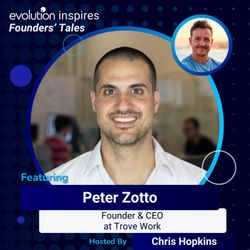
Founders' Tales - Rethinking How Frontline Teams Stay Connected
20:03|In this episode of Founders' Tales, Chris Hopkins sits down with Peter Zotto, Founder & CEO of Trove Work, to discuss how his company is helping organizations better connect, engage, and support deskless teams through technology built specifically for the frontline workforce.Peter shares the story behind Trove Work, the lessons he's learned building an early-stage startup, and why listening to customers early can shape a product far better than striving for perfection. He also reflects on navigating the challenges of entrepreneurship, building within Boston's thriving startup ecosystem, and staying resilient through the highs and lows of founder life.From product iteration and customer discovery to scaling a SaaS business and supporting millions of frontline employees, this conversation offers valuable insights for founders, operators, and everyone that's interested in the future of work.
More episodes
View all episodes
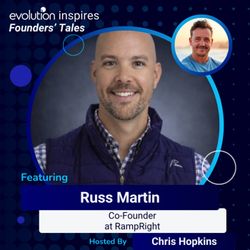
Founders' Tales - Why Most Companies Get Onboarding Wrong and How RampRight Is Fixing It
16:11|In this episode of Founders' Tales, Chris Hopkins sits down with Russ Martin, Co-Founder of RampRight, to discuss how years of revenue leadership experience led him to identify a major blind spot in employee onboarding and ramping.RampRight is building the first ramp intelligence platform, helping companies move beyond subjective onboarding processes with objective, measurable, real-time insights. Russ shares how the idea emerged from seeing organizations invest heavily in hiring and training without having a reliable way to measure whether new hires were actually progressing toward success.Russ reflects on transitioning from revenue leadership into startup life, the realities of launching a company, learning to handle rejection, and why experience, perspective, and resilience matter when building something from scratch. He also discusses the value of strong professional networks, the Boston startup ecosystem, and the importance of focusing on consistent progress rather than chasing overnight success.Whether you're a founder, revenue leader, HR professional, or someone interested in startup journeys, this conversation offers practical insights on building a business, navigating uncertainty, and creating systems that drive measurable results.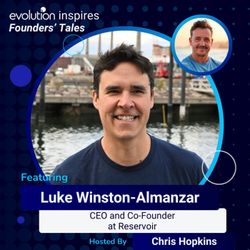
Founders' Tales - Reinventing Home Energy with Intelligent Electric Infrastructure
24:32|In this episode of Founders' Tales, we speak with Luke Winston-Almanzar, CEO and Co-Founder of Reservoir, a climate technology company developing intelligent electric water heaters designed to improve energy efficiency, reduce costs, and make sustainable living the obvious choice for homeowners.Reservoir is rethinking one of the most energy-intensive yet overlooked systems in the home: water heating. By combining predictive intelligence with advanced industrial controls, the company is transforming traditional water heaters into smart infrastructure that delivers instant hot water, prevents issues like frozen pipes, and significantly reduces household energy costs.Building in Boston has provided Reservoir with access to world-class engineering talent and a strong climate technology ecosystem. Luke explains how prior networks, including connections formed through Formlabs, helped shape Reservoir’s early momentum and provided valuable mentorship along the way.The conversation explores how Luke and his co-founders built a complementary founding team despite not knowing each other previously, emphasizing the importance of aligning on mission, principles, and execution mindset. Drawing from his experience helping scale Formlabs from early-stage startup to global hardware company, Luke highlights key lessons about staying lean, iterating quickly, and prioritizing simplicity to maintain speed and focus.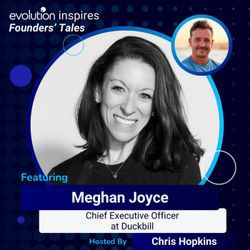
Founders' Tales - Connecting AI to the Real World Through Human-in-the-Loop Execution
26:03|In this episode of Founders' Tales, we speak with Meghan Joyce, CEO of Duckbill, a company building execution infrastructure that enables AI systems to complete complex real-world tasks through a combination of automation and human support. Drawing on her experience at Uber and Oscar Health, Meghan shares how her career at the intersection of technology and human services inspired the creation of Duckbill.Duckbill focuses on solving one of the biggest challenges in the AI era: translating digital intelligence into real-world outcomes. While AI can generate insights and recommendations, many everyday tasks still require coordination, judgment, and execution in environments that are unpredictable or not designed for automation. Duckbill bridges this gap by creating systems that allow AI agents to hand off tasks to human operators when needed, ensuring reliable and high-quality results.They also discuss leadership principles such as maintaining high standards while providing strong support, fostering a culture where feedback is encouraged and continuous improvement is expected. Meghan shares insights on how strong team culture enables organizations to evolve alongside the changing needs of the business.Beyond product and technology, Meghan reflects on the importance of resilience in entrepreneurship, noting that persistence is often the key differentiator between companies that succeed and those that fall short. She emphasizes that roadblocks are a natural part of building something new, and progress comes from consistently finding ways to move forward.Looking ahead, Duckbill is expanding access to its infrastructure through APIs and integrations that allow AI agents to interact directly with its execution layer. As AI adoption accelerates, the company aims to become a foundational layer connecting digital intelligence with real-world action.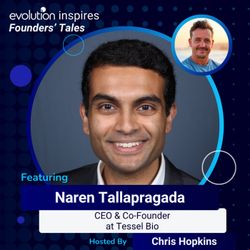
Founders' Tales - Simulating Human Biology with AI to Transform Drug Discovery
49:36|In this episode of Founders' Tales, we sit down with Naren Tallapragada, CEO & Co-Founder of Tessel Bio, a biotech company pioneering virtual tissue models to accelerate the discovery of new treatments for complex chronic diseases. Drawing from a deeply personal motivation and a background spanning physics, engineering, and biology, Naren shares how Tessel Bio is combining AI-driven modeling with experimental biology to identify new therapeutic targets and better understand disease mechanisms.Tessel Bio’s approach focuses on simulating how human organs behave across different disease states, enabling researchers to predict how interventions may restore healthy function. By integrating computational models with real biological data, the company aims to improve how drug targets are identified and ultimately help bring more effective therapies to patients.Naren discusses the importance of pursuing difficult scientific challenges, including chronic diseases that impact millions worldwide, and why early conviction in a problem space can create long-term opportunity even when market trends shift. He also shares insights on transitioning from academia into entrepreneurship, emphasizing that the most valuable skill researchers develop is the ability to think critically and identify meaningful problems worth solving.The conversation explores how AI can be applied beyond chemistry to better understand biological systems, helping researchers determine where interventions can create meaningful therapeutic impact. Naren highlights the importance of generating high-quality biological data and building predictive models that can guide experimental decision-making, reducing uncertainty in drug development.
Founders' Tales - Eliminating Tax Surprises Through Smart Withholding Optimization
18:21|In this episode of Founders Tales, Chris Hopkins sits down with Maria Teigeiro, Co-Founder and CTO of Real Time Taxes, to explore how her team is rethinking one of life’s most frustrating financial moments like unexpected tax bills.Real Time Taxes helps individuals proactively plan for tax season by adjusting withholdings throughout the year, ensuring there are no surprises when filing returns. Instead of overpaying or underpaying taxes, users can define what they want tax day to look like and the platform dynamically aligns their financial plan to match that outcome.Maria shares the origin story behind the company, sparked by her own experience receiving an unexpected tax bill, and explains how Real Time Taxes is building tools that improve financial predictability while helping users make better use of their money throughout the year.She also discusses lessons learned while navigating early-stage fundraising, the importance of choosing the right financial partners such as credit unions, and the challenge founders face in balancing when to stay the course versus when to adapt. The conversation highlights how strong networks, community support, and resilience play a critical role in building momentum as an early-stage startup.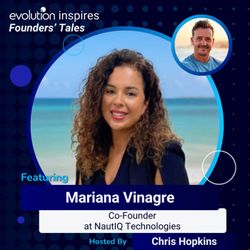
Founders' Tales - Transforming Maritime Maintenance Through Robotics and Automation
26:22|In this episode of Founders' Tales, we speak with Mariana Vinagre, Co-Founder of NautIQ Technologies, a robotics company developing automation solutions for the boat maintenance industry. With over a decade of entrepreneurial experience, Mariana shares how her journey across multiple industries has shaped her perspective on building mission-driven companies that combine innovation with real-world impact.NautIQ Technologies is focused on modernizing a highly manual and physically demanding sector by introducing robotics and automation to improve efficiency, consistency, and scalability in boat maintenance. Despite advances in many industries, much of the maintenance work in recreational marine environments is still performed manually, creating bottlenecks, inefficiencies, and operational challenges for boat owners and service providers.Mariana explains how the idea originated from firsthand experience identifying inefficiencies in marine servicing workflows, where inconsistent manual processes create delays and limit scalability. By applying automation and robotics, NautIQ aims to improve reliability and enable more standardized maintenance outcomes across the industry.The conversation highlights the importance of adaptability in entrepreneurship, emphasizing that initial ideas often evolve significantly as founders gather customer insights and validate assumptions. Mariana shares how founders must remain flexible, continuously iterating based on real-world feedback rather than becoming overly attached to their original concept.