Share
Environment Variables
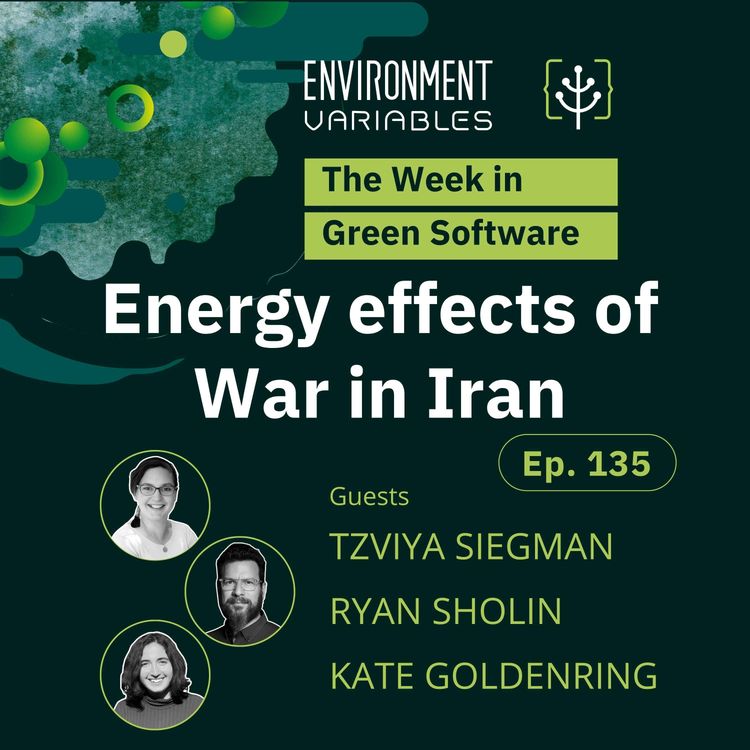
The Week in Green Software: Energy effects of War in Iran
Ep. 135
•
TWiGS hosts Tzviya and Kate are joined by Ryan Sholin of Electricity Maps to discuss how global events impact electricity availability, cost, and carbon intensity. They highlight that improving efficiency and better utilizing existing power grids could reduce the need for new energy infrastructure. The conversation connects energy awareness with software design decisions, emphasizing that developers and organizations can play a role in sustainability by aligning workloads with cleaner energy and understanding the broader energy context behind digital systems.
Learn more about our people:
- Tzviya Siegman: LinkedIn | Website
- Ryan Sholin: LinkedIn | GitHub | Website
- Kate Goldenring: LinkedIn | GitHub | Website
Find out more about the GSF:
News:
- Exclusive: Google, Tesla, others tackle energy affordability | Axios [02:10]
- Virginia to utilities: Do more with the existing power grid | CanaryMedia [03:38]
- There's another energy market that may get hit harder than oil by Strait of Hormuz closure [10:08]
- PUE Ranking - Paweł Czyżak on LinkedIn [14:44]
- Markdown, llms.txt and AI crawlers | Dries Buytaert [25:44]
- Datacentre developers face calls to disclose effect on UK’s net emissions | The Guardian [39:14]
Events:
- LUT x Sustinaires | 25 Mar 7:15 AM CET (Remote) [41:29]
- UX Jumpstart | 26 Mar 2:00 PM CET (Virtual) [41:46]
- Are you speaking about Green Software? | GSF [41:59]
Resources:
- Marc Brooker's Blog [06:32]
- Environment Variables Ep 133: TWiGS: Who Pays for AI’s Energy Footprint? [07:09]
- US data centre efficiency ranked by PUE - Rod McLaren: Words that work
- TPU vs GPU: Which Is Better for AI Infrastructure in 2025? [19:57]
- TPUs improved carbon-efficiency of AI workloads by 3x | Google Cloud Blog
- Software Carbon Intensity for Artificial Intelligence [21:51]
- Hugging Face AI Energy Score Project [22:43]
- Google & Bing Warn: Markdown Files Can Increase Crawl Load and Cause SEO Issues [27:35]
- Introducing Markdown for Agents [28:57]
- agent-md | GitHub
- w3c-cg / ai-content-disclosure | GitHub [30:02]
- AI Preferences
- Measuring for Reporting vs Measuring for Action | GSF
- CarbonDB [34:22]
If you enjoyed this episode then please either:
- Follow, rate, and review on Apple Podcasts
- Follow and rate on Spotify
- Watch our videos on The Green Software Foundation YouTube Channel!
- Connect with us on Twitter, Github and LinkedIn!
More episodes
View all episodes
142. The Week in Green Software: Asynchronous and Unreliable
46:07||Ep. 142Host Anne Currie chats to Sara Bergman and they unpack the latest developments in green software, exploring how AI growth, infrastructure demands, and policy shifts are reshaping the sustainability conversation. They discuss the real-world impact of energy use, the importance of better measurement and transparency, and the practical steps teams can take to build more efficient systems. It’s a grounded look at the tradeoffs behind modern software and how the industry can move toward more responsible innovation.Learn more about our people:Anne Currie: LinkedIn | GitHub | WebsiteSara Bergman: LinkedIn | GitHub | WebsiteFind out more about the GSF:The Green Software Foundation Website Sign up to the Green Software Foundation NewsletterNews:Asynchronous and Unreliable Episode 1 [05:37]How to improve AI efficiency beyond cost optimisation | Computer Weekly [09:58]Towards Green AI: Decoding the Energy of LLM Inference in Software Development | Arxiv [21:59]annecurrie.com [34:02] Greenhouse Gas Protocol changes can bring trust back to climate accounting | Utility Dive [37:44] Green Software Maturity Matrix | GSF [40:22] Where AI Runs Determines Water Stress | ESS Open Archive If you enjoyed this episode then please either:Follow, rate, and review on Apple PodcastsFollow and rate on SpotifyWatch our videos on The Green Software Foundation YouTube Channel!Connect with us on Twitter, Github and LinkedIn!
141. The Week in Green Software: Tokens, Water, and Transparency
29:51||Ep. 141Tzviya Siegman and Kate Goldenring dive into the latest stories shaping green software, from the rising energy demands of AI to the practical tradeoffs developers face when building more efficient systems. They explore new ideas around measuring impact, smarter infrastructure choices, and how industry and policy are starting to respond. The conversation brings together real-world challenges and emerging solutions, showing how sustainability is quickly becoming a core part of modern software development.Learn more about our people:Chris Adams: LinkedIn | GitHub | WebsiteKate Goldenring: LinkedIn | WebsiteTzviya Siegman: LinkedIn | WebsiteFind out more about the GSF:The Green Software Foundation Website Sign up to the Green Software Foundation NewsletterNews:7 Ways to More Frugal AI | BetterTech [02:04]Where AI Runs Determines Water Stress | ESS Open Archive [09:54]US tech firms successfully lobbied EU to keep datacentre emissions secret | The Guardian [18:14]Resources:The ML.ENERGY Leaderboard [08:04] TWiGS: Who Pays for AI’s Energy Footprint? - Environment Variables Ep133 [09:15]TWiGS: Green AI Tradeoffs - Environment Variables Ep139 [20:43]Events:Measuring Software "at Scale" 5 May 6:30 pm CEST (Karlsruhe) [27:53] Call for Speakers | GreenIO [28:13]Call for Papers | HotCarbon [28:27]If you enjoyed this episode then please either:Follow, rate, and review on Apple PodcastsFollow and rate on SpotifyWatch our videos on The Green Software Foundation YouTube Channel!Connect with us on Twitter, Github and LinkedIn!
140. The Week in Green Software: CSRD and the SCI Standard
41:05||Ep. 140This Week in Green Software, hosts Carlos and Adi cover the latest developments in green software, including new insights into measuring and reducing the energy impact of digital systems. They explore research challenging common assumptions about efficiency, highlight practical tools for tracking software emissions, and discuss ongoing challenges in standardizing measurement. They also broaden the conversation around digital sustainability, emphasizing that it extends beyond carbon to include social and economic factors.Learn more about our people:Aditya Manglik: LinkedIn | GitHub | WebsiteCarlos Pignatoro: LinkedIn | GitHub | WebsiteFind out more about the GSF:The Green Software Foundation Website Sign up to the Green Software Foundation NewsletterNews:The SCI Standard: Providing the Software Emissions Data CSRD Needs | GSF [03:35]Green Prompting: Characterizing Prompt-driven Energy Costs of LLM Inference | Adamska et al. [13:19]GitHub - LLM Energy Lab | Adora Foundation [20:25]YouTube - I Can’t Sell You Laptops Anymore [30:43]Events:Sustainable AI for Climate Tech Founders (April 22 at 1:00 pm PDT - San Francisco) [37:55]Sustainable AI (April 23 at 6:00 pm CEST - Utrecht) [38:10]If you enjoyed this episode then please either:Follow, rate, and review on Apple PodcastsFollow and rate on SpotifyWatch our videos on The Green Software Foundation YouTube Channel!Connect with us on Twitter, Github and LinkedIn!
139. The Week in Green Software: Green AI Tradeoffs
53:46||Ep. 139Host Kate Goldenring is joined by Chris Adams to explore how the Software Carbon Intensity (SCI) standard can help companies meet new EU sustainability reporting requirements, shifting green software from best practice to audited obligation. They also discuss research on “green prompting,” showing that specific words can significantly impact AI energy use, along with new tools that reveal real-time energy consumption in AI workflows. They close by examining how rising AI demand is increasing hardware costs and disrupting the refurbished laptop market.Learn more about our people:Chris Adams: LinkedIn | GitHub | WebsiteKate Goldenring: LinkedIn | WebsiteFind out more about the GSF:The Green Software Foundation Website Sign up to the Green Software Foundation NewsletterNews:The SCI Standard: Providing the Software Emissions Data CSRD Needs | GSF [02:47]Green Prompting: Characterizing Prompt-driven Energy Costs of LLM Inference | Adamska et al. [29:40]I Can’t Sell You Laptops Anymore [44:30] Resources:Green Metrics Tool | green-coding.io [19:25] Cardamon [19:48]Briefing 1 - XBRL and materiality briefing video | Chris Adams [21:18] Deck 1 - XBRL and materiality carbon.txt - Green Web Foundation [25:48]A validator for carbon.txt files, and linked documents in them · GitHub [26:51]Introducing our new work on carbon.txt - Green Web Foundation GitHub - ml-energy/zeus: Measure and optimize the energy consumption of your AI applications! We know AI can use loads of energy. So why isn't it visible at the point of use when you use it? Is it because it's just too hard to show it? | Chris Adams [34:30] How to use GenAI models if you care about the energy they consume | Chris Adams GitHub - Energy and Carbon Tracking for OpenCode Release Guide: CO2.js v0.18 - Green Web Foundation [40:31]Putting things in perspective: Data center investments now on par with renewables, oil and gas [49:14]Events:Sustainable AI for Climate Tech Founders (April 22, 1:00 pm PDT - San Francisco) [51:32]Sustainable AI (April 23, 6:00 pm CEST - Utrecht) [51:41]HotCarbon Workshop If you enjoyed this episode then please either:Follow, rate, and review on Apple PodcastsFollow and rate on SpotifyWatch our videos on The Green Software Foundation YouTube Channel!Connect with us on Twitter, Github and LinkedIn!
138. The Week in Green Software: Does Faster AI mean Greener AI?
33:15||Ep. 138Hosts Adi and Valeria cover new research showing that faster AI models do not always use less energy, especially when multiple models run in parallel. They highlight how the lack of standardized metrics makes it difficult to fairly compare energy efficiency and can lead to inconsistent reporting. They also discuss a curated set of open-source tools for measuring software energy use and why measurement is a critical but challenging first step. Finally, they explore a broader view of digital sustainability beyond carbon and highlight the launch of the Green Software Foundation website as a key resource.Learn more about our people:Aditya Manglik: LinkedIn | GitHub | WebsiteValeria Salis: LinkedIn | GitHub | WebsiteFind out more about the GSF:The Green Software Foundation Website Sign up to the Green Software Foundation NewsletterNews:Benchmarking the Energy Savings with Speculative Decoding Strategies | ACL Anthology [02:11]A Curated List of Open-source Software‑only Energy Efficiency Measurement Tools: A GitHub Mining Study [12:32]What do we mean by Digital Sustainability? | Catherine Mulligan [19:33]Green Software Foundation [25:42] Green Software Movement [27:21]Events:When Sustainable Product Design Becomes Strategic Advantage | 7 Apr 5:00pm CEST (Virtual) [28:17] GreenOps PowerBI Dashboard | 7 Apr 6:30pm CEST (Karlsruhe, hybrid) [28:32]CodeCarbon x Pruna x Ecologits Frugal AI Party | 8 Apr 6:00pm CEST (Paris) [28:51]Singapore Conference April 14th to 15th 2026 | 14-15 Apr (Singapore) [29:18]If you enjoyed this episode then please either:Follow, rate, and review on Apple PodcastsFollow and rate on SpotifyWatch our videos on The Green Software Foundation YouTube Channel!Connect with us on Twitter, Github and LinkedIn!
137. The Week in Green Software: Local AI & Lean Observability
32:27||Ep. 137Hosts Kate and Tzviya unpack the latest news This Week in Green Software, focusing on how sustainability is increasingly being integrated into everyday engineering decisions. They explore the push toward earlier measurement and accountability, the role of tooling in helping developers understand energy use, and the growing influence of policy and industry initiatives. The conversation highlights both the challenges and opportunities in making sustainability a standard part of software design, rather than an afterthought.Learn more about our people:Kate Goldenring: LinkedIn | WebsiteTzviya Siegman: LinkedIn | WebsiteFind out more about the GSF:The Green Software Foundation Website Sign up to the Green Software Foundation NewsletterNews:Letter from the Outgoing ED of GSF [01:18]When is Local AI Greener than the Cloud? | Intelligent Living [12:52]The Green Side of Observability: Why Less Data Can Mean More Insight | DevOps.com [18:30]Graphics card environmental impact calculator | Hubblo [22:45]Resources:Software Carbon Intensity (SCI) specification | GSF [02:07]SCI for AI | GSF [02:17]SCI for Web | GSF [02:33]Green Software Practitioner course | GSF [09:00]OnePointFive [09:37]GreenOps Academy | Greenpixie [09:52] Electricity Maps [15:15]Honeycomb Refinery [20:21]More than Carbon: Cradle-to-Grave environmental impacts of GenAI training on the Nvidia A100 GPU [25:47]From FLOPs to Footprints: The Resource Cost of Artificial Intelligence [26:12]Dr. Sasha Luccioni's Award [27:14]Events:Hobby Projects to Green Production Systems (March 31 at 6:00 pm - Budapest) [29:46]PowerBI Dashboard (April 7 at 6:30 pm CEST - Karlsruhe - Hybrid) [30:17]Green IO Singapore (April 14-15) [30:51]If you enjoyed this episode then please either:Follow, rate, and review on Apple PodcastsFollow and rate on SpotifyWatch our videos on The Green Software Foundation YouTube Channel!Connect with us on Twitter, Github and LinkedIn!
136. The Week in Green Software: Hourly Carbon Accounting
47:15||Ep. 136This Week in Green Software, hosts Oli, Adi, and Valeria explore the growing importance of hourly carbon accounting and what it means for building truly sustainable software. They discuss how moving beyond annual averages to real-time energy data can unlock more accurate insights, better decision-making, and smarter workload placement. The conversation highlights the challenges of measurement, the role of tooling and standards, and why aligning software systems with cleaner energy in the moment could be a key step toward reducing digital emissions.Learn more about our people:Aditya Manglik: LinkedIn | GitHub | WebsiteOli Winks: LinkedIn | GitHub | WebsiteValeria Salis: LinkedIn | GitHub | WebsiteFind out more about the GSF:The Green Software Foundation Website Sign up to the Green Software Foundation NewsletterNews:GSF’s Response to GHG Protocol: Advocating for Hourly Carbon Accounting | GSF [03:11]Big Tech Says Generative AI Will Save the Planet. It Doesn’t Offer Much Proof | Wired [19:25]Developer engagement in open-source software’s green transition | NatureDisplay: green; applying the web sustainability guidelines - Hidde de Vries - CSS Day 2025 | YouTubeResources:GHG Protocol [03:27]What Central Park’s Squirrel Census says about conservation tech | Mongabay [30:54]Events:GreenOps PowerBI Dashboard | 7 Apr 6:30pm CEST (Karlsruhe - Hybrid) [44:25]Green IO Singapore Conference | 14-15 Apr (Singapore) [45:24]If you enjoyed this episode then please either:Follow, rate, and review on Apple PodcastsFollow and rate on SpotifyWatch our videos on The Green Software Foundation YouTube Channel!Connect with us on Twitter, Github and LinkedIn!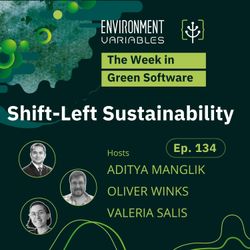
134. The Week in Green Software: Shift-Left Sustainability
37:39||Ep. 134This Week in Green Software, Valeria, Adi, and Oli come together to explore the concept of Shift-Left Sustainability—the idea that environmental impact should be considered early in the software development lifecycle rather than after deployment. They discuss how better measurement, developer tooling, and practical incentives can help teams build more efficient and environmentally responsible software, why sustainability should be treated more like security, and highlight growing government interest in digital sustainability.Learn more about our people:Valeria Salis: LinkedIn | GitHub | WebsiteAditya Manglik: LinkedIn | GitHub | WebsiteOliver Winks: LinkedIn | GitHub | WebsiteFind out more about the GSF:The Green Software Foundation Website Sign up to the Green Software Foundation NewsletterNews:Shift-Left Sustainability: How to develop green software by design | Kolaxis [03:42]We nearly had power profiling in Chromium | Fershad [18:25]GDSA Summit returns: building on our progress | Sustainable ICT [25:36]Events:Green Software Practitioner Study Day | 13 Mar 10:00 am GMT (Brighton) [31:22]What Software Doesn’t “Count” | 17 Mar 6:00 pm CET (Barcelona) [3:19]Reducing Cost and Carbon | 18 Mar 6:00 pm CET (Hamburg) [33:56]LUT x Sustinaires | 25 Mar 7:15 am CET (Virtual) [34:55]Green Software Italia | 30 Mar 6:30 pm CET (Milan) [35:18]UX Jumpstart 26 Mar 2:00 pm CET (Virtual) [35:42]If you enjoyed this episode then please either:Follow, rate, and review on Apple PodcastsFollow and rate on SpotifyWatch our videos on The Green Software Foundation YouTube Channel!Connect with us on Twitter, Github and LinkedIn!