Share
Environment Variables
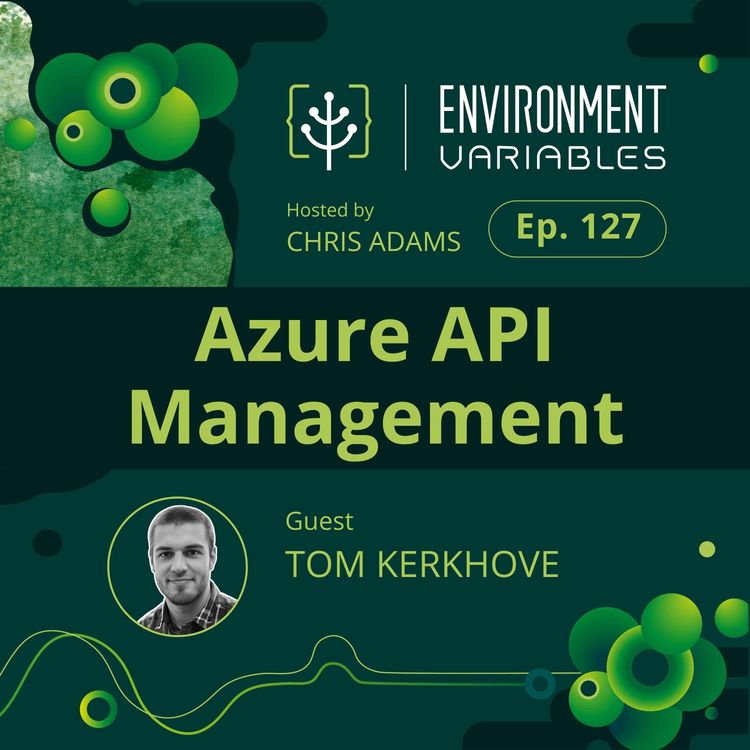
Azure API Management
Ep. 127
•
Chris Adams speaks with Tom Kerkhove of the Microsoft Azure API Management team about how thoughtful API design can reduce energy use and improve system efficiency. They discuss how API gateways, caching, throttling, and observability can cut unnecessary compute and data transfer, while also improving reliability and developer experience. The conversation shows how small architectural decisions at the API layer can have an outsized impact on cost, performance, and sustainability at scale.
Learn more about our people:
Find out more about the GSF:
Resources:
- Solar Protocol [02:33]
- KEDA [04:37]
- Azure API Management [10:01]
- Grid-aware websites - Green Web Foundation [20:37]
- Electricity Maps [23:25]
- Real Time Energy and Carbon Standard for Cloud Providers [26:17]
- Azure API Management | Microsoft Azure Blog [30:01]
If you enjoyed this episode then please either:
- Follow, rate, and review on Apple Podcasts
- Follow and rate on Spotify
- Watch our videos on The Green Software Foundation YouTube Channel!
- Connect with us on Twitter, Github and LinkedIn!
More episodes
View all episodes
153. Backstage: Software Water Intensity
37:52||Ep. 153Producer Chris Skipper goes Backstage with Yi Ding and Hongliu Cao, chair and co-chair of the Software Water Intensity project, to discuss the development of the standard. They explore why water is a unique sustainability challenge, how data centres and semiconductor manufacturing contribute to water use, and the complexities of measuring water withdrawal, consumption, and stress. The conversation also looks at the challenges of data availability and how SWI could turn water impact into a practical metric for making better software and infrastructure decisions.Learn more about our people:Chris Adams: LinkedIn | WebsiteYi Ding: LinkedIn | Website | ScholarHongliu (Leo) Cao: LinkedIn | ScholarFind out more about the GSF:The Green Software Foundation Website Sign up to the Green Software Foundation NewsletterResources:Global Water Bankruptcy Report | United Nations [09:50]Software Carbon Intensity | GSF [14:43]SCI for AI | GSF [15:26]Not All Water Consumption Is Equal: A Water Stress Weighted Metric for Sustainable Computing (SCARF Paper) [18:07]Why AI’s Water Footprint Is Harder to Measure Than Carbon | Hongliu Cao [22:32]Different Clouds, Different Water Stories: Why AI’s Water Footprint Is Harder to Measure (Part 2) Welcoming the Software Water Handbook | GSF Software Water Handbook: A companion resource to the SWI specification | GSFGreen Software Movement Platform | GSF If you enjoyed this episode then please either:Follow, rate, and review on Apple PodcastsFollow and rate on SpotifyWatch our videos on The Green Software Foundation YouTube Channel!Connect with us on Twitter, Github and LinkedIn!
152. The Week in Green Software: Flexibility in the Age of AI
52:02||Ep. 152TWiGS hosts Kate and Tzviya are joined by Dave Masselink, founder of Compute Gardener, to discuss how software engineers can play a direct role in building a cleaner energy future. The conversation explores flexible computing, carbon aware workload scheduling, and the growing impact of AI on electricity demand, while highlighting practical ways developers can reduce emissions without sacrificing performance. They offer a grounded look at how better, flexible software decisions can support a more sustainable grid.Learn more about our people:Tzviya Siegman: LinkedIn | WebsiteKate Goldenring: LinkedIn | WebsiteDave Masselink: LinkedIn | WebsiteFind out more about the GSF:The Green Software Foundation Website Sign up to the Green Software Foundation NewsletterNews:EV Ep151 TWiGS: The AI Water Management Challenge with Masheika Allgood [08:24]Data centers are ready to negotiate flexibility for speed | Utility Dive [15:40]Sustainability Interoperability Layer for Operations (SILO) | GSF [25:47]Introducing Neuralwatt Cloud: Energy-Based AI Inference Pricing [33:23]How Gridware’s grid monitoring sensors won over a career lineman | Latitude Media [41:42]Events:CNCF Environmental Sustainability Technical Community Group Meeting | 11 Aug 02:00 PM CEST (Virtual) [50:20]Green Software San Francisco Bay Area | Meetup | October 2026 (San Francisco) [50:40]If you enjoyed this episode then please either:Follow, rate, and review on Apple PodcastsFollow and rate on SpotifyWatch our videos on The Green Software Foundation YouTube Channel!Connect with us on Twitter, Github and LinkedIn!
151. The Week in Green Software: The AI Water Management Challenge with Masheika Allgood
53:12||Ep. 151This Week, hosts Tzviya and Kate are joined by AI ethicist Masheika Allgood to discuss the growing environmental impact of AI data centres through the lens of water use. Drawing on a new case study from Georgia, the conversation explores how communities can better understand the local effects of AI infrastructure, why transparency and public engagement matter, and what policymakers, developers, and residents should consider before new data centres are built. Learn more about our people:Kate Goldenring: LinkedIn | WebsiteTzviya Siegman: LinkedIn | WebsiteMasheika Allgood: LinkedIn | WebsiteFind out more about the GSF:The Green Software Foundation Website Sign up to the Green Software Foundation NewsletterResources:When Will the Taps Run Dry? | AllAI [01:31]The AI Data Center Water Management Challenge: A Georgia Case Study | Taps Run Dry [03:51]The AI Data Center Water Management Challenge | Masheika Allgood [07:46]UN Open Source Week [14:09]Summit 26 - Unlock AI's potential to serve humanity [14:44]Wyoming tightens wastewater rules after Meta datacenter contractor flushed contaminated water | The Guardian [27:39]EV Ep141 TWiGS: Tokens, Water, and Transparency [42:16]If you enjoyed this episode then please either:Follow, rate, and review on Apple PodcastsFollow and rate on SpotifyWatch our videos on The Green Software Foundation YouTube Channel!Connect with us on Twitter, Github and LinkedIn!
150. The Week in Green Software: The Green Side of Observability
43:09||Ep. 150This Week in Green Software, Kate is joined by Diana Todea to explore how observability can become more sustainable by designing systems with efficiency in mind. They discuss practical ways to cut costs and carbon emissions, avoid telemetry bloat, and build greener observability pipelines from the start. Treating observability as an architectural decision is key to creating more efficient and sustainable software systems.Learn more about our people:Kate Goldenring: LinkedIn | WebsiteDiana Todea: LinkedIn | WebsiteFind out more about the GSF:The Green Software Foundation Website Sign up to the Green Software Foundation NewsletterResources:The Green Side of Observability - Diana Todea | DevOps.com [01:01]Retroactive Sampling with OpenTelemetry | KubeCon Amsterdam 2026 [10:09]Observability Is a Mesh, Not a Braid - Diana Todea | Medium [24:54]Grafana Mimir [29:47]VictoriaMetrics [30:03]SCI for Open Telemetry | GSF [33:44]Software Carbon Intensity (SCI) | GSF [34:00]Green Observability: What Needs to Shuffle in Open Source? - Diana Todea | SCALE [34:41]Events:Sustainable Tech in the Age of AI 29 June 18:00 - Hamburg, Germany [40:59]FREE UKSG webinar: Minimising the environmental harm of AI through principle thinking 30 June 13:00 BST - UK, Virtual [41:15]Reducing Cost and Carbon 2 July 18:00 Frankfurt, Germany [41:39]If you enjoyed this episode then please either:Follow, rate, and review on Apple PodcastsFollow and rate on SpotifyWatch our videos on The Green Software Foundation YouTube Channel!Connect with us on Twitter, Github and LinkedIn!
149. Modelling a path to Fossil Free Internet with Tom Brown
58:34||Ep. 149Chris Adams is joined by special guest Dr. Tom Brown from TU Berlin to explore how modelling can help build a fossil free internet and power grid. They discuss Google's 24/7 carbon free energy goals, the growing impact of data centres on electricity systems, and how investments in clean energy technologies could accelerate global decarbonisation. Along the way, Tom shares why open source energy modelling is helping shape a more transparent and sustainable energy future.Learn more about our people:Chris Adams: LinkedIn | GitHub | WebsiteTom Brown: LinkedIn | Bluesky | WebsiteFind out more about the GSF:The Green Software Foundation Website Sign up to the Green Software Foundation NewsletterResources:CO2.js | Green Web Foundation [01:08]Release Guide: CO2.js v0.18 - Green Web Foundation [01:25]Carbon Aware SDK | GSF [01:33]CodeCarbon [01:52]EcoLogits [01:54]PyPSA [03:00]https://www.tu.berlin/en/ensys Clean Coffee #1 [05:15]European Commission recommends open source tools for hydrogen-related cost-benefit analysis [10:49]The Role of Energy Storage in Germany Do renewables make electricity cheaper or more expensive? [20:17]The cost of data centre growth in Ireland | Friends of the Earth [22:08]24/7 carbon-free electricity matching accelerates adoption of advanced clean energy technologies | Igor Riepin [23:47]EV Ep50 TWiGS: Modeling Carbon Aware Software w/ Igor Riepin [24:32]EV Ep31 TWiGS: Code Green and Clean Power w/ Nina Jabłońska EV Ep97 How to Tell When Energy is Green w/ Killian Daley Spatio-temporal load shifting for truly clean computing [27:39]On the means, costs, and system-level impacts of 24/7 carbon-free energy procurement [35:46]Worked example showing that Anthropic is likely paying around 5000 USD per megawatt hour for compute capacity in the Colossus 1 datacentre [39:39] Neuralwatt Cloud [42:06] Solar and batteries can power the world [44:51]Solar electricity every hour of every day is here and it changes everything | Ember [51:32]Solar + Battery Atlas Harnessing the Sun | Solar + Battery Atlas model.energy [52:58]Scenario Builder (TZ-SB) [53:50]Tom Brown LinkedIn Post re: OpenStreetMap [54:51]MapYourGrid [56:09]If you enjoyed this episode then please either:Follow, rate, and review on Apple PodcastsFollow and rate on SpotifyWatch our videos on The Green Software Foundation YouTube Channel!Connect with us on Twitter, Github and LinkedIn!
148. The Week in Green Software: State of The Fossil-Free Internet
35:13||Ep. 148Kate and Tzviya explore the Green Web Foundation’s State of the Fossil-free Internet 2026 report and what it reveals about transparency, energy use, and the environmental impact of today’s digital infrastructure. The discussion examines the limitations of carbon accounting practices, the rapid growth of AI-driven data centers, and the role of policy, open source tools, and public accountability in driving meaningful change. They highlight why better measurement, clearer reporting, and greater awareness are essential for building a more sustainable internet.Learn more about our people:Kate Goldenring: LinkedIn | WebsiteTzviya Siegman: LinkedIn | WebsiteFind out more about the GSF:The Green Software Foundation Website Sign up to the Green Software Foundation NewsletterNews:State of the Fossil-Free Internet 2026 | Green Web Foundation [01:08]How Tech Companies Are Obscuring AI’s Real Carbon Footprint | BloombergEp 97: How to Tell When Energy is Green with Killian Daly [06:18] Cloud Sustainability at Scale: Why Open Source Will Define the Next Era of Green Computing [15:53]Counting own goals: High-level assessment of the economic relationship between the ICT and the Oil and Gas sectors and its environmental implications [23:20]Enabled Eemissions CampaignUK quietly increases AI emissions forecast 100-fold | POLITICO [34:54]If you enjoyed this episode then please either:Follow, rate, and review on Apple PodcastsFollow and rate on SpotifyWatch our videos on The Green Software Foundation YouTube Channel!Connect with us on Twitter, Github and LinkedIn!
147. The Week in Green Software: Turning Green Standards into Code
37:28||Ep. 147This Week in Green Software, hosts Kate and Tzviya explore how green software is moving from theory to practice, highlighting new reference implementations for measuring Software Carbon Intensity in AI workloads and progress toward standardizing SCI for Web. They also examine the growing energy demands of AI and data centers, discuss the role of policy and awareness in driving change, and reflect on why practical tools and real-world examples are essential for turning sustainability goals into everyday engineering decisions.Learn more about our people:Kate Goldenring: LinkedIn | WebsiteTzviya Siegman: LinkedIn | WebsiteFind out more about the GSF:The Green Software Foundation Website Sign up to the Green Software Foundation NewsletterNews:Introducing GSF Reference Implementations | Green Software Foundation [04:13]An update on SCI for Web - a new standard for measuring software carbon intensity for the Web - Green Web Foundation [11:59] Web Sustainability Guidelines (WSG) [13:27]Scotland’s ‘green datacentres’ policy ignores emissions impact of AI, analysis shows | The Guardian [20:04]More than 100 UK datacentres plan to burn gas to generate electricity | The Guardian [21:11] New Gas-Powered Data Centers Could Emit More Greenhouse Gases Than Entire Nations | WIRED [24:46]Google, Meta, Microsoft, Amazon back new data center tech accelerator | Latitude Media [26:41] Resources:Software Carbon Intensity (SCI) Specification | GSF [03:05]EV Ep145: Is Using LLMs for Tech Standards Work Actually Greener? (Harmony) [18:51]The Turing Lectures: Making AI (truly) sustainable (Dr. Sasha Luccioni) [22:04] Events:Web Going Green | June 8 at 12:00 pm BST (Edinburgh, hybrid) [34:26]Green IO Amsterdam | June 9-10 (Amsterdam) [34:37]Green IO - Meetup Community Event | June 9-10 (Amsterdam) [34:53]Who's Going to Save Us From the Energy Use of AI? You Are | June 17 at 6:00 pm BST (Brighton, hybrid) [35:04]SustainableIT Impact Summit | June 23 (London) [35:15] Lean Agentic AI | June 23 at 6:00 pm CEST (Karlsruhe, hybrid) [35:21]Sustainable Tech in the Age of AI | June 29 at 6:00 pm CEST (Hamburg) [35:29]If you enjoyed this episode then please either:Follow, rate, and review on Apple PodcastsFollow and rate on SpotifyWatch our videos on The Green Software Foundation YouTube Channel!Connect with us on Twitter, Github and LinkedIn!
146. The Week in Green Software: Watts That Smell
38:38||Ep. 146Adi and Valeria return to discuss the latest news from The Week in Green Software. They explore whether sustainability can be built directly into the software development process, from identifying “energy smells” in code to using tools that make energy efficiency as visible as performance or security. They also tackle the growing debate around AI’s environmental impact, examining whether today’s resource-intensive investments can be justified by future benefits, and why better measurement of energy, carbon, and water use is essential for making informed decisions about technology’s role in a sustainable future.Learn more about our people:Aditya Manglik: LinkedIn | GitHub | WebsiteValeria Salis: LinkedIn | GitHub | WebsiteFind out more about the GSF:The Green Software Foundation Website Sign up to the Green Software Foundation NewsletterNews:A Comprehensive Taxonomy of Software Energy Smells [02:33]The Net Climate Impact of Artificial Intelligence [11:10]AI Has an Energy Story. Its Water Story Is Still Being Written [22:11]The Cost of Faster and Greener Computing [30:32]Sustainability Beyond Carbon Newsletter [32:34]If you enjoyed this episode then please either:Follow, rate, and review on Apple PodcastsFollow and rate on SpotifyWatch our videos on The Green Software Foundation YouTube Channel!Connect with us on Twitter, Github and LinkedIn!
145. Is Using LLMs for Tech Standards Work Actually Greener?
53:34||Ep. 145Chris Adams invites Joseph Cook, Arctic scientist and GSF Head of R&D, to explore the latest developments in green software and the growing pressure on the tech industry to balance innovation with sustainability. From AI and energy use to policy, measurement, and infrastructure, the conversation highlights the challenges behind building a greener digital future while sharing practical insights for developers and organizations navigating this rapidly changing space.Learn more about our people:Chris Adams: LinkedIn | GitHub | WebsiteJoseph Cook: LinkedIn | SubstackFind out more about the GSF:The Green Software Foundation Website Sign up to the Green Software Foundation NewsletterResources:Software Carbon Intensity (SCI) Specification | GSF [00:44]SCI-Web documents and consensus so far | GitHub/W3C [02:08]Creating a standard for measuring software carbon intensity for the Web Assemblies | Green Software Foundation [02:22]Harmony v2 - Equilibrium Line [06:06]AI can help humans find common ground in democratic deliberation | Science [07:03]Energy and AI – Analysis - IEA [39:28]Why Anthropic’s ultra-dirty deal shouldn’t surprise you at all – Ketan Joshi [46:16]How NOT to build a data center | Energy, Extended Harmony v2 - Equilibrium Line Substack [51:50]If you enjoyed this episode then please either:Follow, rate, and review on Apple PodcastsFollow and rate on SpotifyWatch our videos on The Green Software Foundation YouTube Channel!Connect with us on Twitter, Github and LinkedIn!