Share
Design Talk (dot IE)
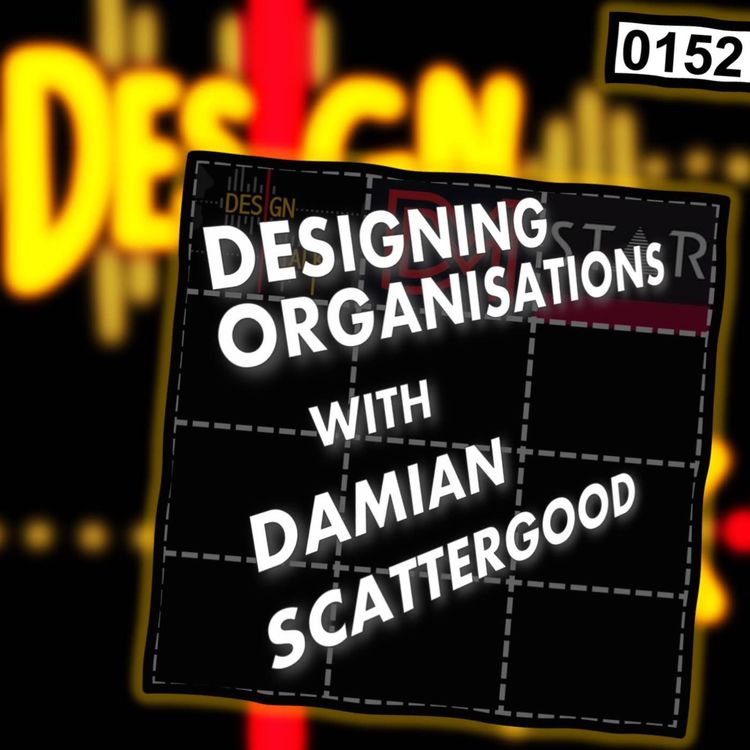
0152 - The Word Game with Damian Scattergood
Hosts: Sheila Duignan and Christof Steiner
We are talking with Damian Scattergood, programmer, entrepreneur, and Managing Director of STAR Translation Ireland (https://www.star-ts.com).
You are very welcome to the podcast, Damian.
Christof: Can you tell us a little about yourself to start?
Christof: What is localization?
Sheila: To move the subject on to that of outsourcing and offshoring
a. What place does outsourcing have in supplier organizations like STAR?
b. Star has 50 offices globally and a number of Centres of Excellence. What is the shape of the Star value chain and global operations footprint – what types or activities and processes are offshored, onshore or nearshore?
Sheila:
a. What were the characteristics of the Irish marketplace that attracted Star? [Incentives/language and tech skills/social and cultural factors]
Christof: Do you think it is inevitable for a business to outsource language services?
Christof: What capabilities would you recommend client organisations keep in-house? Or put another way, what does your ideal client look like?
Sheila: As one of the early adopters of machine translation technology what lessons were learnt, and how does Machine Translation fit within your service portfolio today?
Christof: Where do you see the future of translation and localisation going? Do the algorithms take over, machine learning, AI and MT, is there still a place for humans?
Sheila: Star has extended its value chain into Terminology and Corporate Language Management and Context Management Systems and associated MIS for clients. How is your business set up for management of innovation? Where do you see the next leap in innovation coming from in your business?
Christof: How do you become a “real human translator”?
Well, we’ll wrap up there.
Thank you for sharing your thoughts and experiences today.
Music
Title: Check Them In
Artist: Ema Grace
Source: https://bit.ly/2tJ6Bnd
License: CC BY 4.0
Artist notes: Ema Grace is an AI vocaloid produced by Ryoma MAEDA (@Ryoma_Maeda). Styled as virtual Singer&Idol 架空のバーチャルアイドル & シンガー、それがEma Grace.
Cover Art
Title: Guest Billboard
Artist: Allen Higgins
Source: GuestBillboard_DesigningOrganisations.jpg – The design is a collage incorporating edited media, publicly available graphics from our guest’s organisations used here under ‘Fair Use’.
License: CC BY-NC-SA 4.0
Podcast License
Design Talk (dot IE) CC BY-NC-SA 4.0
The license can be viewed at https://creativecommons.org/licenses/by-nc-sa/4.0
By taking part you give permission for your voice to be recorded, for the recording to be edited, and for it to be posted and published as a podcast.
More episodes
View all episodes
276. 0276 - The 4Rs of Research with Pamela Abbott
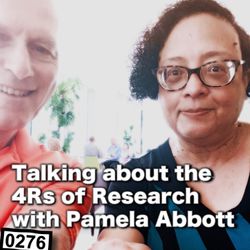
46:22||Season 13, Ep. 276In this episode I talk with Pamela Abbott from the University of Sheffield about a paper she coauthored with Salihu Dasuki and Andrea Jimenez and published by the Information Systems Journal in 2025. The paper is titled "The 4Rs: A collective reflexive methodology for realising critical self-transformation in ICT4D research practice." This part of the talk focuses upon being "in between", a concept she and her colleagues have developed to better understand the role and experience of being a researcher studying and developing complex infrastructure initiatives involving and impacting people from the Global South. I also ask Pamela what was the best research environment she has encountered thus far and what made it so good?Notes, extra questions, and further reading:Abbott, P. Y., Dasuki, S., & Jimenez, A. (2025). The 4Rs: A collective reflexive methodology for realising critical self-transformation in ICT4D research practice. Information Systems Journal, 35(3), 855–906. https://doi.org/10.1111/isj.12561Disclosure: this project benefited from seed-funding grant that Paul Dylan-Ennis and Allen Higgins received under the Research Culture Local Actions Initiatives and Measures (ReCLAIM) initiative at UCD and supported by the Wellcome Trust.AcknowledgementsMusic Title: Earl GreyArtist: Benjimanji (2016)Source: https://freemusicarchive.org/music/Benjimanji/Benjimanji/01_Earl_Grey/License: CC-BY - an Attribution License.Cover Art Title: Selfie in the University ClubArtist: Allen HigginsSource: Pamela_pod.pptxLicense: CC BY-NC-SA 4.0Podcast LicenseDesign Talk (dot IE) CC BY-NC-SA 4.0 The license can be viewed at https://creativecommons.org/licenses/by-nc-sa/4.0By taking part you give permission for your voice to be recorded, for the recording to be edited, and for it to be posted and published as a podcast.
275. 0275 - Talking about reading groups with Adam Kelly
34:53||Season 13, Ep. 275In this episode I talk with Adam Kelly about ACADEMIC reading groups, which I think we’ll DISCOVER, are a whole lot different to book clubs.Adam is an Associate Professor of English in UCD’s School of English, Drama and Film.He has written books himself and published special editions and edited collections and proceedings, (which, for our audience, are books too), and written numerous journal articles, conference papers and reviews (publications that are a bit like books but shorter).OBVIOUSLY you know a thing or two about WRITING (we might talk about that in depth some time)…But, what about this other THING, READING, you must also be very good at it too?Have reading groups had much of an IMPACT on your academic intellectual DEVELOPMENT?We’re talking about READING groups. But when the group meets, you don’t sit around READING do you? Why don’t we call them TALKING groups? So, what is a reading group? What’s it good for? How does the thing you’re reading impact the way you organize the gathering? (monograph, selected chapters, collection of articles, scripts, interpreting artefacts like designs, cases)Must you decide all the readings in advance? (you invited members to offer readings, gave them agency, value of doing it this way?)Where does the audience come from? Relatedly, what about the angle of disciplinary versus inter-disciplinary? Room for both?Thoughts on pace? (weekly, fortnightly, monthly)Are deliverables or traces important? (artefacts like blogs, pods, websites). I know some people hope that each topic would be written up. Is that too much to expect?Reading group lifetime - what to do when they run out of steam?AcknowledgementsMusic Title: Menehune Dance Artist: James PantsSource: https://freemusicarchive.org/music/James_Pants/Bonus_Beat_Blast_2011/39_james_pants-menehune_dance/License: CC-BY. Creative Commons Attribution License. Cover Art Title: Meitheal Machnaimh 275Artist: Allen HigginsSource: AdamKelly_pod.pptxLicense: CC BY-NC-SA 4.0Podcast LicenseDesign Talk (dot IE) CC BY-NC-SA 4.0 The license can be viewed at https://creativecommons.org/licenses/by-nc-sa/4.0By taking part you give permission for your voice to be recorded, for the recording to be edited, and for it to be posted and published as a podcast.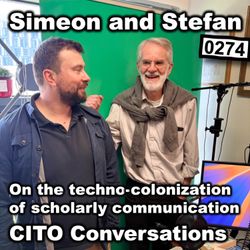
274. 0274 - Techno-colonization with Simeon Vidolov and Stefan Klein
01:28:35||Season 13, Ep. 274Professor Stefan Klein and Dr. Simeon Vidolov present their paper, "Techno-colonization of scholarly communication: A call to reclaim control". This paper contributes to wider research into how extractive publishing systems have colonized scholarly communication to gain not only infrastructural control but increasingly epistemic control as well. For far too long, big publishing companies have trapped academics in a vicious circle of parasitic business models employing monopolistic pricing and arbitrary gate-keeping where researchers provide the labour, only for corporate giants to end up owning the published element of scientific intellectual property (often publicly funded) and consequently, control the visibility of research outputs. These companies have moved beyond publishing; they are now providers of critical, AI and data-analytics enabled research infrastructures. They are reshaping scientific knowledge production, academic values and increasingly claim epistemic authority.That such a system can be used to publish research so critical of its inherent structure is both ironic and potentially positive. The authors call for each of us to reject the role of passive participant in our own exploitation. They conclude by calling for us to devise ways to dismantle these corporate infrastructures and reclaim the autonomy of the scientific community. Whether you are a student, a researcher, or a faculty member, join us to discuss how we can build a future for academia that prioritises collective knowledge over commercial surveillance.The underlying paper(s) are both Open Access, links below:· Vidolov, S., & Klein, S. (2026). Techno-colonization of scholarly communication: A call to reclaim control. Organization, Article 13505084261416192. https://doi.org/10.1177/13505084261416192· Ngwenyama, O., Klein, S., & Rowe, F. (2026). Platform Capture of Scientific Knowledge Production: Publishers’ Dominance, Generative AI and Subsumption of Academic Labor. European Journal of Information Systems (EJIS). https://doi.org/10.1080/0960085X.2026.2642660 BiographiesSimeon Vidolov is a Faculty Member in the J.E. Cairnes School of Business at the University of Galway. His research examines how digital technologies transform ways of working and organizing, with a focus on embodied and affective experiences. His work challenges dominant narratives of technological progress and interrogates the harmful and often normalized consequences of contemporary digital infrastructures for individuals, organizations, and society.Stefan Klein is Professor emeritus for Interorganizational Systems at the School of Business and Economics, University of Münster, Germany. His main research areas are information infrastructures, the transformation of work, risks of digitalization, and digital capitalism. He studies practices of technology use and organizational transformation from an individual to an industry level.The event was held on 6 May 2026 in University College Dublin, Ireland.AcknowledgementsMusic Title: StoryArtist: MeydänSource: https://bit.ly/2P5CSCvLicense: CC BYCover Art Title: Smurfit-ZartisArtist: Photo credit: Allen Higgins. Used with permission.Source: SimeonStefan-seminar.pptxLicense: CC BY-NC-SA 4.0Podcast LicenseDesign Talk (dot IE) CC BY-NC-SA 4.0 The license can be viewed at https://creativecommons.org/licenses/by-nc-sa/4.0By taking part, you give permission for your voice to be recorded, for the recording to be edited, and for it to be posted and published as a podcast.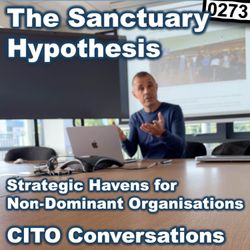
273. 0273 - The Sanctuary Hypothesis by Jean-Fabrice Lebraty
49:52||Season 13, Ep. 273CITO Seminar: The Sanctuary Hypothesis in Information Systems — Blockchain and AI as Strategic Havens for Non-Dominant OrganisationsGuest: Jean-Fabrice Lebraty Host: Donncha Kavanagh Recorded on Tuesday, September 23, 4:00 - 5:00pm in Q2.33 Lochlann Quinn School of Business, UCD Belfield Campus.Abstract This talk introduces a theory of dominant vs non-dominant organisations in digital ecosystems. Dominant actors shape standards, data flows, and platform rules; non-dominant actors operate under asymmetric dependency and limited control over technological stacks. I argue that, for the non-dominant, the core IS problem is not efficiency but survivability—the capacity to endure adverse, shifting, or hostile digital environments. Survivability requires a digital sanctuary: an infrastructure and set of practices that preserve critical informational assets beyond the reach of dominant gatekeepers. I then present two sanctuary technologies. First, blockchain, leveraging immutability, persistence, and verifiable anchoring to secure records and proofs against unilateral alteration. Second, AI via model-level embedding, where strategic data placement in training corpora and model fine-tunes creates durable informational traces and capabilities resilient to upstream platform changes. I conclude with design principles and governance implications for building and stewarding such sanctuaries. Keywords: digital sanctuary; survivability; blockchain; AI/model embedding BioJean-Fabrice LEBRATY is a Full Time Professor of Management Sciences at iaelyon School of Management (Jean Moulin University Lyon 3). He specialises in information systems management. His research focuses on decision-making in extreme contexts, crowdsourcing, social networks, and innovative technologies such as blockchain or AI. Since April 2023, he is in charge of the Magellan research laboratory, which comprises 80 researchers and 50 doctoral candidates.Notes:Jean-Fabrice Lebraty (at Jean Moulin University Lyon 3) https://iae.univ-lyon3.fr/lebraty-jean-fabriceA cross-pod release with CITO Conversations (on the web, Spotify or Apple Podcasts)AcknowledgementsMusic Title: Moody Break 01Artist: Allen HigginsSource: a-Wed10Oct2024License: CC BY-NC-SA 4.0. Includes samples from Ableton Live by Ableton AG and by KORG Inc.Cover Art Title: Room Q233Photo credit: Allen Higgins.Source: Jean-Fabrice-seminar.pptxLicense: CC BY-NC-SA 4.0Podcast LicenseDesign Talk (dot IE) CC BY-NC-SA 4.0 The license can be viewed at https://creativecommons.org/licenses/by-nc-sa/4.0By taking part, you give permission for your voice to be recorded, for the recording to be edited, and for it to be posted and published as a podcast.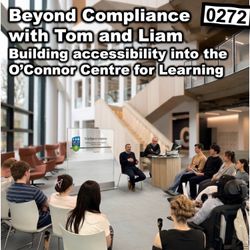
272. 0272 - Beyond Compliance with Liam Brady and Thomas Hamill
47:37||Season 13, Ep. 272Hosted by Sean Lynch and Akshara Jonna. In this episode, the Design Thinking class talk with Liam Brady and Thomas Hamill from the UCD Estate Services team about the complexities of modern campus design, focusing on accessibility features that go "beyond compliance" and how these lessons are applied to the wider campus day-to-day.We take a look inside the design process for the new O’Connor Centre for Learning on UCD’s Belfield campus, from the preliminary brief to the final commissioning.· On to the subject for today, the new O’Connor Centre for Learning. Can you walk us through the story of this building ‘as a project’, the "Before, During, After"?· Would you say that buildings like the Moore Centre (where we are right now) and the O’Connor are high-tech buildings? In what way? How?· Going Beyond Part M: You’ve talked about how building regulations (Part M) provide a baseline for accessibility. How did you move from simple compliance to a design that truly fosters "belonging" for all users?· You mentioned a distinction between "features" and "design elements". How do we ensure accessibility is baked into the architecture rather than just bolted on as an afterthought?· Does user feedback from the wider campus influence the "Fixes" and "Audits" of new projects?· The Logistics of Mobility (MOB): From toilets and doors to steps and lighting - what are the small details that make the biggest difference in a student's daily experience?· In class we have heard that designers should focus on the "smile" (the U-shaped curve) rather than the "sad face" (the standard bell curve). In the context of the O’Connor Centre, how did you practically shift the team's focus toward the extremes of the population rather than just the "average" student?· The Paradox of Safety: A significant portion of your work involves "features we hope are never used," like fire refuge points, emergency intercoms, and smoke-filled space lighting. How can we ensure these features work, are intuitive and accessible during a high-stress emergency?· Curb cutouts and retrofitting the "Smile": It’s one thing to build the O’Connor Centre from scratch with these curves in mind, but how do you apply the "smile curve" logic to the "day-to-day" maintenance and "fixes" of older, more "complicated" UCD buildings?· Audit to Action: Can you talk about how "Audits" can be used as productive levers to rebalance our design focus?· Any questions from the audience?Thank you both for taking the time to talk with us today.Notes:UCD Estate Services project page - https://www.ucd.ie/estates/operations/ucdoconnorcentreforlearning/RKD profile page for the UCD O’Connor Centre for Learning - https://rkd.ie/work/ucd-centre-for-future-learning/From the Government of Ireland, Department of Housing, Local Government and Heritage - Building Regulations Part M: Access and Use requirementsOHAC - O’Herlihy Access Consultancy - https://www.accessconsultancy.ie AcknowledgementsMusic Title: StoryArtist: MeydänSource: https://bit.ly/2P5CSCvLicense: CC BY Cover Art Title: Teleport into O’ConnorArtist: Allen Higgins. Photos prompt merged with Gemini. Classroom in sharp focus overlaid into the O’Connor atrium space in bokeh effect.Source: TomLiam-seminar.pptxLicense: CC BY-NC-SA 4.0Podcast LicenseDesign Talk (dot IE) CC BY-NC-SA 4.0 The license can be viewed at https://creativecommons.org/licenses/by-nc-sa/4.0By taking part, you give permission for your voice to be recorded, for the recording to be edited, and for it to be posted and published as a podcast.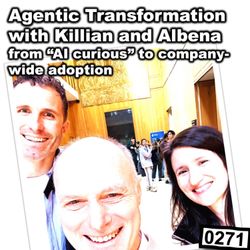
271. 0271 - Agentic Transformation with Killian and Albena
01:14:00||Season 13, Ep. 271Welcome to Design Talk. In this episode Killian O'Connor and Albena Krasteva from Zartis were in to talk to Masters students at the UCD Michael Smurfit Graduate School of Business. Killian and Albena presented a candid behind-the-scenes analysis of Zartis' initial struggles adopting AI within their own organisation. They went on to explain how their experience has led to insights that shape Zartis's AI deployment strategies and use cases for clients. Zartis is a technology services company headquartered in Cork, Ireland and is an official Anthropic partner, supporting organisations that are building with Claude and Claude Code.Notes:Zartis – https://www.zartis.comAnthropic – https://www.anthropic.comUCD Michael Smurfit Graduate School of Business – https://www.smurfitschool.ieAcknowledgementsMusic Title: Calculated Awakening - "Genetic Algorithms Evolution," in the style of a Bytebeat, anchored by a base guitar.Artist: Allen Higgins Source: https://bit.ly/2QkBzvILicense: CC BY-NC-SA 4.0 Includes samples by KORG Inc. and Lyria 3 via Gemini.Cover Art Title: Smurfit-ZartisArtist: Allen Higgins. Photo credits: Yu Su, Denis Buleiko and Allen Higgins. Used with permission.Source: Zartis-seminar.pptxLicense: CC BY-NC-SA 4.0Podcast LicenseDesign Talk (dot IE) CC BY-NC-SA 4.0 The license can be viewed at https://creativecommons.org/licenses/by-nc-sa/4.0By taking part, you give permission for your voice to be recorded, for the recording to be edited, and for it to be posted and published as a podcast.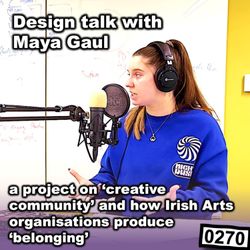
270. 0270 - Creative Community with Maya Gaul
07:38||Season 13, Ep. 270In this, our first episode on ‘research design’ and ‘research designing’ I talk with Maya Gaul and Dunk Murphy from the Creative Futures Academy at UCD. Maya is completing a BA in Creative & Cultural Industries. Her final year project combines research with performance. The subject is Creative Community; an exploration of Irish Arts organisations and how they produce ‘belonging’. Maya talked about her plan for the production - to include elements of documentary, performance and interaction culminating in an event that digs into what arts and inclusion means for practitioners and audience.Notes:The Creative Futures Academy - https://creativefuturesacademy.ieUCD’s BA Major In Creative & Cultural Industries - https://www.ucd.ie/artshumanities/newsandevents/ucdlaunchesnewbaincreativeculturalindustries/AcknowledgementsMusic Title: DeparturesArtist: PortrayalSource: https://bit.ly/2QkBzvILicense: CC BY 4.0Cover Art Title: In the Think LabArtist: Allen Higgins. Photo credits: Dunk Murphy. Used with permission.Source: MayaGaul.pptxLicense: CC BY-NC-SA 4.0Podcast LicenseDesign Talk (dot IE) CC BY-NC-SA 4.0 The license can be viewed at https://creativecommons.org/licenses/by-nc-sa/4.0By taking part, you give permission for your voice to be recorded, for the recording to be edited, and for it to be posted and published as a podcast.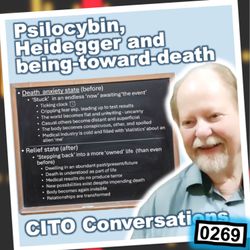
269. 0269 - Johno (Robert Johnston) on Psilocybin, Heidegger and being-toward-death
01:24:54||Season 13, Ep. 269Psilocybin, Heidegger and being-toward-deathBetween 2020 and 2023 psychologist Marg Ross and psychiatrist Justin Dwyer, together with collaborators, ran the largest Australian randomised control of psychedelic assisted psychotherapy for the treatment of extreme death anxiety in terminally ill patients using psilocybin (the active ingredient in magic mushrooms) (Ross et al, 2025). Over the past 15 months I have contributed to the analysis and reporting of qualitative interview data collected by these researchers before and after treatment. The therapy has been shown to be remarkably effective with 21 out of 28 patients who completed the full trial reporting sustained relief. Whereas before the treatment the patients had found themselves 'stuck' in an oppressive lingering present, after treatment they are able to 'step back into' a life that is in some ways fuller even than before the diagnosis (Dwyer et al, 2026). In this reading group/seminar I will briefly present Heidegger's account in Division II of Being and Time of being-toward-death and its role in prompting a more authentic human existence and richer lived temporality. I will point out its striking similarity to the change phenomenon we observed in the qualitative analysis. I invite discussion of this observation, its implications, and suggestions. Note I will devote little time to describing the clinical trial so reading the accompanying paper (Dwyer et al, 2026) is advised.JohnoRobert B. Johnston is a professor (emeritus) at University College Dublin, and a person in his own right.Dwyer, J., Johnston, R. B., O'Callaghan, C., and Ross, M. 2026. "Stepping Back into Life: How Psychedelic Assisted Psychotherapy Transforms the Way of Life of the Terminally Ill," General Hospital Psychiatry (98), pp. 86-96. doi: 10.1016/j.genhosppsych.2025.12.002AcknowledgementsMusic Title: Justice Little LeagueArtist: Ema GraceSource: https://bit.ly/2tJ6BndLicense: CC BY 4.0Artist notes: Ema Grace is an AI vocaloid produced by Ryoma MAEDA (@Ryoma_Maeda). Styled as virtual Singer&Idol 架空のバーチャルアイドル & シンガー、それがEma Grace.Cover Art Title: Inspired by zoomArtist: Allen HigginsSource: CITO-podcast-Johno.pptxLicense: CC BY-NC-SA 4.0Podcast LicenseDesign Talk (dot IE) CC BY-NC-SA 4.0 The license can be viewed at https://creativecommons.org/licenses/by-nc-sa/4.0By taking part you give permission for your voice to be recorded, for the recording to be edited, and for it to be posted and published as a podcast.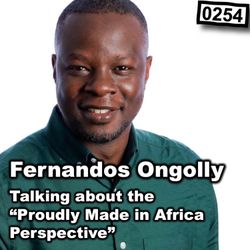
254. 0254 - The PMIA Perspective with Fernandos Ongolly
56:14||Season 13, Ep. 254Today we’re talking with Fernandos Ongolly, to learn about home-grown innovations and digital startups from The Continent – in this case, Africa. Our hosts are Selma Anya, Safa A. A. Emam, and Diana Achiro, students on the MSc Digital Innovation programme.Fernandos has a PhD from UCD. He is the current “Proudly Made in Africa” Fellow in Business and Development at UCD College of Business, and the founder of – Non-EU Academics and Researchers Community in Ireland.Our audience is the class of 2025 studying the Outsourcing and Offshoring module taught by Allen Higgins.First, Fernandos, would you like to say a few words about your current role and a little about your journey?· African nations might not be the first place that investors and business associate with “technology ambition”, can you set the context? [notes: technical infrastructure, physical infrastructure, population demographics, connectedness etc.]· Talk about some success stories from Africa and the sectors they occur in? [notes: in FinTech, Education, AgriTech and eCommerce]· What are the opportunities for outsourcing to Africa? [notes: BPO, content moderation and specialized services, much of today’s AI is/was trained by centers in Africa]· For the startup environment, like Silicon Valley, where are the incubators, clusters, and centers of excellence? [notes: the three big regions East, West and South – Kenya; Nigeria; South Africa]· Can you talk about the role culture plays. No doubt there are challenges but opportunities too? [notes: strong social ties, high-trust cultures, entrepreneurial attitude is prevalent – trading is a way of life]· Questions from the hosts· Questions from the audience.Further reading and notesFernandos Ongolly on LinkedIn - https://www.linkedin.com/in/fernandos-ongolly-phd-89927b32/Proudly Made in Africa is a Trade Justice and Global Citizenship Education organization. For more see - https://www.proudlymadeinafrica.orgAlso, the PMIA Podcast on YouTube - https://www.youtube.com/@proudlymadeinafricaAcknowledgementsMusic Title: Faceplant with UK GarageArtist: Allen HigginsSource: a-Wed23Oct2024License: CC BY-NC-SA 4.0. Includes samples from Ableton Live by Ableton AG and by KORG Inc.Cover Art Title: Guest and classArtist: Allen HigginsSource: Pepperdine_Fernandos.pptxLicense: CC BY-NC-SA 4.0Podcast LicenseDesign Talk (dot IE) CC BY-NC-SA 4.0 The license can be viewed at https://creativecommons.org/licenses/by-nc-sa/4.0By taking part, you give permission for your voice to be recorded, for the recording to be edited, and for it to be posted and published as a podcast.