Share
Deep Learning Dialogues
Privacy Empathy in the Age of AI: How the IPC is Guiding Ontario’s Schools
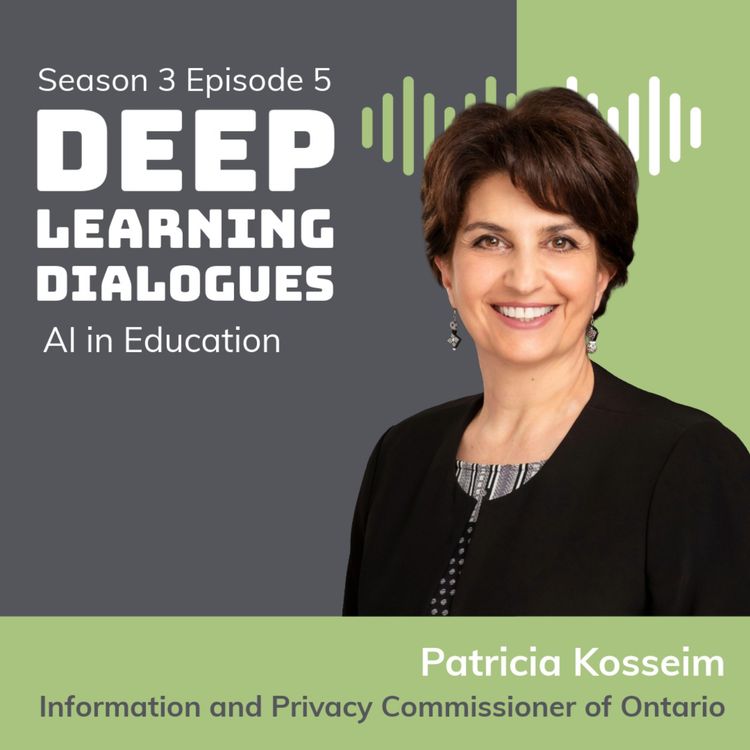
In this episode of Deep Learning Dialogues, we sit down with Patricia Kosseim, Ontario’s Information and Privacy Commissioner, to explore the critical intersection of student privacy, educational technology, and artificial intelligence. From the challenges school boards face when negotiating with EdTech vendors to the ethical complexities of AI in classrooms, Commissioner Kosseim offers expert insights and practical guidance for educators. We discuss the importance of “privacy empathy,” the role of the IPC in safeguarding student data, and the resources available to help schools navigate this evolving digital landscape with confidence and care.
Patricia Kosseim is the Information and Privacy Commissioner of Ontario. She is a lawyer by profession and has extensive experience as a senior executive working in complex, inter-disciplinary environments, across public, private and health sectors. Through integration of legal practice, public policy and academic research, she has led large teams and major strategic initiatives to address ethical, legal and social implications of emerging technologies. She connects people and creative ideas to advance critical reflection, converge around common goals and work towards practical solutions. In March 2025, she was awarded the King Charles III Coronation Medal, in recognition of her valuable contribution to Ontario and to Canada.
Find further information at:
- ipc.ca
- Instagram: https://www.instagram.com/ipc.ontario/
- A Guide to Privacy and Access to Information in Ontario Schools
- Digital Privacy Charter - 12 commitments supporting teachers and students
- Youth ambassador tool kit
- Youth advisory council
Want to know more?
You can check out our: WCDSB GenAI Guidelines, infographics, and Innovation website: https://innovate.wcdsb.ca/
Feedback? You can ask your questions or give us feedback on the show here
Want to get in touch? Contact Katrina & Whitney by email at: katrina.gouett@wcdsb.ca and whitney.mckinley@wcdsb.ca or on LinkedIn
More episodes
View all episodes
30. Season 3 Wrap-up!
06:10||Season 3, Ep. 3080 episodes in the books! In our Season 3 finale, Whitney and Katrina pause to share a simple, heartfelt message: thank you. From staff meetings and PD sessions to individual word-of-mouth shares, this community has grown person-to-person.In this quick season-ender, we share a few ways to dive back into our archive over the break, how you can directly shape our upcoming content, and what to expect when we return in September. Plus, to help you navigate season 3, we’ve created a digital eBook that summarizes this season’s episodes and includes curated playlists for easy listening over the summer. Go back, share an episode with a colleague, send us your questions for Season 4, and we’ll see you in the fall!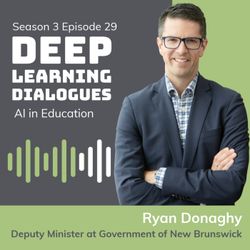
29. Finding the Balance: Environmental Realities, Data Sovereignty, and AI
39:40||Season 3, Ep. 29How do you reform an entire education system without falling into the trap of hype, environmental neglect, or technological whiplash? New Brunswick Deputy Minister Ryan Donaghy joins us to pull back the curtain on Canada’s first province-wide AI initiative. From creating strict guardrails around data centers and cognitive offload to building a ground-up AI literacy framework, Ryan shares why true innovation isn't about moving fast and breaking things; it's about relationships, smart policy, and empowering educators to start small today. You can read a summary article of the conversation here.Ryan Donaghy is a senior executive and systems thinker who has spent more than two decades navigating reform across New Brunswick's public sector serving as Deputy Minister in Environment, Local Government, and now Education. Under his leadership, New Brunswick became Canada's first province to embrace a system-wide, human-centered approach to AI integration. Beyond his work redesigning complex public systems, Ryan is a proud Moncton native, UNB alumnus, dad, ringette coach, and hockey referee—a combination that arguably provides the ultimate training in managing competing priorities. You can reach Ryan by email at ryan.donaghy@gnb.caEpisode ResourcesThe Brookings Institution Research A new direction for students in an AI world: Prosper, prepare, protectNew Brunswick Curriculum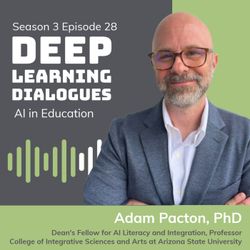
28. Beyond the Trap: Why Hidden AI Prompts Fail Educators and Students
45:53||Season 3, Ep. 28In this episode of Deep Learning Dialogues, hosts Whitney McKinlay and Katrina Gouett sit down with Dr. Adam Pacton to unpack the controversial practice of "prompt injection" or hiding invisible text in assignments to catch students using generative AI. Moving past the initial "ick" factor or ethical intuition that such tactics turn classrooms into policing environments rather than spaces of mutual trust, the conversation explores the concrete legal, technical, and pedagogical failures of these traps. Dr. Pacton explains how hidden instructions act as an accessibility nightmare under regulations like the ADA Title II and Ontario's AODA, because screen readers accidentally surface the invisible text, confusing students who rely on assistive technology. Rather than relying on flawed detection mechanisms, the episode advocates for a systemic paradigm shift toward "process over product," urging institutions to provide teachers with the cover and resources needed to meaningfully redesign assessments and foster relational intelligence. You can read the episode summary here.Dr. Adam Pacton is an associate teaching professor and Dean's fellow for AI literacy and integration at the College of Integrative Sciences and Arts at Arizona State University. Working at the intersection of pedagogy, ethics, and emerging technology, he focuses on institutional AI governance while helping educators move away from fear-based compliance toward thoughtful, human-centered classroom integration. With a PhD in rhetoric and composition, Dr. Pacton brings a deeply grounded perspective to language practices, change management, and student agency in the age of artificial intelligence. Outside of his academic and administrative leadership roles, he rounds out his human perspective as a father, an avid video game player, and a passionate fan of fantasy and sci-fi literature.Episode Link:-ASU Guidance on Hidden-Text/Prompt Injection Techniques in Assignments
27. The Messy Middle: Navigating Artificial Intelligence in the Classroom
45:20||Season 3, Ep. 27In this episode of Deep Learning Dialogues, explore the "messy middle" of artificial intelligence in education with guest Jessica Rizk, PhD, OCT. Moving past the polarizing narratives of absolute tech adoption versus complete avoidance, the conversation examines how generative AI is actively reshaping the classroom from the ground up. Rizk highlights the urgent need for foundational AI literacy beginning in kindergarten, illustrating through personal anecdotes how young children form implicit relationships with technology long before formal instructions begin. Together, they explore the critical shift from viewing AI merely as a baseline productivity tool to utilizing it as a human springboard for deeper critical thinking, assessment restructuring, and meaningful conversation. The discussion culminates in a powerful look at public policy, evaluating Canada’s current ranking in AI literacy training and addressing the crucial systemic tension between maintaining agile institutional structures and empowering educators with a coherent, standardized, and supportive framework. Dr. Jessica Rizk is a senior research associate at Signal 49 Research, a pan-Canadian nonprofit applied research organization dedicated to tackling some of Canada’s largest systemic challenges. Deeply rooted in the education sector, she serves as an instructor at both Wilfrid Laurier University and the University of Waterloo, and previously a former K–8 elementary classroom teacher. Jessica is a prominent voice in educational policy and tech literacy, authoring the impactful January op-ed, "Canada’s AI Strategy is missing kids," which champions the creation of a national, comprehensive AI education strategy. Melding her extensive academic research with her firsthand experience as an educator and a parent, she provides a uniquely well-rounded perspective on what it truly means to build sustainable human agency and foundational skills in an AI-driven world. You can follow and learn more about Jessica on LinkedIn.
26. Critical Thinking, AI Co-Authorship, and the Future of Academic Writing
49:22||Season 3, Ep. 26In this episode of Deep Learning Dialogues, hosts Whitney McKinley and Katrina Gouett sit down with Dr. Christin Wright-Taylor, Manager of Writing Services at Wilfrid Laurier University, to explore the intersection of generative AI, academic writing, and the human voice. Shifting the conversation away from fear and toward hope, Dr. Wright-Taylor discusses why generative AI should be viewed as a "calculator for language" and argues that foundational writing skills are more critical than ever for guiding and assessing AI outputs. The conversation explores the necessity of protecting the "incubator of thinking" by encouraging students to embrace messy, authentic first drafts before turning to digital tools. By reframing writing as an iterative process rather than a transactional product, this episode challenges educators to evaluate their own implicit biases regarding academic tone and explore how rubrics can evolve to celebrate diverse cultural capital and unique student voices.Dr. Christin Wright-Taylor is the Manager of Writing Services at Wilfrid Laurier University, where she and her team specialize in helping students build self-efficacy and critical thinking through the writing process. She holds a PhD in Composition and Rhetoric from the University of Waterloo, as well as an MFA in Creative Writing. Over her 25-year career as an educator, writer, and scholar, Dr. Wright-Taylor has written books and contributed to national publications including The New York Times and The Washington Post. Dedicated to helping students cultivate a "writing state of mind," she is a passionate advocate for preserving human curiosity and individual voice in an increasingly automated landscape. You can find Christin on LinkedIn.Resources Mentioned in This Episode:Bad Ideas About Writing edited by Cheryl E. Ball and Drew M. Loewe: https://textbooks.lib.wvu.edu/badideas/badideasaboutwriting-book.pdf"Should Writers Use They Own English" by Vershawn Ashanti Young: https://artsci.tamu.edu/english/_files/_documents/research/use-they-own.pdfAntiracist Writing Assessment Ecologies: Teaching and Assessing Writin for a Socially Just Future by Asao B. Inoue: https://open.umn.edu/opentextbooks/textbooks/antiracist-writing-assessment-ecologies-teaching-and-assessing-writing-for-a-socially-just-future
25. The Cognitive Death or Deeper Thinking? The AI Tug-of-War
52:35||Season 3, Ep. 25In this episode of Deep Learning Dialogues, hosts Whitney McKinley and Katrina Gouett engage in a captivating conversation with educational scholars Dr. Julie Mueller, Dr. Avis Beek, and Dr. Keri Ewart from Wilfrid Laurier University to tackle the critical tension between cognitive offloading and cognitive replacement in the classroom. Grounded in recent literature on academic integrity, technological disruption, and equitable pedagogy, the panel discusses how generative AI is challenging traditional, colonial structures of higher education and redefining historical standards of "originality." From exploring the generational gap in digital fluency to questioning whether AI will stunt critical thinking or liberate educators to focus on foundational human skills, this discussion serves as an urgent call to prioritize transferable skills, problem-solving, and authentic, experiential learning over reactive, "whack-a-mole" tech policing. Read the episode summary here. Articles discussed in the episode:“ChatGPT for good? On opportunities and challenges of large language models for education”This Changes Everything: Originality, Academic Integrity, and Education in the Age of Generative AI”How generative AI fixes what higher education broke: reframing the “colonization” of knowing and learningGuest Bios:Dr. Julie Mueller, Associate Dean: Graduate Programs and Research, Faculty of Education at Wilfrid Laurier UniversityDr. Mueller is a cornerstone of the EdTech research community. With a PhD in Developmental Psychology, her work centers on the "TPACK" framework—balancing technology, pedagogy, and content. She is a leading voice on Computational Thinking across the curriculum and has collaborated with the Canadian Space Agency to develop STEM modules like "Mission on the Moon." Julie brings decades of experience in understanding how digital tools can empower both teachers and students to navigate a digital world.Dr. Avis Beek, Assistant Professor & Chair of International Education Studies at Wilfrid Laurier UniversityDr. Beek’s perspective is truly global. Before her time in academia, she taught science and math in Nunavut and at international schools in Bahrain, Japan, and the Czech Republic. Her research explores International Mindedness and the "STEMovation" project, which focuses on making STEM education inclusive for underrepresented groups. Avis is an expert in interculturalism and is dedicated to decolonizing K-12 classrooms through experiential learning.Dr. Keri Ewart, Assistant Professor of Language and Literacy at Wilfrid Laurier UniversityDr. Ewart sits at the cutting edge of AI Literacy and culturally responsive pedagogy. With 17 years of K-12 experience, her research focuses on the ethical integration of AI in education, specifically how "micro-prompts" and generative AI can support inclusive teaching. A former coordinator of Equity, Diversity, Inclusion, Decolonization, and Anti-Racism (EDIDA), Keri is passionate about equipping the next generation of educators with the critical literacies needed for a social-justice-oriented future.
24. The First Draft: Preserving the "Friction" of Human Thinking
38:46||Season 3, Ep. 24In this episode of Deep Learning Dialogues, hosts Whitney McKinley and Katrina Gouett are joined by Dr. Alec Couros to discuss the vital role of "productive struggle" in an era of instant AI outputs. Dr. Couros breaks down the concepts from his viral article, "The Shortcut That Costs Us Everything," warning against a "reverse-Bloom’s Taxonomy" where students analyze AI text without ever learning to compose it themselves. The conversation explores how to "protect the first draft" as a sacred space for human thought and identity. From the risks of "Model Autography Disorder" (MAD) to practical classroom strategies like "Think-Pair-AI-Share," this episode offers a roadmap for using AI as a critical collaborator rather than a replacement for student voice. You can read the summary document here.Dr. Alec Couros is a Professor of Educational Technology and Media at the University of Regina and a globally recognized leader in open education and digital citizenship. Throughout his career, he has explored the intersection of technology and pedagogy, recently focusing on the ethical and cognitive implications of generative AI in the classroom. Through his research and popular Substack, Alec advocates for "protecting the human in the loop," emphasizing the importance of preserving the "friction of thinking" and the integrity of the student’s first draft in an increasingly automated world. You can follow his work on Substack or on social media at @courosa.Episode Links:LinkedInSubstackThink-Pair-AI Share
23. Levity and Learning: AI Leadership at St. Benedict CSS
33:36||Season 3, Ep. 23In this episode of Deep Learning Dialogues, hosts Whitney McKinley and Katrina Gouett are joined by Jordan Figueiredo the principal of St. Benedict Catholic Secondary School. Jordan shares his leadership stance on artificial intelligence, moving beyond simple "guardrails" to foster a culture of curiosity and vulnerability among his staff. The conversation explores how to manage the "ping-pong" effect of innovation and how to establish the psychological safety necessary for educators to move from "shadow use" of AI to shared, open practice. From leveraging "lead learners" in staff meetings to using AI "Gems" for analyzing student achievement data, Jordan illustrates how a human-centered approach to technology can actually amplify relationships and professional practice in a large secondary school.Jordan Figueiredo is the Principal of St. Benedict Catholic Secondary School in Cambridge Ontario. Known for his commitment to building a culture of openness and innovation, Jordan focuses on supporting both student and adult learning through collaborative leadership and professional trust. He is an advocate for "being vulnerable on purpose and out loud," encouraging his staff to experiment with new tools like AI without the fear of failure. Beyond his administrative duties, Jordan is active on Instagram (@jordangfigueiredo), where he shares reels aimed at bringing levity and joy to the role of school leadership. He is currently exploring the potential of AI assistants to streamline school operations and better align with strategic system goals.Episode Resource Links:-WCDSB Zero to Infinity Scale-Tutorial Video: How to create a Gem-Webinar: AI-Resistant Assessment: the ADAPT Framework
22. Students Leading the Way with Benny's Innovator Group
54:30||Season 3, Ep. 22In this episode of Deep Learning Dialogues, hosts Whitney McKinley and Katrina Gouett visit St. Benedict Catholic Secondary School in Cambridge, Ontario to speak with the creators and members of the Benny's Innovator Group (BIG). This student-led initiative, facilitated by teachers Lindsay LeBeau and Lisa Wollziefer, focuses on bringing AI literacy to the school community through interactive workshops. The conversation explores the importance of peer-to-peer learning, where students act as "translators" to help both their classmates and teachers understand how to use generative AI tools effectively and ethically. From discussing the "zero to infinity" mindset to sharing the nerve-wracking but rewarding experience of leading a classroom, students highlight how this program is building essential global competencies and fostering a culture of curiosity and human connection in the age of AI.You can read more about the episode here.About Our GuestsLindsay LeBeau: A teacher at St. Benedict who entered the profession after a 15-year career in nursing. She brings her passion for teaching and healthcare to the school and co-founded BIG to empower students to lead through innovation.Lisa Wollziefer: A teacher at St. Benedict who recently transitioned from elementary to secondary education. With a background in the tech and fitness industries, she co-facilitates BIG and is dedicated to using AI to free up time for deeper human connections with her students.Aliaa, Taha, and Umar: Grade 11 students at St. Benedict and leading members of the Benny’s Innovator Group. Driven by interests ranging from software engineering to a general love of learning, these student leaders facilitate workshops that bridge the gap between complex technology and classroom practice, helping their peers and teachers navigate the ethical use of AI.