Share
Coping
Coping With Cognitive Dissonance
Why is it so difficult to change our minds, even when the evidence is staring us in the face?
Between the Russell Brand verdict, endless internet debates about separating art from the artist, and the internal tensions that shape our everyday choices, we're constantly navigating the gap between what we know and what we'd rather believe.
This week, Alice Griffin and Jannah Anderson unpack the psychology behind the stories we tell ourselves to keep discomfort at bay. They explore why humans are surprisingly skilled at bending reality to fit existing beliefs, examine the role denial plays in everyday life, and question whether cognitive dissonance is a flaw to overcome or simply an inevitable part of being human.
Content warning: this episode includes discussion of the rape and sexual assault charges Russell Brand was convicted of, without graphic detail. If this brings anything up for you, you can skip ahead to 23:20 in this episode, or come back to us next week. If you need support, contact 1800RESPECT on 1800 737 732, available 24/7.
British Comedian Russell Brand sentenced to over 10 years for rape and sexual assault by Kate Bartlett, NPR
Watch: Russell Brand: In Plain Sight, Channel 4 Dispatches documentary
A Monster of His Time by Sophie Gilbert, The Atlantic
Russell Brand won an award for his sexual 'conquests'. Three years in a row, by Holly Wainwright, Mamamia
Sexual harassment is rife on comedy circuit and women lack protections, MPs told, Amelia Hill, The Guardian
The Case for Motivated Reasoning by Ziva Kunda, Psychological Bulletin
When Corrections Fail: The Persistence of Political Misperceptions by Brendan Nyhan and Jason Reifler, Political Behavior
The rise and immediate, potentially strategic downfall of Matt Rife by Jared Richards, ABC News
A performance review live on air? When ‘feedback’ turns into public bullying by Kris Grant, Women’s Agenda
‘Dumb c—’: Kyle Sandilands hurls vile abuse at co-hosts during heated live radio interview, by Elanor Wicklund, news.com.au
Cognitive Dissonance, Psychology Today
A theory of cognitive dissonance by Leon Festinger, Stanford University Press
Read: Why We Love Dogs, Eat Pigs, and Wear Cows by Melanie Joy PhD and Yuval Noah Harari
Read: Blind to Betrayal by Jennifer Freyd and Pamela Birrell
The Ostrich Effect: Selective Attention to Information by Niklas Karlsson, George Loewenstein and Duane Seppi, Journal of Risk and Uncertainty
Illusion and Well-Being by Shelley Taylor and Jonathon Brown, Psychological Bulletin
Read: Mistakes Were Made (But Not By Me) by Carol Tavris and Elliot Aronson
Three-Time Trump Voter Delivers Blistering Takedown of President in Stunning CSPAN Call by Joe DePaolo, Mediaite
Want to support our show? We'd be so grateful if you hit 'follow' or left us a 5-star review so we can bring you more Coping content.
Plus, you can follow along with us on Instagram and Pinterest. Find out more about what we're up to (and how you can get involved) at copinginc.com.
More episodes
View all episodes
31. Coping With Romantasy
53:38||Ep. 31We’ve always loved a happily ever after, but in the past few years Romantasy has gone from niche subgenre to full-blown cultural phenomenon – and the arrival of the latest ACOTAR instalment, A Court of Splintered Harmony, has lured even the least likely readers into its magical realms.This week, Alice Griffin and Jannah Anderson unpack the unique appeal of Romantasy – with help from author Olivia O’Flynn – and explore what stories of fated mates, magical kingdoms and all-consuming love reveal about modern life. From yearning, desire and book boyfriends to escapism, larping and the increasingly blurred lines between fantasy and reality, they ask whether Romantasy simply is a distraction from the real world, or a way of making sense of it.☆ Thanks to Skin Studio for collaborating with us on our A Court of Splintered Harmony celebration at Coping Studio! Check out their official ACOTAR collection here. ☆Follow: Olivia O’Flynn on InstagramRead: Olivia O’Flynn’s Ever Cursed seriesRead: A Court Of Thorns And Roses series by Sarah J. MaasThey Can’t Get Enough of the Queen of Fairy Smut by Alexandra Alter, New York TimesThose Books of Smut and Wonder by Honor Jones in The AtlanticSometimes Smut Is Too Good by Michelle Santiago Cortés, The CutFalling for a Minotaur by Emily Gould, The CutEscape Artists: Romantasy at the End of the World, by Daniel Yadin in The DriftRead: A Natural History of the Romance Novel by Pamela RegisHow Romantasy Seduces Its Readers in The New Yorker podcast: Critics at LargeThe Healing and Empowering Influence of Romantasy by Suzanne Bender M.D, Psychology TodayRead: On Fairy-Stories by J.R.R. TolkienLove, Power and Fantasy in the Age of AI Companions, NYUCan two worlds bleed? How live action role-play affects your life, University of Sydney‘Reality bleed’, and the blurred lines of live-action role-playing by Davide Orazi, Monash LensWant to support our show? We'd be so grateful if you hit 'follow' or left us a 5-star review so we can bring you more Coping content.Plus, you can follow along with us on Instagram and Pinterest. Find out more about what we're up to (and how you can get involved) at copinginc.com.
30. Coping With Con Artists
00:00||Ep. 30You've been seeing Elizabeth Holmes everywhere, right? Between the new Nathan Fielder documentary, your favourite podcasts revisiting the Theranos' story and the endless internet discourse, it feels like we simply can't stop ourselves from returning to the world's most famous fraudsters. But why are we so fascinated by con artists in the first place, and how come they continue to captivate us long after the lie has been exposed?This week, Alice Griffin and Jannah Anderson unpack our enduring obsession with scams, grifters and spectacular acts of deception. From Silicon Valley's culture of 'fake it til you make it' to history's most infamous frauds, they explore the psychology of persuasion, unpack why humans are surprisingly wired to trust, and examine how confidence, charisma and social proof can convince us to believe almost anything.Watch: You Can See Everything trailerWatch: The Inventor: Out For Blood In Silicon Valley documentaryIntuitive evaluation of likelihood judgment producers: Evidence for a confidence heuristic, by Paul C. Price, and Eric R. Stone Journal of Behavioral Decision MakingWatch: The DropoutWatch: The Wolf of Wall StreetWatch: Inventing AnnaThe Woman Who Fooled The World by Beau Donelly and Nick ToscanoTruth-Default Theory and the Social Science of Lying and Deception by Timothy R. Levine,Elon Musk’s Statements Could Be ‘Deepfakes’, Tesla Defence Lawyers Tell Court, The GuardianWatch: Onara O Neill's TED Talk: What We Don't Understand About TrustWant to support our show? We'd be so grateful if you hit 'follow' or left us a 5-star review so we can bring you more Coping content.Plus, you can follow along with us on Instagram and Pinterest. Find out more about what we're up to (and how you can get involved) at copinginc.com.
29. Coping With Ghosts
45:23||Ep. 29’Tis the season for a spooky, scary Halloween episode ! We’re diving into one of the longest-standing stories we’ve told ourselves across cultures and literal centuries: life doesn't end with death, and some part of us will always linger in the form of an otherworldly being…This week, Alice Griffin and Jannah Anderson are swapping ghost stories and paranormal “experiences” while weighing up the arguments for and against the age-old question: are ghosts real? They dive into the massive industry born around ghost hunting, explore how we emotionally cope with the idea of the supernatural, and of course share their ultimate Halloween watch list recs.☆ If you're also spiralling about technology, loneliness, and the human condition, Klara and the Sun has your name all over it. Gather the group chat accordingly. In cinemas NOW. ☆Anomalistic Psychology: What Is It And Why Bother? By Chris French, Psychology TodayWired for Weird, by Richard Wiseman in Scientific AmericanListen: How To Sell A Haunted House, Criminal podcastWhy So Many Of Us See Our Loved Ones After They Have Died, by Shayla Love, PsycheMany Americans Say They Believe in Ghosts. Do You? by Anna P. Kambhampaty, The New York TimesThe Broken Technology Of Ghost Hunting by Colin Dickey, The AtlanticWatch: Ghost Hunters Stanley Hotel episodeGlad To Be Sad, And Other Examples Of Benign Masochism, by Rozin et al, Cambridge University PressJannah's watch reccs: The Haunting of Hill House and The Haunting of Bly ManorAlice's watch reccs: Hereditary and Paranormal Activity Want to support our show? We'd be so grateful if you hit 'follow' or left us a 5-star review so we can bring you more Coping content.Plus, you can follow along with us on Instagram and Pinterest. Find out more about what we're up to (and how you can get involved) at copinginc.com.
28. Coping With Taste
42:46||Ep. 28We suddenly seem to care a lot about what the person next to us is reading. Between celebrity book clubs, literary moments on the runway, and the rise of the professional tastemaker, taste itself has never been so public. You may even have started wondering whether the book tucked under your arm on your morning commute is something you love, or something you’d like to be seen loving.This week, Alice Griffin and Jannah Anderson unpack the performance of taste, exploring the psychology of signalling and impression management, the trends and people shaping contemporary reading culture, and what it means to cultivate preferences that exist beyond aesthetics, algorithms and social capital.☆ If you're also spiralling about technology, loneliness, and the human condition, Klara and the Sun has your name all over it. Gather the group chat accordingly. In cinemas from 22 October. ☆Plot Twist! All the Books Guests Brought to the Valentino Show by Anna Cafolla and Francesca Faccani, VogueBring a book: how reading became fashion's favourite accessory, Cur(AI)tion SubstackWatch: Jack Edwards’ Valentino Book Swap videoThe Curious Notoriety Of “Performative Reading” by Brady Brickner-Wood, New YorkerRead: Anti-Intellectualism in American Life by Richard HofstadterSocial Network Profiles as Taste Performances by Hugo LiuImpression management: A literature review and two-component model by Leary & Kowalski Basic Or Pretentious: The Anxiety Of Spotify Wrapped Perceptions by Sofia Appolino, The DiamondbackWant to support our show? We'd be so grateful if you hit 'follow' or left us a 5-star review so we can bring you more Coping content.Plus, you can follow along with us on Instagram and Pinterest. Find out more about what we're up to (and how you can get involved) at copinginc.com.
27. BONUS: Martina Calvi Is Coping
25:32||Ep. 27This week, we're coping a little differently ! Following our AI takeover spiral a few weeks ago, we thought it only fair to balance things out with a timely celebration of what it really means to be human.In this special bonus episode of Coping, we're sharing highlights from our live conversation with crafty queen, artist and author Martina Calvi. We sat down with Martina a few weeks ago to kick off the global tour for her new book, The Art of Snail Mail (out now!) at Coping Studio in an event made possible thanks to Pinterest Australia.In this episode we hear from Martina, Alice Griffin and Jannah Anderson on all things creativity, connection, the analogue revival, and our enduring love affair with nostalgia, reflecting on all the things technology can never replace.☆ Huge thanks to Pinterest Australia for supporting Coping and helping more people step away from the doomscroll and back into their creativity. ☆Follow Martina Calvi on Pinterest and InstagramRead Martina Calvi’s new book The Art Of Snail MailTired Of AI, People Are Committing To The Analogue Lifestyle In 2026 by Ramishah Maruf, CNN BusinessWhy Are Young People So Nostalgic for a Time They Never Lived In? by Sik on SubstackNostalgia: Past, Present, and Future Sedikides, Wildschut, Arndt and Routledge, in Current Directions in Psychological SciencePersonal vs. Historical Nostalgia: A Division Of Emotions, by Chris Marchegiani Curtin Business SchoolWe’re Not Addicted To Nostalgia We’re Just Escaping The Internet, by Hannah Charlton, Roe MagazineWant to support our show? We'd be so grateful if you hit 'follow' or left us a 5-star review so we can bring you more Coping content.Plus, you can follow along with us on Instagram and Pinterest. Find out more about what we're up to (and how you can get involved) at copinginc.com.
26. Coping With Quitting
36:53||Ep. 26Harry Styles is rumoured to be retiring. Amelia Dimoldenberg is bringing the Chicken Shop Date era to a close. We all remember Simone Biles stepping away from the gymnastics mat. More and more, we're watching people opt out of goals they've built their identity around and spent years publicly pursuing. Quitting seems more socially acceptable than ever, so why does walking away still feel like failure?This week, Alice Griffin and Jannah Anderson explore our relationship with quitting (it's complicated). In a conversation about identity, drive and sunk costs, they unpack where the "never give up" mindset actually came from, why perseverance is treated as a virtue while quitting is seen as a flaw, and whether knowing when to stop might be just as important as knowing when to keep going.Harry Styles Is Still Getting Used to Being Harry Styles by Julio Torres, W Magazine Is Harry Styles Retiring? by Sam Prance, Capital UK Harry Styles’ Speech On Together, Together TourSimone Biles Says She Should Have Quit Way Before Tokyo Olympics by Katie Kindelan, ABC News Hyrox Athlete Apologies and Withdraws After Viral Defecation Incident by Alexandra Koster, SBSTime, Work-Discipline, and Industrial Capitalism by E.P. ThompsonThe Protestant Ethic and The Spirit Of Capitalism by Max WeberSelf-Help; with Illustrations of Conduct and Perseverance by Samuel SmilesDid ‘The Life of a Showgirl’ Need an Encore? And Where Is Taylor Swift Going Next? By Maya Georgi, Rolling StoneAmelia Dimoldenberg to close doors of Chicken Shop Date by Naomi de Souza, BBCThe Sunk Cost Trap: Why We Throw Good Money After Bad by Carlos Alós-Ferrer, Psychology Today Errors in Aviation Decision Making: Bad Decisions or Bad Luck? by Judith Orasanu, Lynne Martin and Jeannie Davison, NASA Ames Research CenterLearned Helplessness at Fifty: Insights from Neuroscience by Steven F. Maier and Martin E.P. Seligman, Psychological Review Watch: Jerry Maguire Want to support our show? We'd be so grateful if you hit 'follow' or left us a 5-star review so we can bring you more Coping content.Plus, you can follow along with us on Instagram and Pinterest. Find out more about what we're up to (and how you can get involved) at copinginc.com.
25. Coping With Feeling Behind
30:58||Ep. 25It seems everyone around us is moving through life at exactly the “right” pace: getting engaged, having babies, buying houses, building careers, finding purpose. Meanwhile, we’re left wondering, are we running late to our own lives?This week, Alice Griffin and Jannah Anderson muse on ‘feeling behind’ after rediscovering an article Alice wrote at 25 about comparison culture and the anxiety around reaching success by a certain age, revisiting the question through older (hopefully slightly wiser) eyes. In a conversation about ambition, timelines, and growing up, they explore the social clock and the psychology of comparison, the arbitrary milestones and social expectations we measure ourselves by, and the people who found their way on their own terms.☆ Want to stop guessing what your chart is trying to tell you? Get a personalised reading from real astrologers on CHANI – the #1 app for manifestation, meaning, and self‑discovery. ☆The 27 Club: A Brief History, Rolling StoneSocial Clock: Age Norms, Age Constraints, and Adult Socialization by Bernice Neugarten, Joan Moore, John Lowe in University of Chicago PressAustralia's Fertility Taboo, TasIVF ReportA Theory Of Social Comparison Processes by Leon FestingerLottery Winners and Accident Victims: Is Happiness Relative?When Every Day Is A High School Reunion: Social Media Comparisons and Self Esteem's by Claire Midgley, Sabrina Thai, Penelope Lockwood, Chloe Kovacheff, Elizabeth Page-GouldDealing With Post-Trail Depression by Annie Mueller, Psychology TodayThe Hedonic Treadmill by Dan Pilat and Dr. Sekoul Krastev, Decision LabWant to support our show? We'd be so grateful if you hit 'follow' or left us a 5-star review so we can bring you more Coping content.Plus, you can follow along with us on Instagram and Pinterest. Find out more about what we're up to (and how you can get involved) at copinginc.com.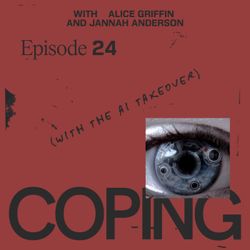
24. Coping With The AI Takeover
36:55||Ep. 24AI experts, executives, and inventors themselves are sounding the alarm – warning us that an AI takeover could threaten all of humanity within just the next ten years. In other words, the call is coming from INSIDE the house.This week, Alice Griffin and Jannah Anderson unpack the full context behind the looming AI threat and its potential ten‑year countdown (and why the narrative is, unsurprisingly, more complicated than the spooky, scary headlines). They contemplate the echo chamber inside Silicon Valley, the psychology that makes our worst‑case scenarios feel super inevitable, and the machine‑god anxieties that have shaped culture for centuries. In a conversation about AI fears, futurism, and the ethics of progress, they mull over our obsession with acceleration – whether it’s sustainable, whether it’s necessary, and whether our future actually involves living among the stars (or just coping with what we’ve already built). ☆ Want to stop guessing what your chart is trying to tell you? Get a personalised reading from real astrologers on CHANI – the #1 app for manifestation, meaning, and self‑discovery. ☆Want to support our show? We'd be so grateful if you hit 'follow' or left us a 5-star review so we can bring you more Coping content.Plus, you can follow along with us on Instagram and Pinterest. Find out more about what we're up to (and how you can get involved) at copinginc.com.Could AI Really Wipe Out Humanity and Hijack the Internet? by Robert Booth, Dan Milmo and Aisha Down, The GuardianAI Could Possibly End Humanity. How Are Humans Supposed to Process That? By William J. Broad and Cade Metz, New York TimesOne of AI’s Fiercest Critics’ Says All The Doom Talk ‘is Meant to Distract Us’ by Lauren Goode, WIRED The AI Researcher Who’s Investment Is Changing Everything on The Daily, New York TimesThe AI Tipping Point by Billy Perrigo, Harry Booth and Naomi Nix, TIMEThis Is Really Bad by Stephen Witt, New York TimesThe AI Con by Emily M BenderThe AI Doomsday Skeptics by Katrin Bennhold, New York TimesDon’t Look UpEx Machina Frankenstein by Mary Shelley‘Black Mirror’ Creator Charlie Brooker Wants Us Worried - and Not for the Reasons You'd Think, by Mikey O’Connell, The Hollywood Reporter