Share
Coping
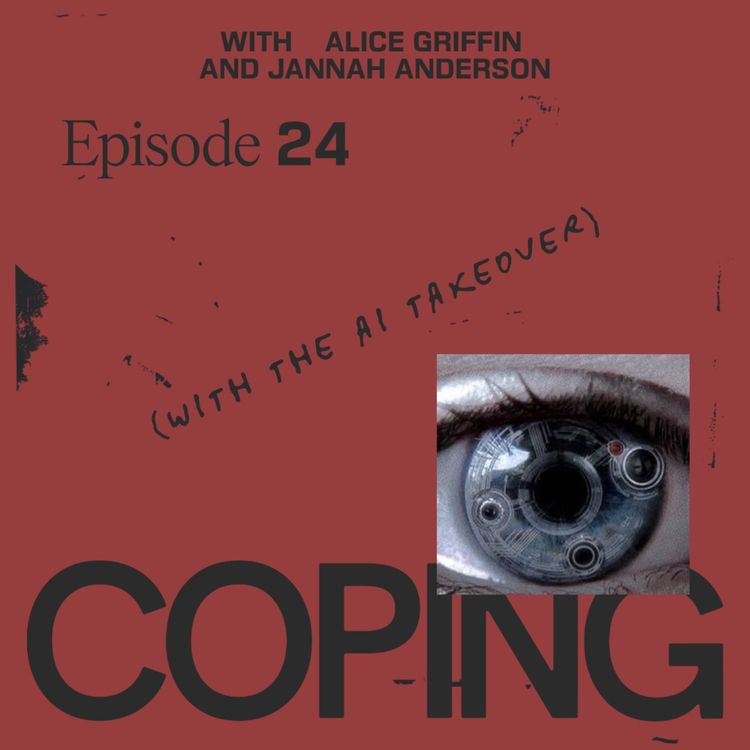
Coping With The AI Takeover
AI experts, executives, and inventors themselves are sounding the alarm – warning us that an AI takeover could threaten all of humanity within just the next ten years. In other words, the call is coming from INSIDE the house.
This week, Alice Griffin and Jannah Anderson unpack the full context behind the looming AI threat and its potential ten‑year countdown (and why the narrative is, unsurprisingly, more complicated than the spooky, scary headlines). They contemplate the echo chamber inside Silicon Valley, the psychology that makes our worst‑case scenarios feel super inevitable, and the machine‑god anxieties that have shaped culture for centuries.
In a conversation about AI fears, futurism, and the ethics of progress, they mull over our obsession with acceleration – whether it’s sustainable, whether it’s necessary, and whether our future actually involves living among the stars (or just coping with what we’ve already built).
☆ Want to stop guessing what your chart is trying to tell you? Get a personalised reading from real astrologers on CHANI – the #1 app for manifestation, meaning, and self‑discovery. ☆
Want to support our show? We'd be so grateful if you hit 'follow' or left us a 5-star review so we can bring you more Coping content.
Plus, you can follow along with us on Instagram and Pinterest. Find out more about what we're up to (and how you can get involved) at copinginc.com.
Could AI Really Wipe Out Humanity and Hijack the Internet? by Robert Booth, Dan Milmo and Aisha Down, The Guardian
AI Could Possibly End Humanity. How Are Humans Supposed to Process That? By William J. Broad and Cade Metz, New York Times
One of AI’s Fiercest Critics’ Says All The Doom Talk ‘is Meant to Distract Us’ by Lauren Goode, WIRED
The AI Researcher Who’s Investment Is Changing Everything on The Daily, New York Times
The AI Tipping Point by Billy Perrigo, Harry Booth and Naomi Nix, TIME
This Is Really Bad by Stephen Witt, New York Times
The AI Con by Emily M Bender
The AI Doomsday Skeptics by Katrin Bennhold, New York Times
Frankenstein by Mary Shelley
‘Black Mirror’ Creator Charlie Brooker Wants Us Worried - and Not for the Reasons You'd Think, by Mikey O’Connell, The Hollywood Reporter
More episodes
View all episodes
25. Coping With Feeling Behind
30:58||Ep. 25It seems everyone around us is moving through life at exactly the “right” pace: getting engaged, having babies, buying houses, building careers, finding purpose. Meanwhile, we’re left wondering, are we running late to our own lives?This week, Alice Griffin and Jannah Anderson muse on ‘feeling behind’ after rediscovering an article Alice wrote at 25 about comparison culture and the anxiety around reaching success by a certain age, revisiting the question through older (hopefully slightly wiser) eyes. In a conversation about ambition, timelines, and growing up, they explore the social clock and the psychology of comparison, the arbitrary milestones and social expectations we measure ourselves by, and the people who found their way on their own terms.☆ Want to stop guessing what your chart is trying to tell you? Get a personalised reading from real astrologers on CHANI – the #1 app for manifestation, meaning, and self‑discovery. ☆The 27 Club: A Brief History, Rolling StoneSocial Clock: Age Norms, Age Constraints, and Adult Socialization by Bernice Neugarten, Joan Moore, John Lowe in University of Chicago PressAustralia's Fertility Taboo, TasIVF ReportA Theory Of Social Comparison Processes by Leon FestingerLottery Winners and Accident Victims: Is Happiness Relative?When Every Day Is A High School Reunion: Social Media Comparisons and Self Esteem's by Claire Midgley, Sabrina Thai, Penelope Lockwood, Chloe Kovacheff, Elizabeth Page-GouldDealing With Post-Trail Depression by Annie Mueller, Psychology TodayThe Hedonic Treadmill by Dan Pilat and Dr. Sekoul Krastev, Decision LabWant to support our show? We'd be so grateful if you hit 'follow' or left us a 5-star review so we can bring you more Coping content.Plus, you can follow along with us on Instagram and Pinterest. Find out more about what we're up to (and how you can get involved) at copinginc.com.
23. Coping With Labels
35:52||Ep. 23Are you Type A or Type B? (Justice for Type C !)Maybe the label you’ve given yourself feels grounding (and that’s okay!). Maybe it’s limiting – something you’ve been trying to shake off..? Or maybe you’ve turned a label into a sort of playbook, a personality shorthand we were never really meant to rely on.This week, Alice Griffin and Jannah Anderson dive into self‑imposed labels – dissecting the logic of Myers-Briggs and comparing their own Enneagram results as they unpack the universal urge to categorise ourselves. And can you ever truly shake off a label once it’s been culturally assigned… sometimes en masse? (Raygun made peace with hers two years post-Olympics – and you probably would too with Sammy Sex in your corner).TikTok’s Obsessed With “Type A” and “Type B” Personality Types - Here’s Why by Keyaira Boone, CosmopolitanThe Carl Jung Quote You’ll Love Based on Your Myers-Briggs Personality by Susan Storm, Psychology JunkeeWhy Myers-Briggs Is Totally Useless - But Wildly Popular by Anna North, New York TimesTo Promote Inclusivity, Stay Away From Personality Assessments by Quinisha Jackson-Wright, New York TimesMindfulness by Dr Ellen LangerThank You For Smoking: How Big Tobacco Created the ‘Type A’ Personality MythUncertainty-identity theory Hogg, M.A, in Advances in Experimental Social Psychology, Vol. 39Schema Theory in Psychology by Charlotte Nickerson, Simply Personality Isn’t Permanent by Benjamin HardyAll I Ever Wanted Was To Be Hot by Lucinda Froomes PriceThe Psychopath Test by Jon RonsonUntold: Raygun Breaking Badly, NetflixWant to support our show? We'd be so grateful if you hit 'follow' or left us a 5-star review so we can bring you more Coping content.Plus, you can follow along with us on Instagram, TikTok, and Pinterest. Find out more about what we're up to (and how you can get involved) at copinginc.com.
22. Coping With Surveillance
39:41||Ep. 22We’re being watched: by surveillance cameras, safety tools, strangers in public, our own devices, and now by wearable tech that turns every interaction into potential content. Observation has become the ambient condition – part convenience, part paranoia.This week, Alice Griffin and Jannah Anderson unpack the psychology of being observed in how it shapes the calculated self, mull over the ethical questions raised by the latest wave of wearable tech like Meta Glasses, and confess the accidental data breaches from their own lives. It seems that the next era of surveillance culture might reshape our inner lives long before legislation ever catches up.Modernising Australia’s Privacy Laws for the Digital Age, Attorney-General Michelle Rowland’s press releaseI Feel So Sorry For My AI Sunglasses by Sam Anderson, New York TimesMeta’s Smart Ray-Ban Glasses Let Me Live in the Moment. But the AI is Useless by Caira Blackwell, Wirecutter What If It All Came Out? by Bridget Read, New York MagazineThe Audience Effect: Why We Change When Other People Are Watching by Anne Laure Le Cunff, Ness Labs Want to support our show? We'd be so grateful if you hit 'follow' or left us a 5-star review so we can bring you more Coping content.Plus, you can follow along with us on Instagram, TikTok, and Pinterest. Find out more about what we're up to (and how you can get involved) at copinginc.com.
21. Coping With Revenge
34:16||Ep. 21We root for revenge plots in our tv shows (beware: House of the Dragon spoilers ahead!), appeal to a sense of karmic justice, hunt for it in celebrity narratives, and even fantasise about getting our own one day.This week, Alice Griffin and Jannah Anderson unpack the psychology of vengeance, why it feels so titillating, and whether the payoff is ever what we had hoped. Plus, why do we cheer louder when women and marginalised characters finally get their moment? A reminder that revenge stories often tell us more about our cultural hunger for balancing the scales than the act itself ever could.☆ Are you a creative looking for support? Visit the or call the Support Act Wellbeing Helpline on 1800 959 500 for a free and confidential chat (and remember, you don't have to be in crisis to call). Sometimes you just need to talk to someone who actually gets it and can hear you out. ☆House Of The Dragon, HBO The Complicated Psychology of Revenge by Eric Jaffe, Association For Psychological ScienceThe Bittersweet Taste of Revenge: On the Negative and Positive Consequences of Retaliation by Fade R. Eadeh, Stephanie A. Peak, Alan J. LambertVictim Blaming and Belief in Karma by Cindel J. M. White, Aiyana K. WillardMargaret Qualley Just Walked the Red Carpet in Chanel’s Viral Naked Sandals by Rosa Sanchez, Harper’s Bazaarreputation, Taylor SwiftWant to support our show? We'd be so grateful if you hit 'follow' or left us a 5-star review so we can bring you more Coping content.Plus, you can follow along with us on Instagram, TikTok, and Pinterest. Find out more about what we're up to (and how you can get involved) at copinginc.com.
20. Coping With Memory
39:37||Ep. 20We’d like to think our memories are fixed but most of us are running on vibes, fragments, and deeply emotional edits n reedits. Our brains so easily forget the “important” stuff, cling to the weirdest details, and seemingly rewrite entire chapters without permission. And the things we actually do remember often says more about who we are now than whatever happened way back when. This week, Alice Griffin (resident unreliable narrator) and Jannah Anderson (she’s got receipts) dive into the mechanics of how memory actually works, the psychology behind recall, the fear of forgetting, and the stories we build from our own mental archives. And how much are we already outsourcing to Big Tech from a scale of 1-that Black Mirror episode?? ☆ Are you a creative looking for support? Visit the or call the Support Act Wellbeing Helpline on 1800 959 500 for a free and confidential chat (and remember, you don't have to be in crisis to call). Sometimes you just need to talk to someone who actually gets it and can hear you out. ☆Creating False Memories, by Elizabeth L Loftus, in Scientific American How The Truth Gets Twisted by By Ann Marsh and Greta Lorge in Stanford Magazine False Memories Under Fire, Scitech DailyMemory and Learning: How the Brain Stores, Retrieves, and Forgets Information, by Renz Solimen, The Science TimesThe Woman Who Can’t Forget by Jill PriceLiving On Record: My First Ten Days, Eka Ventures Newsletter on SubstackThe Entire History Of You, Black Mirror on NetflixWant to support our show? We'd be so grateful if you hit 'follow' or left us a 5-star review so we can bring you more Coping content.Plus, you can follow along with us on Instagram, TikTok, and Pinterest. Find out more about what we're up to (and how you can get involved) at copinginc.com.
Coping With Boredom
34:34|Boredom has gone from something we avoid to something we curate – a new metric in the self‑care economy to measure ourselves by. From 'rawdogging boredom' challenges to the obsession with performing “slow creativity,” we’re told stillness is a portal to a better, more imaginative self. But the research is messy, and our lived experiences even more so. This week, Alice Griffin and Jannah Anderson dig into the neuroscience of boredom, the rise of the serial hobbyist, the existential itches that keep us chasing novelty, and the cultural urge to make boredom meaningful – even when the moments in between fail to deliver us anything profound.☆ Are you a creative looking for support? Visit the Support Act Creative Industries Hub or call the Support Act Wellbeing Helpline on 1800 959 500 for a free and confidential chat (and remember, you don't have to be in crisis to call). Sometimes you just need to talk to someone who actually gets it and can hear you out. ☆Want to support our show? We'd be so grateful if you hit 'follow' or left us a 5-star review so we can bring you more Coping content.Plus, you can follow along with us on Instagram, TikTok, and Pinterest. Find out more about what we're up to (and how you can get involved) at copinginc.com.They Want To Influence You To Do… Nothing by Alexander Nazaryan, The New York TimesBoredom, Sustained Attention and The Default Mode Network by James Danckert and Colleen MerrifieldYou Need To Be Bored, Here’s Why by Arthur Brooks, Harvard Business ReviewThe Association Between Boredom And Creativity In Educational Contexts’ by Anke Zeißig, Julia Kansok-Dusche, Saskia M. Fischer, Julia Moeller, Ludwig BilzBoredom, A Lively History by Peter TooheyJust Think: The Challenges Of The Disengaged Mind by Timothy D. Wilson, David A. Reinhard, Erin C. Westgate, Daniel T. Gilbert, Nicole Ellerbeck, Cheryl Hahn, Casey L. Brown, and Adi Shaked in ScienceWhat Does Boredom Do To Us And For Us? by Margaret Talbot, The New YorkerQuit Romanticising Boredom by Anna North, The Cut
18. Coping With Doomsday
34:25||Ep. 18Doomsday prepping has gone mainstream. What was once a fringe fixation tucked away on conspiracy forums has morphed into a booming industry, with everyday people stockpiling, strategising, and spending (a lot) in the name of “being prepared.”This week, Alice Griffin and Jannah Anderson sit with the existential threats uniquely shaping our generation, the preppers taking that fear to its furthest extreme, the brands that saw an opportunity to sell safety, and ultimately ask whether a state of hypervigilance actually soothes our anxiety or just feeds it. After all, what’s worse: the apocalypse (and the world’s least satisfying “I told you so”), or realising you spent your life waiting for it?Prepper Used To Be A Dirty Word. But These 'Ordinary' People Think It's Just Sensible Now by Alexandra Koster, SBS AustraliaWhat Doomsday Preppers And Survivalists Can Teach The Rest Of Us, by Anna Levy and Rebecca Cushway, ABC The ‘Panic Industry’ Boom by Coralie Kraft, The New York TimesThe cognitive avoidance theory of worry, Sibrava, N. and Borkovec, T in APA PsycInfoBlast From The PastPandemic Practice: Horror Fans And Morbidly Curious Individuals Are More Psychologically Resilient During The COVID-19 Pandemic, by Scrivner, Johnson, Kjeldgaard-Christiansen and Clasen, ScienceDaily‘All Of His Guns Will Do Nothing For Him’: Lefty Preppers Are Taking A Different Approach To Doomsday by Aaron Gell, The GuardianOpenAI Model Hacks Startup After Going Rogue During Testing, ABCNo Worries? Australian Attitudes To National Security, Risk And Resilience, Prof Rory Medcalf AM FAIIA and Tim Wilford, Australian National UniversityKennedy, Rockefeller, and Civil Defense by Naomi Kroll Hassebroek, NPS☆ Are you a creative looking for support? Visit the Support Act Creative Industries Hub or call the Support Act Wellbeing Helpline on 1800 959 500 for a free and confidential chat (and remember, you don't have to be in crisis to call). Sometimes you just need to talk to someone who actually gets it and can hear you out. ☆Want to support our show? We'd be so grateful if you hit 'follow' or left us a 5-star review so we can bring you more Coping content.Plus, you can follow along with us on Instagram, TikTok, and Pinterest. Find out more about what we're up to (and how you can get involved) at copinginc.com.
17. Coping With Closure
33:43||Ep. 17We’re taught to crave closure – the tidy explanation, the perfectly heartfelt apology, the moment where we SEE Idris Elba push the button (or not… idk go watch ‘A House of Dynamite’ and tell us your take).This week, Alice Griffin and Jannah Anderson explore our obsession with resolution: where it comes from, whether it’s even possible, and why some of us need a definitive finish while others move through life more content with the grey. And how are we supposed to cope if closure never shows up??☆ Are you a creative looking for support? Visit the Support Act Creative Industries Hub or call the Support Act Wellbeing Helpline on 1800 959 500 for a free and confidential chat (and remember, you don't have to be in crisis to call). Sometimes you just need to talk to someone who actually gets it and can hear you out. ☆A House Of Dynamite, Netflix The Writer Of Netflix’s ‘A House of Dynamite’ Explains Its Ambiguous Ending by Noah Oppenheim, LA TimesDo You Really Need Closure? by Christina Caron, The New York Times How To Know If You Really Need Closure Or If It’s Just An Excuse To Talk To Them, by Jolie Price, Fashion JournalIndividual Differences In Need For Cognitive Closure, by Donna Webster & Arie Kruglanski, Journal of Personality and Social PsychologyThere’s Not Always ‘Closure’ In The Never-ending Story Of Grief, by Michael Bull, The ConversationBeyond Dogmatism: The Need For Closure As Related To Religion, by Vassilis SaroglouClosure: The Rush to End Grief and What It Costs Us, by Nancy BernsDoes Time Really Heal All Wounds? by Leah Royden, Psychology TodayThis Too Shall Pass: Temporal Distance and the Regulation of Emotional Distress, by Emma Bruehlman-Senecal and Ozlem Ayduk, Journal of Personality and Social Psychology The Widow’s Guide To Dead Bastards by Jessica WaiteRequiem For A Nun by William FaulknerWant to support our show? We'd be so grateful if you hit 'follow' or left us a 5-star review so we can bring you more Coping content.Plus, you can follow along with us on Instagram, TikTok, and Pinterest. Find out more about what we're up to (and how you can get involved) at copinginc.com.