Share
Security Clearance Careers Podcast
Veteran Business Owner Shares How We Can Reach Cybersecurity Talent
Reaching cybersecurity talent for the cleared sector seems to be targeted to younger kids, hoping to get them interested in STEM careers down the road. One veteran trailblazer in the northern Virginia area is seeking to do just that through two businesses she started after retiring from the United States Air Force.
The amazing, innovative, cybersecurity leader and philanthropist, Quiana Gainey, retired from the Air Force out of the Pentagon, and currently works to modernize, transform and secure the digital experience for government entities as the CEO of SecureTech360. She also has her nonprofit, Mysecurekid, which is a global movement created to educate, inspire and promote online safety awareness for parents, educators and children while building a talent pipeline designed to connect youth in underserved communities with meaningful information technology career opportunities. Gainey has seen a 100% success rate through this program.
Through these ventures, she is also working to increase diversity and inclusion in cybersecurity and information technology.
More episodes
View all episodes
Cleared Jobs with Salaries Listed Over $150,000 Per Year
17:40|From creative work and defense business development to military advising, industrial risk, and telehealth, explore five ClearanceJobs listings with salary ranges reaching beyond $150,000. When someone says "high-paying cleared job," your mind might jump straight to software engineering or cyber. Those are certainly options, but they're far from the whole story. These five ClearanceJobs listings show how varied a six-figure career in national security can be. Each posted salary range reaches above $150,000, though that doesn't mean every candidate will earn that amount. Consider qualifications, location, and the final offer. For the part-time role below, hours worked count too.
Growing the Pool: Jamie Jones Miller on Building the Next Generation of Cleared Talent
21:20|Government and industry keep competing for the same small pool of cleared professionals. How do we grow it? Lindy Kyzer of ClearanceJobs talks with Jamie Jones Miller of Northeastern University, a member of the ClearanceJobs Policy Advisory Board. Jamie got her first clearance at 19 as a Defense Intelligence Agency intern. She explains how Northeastern's co-op model sponsors students for clearances and places them with industry partners. They also discuss why scaling university programs is hard, the friction of reciprocity and eligibility timelines, and how to keep human judgment at the center as AI changes intelligence work. Hear Jamie in person at ClearanceJobs Connect Reston, October 15–16.
How to Get a Job at the Central Intelligence Agency (CIA)
29:12|What does it take to build a career spanning nearly four decades inside the CIA? And what can today’s cleared professionals learn from someone who has experienced the intelligence mission from just about every angle? On this episode of the Security Clearance Careers Podcast, we sit down with retired CIA officer Susan Miller to talk about the people, skills, and career paths behind the Intelligence Community.Miller spent nearly 40 years at the CIA, building a career that included HUMINT, counterintelligence, overseas assignments, leadership positions, and serving as a Chief of Station. But like many intelligence professionals, her path into the field may not look exactly like what aspiring IC employees expect.
Landing the Job Isn’t the Finish Line: Rethinking Military Transition
25:20|When we talk about leaving the military, we tend to talk about the checklist.Build a resume. Translate your MOS. Start networking. Apply for jobs. Figure out SkillBridge. Prepare for interviews. And, if you’re part of the cleared community, try not to let that security clearance collect dust while you figure out what comes next.Those things matter. But they’re also only one piece, because landing a civilian job and successfully transitioning into civilian life are not necessarily the same thing.On a recent episode of the Security Clearance Careers Podcast, I sat down with Emily King Grandinetta, a behavioral scientist, Master Certified Coach, organizational consultant, military transition expert, and author of At Ease: The Guide to a Smooth & Successful Military Transition, to talk about what happens beyond the resume and job offer.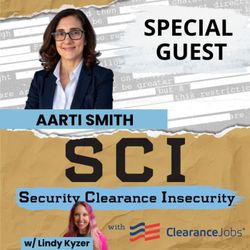
Workforce Risk Doesn't Arrive in One Package Anymore
21:47|Trusted Workforce 2.0 has changed how the government vets its people. The old model of periodic reinvestigation, which was basically "set it and forget it," has given way to continuous vetting. Adjudicators now have to reassess risk as each new alert comes in. The policy is in place, but agencies are still working out how to carry it out day to day.In this episode of ClearedCast, Lindy Kyzer talks with Aarti Smith, CEO of Chainbridge Solutions, about the "continuous vetting gap," the space between getting a Continuous Vetting Action Report (CVAR) and managing it well at scale. They cover:Why a single CVAR rarely tells the full story, and why the whole-person concept still mattersHow DCSA's move toward DISS as a shared services hub helps, and why API integrations are the next stepThe manual work that still slows agencies down: roster management, enrollment, and alerts for people affiliated with more than one agencyWhat happens when public trust and suitability populations are added under Trusted Workforce 2.0What a modern personnel security system needs: automated triage, risk weighting, dashboards, and integrations with HR, identity management, and insider threat systemsWhat applied AI can and can't do in adjudication (it supports the decision-maker but doesn't replace them)Why the applicant experience matters as much as the security team's, and how applicant portals helpIf you work in personnel security, adjudication, or federal HR, this episode is a practical look at where continuous vetting stands now and what agencies should tackle first.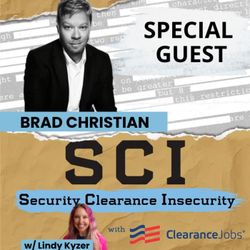
The Cipher Brief's Brad Christian Previews the Threat Conference's 10th Year
22:11|Lindy Kyzer talks with The Cipher Brief COO Brad Christian ahead of the organization's 10th annual Threat Conference in Sea Island, Georgia. Christian breaks down why the past year has been the most complicated yet — from AI's expanding role in intelligence and autonomous weapons, to a new national cybersecurity strategy, the ongoing conflicts in Ukraine and Iran, and the rise of "gray warfare" targeting the U.S. homeland. He also shares what makes the invite-only conference unique: 250 attendees spanning government, industry, and academia, all working to close the gap between public-sector mission and private-sector innovation.Apply to register here: https://www.tcbconference.com/
ClearanceJobs Connect 2026: What’s on the Agenda in Reston
19:07|What began in 2021 as a first-of-its-kind gathering for recruiters in the national security space has quickly become a fixture on the cleared-talent calendar. The inaugural ClearanceJobs Connect brought government and industry leaders together to discuss candidate scarcity, employer branding, recruiter burnout and the emerging Trusted Workforce 2.0 framework. By 2022, attendance had nearly tripled to more than 200 people, and the event had added distinct afternoon tracks for recruiting and security professionals.That history sets the stage for ClearanceJobs Connect 2026, scheduled for October 15–16 at the Carahsoft office in Reston, Virginia. The two-day agenda combines cleared recruiting strategy, security-policy updates, leadership lessons, emerging technology and practical training. For talent acquisition professionals supporting the national security community, the result is a concentrated look at both the pressures shaping today’s market and the practices likely to define what comes next.
You Don’t Have to Fit in a Box to Have a Career in National Security
22:19|There’s an idea that some people have about the cleared space: if you want to work in national security, you’re supposed to fit into a certain box. There’s a traditional path. A traditional résumé. A certain kind of background that makes you look like you “belong” in the room. After our recent conversation with Jessie Levin from the Defense Entrepreneurs Forum (DEF) on the Security Clearance Careers Podcast, we walked away thinking we need to throw that box out entirely. Because national security doesn’t just need one type of person.
Modernizing SCI Access: Why Security Clearance Technology Can't Wait
23:19|This episode of Security Clearance Insecurity covers a timely issue facing the cleared workforce. Lindy Kyzer talks with Mike Flanders, founder of SudoTouch, about the technology gap slowing SCI nomination processing and how automation can help security offices keep pace with Trusted Workforce 2.0's shift to continuous vetting.