Share
Security Clearance Careers Podcast
Here's Your Job Search Target List of Large Contractors in the DoD
1. LMI
LMI snagged the The Washington Post Top Workplaces 2021 Award, continuing its long history in pushing innovation and growing talent. LMI’s employees have diverse backgrounds, coming from government and defense, business and industry, and academia and research. And more than half of LMI employees are either veterans or former civil servants, but they all come together at LMI to support the mission of improving the management of government.
CGI offers business and systems consulting, IT outsourcing, Infrastructure support and other services for the federal government. Whether it’s managing change in the federal workforce, making a digital transformation, or increasing cybersecurity defenses, CGI has various contract vehicles to support the work. They were founded in 1976, and now, they are a global company with positions all around the world.
CACI is all about career mobility and talent development. At CACI, career mobility keeps talent engaged as their CACI career evolves. CACI’s culture promotes a career growth mindset to embrace learning and development opportunities. Professionals need a place to work that fosters new skills and offers new experiences to challenge them. CACI has over 1,000 Top Secret/SCI open positions, as well as, over 500 open Secret positions.
Peraton has a great mission in national security to do the “can’t be done” – which is a noble and necessary goal that we need to advance technology and policy. They also had a recent acquisition of Perspecta, growing the company’s presence in the national security industry. Peraton supports space, intelligence, cyber, Homeland Security – and more with a lot of programs with federal agencies. And with the recent acquisition of Perspecta came the recent Defense Counterintelligence and Security Agency (DCSA) contract for $474 million to develop the data analytics and security enterprise architecture prototype.
Science Systems and Applications, Inc. (SSAI) is a leading provider of scientific, engineering, and IT support for customers seeking new frontiers in science and technology. SSAI has been in business for more than 40 years. They support pioneers in science and engineering—such as NASA and NOAA—and have made significant contributions to more than 150 Earth and space science missions.
Systems Planning and Analysis INC has worked in national security for over 50 years. They provide advanced analytics, systems engineering, strategy, policy, & compliance support, and program support to the national security field. One former marine with the company connected with SPA upon his military transition and never looked back – citing the ability to move around in the company and how SPA supports his family life as well.
AMERICAN SYSTEMS has been delivering IT and engineering solutions for complex national priority programs since 1975.They are based in Chantilly, VA. Customers and job searchers can also check out their blog where they cover topics like a recent fraud alert, noting how scammers were impersonating recruiters with an app called Telegram, often extending job offers and asking for personal financial information by having “new hire” forms completed and/or asking for money for “new hire” equipment. It’s always a good reminder to be sure to use secure job search technologies – especially when looking for cleared positions.
The MIL Corporation began in 1980 and they offer cyber, engineering, IT, and financial services to the federal government. With technical work supporting the government, they have cleared positions as well for candidates to check out. Their President and CEO is the company founder, and 40 years later, he’s still at the helm. Truly an example of visionary leadership that has stood the test of time.
Precise Systems is a professional services company currently working for the U.S. Navy, U.S. Marine Corps, and U.S. Air Force. Their core competencies include systems engineering, program and project management, logistics, information technology and cyber security, and software development services. They were founded in 1990 and continue to provide cutting-edge solutions and support to warfighters. Precise Systems was also recently named a Top Veteran-Friendly Company by U.S. Veterans Magazine for the Second Year.
If ever there was a story that highlights that it only takes a spark to start a fire, REI Systems is it. They began with one NASA contract. And now they still have work with NASA, as well as contracts with Department of Health and Human Services, the Department of Homeland Security, the Department of Energy, and many more. Their name means Reliable, Effective, and Innovative, and it’s great to have a name really encapsulate the company brand. They have work in modernizing government legacy applications on cloud platforms, offer advisory services, and data analytics – among other things, as well as offer many jobs that require some level of a security clearance.
More episodes
View all episodes
Recruiting Subject Lines That Can Increase Your Email Open Rates
22:54|Your first impression often isn’t a handshake. It’s a subject line.Recruiters spend hours crafting the perfect message to candidates, only to see it go unopened. The truth? Even the most compelling opportunity won’t matter if your email never gets clicked. A strong subject line can be the difference between a missed connection and your next great hire.Jay Schwedelson, founder and CEO of GURU Media Hub, has built and led businesses that have generated over $400 million in revenue, all by doing what most marketers are too afraid to try: breaking the so-called “best practices.” He joins the podcast to talk about what subject lines actually increase open rates and what best practices you should ignore.
Want Better Cleared Candidates? Start Here (Before Your Competitors Do)
27:53|If you’re hiring cleared talent, you already know the market is moving fast—AI, clearance timelines, technical recruiting pressure…Today we’re breaking down why ClearanceJobs Connect West is the event recruiters should prioritize this year. Tune in to learn about Connect West in one word and what kind of recruiter gets the most value from attending.
Human Judgment in a Machine-Speed World
26:44|Artificial intelligence is rapidly reshaping national security missions—but real AI readiness goes far beyond adopting new tools.On this episode of Security Clearance Insecurity, host Lindy Kyzer is joined by Jennifer Ewbank, former Deputy Director of the CIA for Digital Innovation, for a deep dive into what it truly means for the federal government to be AI-ready.Together, they explore why AI readiness must start with mission readiness, not technology procurement; why digital literacy is no longer optional for the federal workforce; and how human judgment, accountability, and ethical decision-making become even more critical in an AI-enabled environment. The conversation also examines the growing overlap between AI and cybersecurity, the cultural and bureaucratic barriers slowing adoption, and the risks government faces if it fails to adapt.This episode offers practical insight for clearance holders, hiring leaders, policymakers, and technologists navigating the realities of AI, governance, and workforce transformation in national security.
Cyber and AI Career Pathways
31:04|Breaking into cybersecurity or AI can feel overwhelming—especially with so much conflicting advice online. In our latest podcast episode, we sat down with Dr. Gerald Auger, a cybersecurity leader, educator, and founder of the Simply Cyber community, to cut through the noise and focus on what actually works.With over 20 years of experience across cybersecurity operations, leadership, and higher education, Dr. Auger shared practical guidance for anyone looking to launch or level up a technical career. We talked about the foundational skills employers care about most, how AI is reshaping cybersecurity roles, and why hands-on experience and community involvement often matter more than chasing every new certification.Dr. Auger also offered honest insights into common mistakes job seekers make—from relying too heavily on job boards to underestimating the power of personal branding and networking. For veterans and career switchers, he emphasized translating experience into business value and treating the job search like a mission with clear objectives and accountability.Whether you’re just starting out, transitioning from the military, or navigating the next step in your tech career, this episode delivers clear, actionable advice to help you move forward with confidence.🎧 Listen to the full episode to learn how to build a cybersecurity or AI-adjacent career that lasts.
Defense Contractors Offering Cleared Remote Work
25:40|Remote work is a major factor in how professionals choose roles, companies, and even long-term career paths. But for cleared professionals, the remote work conversation comes with a unique set of questions: Is remote work even possible with a clearance? Which roles can actually be done off-site? How do you find real remote jobs, and avoid the ones that aren’t what they seem?A recent FlexJobs report, Top 100 Companies to Watch for Remote Jobs in 2026, includes several major defense contractors, and that’s a signal worth paying attention to. While many cleared roles still require on-site work, the presence of defense employers on a remote-focused list shows that flexibility is becoming part of the broader defense hiring conversation.In this episode, we break down what remote work really looks like in the cleared space, what job seekers should know before applying, and how to stay competitive as hiring trends evolve.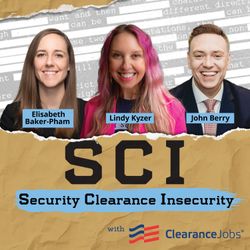
A New Era of Security Clearance Insecurity: New Legal Voices, Real-World Guidance for 2026
28:37|The Security Clearance Insecurity podcast welcomes new legal contributors Elisabeth Baker-Pham of Kalijarvi, Chuzi, Newman & Fitch, P.C. and John Berry of Berry & Berry, PLLC to the mic. In this episode, the panel breaks down how security clearance decisions intersect with employment law, why agencies handle cases differently, and what cleared professionals should know before filling out an SF-86, responding to investigators, or facing a statement of reasons. A must-listen for anyone navigating the cleared workforce this year.Stories from Inside the CIA
24:59|In the male-dominated world of international espionage, the stories of the women who quietly shaped history have too often been overlooked. Agents of Change: The Women Who Transformed the CIA by Christina Hillsberg brings those stories into the spotlight, revealing how courage, resilience, and grit helped women redefine what it means to be a spy.A New Lens on Intelligence HistoryFor decades, popular culture has portrayed female spies as glamorous sidekicks or exotic figures. But the real history of women in the Central Intelligence Agency (CIA) tells a very different story: one of trailblazers who fought systemic bias, navigated dangerous operations, and forged paths in one of the most secretive institutions in the world.Agents of Change charts that history from the 1960s “secretarial era” through decades of steady progress toward leadership and influence. Along the way, Hillsberg weaves together firsthand accounts from female CIA officers who broke barriers, tackled espionage missions, and reshaped the agency from within.A Beginner's Guide to Polygraph Examinations
21:53|Polygraphs, often called “lie detector tests”, have long been surrounded by mystery, pop culture myths, and a fair amount of anxiety. While they’re frequently portrayed as foolproof truth machines, polygraphs are better understood as tools that measure physiological responses rather than lies themselves.Why Workplace Flexibility Matters for the National Security Workforce
28:00|What does flexibility really mean for the national security workforce—and why does it matter now?In this episode, Lindy is joined by workforce strategist and former federal executive Mika Cross for a timely conversation on the future of federal and cleared work. Drawing from congressional testimony, workforce data, and decades of public service experience, they unpack how telework, hybrid models, and strategic flexibility directly impact mission readiness, talent retention, and national security outcomes.The discussion explores:Why flexibility is a national security imperative, not a workplace perkThe real costs of losing high-performing cleared professionalsMilitary spouse employment and its impact on readinessWhat the President’s Management Agenda signals for the federal workforceHow national security agencies can lead on agility, trust, and innovationThis episode offers critical insight for cleared professionals, federal leaders, recruiters, and policymakers navigating the evolving realities of government work.