Share
Security Clearance Careers Podcast
Welcome to ClearedCast, by ClearanceJobs.
Latest episode
10 Cleared Jobs You Didn't Know Existed
33:14|Think every security-cleared job involves coding, cybersecurity, or intelligence analysis? Think again.When most people picture careers requiring a security clearance, they imagine intelligence analysts tracking foreign threats, cybersecurity professionals defending classified networks, or engineers working on top-secret technology. And while those jobs certainly make up a significant part of the national security workforce, they're far from the only opportunities available. The cleared job market is filled with unexpected career paths that combine everyday skills with extraordinary missions. From designing secure workspaces and preparing meals to examining fingerprints and diving beneath the surface, supporting national security doesn't always look the way you'd expect. Whether you're a transitioning service member, a cleared professional looking for a career change, or someone who never imagined their skills could translate to government contracting, these 10 jobs prove there's more than one way to support the mission.
More episodes
View all episodes
Mission Ready for What’s Next: A Veteran’s Guide to Transition, Resilience, and AI
22:37|Leaving military service means making decisions about more than your next job. You may be choosing where to live, finding a new professional community, and figuring out what purpose looks like outside the uniform.For Veterans Day, our upcoming Security Clearance Careers Podcast conversation with Army veteran and workplace strategist Mika Cross will explore that next chapter: preparing for transition, building resilience, and approaching new technology with curiosity.Whether you’re preparing to separate or considering a career change years after service, these practical steps can help you move forward.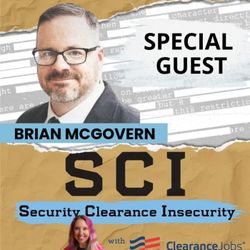
Who Am I Now? Finding Your Identity After the Uniform Comes Off
17:38|The military gives you an identity whether you want one or not: your rank, your uniform, your ribbon rack. When you take off the uniform, all of that disappears overnight.In this episode of Security Clearance Insecurity on Federal News Network, Lindy Kyzer of ClearanceJobs talks with Army veteran Brian McGovern. McGovern spent nearly 12 years on active duty as a paralegal specialist and public affairs specialist, with deployments to Iraq and Afghanistan, and left the Army as a staff sergeant. He is the author of Who Am I Now: An NCO’s Guide to Life, Work, and Identity After Military Service, a book less about landing your first civilian job and more about figuring out who you are before you decide what you want to do.Brian explains:Why your transition should start on day one, and why that isn’t disloyaltyWhy trading your rank for a CAC card and a badge reel can work as a “shock absorber” that postpones your identity shift instead of completing itWhat happens to an NCO’s sense of purpose when the 2 a.m. phone calls stopMoney mistakes that follow service members out, from 27% APR car loans to underestimating civilian cost of living, and why Guideline F makes financial health a career issueWhy your family is transitioning too, and the honest question every household should ask: whose turn is it to sacrifice?How he found his people after leaving the Army, as an introvert, by showing up consistently over timeIf you’re six months from getting out, Brian’s advice is simple: read chapter four.Get Who Am I Now here.Have a question or a topic you’d like covered? Email editor@clearancejobs.com.
ClearanceJobs Heads to Texas
15:37|From NFL veterans and military transitions to artificial intelligence and quantum technology, ClearanceJobs Connect San Antonio is bringing some big conversations to Texas.Cleared recruiting isn't your average talent acquisition gig. Between navigating security clearance requirements, shifting government contracts, evolving technologies, and an increasingly competitive talent market, recruiters supporting national security have a unique set of challenges. And sometimes, the best way to tackle those challenges is to get everyone in the same room. On November 5, ClearanceJobs Connect San Antonio will bring together cleared recruiting professionals, industry leaders, and subject matter experts at the InterContinental San Antonio Riverwalk for a full day of conversations about what's happening in our industry and where we're headed next. From finding purpose after military service to navigating AI in recruiting, here's a look at some of the conversations we're especially excited about.Conference: 8am-3pm https://about.clearancejobs.com/employers/events/clearancejobs-connect-san-antonio Career fair: 3pm-6pm https://about.clearancejobs.com/candidates/career-events/san-antonio-in-person
Clearance Horror Stories: What Applicants and Clearance Holders Need to Know
29:55|A security clearance problem rarely begins with a denial letter. More often, it starts with a financial issue, an arrest, undisclosed drug use, a forgotten foreign contact, or a decision not to report something because the clearance holder hopes it will quietly disappear. Then the paperwork arrives. In this episode of the Security Clearance Careers Podcast, security clearance attorney Matthew Thomas joins us to discuss clearance horror stories and, more importantly, what applicants and clearance holders can learn from them.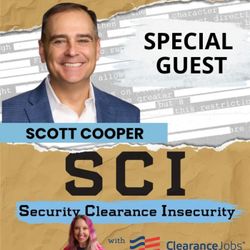
Radical Moderates and the Ethos of Service: Scott Cooper of With Honor
21:17|Lindy Kyzer of ClearanceJobs talks with Scott Cooper, a retired Marine who leads policy at With Honor, about veterans in Congress and what they get done when they work across party lines. Scott explains how With Honor started as an effort to elect more veterans to Congress. Today it supports the For Country Caucus, a bipartisan group of more than 50 House and Senate members he calls “radical moderates.” He describes the caucus’s role in passing the Russia Sanctions Act and the friendships behind its work.Lindy and Scott also cover:With Honor’s 13-month congressional fellowship, which gives mid-career professionals Hill experience. Veterans and military spouses get preference, but anyone can apply.The civil-military divide, and why it matters that veterans make up a larger share of Congress than of the general populationWhy security clearance reform has strong support from both parties, and how Congress shapes clearance policy through the NDAA and the Intelligence Authorization ActScott’s book recommendation, Courage Can Save Us, and the Winslow Homer painting that reminds him that service doesn’t end when you take off the uniformLearn more about With Honor: https://withhonor.org/ Have a topic that you'd like to cover? Send your questions to editor@clearancejobs.com.
PCS Moves, Career Gaps, and New Beginnings: How Military Spouses Can Get Ahead
30:54|Military spouses are no strangers to change. Between permanent change of station (PCS) moves, deployments, unpredictable schedules, and the constant balancing act of military family life, building a successful career can sometimes feel like an uphill battle. But those same experiences can also create some of the most adaptable, resilient, and resourceful professionals in the workforce.On this episode of the Security Clearance Careers Podcast, we're joined by Rae Mueller, who supports strategic accounts for Point Solutions Group, a ClearanceJobs brand, to discuss navigating a career as a military spouse, building professional relationships, and finding opportunities in the national security industry.