Share
CITO Conversations
Investigate the frontline with Laura Lucia Parolin and Carmen Pellegrinelli
This seminar is titled "Investigate the frontline: performing an affective ethnography in a theatre workshop" by Laura Lucia Parolin, University of Southern Denmark & Carmen Pellegrinelli, University of Lapland
Laura is an ethnographer who uses the Latourian ANT approach, familiar with SCOT and HCI, Carmen is a theatre director, producer, and playwright. Their research is in the areas of materiality, affectivity and embodiment examining diverse empirical settings. They will present work-in-progress that on an affective ethnography of a theatrical laboratory organised for/by the hospital staff in Bergamo as a form of collective therapy. If you remember the hospitals in Bergamo were acutely affected during the Covid pandemic.
Organised by the UCD Centre for Innovation Technology and Organisation (CITO) - The seminar took place in-person on Tuesday, February 21st, 16.00-17.00 - in the Q026 Angela Moore Boardroom, Quinn School, University College Dublin. Introduction by Donncha Kavanagh, Professor of Information & Organisation, UCD College of Business.
Abstract
In March 2020, Bergamo was hit by the first wave of the pandemic. More than 6.000 people have died in the area, where the emergency facilities lived in a stressful situation for months. In January 2022, a group of ER doctors and nurses from the main hospital in Bergamo - the frontline in the crisis - wanted to reflect collectively on their experience with the pandemic. The group set up a one-year-long theatre workshop involving around thirty colleagues from the ER. The workshop also aimed to prepare a theatre show, "Giorni muti, notti bianche" (Silent days, sleepless nights), presented in Bergamo's main theatre. By participating in the theatre workshop, we conducted a collaborative affective ethnography to investigate the dimension of affect in ER professionals' work practices during the first wave of the pandemic. This contribution focuses on affective ethnography discussing the characteristics and potentials of this (post)qualitative research method for organisational scholars.
Laura Lucia Parolin (parolin@sdu.dk) is Associate Professor of Organizational Communication at the University of Southern Denmark. She is interested in the relationship between knowledge, body, sensitivity, affect, care, materiality, and innovation in work practices. She is currently visiting UCD, having been awarded a Carlsberg foundation grant.
Carmen Pellegrinelli (cpellegr@ulapland.fi) is finishing her PhD at Lapland University in the Faculty of Social Sciences. Her research interests are focused on creative practices, theatre and post-human philosophy. She is a professional playwright and director of theatre.
Acknowledgements
Music
Title: Adagio in G minor
Artist: Remo Giazotto attributed to Tomaso Albinoni
Source: https://soundcloud.com/dick-de-ridder/adagio-in-g-minor-albinoni
Licensed by Dick de Ridder: CC-BY 3.0
Cover Art
Title: Digital Iris
Artist: (no attribution)
Source: digital_iris.pptx
License: CC BY-NC-SA 4.0
Podcast License
Design Talk (dot IE) CC BY-NC-SA 4.0
The license can be viewed at https://creativecommons.org/licenses/by-nc-sa/4.0
By taking part you give permission for your voice to be recorded, for the recording to be edited, and for it to be posted and published as a podcast.
More episodes
View all episodes
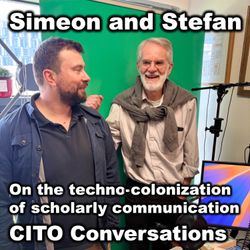
14. Techno-colonization with Simeon Vidolov and Stefan Klein
01:28:28||Season 1, Ep. 14Professor Stefan Klein and Dr. Simeon Vidolov present their paper, "Techno-colonization of scholarly communication: A call to reclaim control". This paper contributes to wider research into how extractive publishing systems have colonized scholarly communication to gain not only infrastructural control but increasingly epistemic control as well. For far too long, big publishing companies have trapped academics in a vicious circle of parasitic business models employing monopolistic pricing and arbitrary gate-keeping where researchers provide the labour, only for corporate giants to end up owning the published element of scientific intellectual property (often publicly funded) and consequently, control the visibility of research outputs. These companies have moved beyond publishing; they are now providers of critical, AI and data-analytics enabled research infrastructures. They are reshaping scientific knowledge production, academic values and increasingly claim epistemic authority.That such a system can be used to publish research so critical of its inherent structure is both ironic and potentially positive. The authors call for each of us to reject the role of passive participant in our own exploitation. They conclude by calling for us to devise ways to dismantle these corporate infrastructures and reclaim the autonomy of the scientific community. Whether you are a student, a researcher, or a faculty member, join us to discuss how we can build a future for academia that prioritises collective knowledge over commercial surveillance.The underlying paper(s) are both Open Access, links below:· Vidolov, S., & Klein, S. (2026). Techno-colonization of scholarly communication: A call to reclaim control. Organization, Article 13505084261416192. https://doi.org/10.1177/13505084261416192· Ngwenyama, O., Klein, S., & Rowe, F. (2026). Platform Capture of Scientific Knowledge Production: Publishers’ Dominance, Generative AI and Subsumption of Academic Labor. European Journal of Information Systems (EJIS). https://doi.org/10.1080/0960085X.2026.2642660 BiographiesSimeon Vidolov is a Faculty Member in the J.E. Cairnes School of Business at the University of Galway. His research examines how digital technologies transform ways of working and organizing, with a focus on embodied and affective experiences. His work challenges dominant narratives of technological progress and interrogates the harmful and often normalized consequences of contemporary digital infrastructures for individuals, organizations, and society.Stefan Klein is Professor emeritus for Interorganizational Systems at the School of Business and Economics, University of Münster, Germany. His main research areas are information infrastructures, the transformation of work, risks of digitalization, and digital capitalism. He studies practices of technology use and organizational transformation from an individual to an industry level.The event was held on 6 May 2026 in University College Dublin, Ireland.AcknowledgementsMusic Title: StoryArtist: MeydänSource: https://bit.ly/2P5CSCvLicense: CC BYCover Art Title: Smurfit-ZartisArtist: Photo credit: Allen Higgins. Used with permission.Source: SimeonStefan-seminar.pptxLicense: CC BY-NC-SA 4.0Podcast LicenseDesign Talk (dot IE) CC BY-NC-SA 4.0 The license can be viewed at https://creativecommons.org/licenses/by-nc-sa/4.0By taking part, you give permission for your voice to be recorded, for the recording to be edited, and for it to be posted and published as a podcast.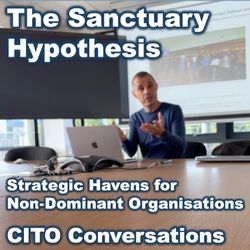
13. The Sanctuary Hypothesis by Jean-Fabrice Lebraty
49:45||Season 1, Ep. 13CITO Seminar: The Sanctuary Hypothesis in Information Systems — Blockchain and AI as Strategic Havens for Non-Dominant OrganisationsGuest: Jean-Fabrice Lebraty Host: Donncha Kavanagh Recorded on Tuesday, September 23, 4:00 - 5:00pm in Q2.33 Lochlann Quinn School of Business, UCD Belfield Campus.Abstract This talk introduces a theory of dominant vs non-dominant organisations in digital ecosystems. Dominant actors shape standards, data flows, and platform rules; non-dominant actors operate under asymmetric dependency and limited control over technological stacks. I argue that, for the non-dominant, the core IS problem is not efficiency but survivability—the capacity to endure adverse, shifting, or hostile digital environments. Survivability requires a digital sanctuary: an infrastructure and set of practices that preserve critical informational assets beyond the reach of dominant gatekeepers. I then present two sanctuary technologies. First, blockchain, leveraging immutability, persistence, and verifiable anchoring to secure records and proofs against unilateral alteration. Second, AI via model-level embedding, where strategic data placement in training corpora and model fine-tunes creates durable informational traces and capabilities resilient to upstream platform changes. I conclude with design principles and governance implications for building and stewarding such sanctuaries. Keywords: digital sanctuary; survivability; blockchain; AI/model embedding BioJean-Fabrice LEBRATY is a Full Time Professor of Management Sciences at iaelyon School of Management (Jean Moulin University Lyon 3). He specialises in information systems management. His research focuses on decision-making in extreme contexts, crowdsourcing, social networks, and innovative technologies such as blockchain or AI. Since April 2023, he is in charge of the Magellan research laboratory, which comprises 80 researchers and 50 doctoral candidates.Notes:Jean-Fabrice Lebraty (at Jean Moulin University Lyon 3) https://iae.univ-lyon3.fr/lebraty-jean-fabriceAcknowledgementsMusic Title: Moody Break 01Artist: Allen HigginsSource: a-Wed10Oct2024License: CC BY-NC-SA 4.0. Includes samples from Ableton Live by Ableton AG and by KORG Inc.Cover Art Title: Room Q233Photo credit: Allen Higgins.Source: Jean-Fabrice-seminar.pptxLicense: CC BY-NC-SA 4.0Podcast LicenseDesign Talk (dot IE) CC BY-NC-SA 4.0 The license can be viewed at https://creativecommons.org/licenses/by-nc-sa/4.0By taking part, you give permission for your voice to be recorded, for the recording to be edited, and for it to be posted and published as a podcast.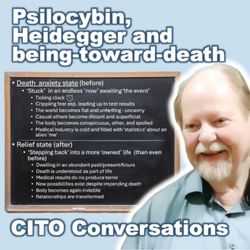
12. Johno (Robert Johnston) on Psilocybin, Heidegger and being-toward-death
01:24:47||Season 1, Ep. 12Psilocybin, Heidegger and being-toward-deathBetween 2020 and 2023 psychologist Marg Ross and psychiatrist Justin Dwyer, together with collaborators, ran the largest Australian randomised control of psychedelic assisted psychotherapy for the treatment of extreme death anxiety in terminally ill patients using psilocybin (the active ingredient in magic mushrooms) (Ross et al, 2025). Over the past 15 months I have contributed to the analysis and reporting of qualitative interview data collected by these researchers before and after treatment. The therapy has been shown to be remarkably effective with 21 out of 28 patients who completed the full trial reporting sustained relief. Whereas before the treatment the patients had found themselves 'stuck' in an oppressive lingering present, after treatment they are able to 'step back into' a life that is in some ways fuller even than before the diagnosis (Dwyer et al, 2026). In this reading group/seminar I will briefly present Heidegger's account in Division II of Being and Time of being-toward-death and its role in prompting a more authentic human existence and richer lived temporality. I will point out its striking similarity to the change phenomenon we observed in the qualitative analysis. I invite discussion of this observation, its implications, and suggestions. Note I will devote little time to describing the clinical trial so reading the accompanying paper (Dwyer et al, 2026) is advised.JohnoRobert B. Johnston is a professor (emeritus) at University College Dublin, and a person in his own right.Dwyer, J., Johnston, R. B., O'Callaghan, C., and Ross, M. 2026. "Stepping Back into Life: How Psychedelic Assisted Psychotherapy Transforms the Way of Life of the Terminally Ill," General Hospital Psychiatry (98), pp. 86-96. doi: 10.1016/j.genhosppsych.2025.12.002AcknowledgementsMusic Title: Justice Little LeagueArtist: Ema GraceSource: https://bit.ly/2tJ6BndLicense: CC BY 4.0Artist notes: Ema Grace is an AI vocaloid produced by Ryoma MAEDA (@Ryoma_Maeda). Styled as virtual Singer&Idol 架空のバーチャルアイドル & シンガー、それがEma Grace.Cover Art Title: Inspired by zoomArtist: Allen HigginsSource: CITO-podcast-Johno.pptxLicense: CC BY-NC-SA 4.0Podcast LicenseDesign Talk (dot IE) CC BY-NC-SA 4.0 The license can be viewed at https://creativecommons.org/licenses/by-nc-sa/4.0By taking part you give permission for your voice to be recorded, for the recording to be edited, and for it to be posted and published as a podcast.
11. Data Practices with Hippolyte Lefebvre
28:43||Season 1, Ep. 11Welcome to the CITO Podcast.Séamas Kelly invites Hippolyte Lefebvre to present an overview of his research interests and direction. Hippolyte is a member of CITO and the Management Information Systems group in the UCD College of Business, Dublin, and previously at the Université de Lausanne, Switzerland.Notes, extra questions, and further reading:Homepage at UCD - https://people.ucd.ie/hippolyte.lefebvreHippolyte’s Google scholar page ishttps://scholar.google.com/citations?user=Uxo4pH4AAAAJ&hl=en&oi=aoAcknowledgementsMusic Title: Justice Little LeagueArtist: Ema GraceSource: https://bit.ly/2tJ6BndLicense: CC BY 4.0Artist notes: Ema Grace is an AI vocaloid produced by Ryoma MAEDA (@Ryoma_Maeda). Styled as virtual Singer&Idol 架空のバーチャルアイドル & シンガー、それがEma Grace.Cover Art Title: Inspired by selfie and AIArtist: Allen HigginsSource: CITO-podcast-DataPractices.pptxLicense: CC BY-NC-SA 4.0Podcast LicenseDesign Talk (dot IE) CC BY-NC-SA 4.0 The license can be viewed at https://creativecommons.org/licenses/by-nc-sa/4.0By taking part you give permission for your voice to be recorded, for the recording to be edited, and for it to be posted and published as a podcast.
10. Making New Money by Quinn DuPont
01:10:28||Season 1, Ep. 10Welcome to the CITO Podcast.This episode is a seminar by Quinn DuPont titled “Making New Money: How autonomous communities produce and govern cryptocurrencies.” Paul Dylan-Ennis will open the session with a brief introduction after which Quinn will present an overview of his project, after which Donncha Kavanagh will make some observations and invite reactions.Decentralized cryptocurrencies are upending the foundations of economic power, challenging centuries of state and bank control over money. This research critically examines the rise of digital wildcat banking and its profound implications for economic sovereignty. Leveraging digital forensics, data science, and OSINT, this work reveals who actually produces and governs cryptocurrencies—and how their collective labor reshapes value and risk. It explores the forces behind decentralized money, the vulnerabilities these systems introduce, and the future role of state-issued currencies in an era of rapid monetary transformation.Reflecting on the project Quinn notes:"I've been working on this for well over a year now, and while it is still in development, the basic outline is complete. I make some pretty provocative claims, like arguing that global forces first emerging in the 1970s lead us inexorably to this point where the labour required to produce and govern new money has become involuted[1]. It’s a unique project that reveals how new money is made and details the implications for banks, nation states, and society. I also have some fun stories to share, like my effort to vampire attack Trump's WLFI token or my reverse engineering of the FBI's Operation Token Mirrors."[1] Involution; the theory from Clifford Geertz where, in the original context, rice production becomes internally competitive and the processes require more labour without an increase in output - analogous to this story of technological development and precarious technological labour. I argue that the operational infrastructure of crypto expands to require more labour, despite no correlated increase in output. Thus, crypto overtakes national currencies not by meeting a market demand, but by accommodating excess labour supply.Notes, extra questions, and further reading:Quinn’s homepage - https://iqdupont.comChina’s “Involuted” Generation by Yi-Ling Lu | The New Yorker Published MAY 14The president and the billion-dollar crypto businesses – How the Trump companies made $1bn from crypto by Joe Miller and Alex Rogers in Washington, Paul Caruana Galizia, Nikou Asgari, Eade Hemingway, Oliver Hawkins and Chris Cook in London | FT.com Published OCT 16 2025"Overcapacity" or "involution"? How China's manufacturing suffers from over-competition Tracing the roots and perils by Elena Wang and Nina Chen | Baiguan.news Published APR 18 2024AcknowledgementsMusic Title: CrazyMixArtist: Sandbox Korg AbletonSource: CrazyMix.aifLicense: : CC BY-NC-SA 4.0Cover Art Title: Inspired by Wordpress DefaultsArtist: Allen HigginsSource: CITO-podcast-STS.pptxLicense: CC BY-NC-SA 4.0Podcast LicenseDesign Talk (dot IE) CC BY-NC-SA 4.0 The license can be viewed at https://creativecommons.org/licenses/by-nc-sa/4.0By taking part you give permission for your voice to be recorded, for the recording to be edited, and for it to be posted and published as a podcast.
9. STS Community Making with Cassidy R. Sugimoto and Rob Kitchin
01:08:21||Season 1, Ep. 9The STS Ireland unconference of 25 June 2024.Welcome by Kalpana ShankarProfessor Cassidy R. Sugimoto, chair of the School of Public Policy at Georgia Institute of Technology and Professor Rob Kitchin from the Social Sciences Institute at Maynooth University.(the unconference was held at the Museum of Literature Ireland (MoLI), St Stephen’s Green South, Dublin.)Why an unconference? An unconference is an event where the attendees help set the agenda and content. Rather than papers and panels, we want to use this opportunity to foster networking and discussion.The goal of this inaugural event was to acknowledge the specificities but also international connections/reach of STS (and the general implications of scientific research and policy here in Ireland) and bring researchers together for networking from different institutional and disciplinary homes. The unconference format included panel talks and small-group discussions to explore various facets of the socio-cultural study of technology, science, and medicine.Schedule:9:45 Registration10:30-10:40 Overview/welcome10:45-11:40 Keynotes11:50-12:40 Panel discussion - Cassidy, Rob, Kalpana (Moderator - Christo)12:50-1:50 Lunch1:50-2:45 Breakout 1 (1:50 - 2:30, then return and discuss)2:45-3:40 Breakout 2 (2:45 - 3:40)3:45-4:30 Debrief and next steps4:30-4:45 ClosingNotes, further reading:Organised by Kalpana (kalpana.shankar@ucd.ie); Christo (christo.jacob@ucdconnect.ie)The Website and registration link: https://stscommunityireland.wordpress.com/Supported by the European Association for the Study of Science and Technology (EASST) Network Fund and the University College Dublin Centre for Digital Policy.Museum of Literature Ireland - https://moli.ieAcknowledgementsMusic Title: CrazyMixArtist: Sandbox Korg AbletonSource: CrazyMix.aifLicense: : CC BY-NC-SA 4.0Cover Art Title: Inspired by Wordpress DefaultsArtist: Allen HigginsSource: CITO-podcast-STS.pptxLicense: CC BY-NC-SA 4.0Podcast LicenseDesign Talk (dot IE) CC BY-NC-SA 4.0 The license can be viewed at https://creativecommons.org/licenses/by-nc-sa/4.0By taking part you give permission for your voice to be recorded, for the recording to be edited, and for it to be posted and published as a podcast.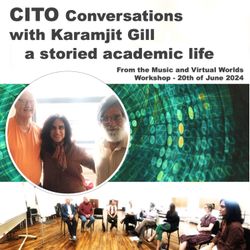
8. A Storied Academic Life - Karamjit Gill
57:46||Season 1, Ep. 8The following is the second recording from the Music and Virtual Worlds Workshop held on the 20th of June, 2024 – where invited guest, Emeritus Professor Karamjit Gill, co-founder and editor of the journal AI & Society reflected on his personal academic habitus; How he felt called to take action and respond to the question: How do you bring people together to help others, to make change and create social value through technology, without money, without power, without fame, and when the human-technological-systems to do this are yet to be invented?As a side note: This segment of the workshop was originally intended as a dialog between Professors Karamjit Gill and Liam Bannon, talking about the role of technology in shaping human society and implications for computer mediated immersive experiences. Unfortunately, due to illness Liam was unable to attend on the day, but we did visit him later in the afternoon at University Hospital Limerick. As it happened, Liam was in great form and while he wasn’t able to check-out from the hospital on the day, he was able to finally meet Karamjit and Satinder on a warm summer’s evening. In fact it was their first face-to-face meeting even though they had known one another for many years and been involved in writing and reviewing for the journal from afar. So this is something by way of explanation for this episode’s cover art; a photo of Liam, Satinder, and Karamjit at UHL. And the lower picture is a snapshot from the panel discussion in the Irish Chamber Orchestra Building, University of Limerick.Credit: Allen Higgins, 20th June 2024.Notes, mentions, and further reading:Mike Cooley (Wikipedia link) – Author of Architect or Bee? (1980). The Journal AI & Society: Knowledge, Culture and Communication (link). Published by Springer. Established in 1987. Co-founded by Professors Michael Cooley and Karamjit Gill. Founding advisory board members: Joseph Weizenbaum, Hubert Dreyfus, Daniel Dennett, Maggie Boden, Terry Winograd, David F. Noble, Seymour Papert, Marvin Minsky and others (see article at link).XTREME – “Mixed Reality Environment for Immersive Experience of Art and Culture” (link) The INSYTE-Cooley Research Lab (I-CRL link) AcknowledgementsMusicTitle: Adagio in G minorArtist: Remo Giazotto attributed to Tomaso AlbinoniSource: https://soundcloud.com/dick-de-ridder/adagio-in-g-minor-albinoniLicensed by Dick de Ridder: CC-BY 3.0Cover Art Title: Vignettes from LimerickArtist: Allen Higgins Source: LiamKaramjitSatinder_Cover_Art.pptxLicense: CC BY-NC-SA 4.0Podcast LicenseDesign Talk (dot IE) CC BY-NC-SA 4.0 The license can be viewed at https://creativecommons.org/licenses/by-nc-sa/4.0By taking part you give permission for your voice to be recorded, for the recording to be edited, and for it to be posted and published as a podcast.
7. The Music and Virtual Worlds Workshop
01:07:31||Season 1, Ep. 7The following is a recording from the Music and Virtual Worlds Workshop held on the 20th of June, 2024 - a working event of the XTREME project, a research projected funded by the European Union.The workshop was a preliminary activity of the XTREME project; which stands for“’miXed Reality Environment for IMmersive Experience’ of Art and Culture”.The goal of the project being to research new applications at the intersection between augmention technology and human kinaesthetic being. For example, by experimenting with embodied musical-artistic performance uniting AR/VR and AI, for therapeutic and other forms of human involvement.The panel included:Martin Cunneen, from the Kemmy Business School, University of Limerick and local PI for XTREME.Amanda Clifford, Physiotherapist, from the School of Allied Health, University of LimerickSatinder Gill, from the University of Cambridge’s Centre for Music and ScienceEmeritus Professor Karamjit Gill from University of Brighton and Editor of the journal AI & SocietyCathriona Murphy,Gerry Keenan, And Simon Thompson from the Irish Chamber Orchestra and the Irish World Academy of Music and Dance.And Andrew Kaung a researcher on the XTREME project.The goal for the workshop was to explain the scope of XTREME and its inspiration in ideas surrounding the blend of music, dance, physical and virtual embodiment. The local partners gathered to meet and introduce themselves, their motivations and research interests. Professors Karamjit Gill and Liam Bannon had planned to prompt a dialogue centred on the role of technology shaping human society and implications for computer mediated immersive experiences. Unfortunately, due to illness Liam was unable to attend on the day and so Karamjit offered a personal reflection on his own academic habilitation and storied career, which we present in the second episode/recording of this event.Notes, extra questions, and further reading:XTREME – “Mixed Reality Environment for Immersive Experience of Art and Culture” is an EU Horizon 2020 project that started in January 2024 and will finish in December 2026. XTREME will explore and provide a mixed reality (MR) solution to experience different forms of art. The project is in close collaboration with 14 different partners who together will explore different alternatives to the traditional way of accessing music and art experiences. https://xtremeitu.dk/about-xtreme Speakers: Martin Cunneen, Amanda Clifford, Satinder Gill, Karamjit Gill, Cathriona Murphy,Gerry Keenan, Simon Thompson and Andrew KaungAcknowledgementsMusicTitle: Adagio in G minorArtist: Remo Giazotto attributed to Tomaso AlbinoniSource: https://soundcloud.com/dick-de-ridder/adagio-in-g-minor-albinoniLicensed by Dick de Ridder: CC-BY 3.0Cover Art Title: Complex collage incorporating the XTREME logo imageArtist: Allen Higgins and XTREME projectSource: XTREME_Cover_Art.pptxLicense: CC BY-NC-SA 4.0Podcast LicenseDesign Talk (dot IE) CC BY-NC-SA 4.0 The license can be viewed at https://creativecommons.org/licenses/by-nc-sa/4.0By taking part you give permission for your voice to be recorded, for the recording to be edited, and for it to be posted and published as a podcast.
6. Policy and European Economic Convergence
50:20||Season 1, Ep. 6In this seminar, Professors Frank Barry and Marcin Piątkowski contrast Ireland and Poland’s pathways to economic independence and growth, through the lens of industrial and economic policy. This, against the turbulence of world events straddling the 20th and 21st centuries. We look at the growth of these two European nations ex-post being constituent states of colonial empires.The seminar was chaired by Dorota Piaskowska, associate professor in strategy and international business at University College Dublin, Ireland.Frank Barry is Professor of International Business & Economic Development at Trinity Business School and a member of the Royal Irish Academy.And Marcin Piątkowski is Professor of Economics at Kozminski University, Warsaw, and Lead Economist at the World Bank.This talk was recorded in person with a live audience on April 8th, 2024, in the UCD Michael Smurfit Graduate Business School, Dublin, Ireland.The seminar was supported by the Embassy of the Republic of Poland in Dublin and the UCD College of Business.Location - Lecture Theatre N204 (followed by a reception in the Laurence Crowley Boardroom)UCD Michael Smurfit Graduate Business SchoolCarysfort Avenue, Blackrock, County Dublin Thank you for listening, please follow and share if you liked this episode.The musical elements used are from the ‘Adagio in G Minor’ released under a CC-BY 3.0 license.See the show-notes or the description for details.AcknowledgementsMusic Title: Adagio in G minorArtist: Remo Giazotto attributed to Tomaso AlbinoniSource: https://soundcloud.com/dick-de-ridder/adagio-in-g-minor-albinoniLicensed by Dick de Ridder: CC-BY 3.0Cover Art Title: GraphicsAndTextArtist: Allen HigginsSource: Collage/various (CITO-podcast-FrankMarcin.pptx)License: CC BY-NC-SA 4.0Podcast LicenseDesign Talk (dot IE) CC BY-NC-SA 4.0 The license can be viewed at https://creativecommons.org/licenses/by-nc-sa/4.0By taking part you give permission for your voice to be recorded, for the recording to be edited, and for it to be posted and published as a podcast.