Share
Berkeley Talks
Nate Cohn on polling and the 2024 election
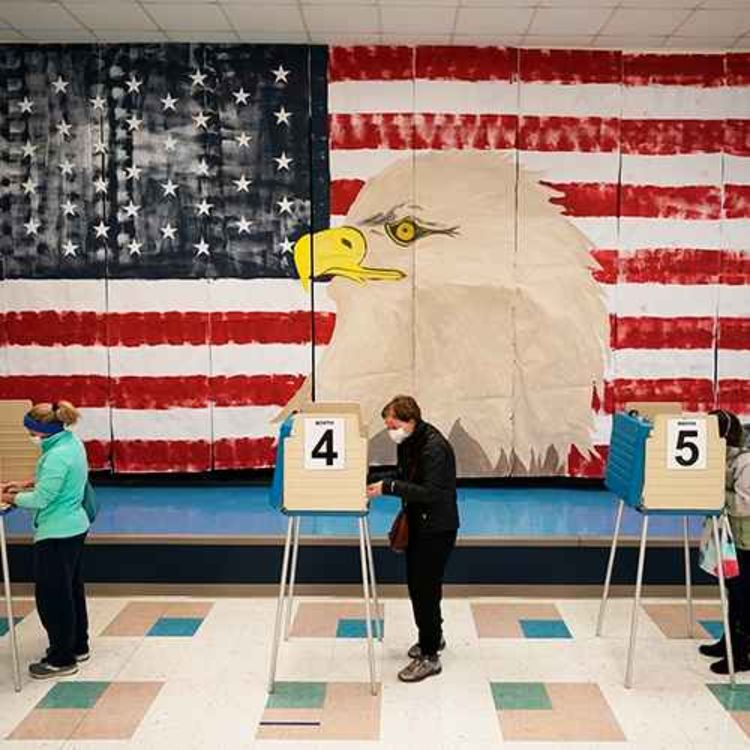
In Berkeley Talks episode 185, New York Times chief political analyst Nate Cohn discusses how polling works, the challenges facing pollsters today and where polling stands as we head into the 2024 U.S. presidential election.
"I don't think it's a coincidence that we have a crisis of polling at the same time we have a crisis of democracy," said Cohn, who gave UC Berkeley’s Citrin Award Lecture on Oct. 19.
"I don't think it's a coincidence that Trump mobilized a so-called silent majority of voters who felt that they were unrepresented in our political system, and who turned out to be underrepresented in polls by an order of magnitude for decades.
"Just think about all of the choices that politicians made from the '80s onward. That in each one of those decisions, they were doing it, in part, based on data that underrepresented the number of white working class Americans by tens of millions. I think it added up, and I think I'll start by proving that to you, and I think it offers a nice launching point for where polling is today. Because although it's tempting to think the problems in polling are recent to Trump, I think it's probably fair to say that Trump exposed issues in polling that had existed for a very long time before that."
The Citrin Award Lecture is an annual event of Berkeley’s Citrin Center for Public Opinion Research. Watch a video of Cohn’s lecture on YouTube.
Listen to the episode and read the transcript on Berkeley News (news.berkeley.edu).
AP Photo by Steve Helber.
More episodes
View all episodes

241. The Page Act and the making of racialized US immigration control
01:27:28||Ep. 241Before there was the Chinese Exclusion Act, there was the Page Act. Passed in 1875 amid growing anti-Chinese sentiment in the 19th century, the Page Act was one of the first national immigration laws in the United States. It targeted several categories of people, including contract laborers from Asia, women brought in for sex work and certain convicted criminals. In practice, however, it functioned mainly to restrict Chinese and other Asian women from entering the country.“It had enormous implications for the issues of race, gender and labor in U.S. immigration history and Asian American history,” says UC Berkeley history professor Hidetaka Hirota, who moderated a campus discussion in April to mark the Page Act’s 150th anniversary.In this Berkeley Talks episode, a panel of Berkeley scholars unpack how the Page Act helped institutionalize racially targeted exclusion and gendered surveillance at the border, and how it laid the groundwork for the 1882 Chinese Exclusion Act and later immigration laws. They also challenge the enduring myth of the “white bootstrapping ethnic,” supposedly living “the right way” without state support, showing instead how immigration and welfare regimes were structured to advantage European newcomers while systematically excluding Asians and other people of color.Panelists include Catherine Ceniza Choy, professor of ethnic studies; Cybelle Fox, professor of sociology; Leti Volpp, professor of law; and Hidetaka Hirota, associate professor of history, who moderated the conversation. The event, which took place on April 23, was hosted by Berkeley’s Social Science Matrix and was co-sponsored by the Berkeley Interdisciplinary Migration Initiative, the Department of Sociology, the Department of History, the Department of Ethnic Studies, the Asian American Research Center and the Center for Race and Gender.Watch a video of the discussion.Listen to the episode and read the transcript on UC Berkeley News (news.berkeley.edu/podcasts/berkeley-talks).Music by HoliznaCC0.Photo from the National Archives.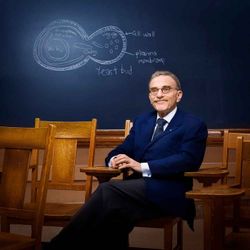
240. For Nobel laureate Randy Schekman, it began with pond scum and a toy microscope
01:00:19||Ep. 240When UC Berkeley Professor Randy Schekman was 12, he scooped up a jar of pond scum and examined it under his toy microscope.“I just could not believe the world that was revealed,” he said during a campus event earlier this month. “This complex set of creatures that you can't see with your naked eye, and yet are moving and somehow mechanically independent, and able to do amazing things. And this was so fascinating.”Schekman went on to become a professor of molecular and cell biology at Berkeley and win the Nobel Prize in Physiology or Medicine in 2013 for his discovery of how yeast membranes work. His research has led to advances in food and fuel production, as well as life-saving drugs and vaccines. In this Berkeley Talks episode, Schekman explains the molecular building blocks that define who we are, the cellular processes that drive health and illness, and how curiosity-driven research leads to revolutionary insights into disease and opens doors to new possibilities for medicine and human health.This lecture, which took place on Nov. 7, was sponsored by UC Berkeley’s Osher Lifelong Learning Institute. Watch a video of Schekman’s talk.Listen to the episode and read the transcript on UC Berkeley News (news.berkeley.edu/podcasts/berkeley-talks).Music by HoliznaCC0.UC Berkeley photo by Elena Zhukova.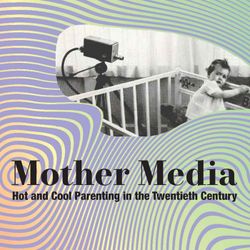
239. The complicated role of media in motherhood
52:42||Ep. 239In the early 20th century, prominent figures in psychology, psychiatry and pediatrics in the U.S. began to promote a new standard for mothers: that they should serve as a constant, unchanging and wholly nurturing presence in their children’s lives. It was the best way, they claimed, to raise healthy and successful children. This ideal marked a shift away from earlier traditions where caregiving was often distributed among extended family members, hired help and community. In her new book, Mother Media: Hot and Cool Parenting in the Twentieth Century, UC Berkeley associate professor Hannah Zeavin explores how the new ideal of constant mothering was advanced by the mind sciences during the rise of the nuclear family and became especially powerful for white, middle-class mothers.Yet this expectation was both unrealistic and deeply shaped by issues of race and class, says Zeavin, who spoke last month at a Berkeley Book Chats event hosted by the Townsend Center for the Humanities.As more mothers entered the workforce and social changes disrupted older forms of caregiving, media researchers began to explore whether technology could step in, imagining devices — first, baby monitors and later, TVs and tablets — as substitutes for, or supplements to, maternal care. In this Berkeley Talks episode, Zeavin discusses how these ideals and interventions — defining the “perfect mother,” substituting media for maternal presence and punishing deviations from the norm — continue to influence American family life today.Watch a video of the conversation, which was moderated by Ramsey McGlazer, associate professor in the Department of Comparative Literature.Listen to the episode and read the transcript on UC Berkeley News (news.berkeley.edu/podcasts/berkeley-talks).Music by HoliznaCC0.Screenshot of the Mother Media book cover.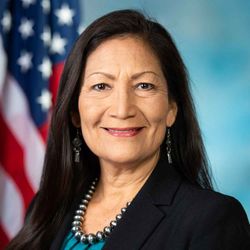
238. Top Biden official calls for unity, ‘moral courage’ in public service
36:14||Ep. 238The United States is in a moment like no other in recent history, says Deb Haaland, former President Joe Biden's secretary of the Interior Department from 2021 to 2025. Every day, she says, it seems a new pillar of the American government is under attack. But what makes this moment unique aren’t these crises themselves, but the attack on the idea that problems can be solved at all. “We face a creeping cynicism that suggests that our real enemy is our desire to make a difference,” she said during the keynote address at the Goldman School of Public Policy’s Annual Conference and Alumni Gathering in September. “We face attacks on the very idea of wanting to make things better. That's why the Goldman School of Public Policy is so vital. Without places like this, without people like those in this room today, America wouldn't have a prayer of meeting this moment.”In this Berkeley Talks episode, Haaland discusses how policy — not politics — is the only path to real change, and why we need a unified effort grounded in moral courage and diverse perspectives to meet the challenges facing the country. “Part of the reason I wanted to join you today is to speak to the importance of faith in the possibility of what we can do together,” she says. “And I use the word ‘faith’ deliberately. Especially in times like these, it takes belief, moral courage and determination in the face of despair to keep going. We have to find it inside ourselves, nurture that flame and keep it lit.”More about the speaker: Haaland is a member of the Laguna Pueblo tribe in New Mexico and the first Native American to serve as a U.S. Cabinet secretary. Before that, she was the U.S. representative for New Mexico's 1st Congressional District from 2019 to 2021, one of the first two Native American women elected to Congress. She is running for governor of New Mexico in the 2026 election. Watch a video of Haaland’s keynote, followed by a conversation with Goldman School of Public Policy Dean David Wilson.Listen to the episode and read the transcript on UC Berkeley News (news.berkeley.edu/podcasts/berkeley-talks).Music by HoliznaCC0.U.S. House Office of Photography photo by Franmarie Metzler.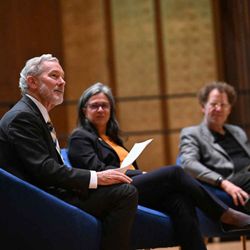
237. How Berkeley became a powerhouse for innovation and startups
01:00:36||Ep. 237UC Berkeley is widely considered a leader in innovation and startups. Pitchbook university rankings from 2025 announced, for the third year in a row, that Berkeley graduates have founded more venture-backed companies than undergraduate alumni from any other university in the world. Some might wonder, says Chancellor Rich Lyons, if this entrepreneurial energy clashes with Berkeley’s tradition of top-tier research and teaching. But Lyons sees it differently: These forces fuel each other, combining to drive the campus’s ultimate goal of making a lasting difference in the world. It’s a dynamic duo, he says, that keeps the campus pushing boundaries and shaping the future. In this Berkeley Talks episode, a panel of prominent Berkeley faculty and an alum join Lyons to discuss how the campus’s startup culture has powered their work and encourages the next generation of scholars to grow their ideas. The panel, which took place on Oct. 6 during Homecoming weekend, includes: Ana Claudia Arias, professor of electrical engineering and computer sciencesKen Goldberg, professor of engineeringMarco Lobba, alum and co-founder and CEO of CatenaBio Chancellor Rich Lyons (moderator)Watch a video of the conversation. Read more about the event.Listen to the episode and read the transcript on UC Berkeley News (news.berkeley.edu/podcasts/berkeley-talks).Music by HoliznaCC0.UC Berkeley photo by Keegan Houser.
236. Long said to be ‘too big to fail,’ the ocean needs a new narrative
01:07:25||Ep. 236In this Berkeley Talks episode, renowned marine ecologist Jane Lubchenco discusses how a persistent narrative that the ocean is “too big to fail” has led to its degradation. While many now believe its problems are “too big to fix,” Lubchenco explains why we need to embrace a new narrative: That it’s too central to our future to ignore.“There is a historic narrative about the ocean, one that has framed the way people have talked about the ocean and have treated the ocean for almost all of human history,” Lubchenko told the audience at a UC Berkeley event in March. “The ocean, for thousands and thousands of years, was seen as so immense, so endlessly bountiful that people thought it must be infinitely resilient and impossible to deplete or disrupt.”But now, she said, the impossible has happened — “it’s depleted, it’s disrupted, it’s polluted, it’s warmer, it’s more acidic, it’s deoxygenated" — and we need to create a new narrative, one that acknowledges that a healthy ocean is central to a just and prosperous future on Earth. While she admits there are “huge challenges,” Lubchenco stresses that there are solutions that already exist that can be scaled up, like enabling sustainable aquaculture, reforming fisheries management, employing nature-based blue carbon ecosystems and creating and strengthening marine protected areas.“This ocean that we have, that connects us all, that feeds us all, is at the center of climate change solutions, health solutions, food security, recreational opportunities,” she said. “This is really all one ocean. It is possible to use it without using it up. We're not there yet. But given what I've said, it's not impossible. And I think that these findings and these actions and these results are leading to the emergence of a new narrative for the ocean.”Lubchenco spoke at Berkeley on March 13, 2025, as part of the Martha Charles M. and Martha Hitchcock Lectures series. This lecture was one of two given by Lubchenco for the series, together titled “Agency, Urgency, and Hope: Science and Scientists Serving Society.” Watch the event on the UC Berkeley Graduate Lectures YouTube page. Lubchenco is former deputy director for climate and environment in the White House Office of Science and Technology Policy, and Wayne and Gladys Valley Professor of Marine Biology and University Distinguished Professor at Oregon State University.Listen to the episode and read the transcript on UC Berkeley News (news.berkeley.edu/podcasts/berkeley-talks).Photo by Daniel J. Schwarz for Unsplash.Music by HoliznaCC0.
235. Alva Noë on how art allows us to see everyday things anew
31:18||Ep. 235In his 2023 book The Entanglement, UC Berkeley philosopher Alva Noë argues that human nature is not a fixed phenomenon, and that art acts as a kind of “strange tool” that actively changes us. “Life and art are entangled,” says Noë, who spoke about his research at a Berkeley event in June 2023. “To say that life and art are entangled is to say not only that we make art out of life, all the habits and systems and meanings and certainties, but that art then works these raw materials over — art works us over, art makes us new. Art makes us.”In this Berkeley Talks episode, Noë discusses how humans are in a constant state of becoming, and that art works to unveil us to ourselves in ways that empirical inquiry common in scientific fields cannot. By removing an object, like a photo, from its normal setting, he says, it allows us to reflect on what we normally take for granted about the object and presents an opportunity to make new meaning from it. “We are makers,” he continues. “We are put together, literally made up, by the habits and skills of making that constitute us. So by making, and thus exposing what our lives as makers take for granted, art puts us on display … in ways that hold out the opportunity of changing us, of liberating us. Liberating us precisely from the bonds of habit which our activities consist in.”Noë’s lecture was part of the 2023 Berkeley Art, Law and Finance Symposium, presented by the Berkeley Center for Law and Business. Watch a video of Noë’s talk on UC Berkeley Law’s YouTube page.Listen to the episode and read the transcript on UC Berkeley News (news.berkeley.edu/podcast/berkeley-talks).Music by HoliznaCC0.Photo via Unsplash.
234. How forgiveness changes you and your brain
01:02:13||Ep. 234As the science director at UC Berkeley’s Greater Good Science Center, Emiliana Simon-Thomas thinks a lot about how prosocial emotions and behaviors — like compassion and gratitude — influence our well-being and society as a whole. And recently, she’s been more deeply exploring the effects of forgiveness. “Forgiveness is an idea that most people endorse, that most people feel is a virtue or the right thing to do, but can often be more challenging than we expect in actual day-to-day life,” Simon-Thomas said during a Berkeley event in July. Not only is it difficult to put into practice, she says, but it’s also hard to define — it’s often understood differently from person to person and culture to culture. In this Berkeley Talks episode, Simon-Thomas is joined in a conversation by child clinical psychologist Allison Briscoe-Smith, a senior fellow at the center, and clinical neuropsychologist Melike Fourie of the Neuroscience Institute at the University of Cape Town in South Africa. Together, they explore what forgiveness is, how it works in the body and brain and the ways people can practice forgiveness that feel safe and empowering. This event took place on July 30, 2025, and was part of a Greater Good Science Center project on forgiveness supported by the Templeton World Charity Foundation. Learn more on the foundation’s Discover Forgiveness website.Watch a video of the conversation on the Greater Good Science Center YouTube page.Listen to the episode and read the transcript on UC Berkeley News (news.berkeley.edu/podcast/berkeley-talks).Music by HoliznaCC0.Photo by Milad Fakurian via Unsplash.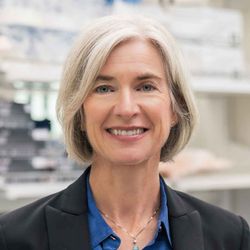
233. Nobel laureate Jennifer Doudna on CRISPR and the future of gene editing
50:57||Ep. 233For UC Berkeley’s Jennifer Doudna, the revolutionary discovery of CRISPR-Cas9 gene editing began 15 years ago with a meeting at the campus’s Free Speech Movement Cafe. “This is a quintessential story about Berkeley,” begins Doudna, a professor of molecular and cell biology and of chemistry, in a lecture she gave on campus in April. “The research that I'll talk about today wouldn't have happened … if I had been working anywhere else. And that's because we have a really collaborative environment on our campus.”At the cafe, Doudna listened while a Berkeley colleague described a possible adaptive immune system in bacteria that helps them fight off viral infection. Doudna's lab went on to research the molecules involved, discovering a pathway that allows bacteria to "learn" about viruses, store the information and use it for protection.The scientists realized this same system could be used to trigger DNA repair in plant, animal and human cells, effectively allowing them to "rewrite the code of life." The seminal paper on CRISPR was published in 2012 by Doudna and her key collaborator, French microbiologist Emmanuelle Charpentier. The pair went on to win the Nobel Prize in Chemistry in 2020.In this Berkeley Talks episode, Doudna discusses how CRISPR can be used to correct disease-causing genetic mutations, the impact that it's already having on people's lives and where she sees the technology going in the future. “We're in an era of programmable genome editing,” she says. “It's really exciting to see all the possible applications of this. We know that it can be safe and effective to treat and even to potentially cure human disease, and we need to continue to advance the technology so that it can be deployed more widely.”Not only will that require continual activity on the science and technology front, she adds, but also in developing appropriate guidelines and regulations to ensure that CRISPR’s applications move forward responsibly. Doudna’s talk took place on April 4 as part of Brilliance of Berkeley, a course offered every spring by the College of Letters and Science that celebrates the campus’s exceptional faculty and their accomplishments. Each week, students listen to two guest lectures by top Berkeley scholars from an array of fields, followed by a Q&A. Watch the video on the Brilliance of Berkeley YouTube page. Listen to the episode and read the transcript on UC Berkeley News (news.berkeley.edu/podcasts/berkeley-talks).Music by HoliznaCC0.Photo by Glenn Ramit/IGI.